
This guide covers what pharmaceutical manufacturers need to evaluate before specifying a boiler: steam purity requirements, pressure control tolerances, GMP and IBR compliance, and which boiler types are actually built for the zero-tolerance environment pharma demands.
Why Pharma Boiler Requirements Are in a Category of Their Own
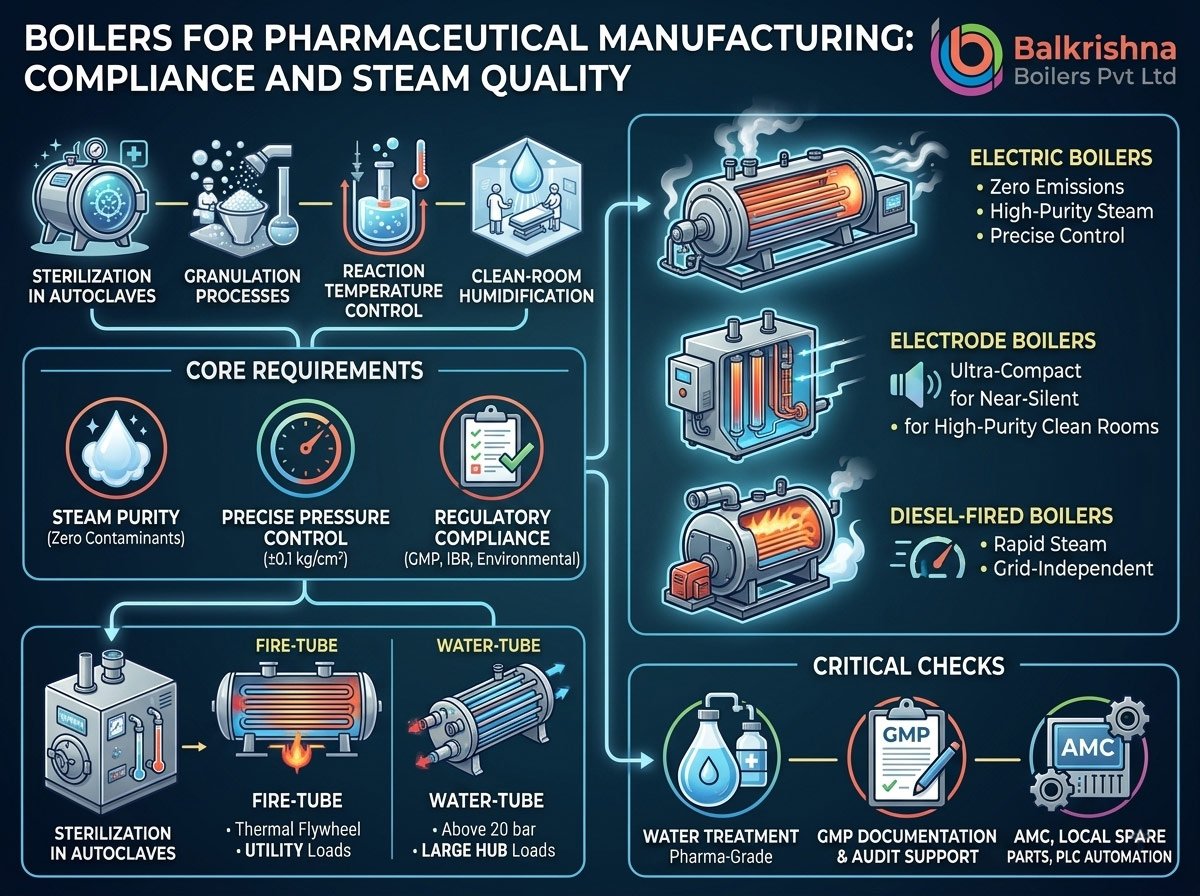
Across most industrial sectors, boiler selection is a balance of capacity, running cost, and fuel availability. Pharma adds a layer none of those sectors have to fully contend with: the boiler isn’t just a utility, it’s a critical part of the production chain itself. Steam is used directly for sterilization in autoclaves, for granulation processes, and for maintaining precise temperatures in chemical reactors — all of which are governed by validation protocols that don’t tolerate variance.
Three requirements sit above everything else in pharma boiler selection:
- Steam purity — zero tolerance for contaminants or carryover, since steam frequently contacts equipment, API (Active Pharmaceutical Ingredient) surfaces, or clean-room air
- Precise pressure control — many pharma processes require pressure held within a very tight margin, often around ±0.1 kg/cm², since deviation can invalidate a sterilization cycle
- Regulatory compliance — strict adherence to IBR (Indian Boiler Regulations) alongside environmental norms and GMP documentation requirements
This is covered in more depth in Best Boiler for Textile, Pharma, and Food Industry: An Industry-wise Guide, which lays out exactly why pharma’s requirements diverge from other steam-dependent sectors.
Where Steam Is Used in Pharmaceutical Manufacturing
Understanding the specific touch-points helps explain why purity and precision matter as much as they do:
- Autoclave sterilization — for lab equipment, glassware, and API sterilization, where rapid ramp-up and precise temperature hold are essential to meeting validation protocols
- Granulation — a core step in tablet and formulation manufacturing that relies on consistent steam-driven heat
- Clean-room humidification — maintaining precise humidity without introducing any contamination risk
- Jacketed vessel heating — for controlled reactions during drug formulation
- Reactor temperature control — where fluctuation can directly affect reaction yield and product consistency
Each of these ties back to a validated process. If the steam supply can’t be trusted to perform identically batch after batch, the validation itself is compromised — which is why pharma manufacturers weigh boiler choice far more carefully than most other industrial buyers.
Boiler Types Best Suited to Pharmaceutical Manufacturing
Electric Boilers — The Standard for High-Purity, Validated Processes
Electric boilers have become the default recommendation for pharma manufacturing, and for good reason: they produce zero on-site emissions, which means no combustion byproducts, no soot, and no flue gas risk near a clean-room or sterile manufacturing zone. Since there’s no fuel train or burner system, they’re also considerably easier to defend during a hygiene or GMP audit.
The ELECTRON series is specifically suited to autoclave sterilization, offering rapid ramp-up and precise temperature hold — exactly what validation protocols demand and what minimizes batch cycle times. For higher-capacity needs, the ELECTROMAX and INDUCTRON models produce high-quality, dry saturated steam almost instantly, supporting the consistent performance that validated processes require. More on how electric steam fits pharma specifically is covered here: Electric Boilers for Food, Pharma & Dairy: Safe, Clean Steam Solutions and What Applications Utilize Electric Steam Boilers, Besides Laundries and Hospitals?
Explore the electric boiler category, including the IBR Electric Steam Boiler for larger certified pharma installations.
Electrode Boilers — Built for Ultra-Compact, High-Purity Clean-Room Use
For pharma facilities with limited floor space or units located within or near clean-room environments, an Electrode Boiler is purpose-built for exactly this scenario: sterile steam generation for reactors, autoclaves, and fermentation processes, with an ultra-compact footprint and near-silent operation that suits facilities near residential areas or inside high-purity clean rooms.
Diesel-Fired Boilers — Where Rapid, Precise Steam Is Needed Without Grid Dependence
Some pharma facilities, particularly those needing rapid steam generation independent of electrical infrastructure constraints, specify a Diesel Fired Steam Boiler, engineered for precise sterilization and clean-room humidity control, with 3-pass wet-back technology built for fuel efficiency and compliance with pollution board norms.
Standard Steam Boilers — For Non-Sterile, Utility-Adjacent Pharma Processes
Not every pharma boiler application requires the absolute purity of electric or electrode systems. General utility steam — building heating, non-critical process support — can still run on a conventional fire-tube or water-tube steam boiler. Browse the full steam boiler range, and see What Is Industrial Steam Boiler? for a broader look at how steam boilers serve pharma alongside other regulated sectors.
Fire-Tube vs. Water-Tube in a Pharma Context
Where a conventional steam boiler is appropriate — for utility loads rather than direct sterile-process steam — the fire-tube vs. water-tube decision still matters. Fire-tube designs offer a large water storage “thermal flywheel” that absorbs demand spikes without dramatic pressure drops, useful for pharma sites with variable utility load. Water-tube designs become necessary above roughly 20 bar, relevant for larger pharma manufacturing hubs with higher-pressure requirements. The full technical breakdown is here: Water Tube vs Fire Tube Boilers: Which Is Better for Your Plant?
Steam Purity and Water Treatment: Non-Negotiable in Pharma
Steam purity starts with feedwater quality. Scale and impurities inside a boiler don’t just reduce efficiency — in a pharma context, any particulate carryover risks contaminating a process that may feed directly into sterilization or formulation. Feedwater treatment tolerances for pharma-grade steam are tighter than in almost any other industrial application, and this becomes especially critical when specifying an electric system: Electric Boiler Water Quality Requirements Explained.
Beyond initial treatment, ongoing discipline matters just as much — consistent blowdown practice, scheduled water treatment plant checks, and documented logs that can be produced during a GMP or regulatory audit. The underlying mechanics of how water becomes usable steam, and why treatment quality determines downstream purity, are explained in Steam Boiler Working Principle Explained Simply.
GMP, IBR, and Regulatory Compliance
Pharma boilers sit at the intersection of two compliance regimes that both need to be satisfied simultaneously:
- IBR certification, mandatory for boilers above the capacity or pressure threshold, requiring government inspection before commissioning
- GMP compliance, which governs documentation, validated process consistency, and how steam quality is monitored and recorded over time
- Environmental and pollution board norms, particularly relevant for fuel-fired systems, where flue gas and emissions are closely regulated near pharma manufacturing hubs
Since pharma facilities are among the most heavily audited industrial environments, documentation matters as much as the equipment itself. Suppliers should be able to provide water treatment logs, maintenance records, and commissioning documentation as a matter of course — not as a special request during an audit cycle.
Reliability and Validation: Why Downtime Is a Compliance Risk, Not Just a Production Loss
In most industries, a boiler breakdown means lost production time. In pharma, it can mean an interrupted sterilization cycle, an invalidated batch, or a validation protocol that needs to be re-run entirely — all of which carry cost and compliance consequences well beyond the downtime itself.
This makes a few supplier factors especially important:
- AMC coverage with defined response times, not a general service agreement
- Local spare parts availability, since import lead times can turn a minor fault into an extended validated-process outage
- Installation and commissioning support with operator training, so plant teams can run and document the system correctly from day one — the general sequencing is covered in Electric Boiler Installation: What to Expect
- PLC-based automation, which allows instantaneous, repeatable response to the delicate temperature requirements drug formulation and sterilization demand — a factor that directly supports validation consistency
A Practical Buying Checklist for Pharma Boilers
- Steam purity requirement — confirm the level of purity your specific process (autoclave, reactor, humidification) actually demands
- Pressure control tolerance — validated processes often need control within a very tight margin; confirm this against the boiler’s rated performance
- Boiler type fit — electric or electrode for maximum purity and clean-room suitability, diesel where rapid grid-independent steam is needed, conventional steam boilers for non-sterile utility loads
- Water treatment plan, sized specifically for pharma-grade steam purity
- IBR classification and GMP documentation support, confirmed with your supplier in writing before ordering
- AMC terms and spare parts access, given how costly a validated-process interruption is
- Automation level, since PLC-based control supports the consistency validation protocols require
Why Pharma Manufacturers Choose Balkrishna Boilers
Balkrishna Boilers Pvt Ltd has spent over 25 years engineering steam boilers, electric boilers, electrode boilers, and diesel-fired systems for hygiene-critical, compliance-heavy industries, with pharmaceutical manufacturing among our most consistently served sectors — including facilities across Ahmedabad, Baddi, and Sikkim’s pharma clusters. Our steam boiler and electric boiler ranges are engineered for the purity, pressure precision, and reliability that validated pharma processes demand, and every IBR-rated unit is inspected and tested before it leaves the factory.
If you’re evaluating a new boiler for a pharma manufacturing line, our engineering team can help match your validation requirements to the right boiler type, capacity, and compliance documentation — reach out through the contact page or browse the full product range to compare specifications directly.
Frequently Asked Questions
Do pharma manufacturing plants need IBR-certified boilers? Yes, in most cases — any steam boiler above the IBR capacity or pressure threshold requires government inspection and certification, in addition to satisfying GMP documentation requirements specific to pharma.
Why are electric boilers preferred for pharma sterilization? Electric boilers eliminate combustion byproducts entirely, offer rapid ramp-up and precise temperature hold, and are easier to defend during a GMP audit since there’s no fuel train or flue gas system involved.
What steam purity level does pharma manufacturing actually require? It varies by process — autoclave sterilization and API-contact processes require essentially zero tolerance for contaminants or carryover, while general utility steam for building heating can use a more conventional standard.
How does an electrode boiler differ from a standard electric boiler for pharma use? Electrode boilers are built for an especially compact footprint and near-silent operation, making them well suited to clean-room-adjacent installations where space and noise constraints are tighter than a standard electric system can accommodate.
What happens if boiler pressure drifts during a sterilization cycle? Even small deviations outside the validated pressure tolerance can invalidate the sterilization cycle, potentially requiring the batch or process to be re-run — which is why precise, stable pressure control is treated as a compliance requirement, not just an efficiency metric.
Specifying a boiler for a pharmaceutical manufacturing or clean-room facility? Get in touch with our engineering team for a purity, pressure, and compliance assessment.