
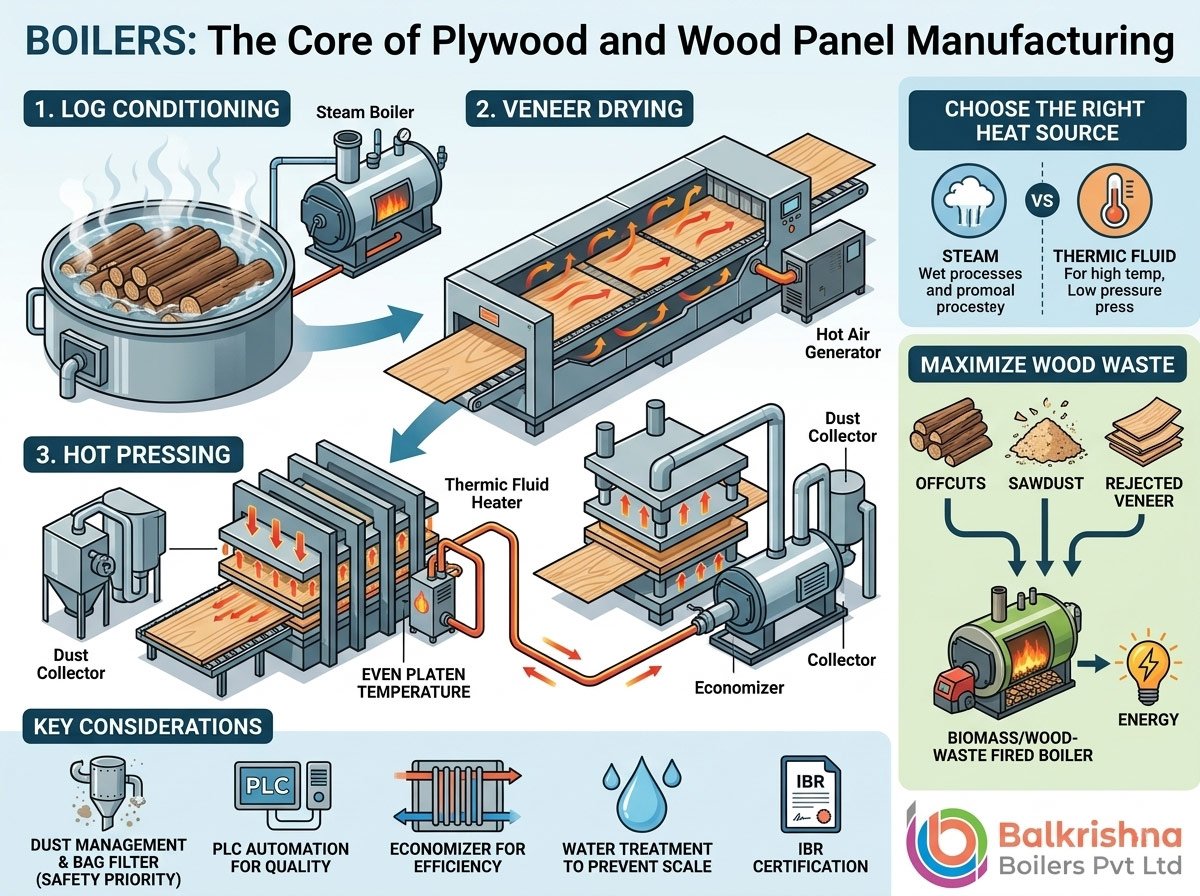
Walk through any plywood or wood-panel plant and you’ll find heat working at almost every stage — softening logs before they’re peeled into veneer, drying that veneer down to a workable moisture content, and finally curing the adhesive that bonds layers together under the hot press. Get any one of those heat stages wrong, and the result shows up immediately: veneer that splits during peeling, boards that warp after pressing, or a bond line that fails under load.
For plywood, MDF, particle board, and other wood-panel manufacturers, the boiler or heater system isn’t a background utility — it’s directly responsible for product strength, dimensional stability, and surface finish. This guide covers where heat is actually used across a wood-processing plant, which boiler and heater types fit each stage, and what matters most when specifying a thermal system for this industry.
Where Heat Is Used in Plywood and Wood Panel Manufacturing
A typical plywood or wood-panel operation uses heat at several distinct points, each with different requirements:
- Log conditioning: Before logs are peeled into veneer sheets, they’re often steamed or soaked in heated water to soften the wood fibre, making it easier to peel thin, consistent veneer without splitting.
- Veneer drying: Freshly peeled veneer carries high moisture content and must be dried to a controlled level before it can be glued and pressed — too wet, and the panel will have poor bond strength or delaminate later; too dry, and the veneer becomes brittle and prone to cracking.
- Hot pressing: This is the defining step in plywood, MDF, and particle board manufacturing. Layers of veneer, particle, or fibre — coated with adhesive resin — are pressed together under heat and pressure, which activates the resin and cures it into a permanent bond. As one buying resource in this space notes, plywood and laminate manufacturing depends on consistent high pressure and temperature for critical hot-press cycles, since even small variation across the press platen can produce an inconsistent bond.
- Surface lamination: Decorative laminates, melamine sheets, or veneers applied to the panel surface go through their own heat-and-pressure cycle, often on a separate short-cycle press.
- Drying and curing of coated or laminated boards: Post-lamination boards frequently need additional controlled drying before cutting, sanding, and packing.
Because hot pressing sits at the centre of product quality, and drying accounts for a large share of total energy use, these two stages should drive your thermal system specification.
Steam, Thermic Fluid, or Hot Air — Matching the Heat Source to the Process
Wood processing is one of the few industries that genuinely uses all three major industrial heat-transfer methods, often side by side in the same plant:
Steam is well suited to log conditioning vats and any process where direct or near-direct heat transfer to a wet material is useful. A steam boiler sized for continuous, high-volume output is the backbone of most integrated plywood operations.
Thermic fluid is frequently the preferred choice for hot-press platens, since it can deliver the sustained high temperature a press needs while running at low operating pressure — a meaningful safety and maintenance advantage on equipment that runs continuous multi-shift cycles. A thermic fluid heater circulating through the press platens gives more uniform, controllable heat distribution across the full press area than steam alone typically achieves.
Hot air is the standard choice for veneer, particle, and fibre drying, where direct hot air movement through the material is far more efficient than indirect heat exchange. Our detailed comparison, hot air generators vs thermic fluid heaters for drying applications, walks through exactly this kind of decision and is worth reading if you’re weighing the two technologies for a veneer or fibre dryer line.
Boiler and Heater Types for Wood Processing Plants
Steam Boilers for Log Conditioning and General Utility
Plants running log-conditioning vats or steam-assisted peeling lines typically specify a steam boiler capable of sustained, high-volume output, since conditioning large batches of logs draws heavily and continuously through a shift.
Thermic Fluid Heaters for Hot-Press Platens
For the hot-press stage itself, a properly sized thermic fluid heater gives plywood, MDF, and particle board manufacturers the even platen temperature that bond quality depends on, without the higher-pressure piping a comparable steam system would need running across the press floor.
Hot Air Generators for Veneer and Fibre Drying
Veneer and fibre drying is one of the largest energy consumers in the plant, and a properly sized hot air generator is central to getting it right. Capacity matters enormously here — undersized systems create drying bottlenecks that limit overall plant throughput, while oversized systems waste fuel. Our guide on how to choose capacity for a hot air generator walks through exactly this sizing decision, and applies directly to a veneer or particle dryer line.
Wood Waste and Biomass Fired Boilers — A Natural Fit
Few industries are as naturally positioned to fuel their own boiler as wood processing. Bark, offcuts, sawdust, and rejected veneer are generated continuously as a by-product of production, and a boiler built for this fuel stream turns a disposal cost into usable energy. A wood chip fired boiler or general biomass fired steam boiler lets a plywood or panel plant run much of its thermal load on its own waste, cutting purchased-fuel costs substantially. Our post on hot air generator fuel options: biomass, coal, and gas compared breaks down the handling and cost trade-offs of these fuel choices in more detail — most of it applies just as directly to a wood-panel plant’s boiler house as it does to the agro-processing sectors it was originally written for.
Managing Wood Dust: A Safety Priority
Wood processing generates large volumes of fine sawdust and wood fibre, which creates a genuine combustible-dust hazard around both the production floor and the boiler house. A well-designed dust collector or bag filter system isn’t just an emissions-compliance measure in this industry — it’s a core safety control, and should be specified alongside your boiler or heater rather than treated as a separate, later decision. Plants burning wood waste as boiler fuel also need proper fuel handling and storage design to keep dust accumulation away from ignition sources.
Water and Fluid Quality: Protecting Both Fuel Cost and Product Quality
As with any industrial boiler, scale build-up inside a steam system wastes fuel — even 1mm of scale can raise fuel consumption by 7–10% — but in log conditioning and hot-press applications, inconsistent heat transfer caused by fouling can also translate directly into uneven veneer softening or an inconsistent press-platen temperature. Regular water treatment and blowdown discipline protects both your running costs and your finished-panel quality.
An economizer, which recovers waste heat from flue gas to pre-heat boiler feedwater, is a sensible standard fitment given how much continuous fuel a multi-shift plywood or panel operation consumes.
Sizing and Redundancy for Continuous Production
Plywood and panel plants typically run multiple hot presses and dryer lines simultaneously, so capacity planning should be based on peak simultaneous demand across log conditioning, drying, and pressing — not average demand. The standard approach is to total peak requirements across every stage, then add a 10–15% margin for future expansion and process variability. Larger operations often install more than one boiler or heater so that scheduled maintenance on one unit doesn’t force a shutdown of the entire production line, since a stopped hot press mid-cycle can mean a full batch of scrapped panels.
Automation for Consistent Panel Quality
Because hot-press bond quality is so sensitive to temperature consistency, PLC-based combustion and temperature control is worth prioritizing over manually operated systems, particularly on thermic fluid circuits feeding the press platens. Automated control also makes it far easier to hold a consistent cure profile across different panel thicknesses and resin types without relying on manual adjustment between batches.
Choosing a Boiler Partner for Plywood and Wood Processing
Given how directly thermal consistency affects panel strength and finish, your equipment supplier’s process experience matters as much as the boiler specification itself. Look for a partner who can demonstrate:
- Experience across all three heat-transfer methods — steam, thermic fluid, and hot air — since most wood-panel plants need more than one.
- Multi-fuel and wood-waste combustion expertise, given how commonly this industry fires its own bark, sawdust, and offcuts.
- Proper dust and emissions control design integrated into the boiler specification, not added afterward.
- IBR certification and full documentation support, along with end-to-end service from site layout through installation, commissioning, and after-sales AMC support.
- A track record across other quality-sensitive process industries — our guides on boilers for the textile industry and boilers for food processing cover two other sectors where consistent heat delivery is directly tied to product outcome, much like plywood pressing.
Indian Boilers.com and Balkrishna Boilers Pvt Ltd manufacture steam boilers, thermic fluid heaters, and hot air generators engineered for continuous-duty, multi-fuel wood processing operations, backed by dust collector and pollution control solutions suited to this industry’s specific fuel and dust profile. Our engineering team can help you map heat demand across log conditioning, drying, and pressing, and recommend the right combination of systems for your plant.
Frequently Asked Questions
What type of boiler is best for a plywood plant? Most plywood and panel plants use a combination: a steam boiler for log conditioning and general utility loads, a thermic fluid heater for hot-press platens, and a hot air generator for veneer or fibre drying. The right mix depends on your specific process layout.
Can a plywood plant run its boiler on its own wood waste? Yes. Bark, sawdust, offcuts, and rejected veneer are common boiler fuels in wood processing, and a properly designed biomass or wood-chip boiler can absorb much of this waste stream directly, cutting purchased-fuel costs significantly.
Why is temperature consistency so important in hot pressing? Hot pressing activates and cures the adhesive resin bonding the panel layers together. Uneven platen temperature can produce an inconsistent bond across the panel, leading to weak spots, delamination risk, or rejected boards.
Is a thermic fluid heater or a steam system better for hot-press platens? Thermic fluid is often preferred because it delivers sustained high temperature at low operating pressure, giving more uniform heat distribution across the press platen with a simpler, lower-pressure piping system than an equivalent steam setup.
Why does dust control matter so much in this industry? Wood processing generates significant volumes of fine sawdust and fibre, which pose a combustible-dust hazard. Proper dust collection and bag filtration should be built into the plant and boiler-house design as a safety measure, not just for emissions compliance.
How many boilers or heaters does a plywood plant typically need? Larger operations generally run separate systems for conditioning, pressing, and drying, often with redundancy on critical units so scheduled maintenance doesn’t halt hot-press production and risk a scrapped batch mid-cycle.
Planning a new thermal system for your plywood, MDF, or wood-panel operation? Contact our engineering team for a capacity and configuration recommendation tailored to your production line.