
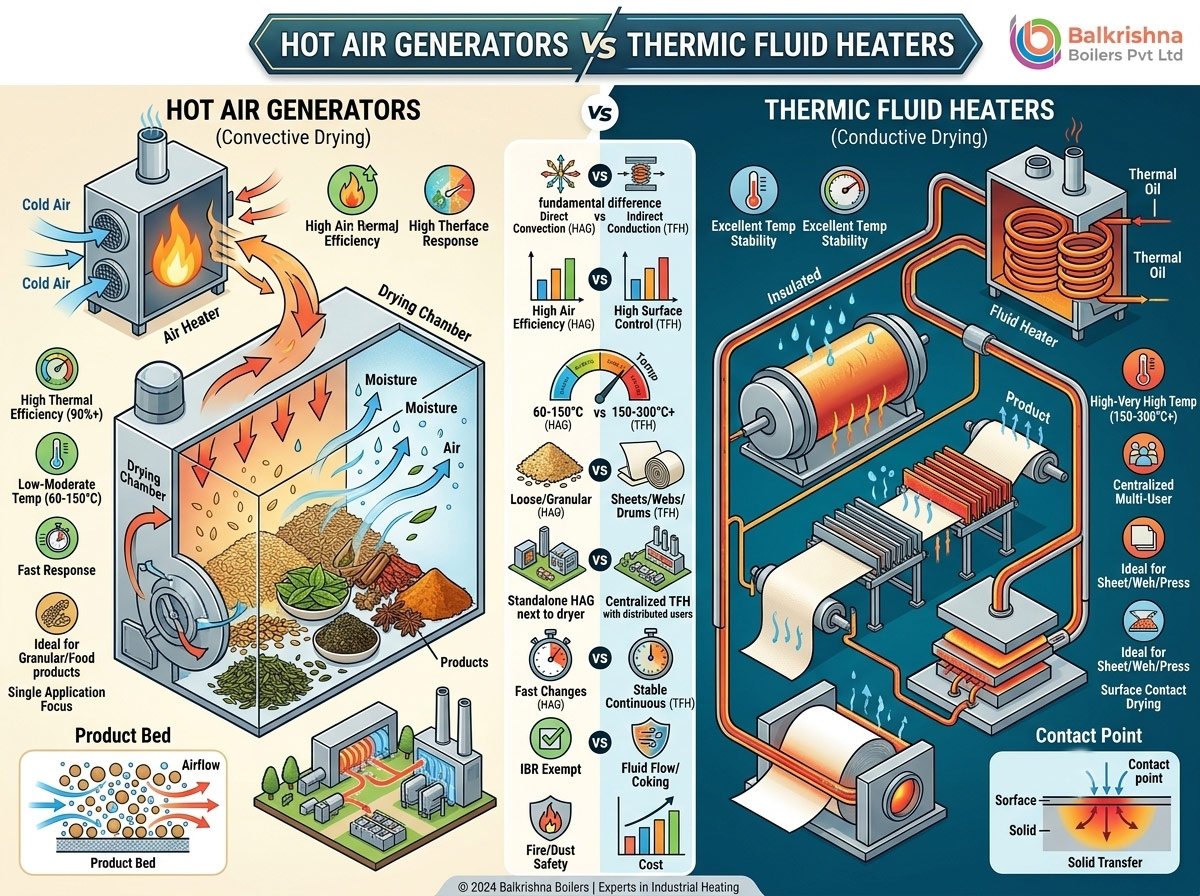
Drying is one of the few industrial heating applications where two genuinely different technologies — hot air generators and thermic fluid heaters — regularly compete for the same job. Both can dry a product. Both can be fuel-fired or electric. But they achieve the result through fundamentally different mechanisms, and the right choice has real consequences for efficiency, product quality, control precision, and long-term operating cost.
This guide gives a direct, practical comparison between the two technologies specifically for drying applications — building on our broader comparison in hot air generator vs boiler: when to use which — so you can make an informed decision for your specific drying process rather than defaulting to whichever technology your plant happens to already use.
1. The Fundamental Difference in How Each Technology Dries
A. Hot Air Generators: Direct Convective Drying
A hot air generator heats air directly, then delivers that heated air into direct contact with the product being dried. Moisture evaporates from the product surface into the moving air stream, which then carries that moisture away and out of the drying chamber. This is direct convective heat transfer — the heating medium (air) is also the moisture-carrying medium.
B. Thermic Fluid Heaters: Indirect Conductive Drying
A thermic fluid heater heats a thermal fluid, which is then circulated through finned coils, drums, cylinders, or heated surfaces that the product contacts either directly or through a solid surface. Heat transfers to the product primarily by conduction (through a solid heated surface) rather than direct hot air contact — moisture removal happens because the product surface is heated, not because a moving air stream is sweeping across it (though many thermic fluid-heated dryers do incorporate supplementary airflow to assist moisture removal).
This distinction — convective vs conductive primary heat transfer — is the root of nearly every practical difference between the two approaches for drying applications.
2. Efficiency Comparison
A. Hot Air Generators
Direct-fired hot air generators achieve very high thermal efficiency (often 90%+) since there’s no intermediate heat exchange step between combustion and the air reaching the product. Even indirect-fired systems, while carrying a modest efficiency penalty for the heat exchanger step, remain highly efficient for pure air-heating applications.
B. Thermic Fluid Heaters
Thermic fluid systems introduce at least one additional heat transfer step (fluid heating, then fluid-to-product heat transfer) compared to direct hot air. However, they excel at delivering very high, precisely controlled temperatures to a solid surface — something hot air alone struggles to match at comparable uniformity, particularly for products requiring sustained contact with a specific, stable surface temperature.
C. The Practical Difference
For applications where the product benefits from direct air contact and moisture is carried away by airflow (most food, agricultural, and textile drying), hot air generators generally deliver better overall process efficiency. For applications requiring a heated solid surface at precise, sustained high temperature (rollers, drums, presses), thermic fluid systems are typically the more efficient and effective choice.
3. Temperature Range and Precision
- Hot Air Generators: Well suited to the low-to-moderate temperature range typical of most drying applications (60-150°C), with good but not exceptional temperature uniformity across a drying bed, dependent heavily on ducting and airflow design quality.
- Thermic Fluid Heaters: Purpose-built for precise, sustained high-temperature applications (150-300°C+), with excellent surface temperature uniformity across a heated coil or drum — a meaningful advantage for processes where surface temperature consistency directly determines product quality.
If your drying process operates comfortably within moderate temperature ranges and doesn’t require an actively heated solid surface, a hot air generator is typically the simpler, more cost-effective choice. If your process requires sustained high-temperature contact with a solid surface — such as certain textile calendering or specialty drum-drying applications — a thermic fluid system may be the better technical fit despite the added system complexity.
4. Product Contact Considerations
A. Loose, Granular, or Particulate Products
Products like grain, tea leaf, spices, and granular food products dry most effectively through direct hot air exposure, since air can penetrate and circulate through a loose product bed in a way a solid heated surface cannot. This is why hot air generators dominate applications like rice milling, covered in our guide on hot air generators in the rice milling industry, and tea processing, detailed in hot air generators for the tea processing industry.
B. Sheet, Web, or Roll-Form Products
Products processed in continuous sheet or web form — certain textile finishing stages, paper, and film — can benefit from either technology depending on the specific process step. Textile stenter frames, for example, are successfully run using either hot air generators or thermic fluid-heated finned coils, as explored in our dedicated comparison within hot air generators for textile stenter machines.
C. Products Requiring Surface Contact Drying
Some products dry more effectively or efficiently through direct contact with a heated surface (drum dryers, contact dryers) rather than air exposure alone — this is squarely thermic fluid heater territory, where a circulating fluid maintains precise, uniform surface temperature across a drum or roller.
5. Multi-User and Distribution Considerations
- Hot Air Generators are typically installed close to their single point of use, since ducting hot air over significant distances introduces meaningful heat loss and pressure-drop inefficiency.
- Thermic Fluid Heaters excel at serving multiple, distributed heat users from a single centralized system — a major advantage for plants with several drying lines, presses, or heated surfaces that can all draw from one heater via an insulated piping network, as explained in our guide on thermic fluid heaters for rubber and tyre manufacturing.
For a single-line, single-application drying need, a dedicated hot air generator is often the simpler and more cost-effective choice. For a plant with multiple drying and heating demands across different areas, a centralized thermic fluid system may offer better overall economics despite higher upfront piping infrastructure cost.
6. Response Time and Process Flexibility
Hot air generators generally respond faster to temperature setpoint changes than thermic fluid systems, since there’s typically less overall thermal mass in the air-heating path compared to a full fluid circulation loop. This makes hot air generators well suited to processes with frequent product or recipe changes requiring quick temperature adjustment.
Thermic fluid systems, while carrying more thermal mass and therefore somewhat slower to respond to setpoint changes, offer excellent temperature stability once at operating condition — valuable for continuous, high-consistency production runs where stability matters more than rapid changeover flexibility.
7. Compliance and Safety Comparison
Both technologies generally operate at low pressure and fall outside IBR (Indian Boiler Regulations) jurisdiction, offering a simpler compliance path than steam-based drying systems. Safety considerations differ somewhat by technology:
- Hot Air Generators: Primary safety focus areas include combustion safety, high-temperature cutoffs, and — particularly for combustible products like grain dust, tea fiber, or textile lint — fire and dust management around the heat source.
- Thermic Fluid Heaters: Safety considerations center on fluid oxidation prevention, flow interlocks, and coking prevention, as detailed in our guides on thermic fluid heater safety precautions and how to prevent coking in thermic fluid heaters.
8. Cost Comparison
- Upfront Capital Cost: Hot air generators are generally less expensive for single-line applications, since they avoid the piping, expansion tank, and pump infrastructure a thermic fluid system requires.
- Operating Cost: For appropriate applications (direct product contact, moderate temperature), hot air generators typically offer lower operating cost due to higher direct efficiency. For high-temperature, multi-user applications, a centralized thermic fluid system can offer better overall operating economics despite higher upfront infrastructure investment.
- Maintenance Cost: Hot air generators generally have simpler maintenance requirements (no fluid analysis, no coking risk) compared to thermic fluid systems, though both require regular burner, filter, and mechanical component maintenance.
9. A Practical Decision Framework
Use these questions to determine which technology fits your drying application:
- Does your product benefit from direct air contact and airflow-driven moisture removal? → Hot air generator is likely the better fit.
- Does your process require a precisely controlled, sustained high-temperature solid surface? → Thermic fluid heater is purpose-built for this.
- Do you have multiple drying or heating demands across your plant that could share one centralized heat source? → Thermic fluid system likely offers better overall economics.
- Is your process a single, standalone drying line with moderate temperature requirements? → A dedicated hot air generator is typically simpler and more cost-effective.
- Does your process demand fast, frequent temperature changeover? → Hot air generators generally offer quicker response.
For a full sizing methodology once you’ve selected the right technology, our guide on how to choose capacity for a hot air generator covers the complete calculation approach for hot air systems, while our thermic fluid heater capacity guide covers the equivalent methodology for fluid-based systems.
10. Get Expert Guidance on the Right Drying Technology
Choosing between a hot air generator and a thermic fluid heater for your drying application isn’t a question with a universal answer — it depends on your product, your process, and your plant’s broader heating infrastructure. At Indian Boilers.com, our technical team regularly helps plants evaluate exactly this decision, drawing on direct experience across both technologies and a wide range of industries.
Our parent company, Balkrishna Boilers Pvt Ltd, brings over 25 years of experience and more than 5,000 installations worldwide across hot air and thermic fluid heating systems alike.
- Explore Our Hot Air Generator Range: indianboilers.com/product-category/hot-air-generator
- Explore Our Thermic Fluid Heater Range: indianboilers.com/product-category/thermic-fluid-heater
- View the Full Balkrishna Boilers Range: balkrishn.com
- Get a Technology Recommendation: Contact our technical team with your product and process details for a tailored recommendation.