
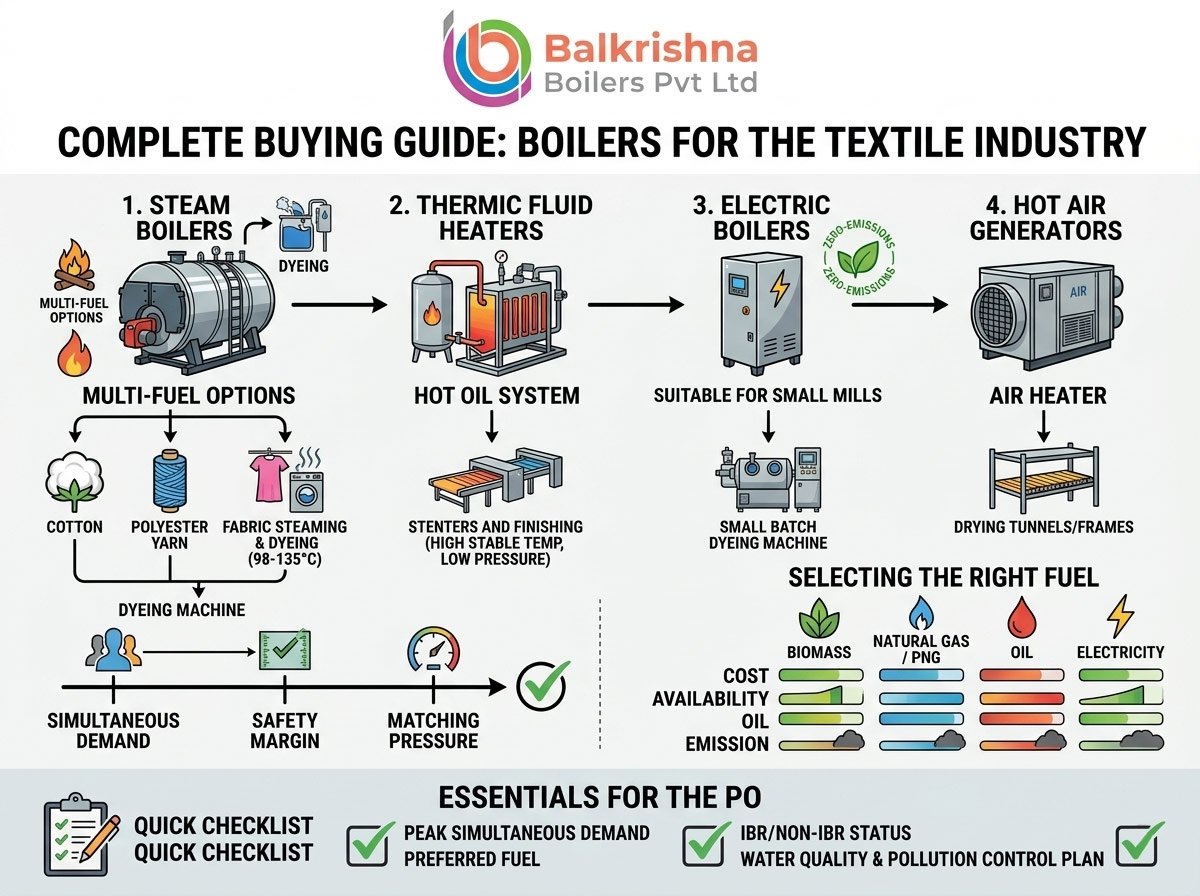
Textile manufacturing runs on heat. Whether it’s dyeing a batch of cotton yarn, steaming fabric after printing, sizing warp threads, or drying finished cloth on a stenter, almost every wet-processing stage depends on a reliable, right-sized heat source. Get the boiler wrong — undersized, over-fueled, or mismatched to the process — and you end up with uneven dyeing, production bottlenecks, and a fuel bill that eats into margins. Get it right, and the boiler becomes one of the quietest, most dependable assets on the shop floor.
This guide walks textile plant owners, purchase managers, and process engineers through everything worth knowing before signing a purchase order: which boiler type fits which process, how to size capacity correctly, what fuel actually makes sense for your location, and the compliance and after-sales questions too many buyers only ask after installation.
Why Textile Processing Is So Heat-Intensive
Textile wet processing isn’t one operation — it’s a chain of them, and nearly every link needs steam or hot fluid at a specific temperature and pressure:
- Sizing: Warp yarn is coated and dried before weaving, usually needing hot air or steam-heated drying cylinders.
- Desizing, Scouring & Bleaching: These preparatory stages run at 60–100°C and consume large volumes of process steam.
- Dyeing: Jet dyeing machines, jiggers, and package dyeing units typically operate between 98°C and 135°C depending on the fibre (polyester dyeing under pressure needs higher temperatures than cotton).
- Printing & Steaming: Printed fabric is steamed to fix dye into the fibre — a process that’s extremely sensitive to steam quality and pressure consistency.
- Stentering & Drying: Thermic fluid heaters are widely used here because they deliver very high, stable temperatures without the pressure risks of high-pressure steam.
- Finishing (calendering, sanforizing): Needs consistent, moderate heat for fabric stability.
Because these stages run almost continuously across shifts, the boiler isn’t a support utility — it’s effectively a production-line component. That’s why capacity, turndown ratio, and fuel flexibility matter more here than in many other industries.
Types of Boilers Used in Textile Mills
1. Steam Boilers
The workhorse of most textile units, especially for dyeing, bleaching, and steaming. Textile plants generally choose between solid-fuel (biomass/agro-waste), oil & gas, and electric steam boilers depending on fuel availability and emission norms. You can browse the full range of steam boilers available for textile applications, including models rated from a few hundred kg/hr up to multiple TPH.
Popular configurations for textile buyers include:
- Biomass Fired Steam Boiler – 1 Ton to 6 Ton for mid-sized dyeing and processing units
- Oil / Gas Fired Steam Boiler 500 Kg/hr to 10 TPH/hr where a clean, quick-response fuel is preferred
- Cotton Stalk Fired Boiler — a natural fit for textile clusters in cotton-growing belts, where agricultural residue is cheap and locally available
On the Balkrishna Boilers product line, the STEAMPOWER and HUSKPOWER ranges are commonly specified for continuous textile dyeing loads, while COMBIPOWER suits mills that want multi-fuel flexibility.
2. Thermic Fluid Heaters (Hot Oil Systems)
For stenters, calendering machines, and certain drying tunnels, many textile plants prefer a thermic fluid heater over a steam boiler. Thermic fluid systems run at atmospheric pressure even at very high temperatures, which significantly reduces the safety and IBR compliance burden compared to high-pressure steam. If you’re weighing the two, this comparison is worth reading before you decide: Thermic Fluid Heater vs Steam Boiler: Which Suits Your Process?
You can explore the full thermic fluid heater range, and on the Balkrishna Boilers side, models like DELTAPAC and THERMPAC are frequently installed for stentering and finishing lines.
3. Electric Boilers
Electric boilers have gained real traction in textile dyeing over the last few years — particularly for smaller batch-dyeing units, export-oriented mills chasing zero-emission certifications, and plants in zones with tightening Pollution Control Board norms. We’ve covered this in detail here: Are Electric Boilers a Good Fit for Textile Dyeing Units?
Before deciding, it’s worth reviewing the running-cost math — electric boilers have a different cost curve than fuel-fired units, and the payback period depends heavily on your local tariff and effluent norms: Electric Boiler ROI: When Does It Pay Off? and Electric Boiler Power Consumption: Formulas and Examples.
Explore the electric boiler range, including the Electric Steam Boiler 100 Kg/hr to 400 Kg/hr for smaller dyeing units and the IBR Electric Steam Boiler for larger, certified installations. On Balkrishna Boilers, the ELECTROMAX and ELECTROPAC series are built specifically for this kind of continuous industrial cycling.
4. Hot Air Generators
Used mainly for direct drying applications — tenter frame dryers, yarn conditioning, and fabric drying tunnels where direct hot air contact is more efficient than indirect heat exchange. See the hot air generator category, or the AIRPOWER and AIRTHERM models from Balkrishna Boilers.
How to Size a Boiler for Your Textile Unit
Undersizing is the single most common — and most expensive — mistake textile buyers make. A few pointers:
- Add up simultaneous demand, not total capacity. List every machine that could realistically run at the same time (dyeing jets, steaming chambers, drying tunnels) and add their steam/heat requirements together, not the theoretical maximum of each machine individually.
- Build in a 10–15% safety margin for future expansion, seasonal peaks, and heat loss in long pipe runs — a rule that applies across industries, not just textiles.
- Account for batch peaks. Dyeing is often cyclical — several machines may hit their heat-up phase together at shift start, creating a demand spike well above the average running load.
- Match pressure to your highest-pressure process, usually polyester or synthetic-blend dyeing, then regulate down for lower-pressure stages rather than running two separate systems.
- Factor in turndown ratio. Mills with fluctuating batch sizes benefit from boilers with a wide turndown range so efficiency doesn’t collapse during partial loads.
Choosing the Right Fuel
Fuel choice in textile boiler buying usually comes down to three factors: availability, running cost, and emission compliance.
- Biomass and agro-waste (cotton stalk, rice husk, groundnut shell) remain the lowest-running-cost option and are especially practical for textile clusters located near agricultural belts — cotton stalk availability near cotton-processing hubs is a natural synergy.
- Natural gas / PNG offers the cleanest combustion and easiest compliance, but depends on pipeline access.
- Oil (FO/LDO/diesel) is compact and low-maintenance but has the highest running cost of the fuel-fired options.
- Electricity eliminates on-site combustion entirely, which is increasingly attractive as state Pollution Control Boards tighten norms for dyeing and processing units — see How Electric Boilers Help Meet Pollution Control Norms for what’s driving that shift.
If you’re still deciding between an electric boiler and a thermic fluid heater for a specific process line, this side-by-side breakdown covers the trade-offs: Electric Boilers vs Thermic Fluid Heaters: Making the Right Choice.
Water Quality and Compliance Requirements
Textile boilers work harder than most because they cycle constantly and are frequently fed with treated effluent-adjacent water sources. Scale buildup from hard water is a bigger risk here than in many other sectors, and even a thin scale layer can raise fuel consumption noticeably while shortening tube life. If you’re specifying an electric boiler for a dyeing line, the water quality tolerances are stricter than for fuel-fired units — worth reviewing before finalising your order: Electric Boiler Water Quality Requirements Explained.
On the emissions side, textile dyeing and processing units are frequently required to fit pollution control equipment alongside the boiler itself, particularly for solid-fuel-fired systems. It’s worth speccing this at the same time as the boiler rather than retrofitting later — see the pollution control equipment range, including bag filters, wet scrubbers, and ESP systems.
IBR Certification: What Textile Buyers Need to Know
Any steam boiler crossing the IBR (Indian Boiler Regulations) threshold — generally above 25 litres of water-holding capacity or higher pressure ratings — must be inspected and certified by the government boiler inspectorate before commissioning. Most mid-to-large textile dyeing setups fall into this category. Smaller batch-dyeing units sometimes qualify for Non-IBR classification, but it’s worth confirming this with your supplier before ordering rather than after, since it affects installation timelines and documentation.
Installation, Commissioning, and What Textile Plants Should Expect
Boiler installation in a running textile unit needs careful sequencing — most mills can’t afford extended downtime on their dyeing floor. Site layout, chimney height (often governed by local Pollution Control Board norms near residential areas), piping runs to multiple dyeing machines, and steam trap placement all need planning before the unit even arrives on site. A detailed walkthrough of what this process typically looks like is covered here: Electric Boiler Installation: What to Expect (the sequencing principles apply broadly across boiler types, with IBR inspection added for pressure-fired steam units).
Cost Considerations and ROI
Boiler pricing depends on capacity (TPH or kg/hr), working pressure, fuel type, automation level, and construction material — stainless steel is often specified for textile units needing very clean steam for light-shade dyeing. As a rough benchmark, a standard 1 TPH IBR-certified steam boiler in India typically falls in the ₹8–15 lakh range depending on fuel and automation, though electric and specialty units will price differently.
Most textile buyers evaluating a fuel switch — particularly a move to electric — see payback within 12–18 months when fuel savings, reduced maintenance, and compliance costs are factored in together. It’s worth running these numbers against your own tariff and current fuel spend before committing.
A Practical Buying Checklist
Before you finalise a purchase, confirm you have clear answers to each of these:
- Peak simultaneous steam/heat demand, in kg/hr or TPH, with your 10–15% margin already added
- Working pressure needed for your highest-pressure dyeing process
- Preferred fuel, based on local availability and your compliance timeline
- IBR or Non-IBR classification, confirmed with your supplier in writing
- Water treatment plan, sized for your boiler’s actual feed-water quality
- Pollution control equipment, specified alongside the boiler rather than after commissioning
- Automation level — manual, semi-automatic, or PLC-based, depending on your operator skill availability
- After-sales support terms — AMC coverage, spare parts stocking, and response time commitments
Why Textile Manufacturers Choose Balkrishna Boilers
Balkrishna Boilers Pvt Ltd has spent over 25 years engineering steam boilers, thermic fluid heaters, electric boilers, and hot air generators for heat-intensive industries, with dyeing and textile processing among our most consistently served sectors. Our steam boiler, thermic fluid heater, and electric boiler ranges are engineered for the continuous, cyclical loads typical of dyeing and finishing floors, and every IBR-rated unit goes through the same rigorous inspection and testing process before it leaves the factory.
For plants evaluating options in more detail, our team can help translate your process load into the right capacity, pressure, and fuel combination — reach out through the contact page or browse the complete product range to compare specifications directly.
Frequently Asked Questions
Which boiler type is best for cotton dyeing? Most cotton dyeing units run comfortably on a biomass or oil/gas fired steam boiler in the 1–6 TPH range, depending on machine count. Where emission norms are tight, an electric boiler is increasingly the preferred alternative.
Do textile boilers need IBR certification? Yes, in most cases. Any steam boiler above 25 litres of water-holding capacity or operating at higher pressure needs IBR inspection and certification before commissioning.
Is an electric boiler expensive to run for dyeing? Running cost depends on your local electricity tariff versus fuel prices, but many textile units recover the cost difference within 12–18 months through lower maintenance, no fuel handling, and easier pollution compliance.
What size boiler does a mid-sized dyeing unit need? It depends entirely on simultaneous machine load, but many mid-sized units fall in the 2–6 TPH range. A proper load audit before ordering is strongly recommended over estimating from machine nameplates alone.
Can one boiler supply both dyeing and stentering lines? Technically yes, but many mills prefer a steam boiler for dyeing and a separate thermic fluid heater for stentering, since the two processes have very different pressure and temperature profiles.
Looking for a boiler sized specifically for your textile plant’s load? Get in touch with our engineering team for a capacity assessment and quote.