
Every industrial plant that relies on process heat eventually faces the same decision: which heating technology actually fits the job? Two systems dominate this conversation today — electric boilers and thermic fluid heaters. Both deliver reliable, efficient heat, but they work in fundamentally different ways, and choosing the wrong one can quietly inflate your energy bills, complicate your compliance paperwork, or leave your process without the temperature control it actually needs.
At Balkrishna Boilers Pvt Ltd, we manufacture both technologies, so we don’t have a bias to sell you one over the other — our job is to help you match the equipment to the process. This guide breaks down how each system works, where each one wins, and how to make a decision you won’t have to revisit in two years.
Understanding the Two Technologies
How an Electric Boiler Works
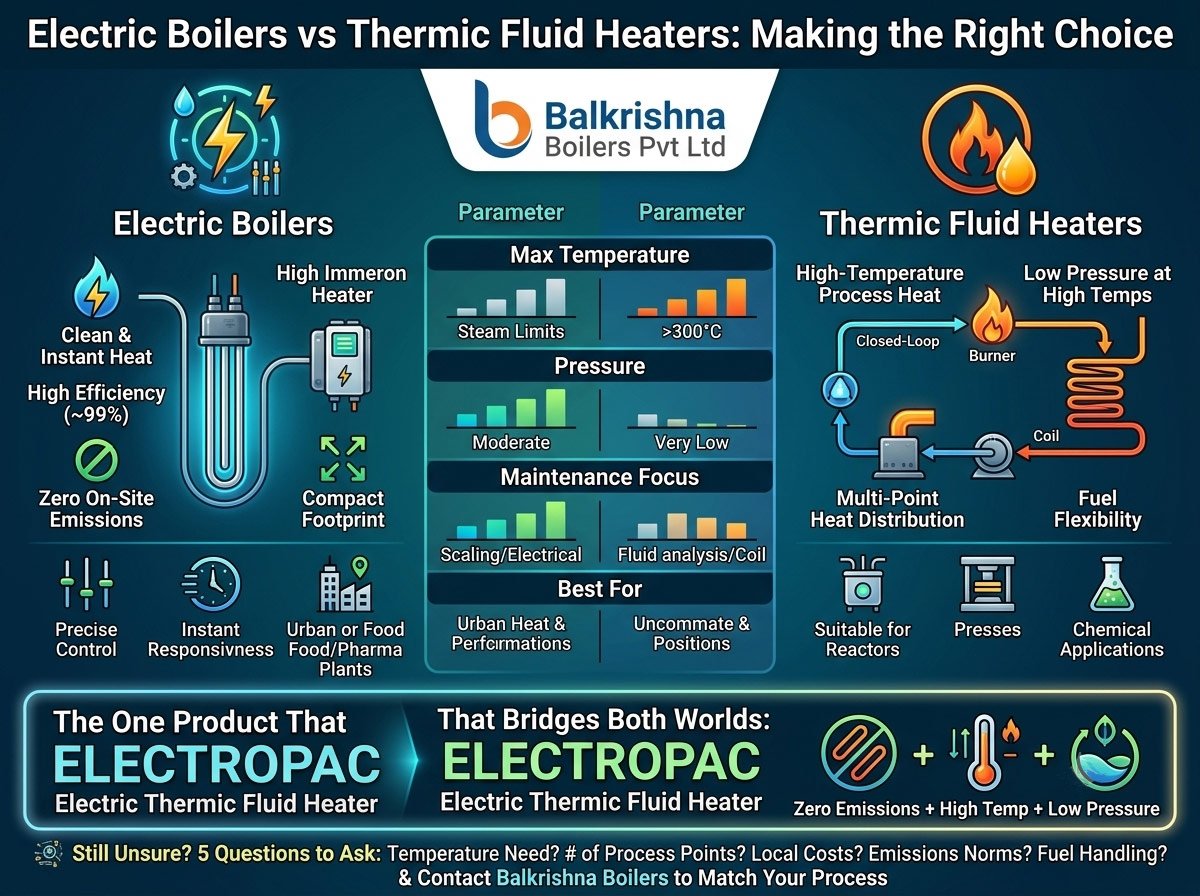
An electric boiler generates heat by passing electrical current through resistance elements, electrodes, or an induction core, which is then transferred directly to water or steam. There is no combustion, no flame, and no flue gas involved at all. We’ve covered the underlying mechanics — resistance heating, electrode-contact systems, and induction cores — in detail in our guide on electric boiler technology, from immersion elements to electrode types.
Because the conversion of electricity to heat is nearly direct, electric boilers routinely achieve thermal efficiencies of 98–99.5%. There’s no chimney, no fuel storage, and no combustion byproducts to manage on site.
How a Thermic Fluid Heater Works
A thermic fluid heater, sometimes called a hot oil heater, operates on a completely different principle. Instead of generating high-pressure steam, it heats a special heat-transfer fluid (thermic oil) in a closed loop at low pressure, and that hot fluid is then circulated to wherever the process needs heat — reactors, presses, dryers, or heat exchangers. If you’re new to the concept, our detailed explainer on what a thermic fluid heater is and how it works walks through the full cycle, from fuel combustion to fluid return.
The defining advantage here is the ability to reach very high temperatures — often 250°C to 350°C — without the high pressures that come with steam systems at similar temperatures. That makes thermic fluid heaters inherently safer for high-temperature applications and easier to license and operate under IBR-type regulatory frameworks.
Electric Boilers vs Thermic Fluid Heaters: Side-by-Side Comparison
| Parameter | Electric Boiler | Thermic Fluid Heater |
|---|---|---|
| Heat generation | Electrical resistance, electrode, or induction | Fuel combustion (gas, oil, biomass, coal) heating a thermal fluid |
| Operating pressure | Low to moderate, depends on steam demand | Very low (typically 2–5 bar), even at high temperature |
| Maximum practical temperature | Efficient up to steam saturation limits | Can comfortably exceed 300°C at low pressure |
| Thermal efficiency | 98–99.5% | 82–88% (higher with heat recovery/APH) |
| Emissions | Zero direct emissions on-site | Combustion emissions depend on fuel type |
| Capital cost | Generally lower for smaller capacities | Higher due to combustion system, coil, and controls |
| Running cost driver | Electricity tariff | Fuel price and availability |
| Space and infrastructure | Compact, no chimney or fuel yard needed | Requires fuel storage, chimney, and larger footprint |
| Best suited for | Clean, low-to-medium temperature process heat; urban or emission-sensitive sites | High-temperature, uniform, closed-loop heating for reactors, presses, and dryers |
| Maintenance profile | Simpler; watch for scaling on elements | Requires fluid analysis, flow interlocks, and coil inspection |
Where Electric Boilers Make the Most Sense
1. Emission-Sensitive and Urban Locations
If your plant sits in a zone with strict pollution norms, or you’re targeting net-zero operations, an electric boiler removes the combustion problem entirely rather than trying to filter it. We explored this in depth in why electric boilers are the best choice for low-emission plants — the short version is that as India’s grid adds more renewable capacity, an electric boiler’s environmental footprint keeps shrinking on its own, something a fuel-fired system can never do.
2. Food, Pharma, and Dairy Processing
Industries where product purity is non-negotiable benefit enormously from the absence of combustion byproducts near the process area. Our article on electric boilers for food, pharma, and dairy applications covers how the lack of flue gas, soot, and fuel odor simplifies both contamination control and compliance audits — a real advantage in validated environments.
3. Compact Installations with Space Constraints
Electric boilers don’t need a chimney, fuel yard, or dedicated boiler house in the traditional sense, which matters when floor space is expensive or simply unavailable. This also shortens installation timelines significantly.
4. Where Precise, Instant Control Matters
Electric systems respond to load changes almost instantly, since there’s no combustion lag. For batch processes with frequent start-stop cycles, this responsiveness reduces energy waste that a fuel-fired system would otherwise burn off during warm-up.
Recommended range: Balkrishna Boilers’ Electric Boiler line includes the ELECTRON electric steam boiler for compact, high-efficiency steam, the heavy-duty ELECTROMAX IBR-approved electric steam boiler for larger loads, and the INDUCTRON induction boiler, which resists scaling better than resistance-type units and holds its efficiency over longer duty cycles.
Where Thermic Fluid Heaters Make the Most Sense
1. High-Temperature Processes
When a process genuinely needs heat above 200°C — think polymerization, distillation, hot-pressing, or curing — a steam boiler would need dangerously high pressure to get there, while a thermic fluid heater delivers the same temperature at pressures barely above atmospheric. This is the single biggest reason process engineers specify thermic fluid systems for reactors and high-temp drying lines.
2. Chemical and Process Industries with Strict Safety Requirements
Because thermic fluid heaters operate at low pressure even at high temperature, the catastrophic-failure risk profile is very different from a high-pressure steam system. That said, they come with their own safety discipline — fluid degradation, flow interlocks, and oxidation control all matter. Our guide on thermic fluid heaters in the chemical industry: the ultimate safety guide covers the maintenance protocols — flow-differential interlocks, nitrogen blanketing, and annual fluid analysis — that keep these systems safe over years of operation.
3. Uniform Heat Distribution Across Multiple Points
A single thermic fluid heater can serve several process points simultaneously through a piped loop, each drawing the heat it needs via heat exchangers. This makes it a natural fit for plants with multiple parallel processes — textile heat-setting lines, plywood presses, or edible oil refining, for example — that all need consistent, high-grade heat from one central source.
4. Fuel Flexibility
Thermic fluid heaters can be configured for gas, oil, biomass, or solid fuel firing, which gives plants in areas with variable fuel access a way to control running costs based on whatever is locally cheapest and most reliable.
Recommended range: Balkrishna Boilers’ Thermic Fluid Heater range includes the THERMPAC three-pass coil-type heater for general industrial use, the DELTAPAC for compact high-efficiency installations, the solid-fuel PELLEPAC for plants looking to cut fuel costs with biomass, and the EDOPAC for demanding continuous-process applications.
The One Product That Bridges Both Worlds
If your process needs the very high temperatures of a thermic fluid system but you still want the zero-emission profile of an electric unit, Balkrishna Boilers manufactures the ELECTROPAC electric thermic fluid heater — a system that delivers thermic-fluid-style high-temperature, low-pressure heating using electric resistance elements instead of combustion. It’s a genuinely useful middle path for chemical reactors, paint curing lines, and specialty manufacturing processes that want high heat without a chimney.
Cost Comparison: What Actually Drives Your Decision
Capital cost is rarely the deciding factor once you look at total cost of ownership. The real comparison comes down to three numbers: your electricity tariff, your available fuel price, and your annual operating hours.
- High utilization, cheap or subsidized fuel available: thermic fluid heaters typically win on running cost, especially with biomass or agro-waste fuels.
- Moderate utilization, unreliable or expensive fuel supply, or a push toward decarbonization: electric boilers often come out ahead once you factor in the absence of fuel logistics, flue maintenance, and emissions compliance costs.
- Very high, continuous temperature demand (250°C+): thermic fluid heaters remain the more practical engineering choice, since replicating that heat electrically at scale means either a very large connected load or a specialized unit like the ELECTROPAC.
We’ve run a direct efficiency and running-cost comparison between electric and conventionally fired steam systems in our analysis of electric vs gas/oil-fired boiler running costs, which is worth reading if electricity tariffs in your state are a major variable in your decision.
A Practical Decision Framework
Before you commit, walk through these five questions:
- What temperature does your process actually need? Below ~180°C, both technologies are viable. Above that, thermic fluid heaters (or the electric ELECTROPAC) become the more natural fit.
- How many process points need heat, and are they spread out? A single centralized thermic fluid loop often beats installing multiple smaller electric units across a large plant.
- What does your local electricity tariff look like versus your fuel cost per delivered kcal? Run the numbers on your actual utilization hours, not nameplate capacity.
- How strict are your emissions or purity requirements? If you’re in food, pharma, or an urban emission-controlled zone, electric systems remove a whole category of compliance headaches.
- What’s your appetite for fuel logistics and storage? If you don’t want to manage fuel yards, deliveries, and ash or flue handling, electric is the lower-friction choice.
If your process spans multiple heating needs — say, high-temperature reaction heat alongside general steam for cleaning or utilities — it’s also worth reviewing how thermic fluid heaters stack up directly against conventional steam boilers, which we cover in thermic fluid heater vs steam boiler: which is better for your industry. And if fire-tube versus water-tube steam design is also on your shortlist, our comparison on fire-tube vs water-tube boilers can help round out that side of the evaluation.
Maintenance and Lifecycle: What Ownership Actually Looks Like
Buying decisions often focus on the purchase price and running cost, but day-to-day maintenance load is what your plant team actually lives with for the next 15–20 years.
Electric boilers are mechanically simple — there’s no burner, no fuel train, and no flue to sweep. The main watch-item is scaling on resistance elements, which is why water treatment discipline matters even more here than on a fuel-fired unit. Induction-based systems like the INDUCTRON largely sidestep this issue because the heating core doesn’t sit in direct contact with untreated water the same way immersion elements do. Beyond water quality, routine maintenance is largely electrical: checking contactors, thyristor control panels, and insulation resistance on a scheduled basis.
Thermic fluid heaters carry a different maintenance rhythm. The thermic fluid itself is a consumable that degrades over time through thermal cracking and oxidation, so annual (or more frequent, depending on duty cycle) fluid sampling is essential to catch viscosity and flash-point changes before they become a safety issue. Coil inspection, soot removal on the fire side, and verifying flow-interlock and nitrogen-blanketing systems are functioning correctly round out a proper maintenance schedule. None of this is difficult, but it does require a trained team and a maintenance calendar that’s actually followed — cutting corners here is where most thermic fluid heater problems originate.
Both technologies, properly maintained, comfortably deliver 15–20+ years of service life. The real difference is the type of discipline required: electrical and water-chemistry discipline for electric boilers, versus fluid-condition and combustion discipline for thermic fluid heaters.
Frequently Asked Questions
Is an electric boiler cheaper to run than a thermic fluid heater? It depends entirely on your local electricity tariff versus your fuel cost per delivered kcal, and your operating hours. At high utilization with access to cheap fuel (especially biomass), thermic fluid heaters usually have the lower running cost. At moderate utilization, or where grid tariffs are favorable and fuel logistics are a hassle, electric boilers often win — see our detailed running cost comparison for the underlying numbers.
Can a thermic fluid heater reach higher temperatures than an electric boiler? For standard electric steam boilers, yes — thermic fluid systems are purpose-built for temperatures well above 250°C at low pressure, which is difficult to replicate economically with a standard electric steam boiler. However, a specialized electric thermic fluid heater like the ELECTROPAC closes that gap by combining electric heating with thermic-fluid-style high-temperature, low-pressure delivery.
Which is safer — electric or thermic fluid? Both are safe when properly engineered and maintained, but the risk profiles differ. Electric boilers eliminate combustion and flue-gas risk entirely. Thermic fluid heaters operate at low pressure even at high temperature, which avoids the high-pressure risks of steam, but require careful fluid-condition monitoring to prevent thermal degradation and fire risk, as detailed in our chemical industry safety guide.
Can I switch from a thermic fluid heater to an electric system later? In most cases, yes, though it typically means replacing the heat source and control system rather than a simple retrofit, since the two use different heat-transfer principles (fluid loop versus direct water/steam heating). It’s usually more cost-effective to size the right system correctly at the outset — our engineering team can help model this against your actual process data.
Do thermic fluid heaters require an IBR license like steam boilers? Regulatory requirements vary by state and by the specific pressure and temperature rating of the unit, so it’s best to confirm with your local boiler inspectorate. Generally, the low operating pressure of thermic fluid systems simplifies compliance compared to high-pressure steam boilers, but you should always verify current requirements for your specific installation.
Final Word
Neither electric boilers nor thermic fluid heaters are universally “better” — they’re built for different jobs. Electric boilers win on cleanliness, simplicity, and responsiveness for low-to-moderate temperature process heat. Thermic fluid heaters win on high-temperature capability, low-pressure safety, and centralized distribution across multi-point processes.
Balkrishna Boilers Pvt Ltd manufactures both product lines — explore our full Electric Boiler range and Thermic Fluid Heater range, or get in touch with our engineering team with your process parameters — temperature, load, fuel access, and space — and we’ll help you size the right system the first time.