
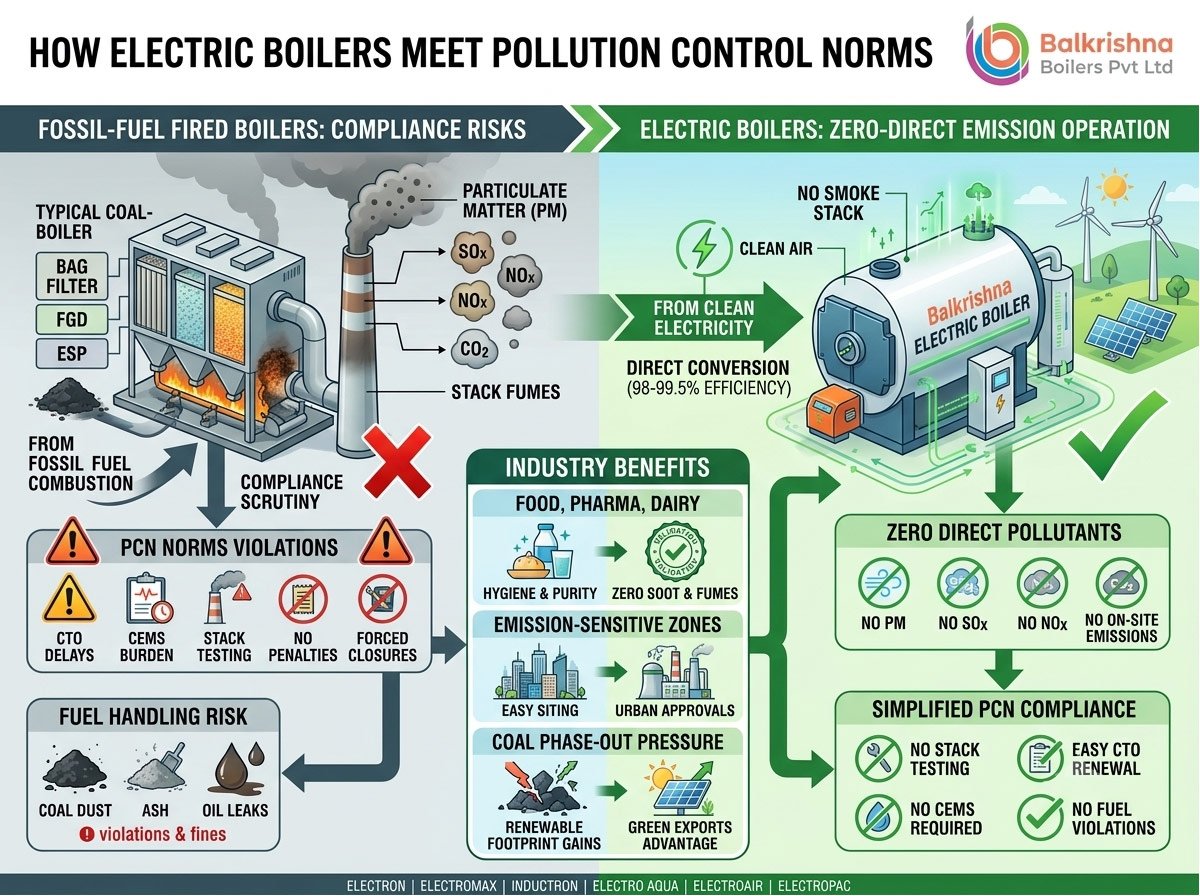
Environmental compliance has stopped being a paperwork exercise for Indian manufacturers — it’s now a condition of staying operational. State Pollution Control Boards are tightening particulate matter limits, the CAQM (Commission for Air Quality Management) is issuing stricter directives in and around the NCR and other industrial corridors, and non-compliant units are increasingly facing “Close Work” notices rather than warnings. In this climate, the boiler house — historically the single largest source of a plant’s stack emissions — has become the first place engineers look when they need to fix their compliance position.
Electric boilers offer a fundamentally different answer to this problem than any fuel-fired system can. Instead of managing emissions after they’re created, they remove the combustion event entirely. At Balkrishna Boilers Pvt Ltd, we manufacture both combustion-based systems with advanced emission control and fully electric boilers, so this guide lays out — honestly — where and why electric heating is the more direct route to compliance, and where combustion with proper pollution control equipment still makes sense.
Why Boilers Sit at the Center of Pollution Control Norms
Any boiler that burns coal, furnace oil, diesel, natural gas, or even biomass produces a mix of pollutants that regulators track closely:
- Particulate Matter (PM): Fine ash and soot particles that are the primary target of most state PCB stack-emission limits.
- Sulphur Oxides (SOx): Produced mainly from high-sulphur fuels like furnace oil and certain coal grades, a major contributor to acid rain and respiratory illness.
- Nitrogen Oxides (NOx): Formed during high-temperature combustion, contributing to smog and ground-level ozone.
- Carbon Dioxide (CO2): The primary greenhouse gas, now tracked not just for local compliance but for carbon border taxes affecting exporters.
We’ve explored how these emissions form and how to reduce them in our detailed guide on how boilers impact carbon emissions and how to reduce them. The short version: every one of these pollutants originates at the point of combustion. If there’s no flame, there’s no flue gas — and that’s precisely the logic behind electrification as a compliance strategy.
How Electric Boilers Solve the Problem at the Source
An electric boiler generates heat through resistance elements, electrode contact, or induction, converting electrical energy directly into steam, hot water, or thermal fluid heat. We’ve covered the mechanics of each heating method in our guide to electric boiler technology, from immersion elements to electrode types. Because there is no combustion at all, there is:
- No chimney or stack required
- No flue gas to treat, filter, or monitor
- No particulate matter, SOx, NOx, or CO2 released on-site
- No Consent to Operate renewal tied to emission testing at the boiler
This is the central argument we made in our earlier piece on why electric boilers are the best choice for low-emission plants: a “low-emission plant” today effectively means a plant with zero direct emissions, and electric boilers deliver that by design rather than through downstream filtering. As India’s electricity grid adds more solar, wind, and hydro capacity every year, the environmental footprint of an electric boiler keeps improving on its own — something a coal- or oil-fired unit, however well-filtered, simply cannot do.
Direct Compliance Benefits of Switching to Electric
1. No Stack Emission Testing or Reporting Burden
Fuel-fired boilers require periodic stack emission monitoring, and increasingly, continuous emission monitoring systems (CEMS) for larger installations. Electric boilers remove this compliance line item entirely, since there’s no stack to test.
2. Simplified Consent to Operate (CTO) Renewals
Pollution Control Boards scrutinize combustion-based installations closely during CTO renewal — fuel type, emission control equipment, and stack height all come under review. An all-electric boiler house dramatically simplifies this process because the emissions category that drives most of the scrutiny simply doesn’t apply.
3. No Fuel Storage or Handling Violations
Fuel oil leaks, coal dust, and biomass ash handling are all separate categories of environmental violation beyond stack emissions. Electric boilers eliminate fuel storage yards altogether, removing this risk category as well.
4. Easier Siting in Restricted or Urban Zones
Many industrial zones and urban-adjacent plots now restrict new combustion-based installations, particularly coal and furnace oil units. Because electric boilers have zero direct emissions, they’re often the only heating technology that can be installed in these locations without extensive additional clearances.
5. Precision Control That Reduces Waste-to-Atmosphere
Beyond the absence of combustion pollutants, electric boilers offer very tight, instantaneous control over temperature and pressure. This matters for compliance in a less obvious way: fuel-fired systems that cycle on and off, or run at partial load, tend to combust less efficiently during those transitions, spiking emissions briefly each time. Electric systems don’t have this problem because there’s no combustion cycle to manage.
Industry-Specific Compliance Advantages
Food, Pharma, and Dairy
These sectors face a dual compliance challenge: environmental norms and product purity/validation requirements. Our article on electric boilers for food, pharma, and dairy applications explains how removing combustion also removes fume, odor, and soot risks near clean processing areas — a benefit that overlaps directly with both environmental compliance and quality audits (FSSAI, WHO-GMP, and similar frameworks).
Chemical, Textile, and Process Manufacturing
For plants in emission-sensitive corridors — Gujarat’s chemical hubs, Tamil Nadu’s textile clusters — the compliance pressure is intensifying every renewal cycle. Where the process temperature demand fits within an electric boiler’s range, switching removes the recurring regulatory friction entirely. For processes needing very high temperatures beyond what a standard electric steam boiler comfortably delivers, the electric thermic fluid heater route (covered below) is worth evaluating before defaulting back to a combustion system.
Plants Facing Coal Phase-Out Pressure
Coal-fired boilers are under the most direct regulatory pressure in 2026, with SPCBs and the CAQM tightening particulate and SOx limits year over year. Our comparison on biomass boilers vs coal for Indian businesses shows that coal units increasingly require expensive Electrostatic Precipitators (ESPs) and Flue Gas Desulphurization (FGD) systems just to stay compliant. For plants weighing that capital cost against a clean-sheet switch, electrification is worth comparing side by side with a biomass retrofit — biomass is carbon-neutral but still requires particulate control; electric removes the emissions question altogether.
What If You Can’t Go Fully Electric?
Not every process or plant is ready for full electrification — high continuous load, extremely high temperature demand, or fuel-cost economics sometimes make combustion the more practical near-term choice. In those cases, meeting pollution norms means investing properly in emission control equipment rather than skipping it. Balkrishna Boilers’ sister range of Pollution Control Equipment includes Bag Filters and Dust Collectors for particulate control, ESP (Electrostatic Precipitators) for high-efficiency fine particulate removal, FGD (Flue Gas Desulphurization) systems for SOx control, the TREMA Cyclone separator for cost-effective bulk particulate removal, and Wet Scrubbers for combined particulate and gas absorption.
This is also where a hybrid approach often makes the most financial sense: use electric boilers for the loads where they fit cleanly, and pair any remaining combustion-based capacity with the right pollution control equipment rather than an outdated or undersized system. We’ve discussed this trade-off in boiler efficiency vs fuel cost: what matters more — cheap fuel with poor emission control often costs more in fines and downtime than the fuel savings are worth.
Recommended Electric Boiler Range for Compliance-Driven Upgrades
Balkrishna Boilers’ Electric Boiler product line covers the full range of process needs for plants moving toward zero direct-emission operation:
- ELECTRON — Electric Steam Boiler, ideal for compact, moderate-capacity steam demand.
- ELECTROMAX — IBR-approved Electric Steam Boiler for heavier industrial loads.
- INDUCTRON — Induction Boiler, with a non-contact heating core that resists scaling and sustains high efficiency over long duty cycles.
- ELECTRO AQUA — Electric Hot Water Boiler for process and utility hot water needs.
- ELECTROAIR — Electric Hot Air Generator for clean, combustion-free drying and curing.
- ELECTROPAC — Electric Thermic Fluid Heater, delivering high-temperature, low-pressure heat without combustion, for reactors, presses, and curing lines that would otherwise need a fuel-fired thermic fluid system.
If your current setup is a fuel-fired thermic fluid heater and compliance is the driving concern, it’s worth reading our explainer on what a thermic fluid heater is and how it works alongside the ELECTROPAC’s specifications — in many high-temperature applications, it’s now a genuine one-for-one replacement without the emissions.
The Economics of Going Electric for Compliance
Plant managers often assume electrification is purely a cost premium paid for environmental compliance. In practice, the total cost picture is more balanced than it looks:
- Avoided compliance costs: No stack testing, CEMS installation/maintenance, ESP/FGD capital and operating cost, or ash/fuel handling infrastructure.
- Avoided penalty risk: Non-compliance penalties and forced shutdowns are increasingly common and expensive — the “cost of pollution fines” is now a real line item in fuel-vs-efficiency decisions, as we discussed in our efficiency vs fuel cost analysis.
- Efficiency gains: Electric boilers convert 98–99.5% of input energy into usable heat, versus 75–90% for well-run fossil fuel systems, which offsets a meaningful part of the higher per-unit electricity cost.
- Faster approvals: Reduced clearance and CTO complexity can shorten project timelines, which has its own financial value.
For a full breakdown of running costs against conventional fuel-fired systems, see our comparison of electric vs gas/oil-fired boiler efficiency and running costs.
Frequently Asked Questions
Do electric boilers need any pollution control clearance at all? Because there’s no combustion and no stack, electric boilers generally fall outside the stack-emission clearance category that applies to fuel-fired systems. However, general industrial consents and electrical safety approvals still apply — always confirm current requirements with your state Pollution Control Board.
Are electric boilers actually zero-emission, or just zero-emission on-site? Electric boilers have zero direct emissions at the point of use. The emissions associated with generating the electricity itself depend on the grid mix, but that burden shifts away from your plant’s compliance profile — and gets cleaner every year as renewable capacity grows on the grid.
Can an electric boiler fully replace a coal or biomass-fired unit under pollution pressure? For most steam, hot water, and hot air process loads, yes. For extremely high continuous capacity or very high-temperature thermic fluid applications, it depends on your load profile and available electrical infrastructure — our engineering team can model this against your actual site data.
What if my process still needs combustion — what’s the fastest compliance fix? Pairing your existing boiler with the right pollution control equipment — ESP, bag filter, FGD, or wet scrubber depending on your fuel and pollutant profile — is the fastest route while you evaluate a longer-term electrification plan.
The Regulatory Landscape Driving This Shift
Understanding why compliance pressure is intensifying helps explain why electrification has moved from a “nice to have” to a genuine business priority for many plants: