
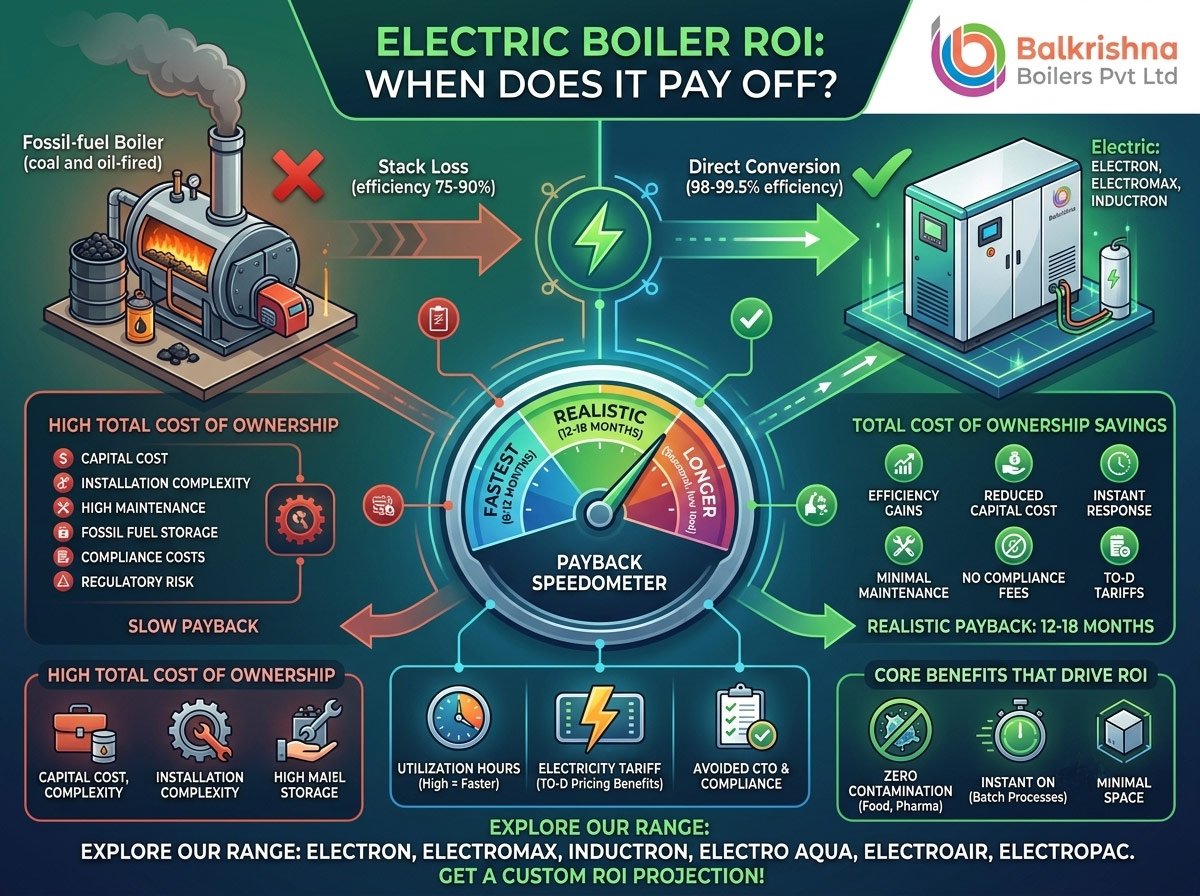
“Electricity costs more per unit than fuel — so how does an electric boiler ever pay for itself?” It’s the first question every plant manager asks us, and it’s the right question to ask. But it’s also the wrong way to frame the math. Electric boiler ROI isn’t about the price of one kWh versus one kg of coal — it’s about total cost of ownership: efficiency, installation cost, maintenance, compliance, and how you actually use the boiler day to day.
At Balkrishna Boilers Pvt Ltd, we’ve installed electric systems across steam, hot water, hot air, and thermic fluid applications, and the payback period varies a lot depending on the plant. This guide breaks down exactly which variables drive that number, so you can work out where your own installation is likely to land — 8 months, 18 months, or considerably longer.
Why the “Cost Per Unit” Comparison Is Misleading
Comparing the rupee cost of a unit of electricity to the rupee cost of a kg of coal or a litre of furnace oil tells you almost nothing about total operating cost, because it ignores efficiency. A fossil-fuel boiler loses a significant share of its input energy up the chimney as stack loss — typically landing at 75–90% thermal efficiency even with a well-run system. Electric boilers convert electrical energy almost directly into heat, routinely hitting 98–99.5% thermal efficiency, as we detailed in our guide on electric boiler technology, from immersion elements to electrode types.
That efficiency gap closes a large part of the per-unit price difference before you even factor in anything else. We’ve run the full math on this in our comparison of electric vs gas/oil-fired boiler efficiency and running costs, and the same efficiency logic that drove us to build the Why Electric Boilers Are the Best Choice for Low-Emission Plants argument also underpins the ROI case — because in this instance, cleaner and cheaper-to-run turn out to be the same story.
The Six Variables That Actually Determine Payback Period
1. Capital and Installation Cost Savings
Electric boilers typically cost less to install than their capital cost alone would suggest, because they eliminate an entire category of civil and infrastructure work: no chimney, no fuel storage tank or yard, no fuel handling conveyor or ash disposal system, and often a smaller boiler house footprint altogether. These are real, one-time capital savings that shorten payback before the boiler has even fired for the first time.
2. Efficiency Gains Over the Old System
If you’re replacing an aging, poorly maintained fossil-fuel boiler running well below its rated efficiency — a common scenario in plants that haven’t upgraded in a decade or more — the efficiency jump to an electric system can be dramatic. The bigger the gap between your old system’s real-world efficiency and 98%+, the faster the payback.
3. Maintenance Cost Reduction
Electric boilers have no burner, no refractory lining to maintain, no soot blowing, and no flue to sweep. Maintenance is largely electrical and water-chemistry focused rather than mechanical and combustion-focused. Over a multi-year period, this consistently lowers total maintenance spend, and it’s a savings line that’s easy to underestimate when building an ROI case upfront.
4. Load Profile and Utilization Hours
This is the single biggest driver of payback speed. A boiler running near-continuously at high utilization amortizes any efficiency or maintenance advantage faster than one running a few hours a day. Batch processes with frequent start-stop cycles benefit especially strongly from electric systems, because there’s no combustion warm-up lag — the boiler responds instantly, so you’re not burning fuel to bring a cold system up to temperature every cycle.
5. Electricity Tariff Structure
Your state’s industrial electricity tariff — and specifically whether you have access to time-of-day (ToD) pricing — has a major effect on running cost. Plants with flexible production schedules can shift electric boiler operation to off-peak hours, when tariffs are meaningfully lower, and use thermal storage or buffer tanks to bank that heat for use during peak hours. This single strategy can materially shorten a payback calculation.
6. Avoided Compliance and Regulatory Cost
This variable rarely makes it into a first-pass ROI spreadsheet, but it should. Stack emission testing, Consent to Operate renewals tied to fuel type, and pollution control equipment capex and upkeep are all real, recurring costs for combustion-based systems that an electric boiler simply doesn’t carry. We’ve covered this angle in detail separately, and it’s worth factoring in as an avoided cost, not just a “nice to have.”
What Realistic Payback Periods Actually Look Like
Based on installations across different plant types, electric boiler ROI generally falls into a few recognizable patterns:
- High-utilization, batch or cyclical processes (food, pharma, textile dyeing): Payback in the 12 to 18 month range is common, driven by the combination of efficiency gains, instant response (no warm-up losses on every cycle), and reduced maintenance labor.
- Replacing a poorly maintained or old fossil-fuel unit at high load: Payback can land on the faster end of that range, sometimes under a year, because the baseline efficiency being replaced is so low.
- Space-constrained or urban installations, where civil/installation savings are large: ROI is often realized “immediately” through reduced civil cost and zero contamination risk, even before running-cost savings are counted, particularly relevant for food, pharma, and dairy plants — see our breakdown on electric boilers for food, pharma, and dairy applications.
- Low-utilization or seasonal operations: Payback stretches out, since there are fewer operating hours over which to recover the cost difference. In these cases, the compliance and space-saving benefits often matter more than the pure financial payback.
- Induction technology specifically: Because of rapid heat transfer and no pre-heating lag, induction boilers can cut electricity consumption by roughly 20–30% compared to standard resistive electric boilers for intermittent-use processes, which further accelerates payback for plants with variable demand.
A Simple Framework for Estimating Your Own Payback
You don’t need a detailed engineering study to get a first-pass estimate. Walk through these four steps:
- Calculate your current annual fuel + maintenance + compliance spend for the boiler you’re replacing, including fuel storage/handling labor and any emission-testing or CTO-related costs.
- Estimate your projected annual electricity spend for an equivalent-capacity electric boiler, using your actual industrial tariff (and factoring in off-peak scheduling if your process allows it).
- Subtract the two to get your estimated annual operating savings.
- Divide the net capital cost difference (electric boiler installed cost minus your combustion system’s installed cost, netting out any civil/infrastructure savings) by your annual savings to get a rough payback period in years.
For a genuinely accurate number specific to your load, fuel type, and tariff, our engineering team can build a detailed ROI projection — this is standard practice for us on any serious inquiry, and it’s worth doing before committing capital either way.
Where Electric Boiler ROI Is Strongest
Certain plant profiles consistently show the fastest, most reliable payback:
- Food, pharma, and dairy facilities where contamination risk, validation requirements, and space constraints stack the case in electric’s favor well beyond pure fuel-cost savings.
- Plants facing near-term compliance pressure — coal phase-out directives, tightening SPCB norms, or CTO renewal difficulty — where the “cost” of staying on combustion includes real regulatory risk, not just fuel price.
- Batch and intermittent processes that benefit disproportionately from instant response and zero warm-up loss, especially when paired with induction technology.
- Urban or space-constrained sites where civil cost savings alone can offset a large share of the capital premium.
Where Payback Takes Longer — and Why It May Still Be Worth It
Continuous, very high-capacity steam demand with cheap, locally available fuel (particularly biomass) is the scenario where a combustion-based system, properly filtered, can still out-compete electric on pure running cost. In these cases, electrification may show a longer payback period on paper, but plants often still move forward because of compliance certainty, reduced operational complexity, or a corporate sustainability commitment that isn’t purely financially driven. It’s a legitimate business decision either way — the point is to go in with real numbers rather than assumptions.
A Worked Example: What the Math Looks Like in Practice
To make this concrete, consider a mid-sized food processing plant running a 1,000 kg/hr steam requirement roughly 16 hours a day, replacing an aging oil-fired boiler that has drifted down to around 78% efficiency after years of service.
On the fuel side, that plant is paying for combustion inefficiency every single day — nearly a quarter of every litre of fuel oil purchased is being lost up the stack rather than converted into usable steam. Layer on top of that the recurring cost of burner servicing, refractory upkeep, and periodic stack emission testing to maintain the Consent to Operate, and the “cheap fuel” narrative starts to look considerably less cheap once every line item is counted.
Switching to an ELECTROMAX-class electric steam boiler at the same capacity changes several of these line items simultaneously: efficiency jumps to the high-90s, fire-side maintenance disappears entirely, fuel storage and handling costs go to zero, and stack-emission compliance work is no longer needed because there’s no stack. The capital cost premium on the boiler itself is real, but it’s partially offset by not needing a chimney, fuel yard, or expanded boiler house civil work. For a plant of this profile — high utilization, food-grade compliance pressure, and an old system running well below its rated efficiency — a payback inside the 12-to-18-month window is a realistic outcome, not an optimistic one.
The exact numbers shift with your tariff, your current system’s real efficiency, and your utilization hours, which is exactly why a proper ROI projection should be built on your actual site data rather than a generic industry average.
Recommended Electric Boiler Range for ROI-Driven Decisions
Balkrishna Boilers’ Electric Boiler range covers the load profiles most likely to deliver fast payback:
- ELECTRON — Electric Steam Boiler for moderate, steady steam demand with a straightforward payback profile.
- ELECTROMAX — IBR-approved Electric Steam Boiler for heavier industrial loads where efficiency gains compound quickly at scale.
- INDUCTRON — Induction Boiler, purpose-built for intermittent and batch processes where its rapid heat transfer delivers the fastest payback of the electric range.
- ELECTRO AQUA — Electric Hot Water Boiler for process and utility hot water applications.
- ELECTROAIR — Electric Hot Air Generator for drying and curing lines with cyclical demand.
- ELECTROPAC — Electric Thermic Fluid Heater for high-temperature process heat without a combustion system’s fuel and maintenance overhead.
Frequently Asked Questions
What’s a realistic average payback period for an electric boiler? Most clients see a complete return on investment within 12 to 18 months, based on fuel and energy savings alone, though this varies with load profile, tariff, and what system is being replaced.
Does electric boiler ROI improve if I use off-peak electricity tariffs? Yes, significantly. Plants with flexible schedules can run the boiler during off-peak hours and use thermal storage to bank heat for peak-hour use, which materially lowers effective running cost and shortens payback.
Is induction technology worth the higher upfront cost? For intermittent or batch processes, often yes — the 20–30% electricity savings from eliminating pre-heating losses typically outweighs the higher initial price over the system’s lifecycle, especially at higher utilization.
Does ROI improve for plants facing pollution control pressure? Yes — avoided compliance costs (stack testing, CTO renewal friction, pollution control equipment capex) rarely appear in a basic payback spreadsheet but are real, recurring savings that should be included in a full ROI picture.
How is electric boiler cost actually determined? Cost is driven by kW rating, material of construction (e.g., SS 316 for food-grade applications), automation level (PLC/touchscreen controls), and whether IBR certification is required — all of which our engineering team factors into a custom proposal.
Final Word
Electric boiler ROI rarely comes down to a single number that applies to every plant — it’s a function of your load profile, utilization hours, tariff structure, and what you’re replacing. For high-utilization, batch, or compliance-pressured operations, payback in the 12-to-18-month range is realistic and often faster. For continuous, high-capacity loads with cheap local fuel, the case is closer and worth running the numbers on before deciding.
Explore Balkrishna Boilers’ full Electric Boiler range, or contact our engineering team with your steam, hot water, or process heat requirement — we’ll put together a detailed ROI projection based on your actual load and tariff before you commit.