
There’s a common misconception that electric boilers are “maintenance-free” simply because they don’t have a burner, a flue, or a fuel train. It’s true that electric boilers eliminate an entire category of combustion-related maintenance — but they introduce a different discipline that matters just as much: water quality. An electric boiler that’s fed poor-quality water won’t fail because of soot or a clogged burner. It fails because of scale, and scale is arguably a more direct threat to an electric boiler’s efficiency and lifespan than it is to a conventional fuel-fired unit.
At Balkrishna Boilers Pvt Ltd, water quality is one of the first things our engineers discuss with any client moving to electric heating, because getting it wrong quietly erodes the efficiency and reliability gains that make electric boilers worth choosing in the first place. This guide explains exactly what electric boilers need from your feedwater, why it matters more for some technologies than others, and how to set up a treatment regime that protects your investment.
Why Water Quality Matters More on an Electric Boiler
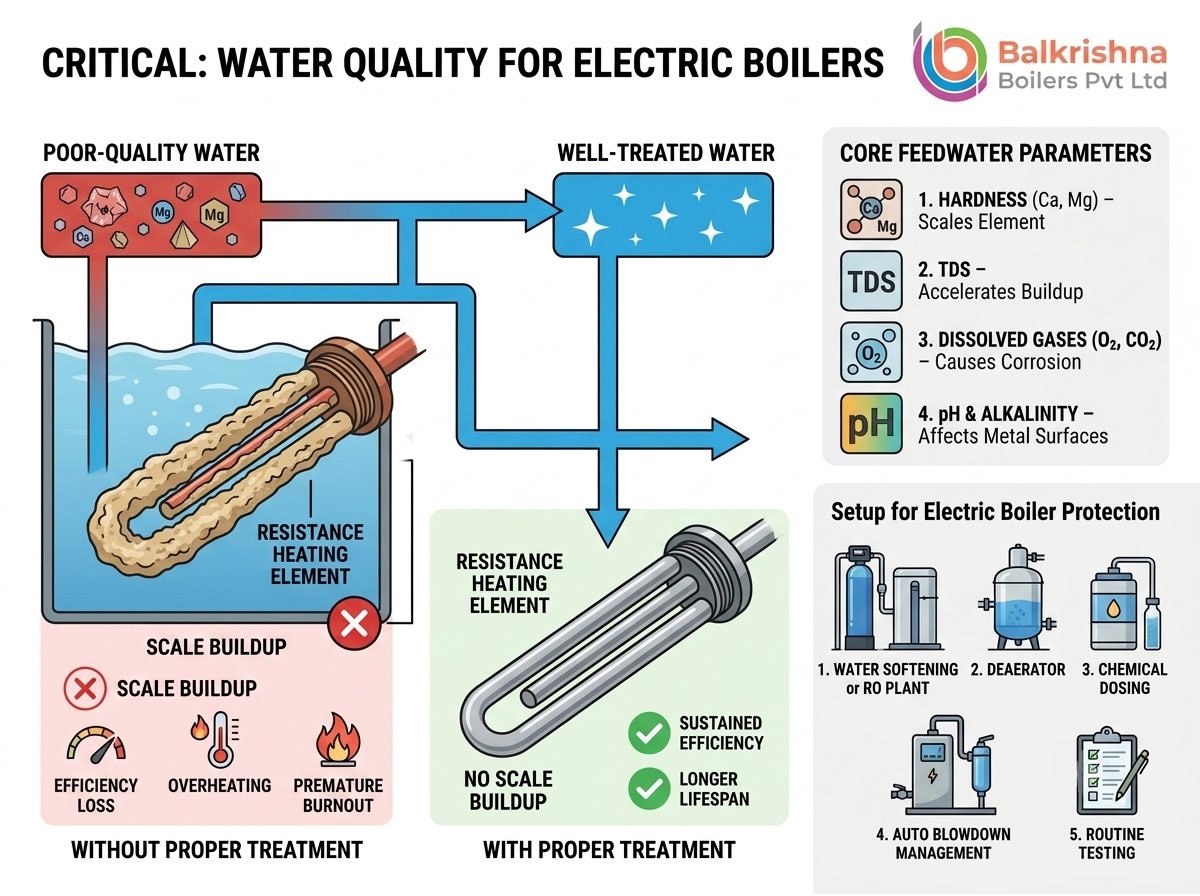
In a fuel-fired boiler, heat is generated in a furnace and transferred to water across tube or shell surfaces — the hottest point in the system is the combustion chamber, not the water-contact surface itself. In a resistance-type electric boiler, the situation is different: the heating element sits directly immersed in the water, and it is the single hottest surface in the entire system. We explained this mechanism in detail in our guide on electric boiler technology, from immersion elements to electrode types — if water treatment is inadequate, dissolved solids in the water precipitate directly onto that element, forming scale exactly where you can least afford it.
Scale is a poor conductor of heat compared to metal, so even a thin layer acts as an insulating barrier between the element and the water it’s meant to be heating. The practical consequences compound quickly:
- Reduced efficiency: The element has to work harder and run hotter to transfer the same amount of heat through the scale layer, eating directly into the 98–99.5% efficiency that’s the whole reason to choose electric heating.
- Premature element failure (burnout): As scale insulates the element, the element’s own surface temperature climbs, eventually leading to localized overheating and burnout — an entirely avoidable failure mode.
- Increased downtime: Elements must be cleaned or replaced when scaled, and that means taking the boiler offline, unlike routine water-treatment maintenance which can typically be scheduled around production.
Core Feedwater Parameters for Electric Boilers
Good boiler feedwater treatment generally targets the same handful of parameters, regardless of whether the boiler is fuel-fired or electric — but electric systems have less tolerance for drift on these numbers because there’s no combustion-side buffer to absorb the impact.
1. Hardness (Calcium and Magnesium)
Hardness minerals are the primary scale-forming culprits. Indian groundwater is frequently hard, which is exactly why a properly sized water softening system is non-negotiable ahead of an electric boiler installation, not an optional add-on.
2. Total Dissolved Solids (TDS)
High TDS water leaves more residue behind as water evaporates during steam generation, accelerating scale and sludge buildup inside the vessel and increasing the frequency of blowdown required to keep concentrations under control.
3. Dissolved Oxygen and Carbon Dioxide
Left untreated, these dissolved gases cause corrosion inside the boiler shell and piping rather than scaling on the element, but the damage is just as serious over time. A deaerator removes these gases from the feedwater before it enters the system, protecting both the vessel and the internal piping.
4. pH and Alkalinity
Feedwater pH needs to sit within a controlled range — too acidic and you risk corrosion; too alkaline and you risk caustic attack and foaming, which can carry solids over into the steam itself and affect downstream process equipment.
5. Silica
Often overlooked, silica forms a particularly hard, glass-like scale that’s difficult to remove once deposited. It matters especially for high-pressure or high-purity applications where even small silica carryover can affect turbine blades or sensitive process equipment downstream.
How Water Treatment Requirements Differ by Electric Boiler Technology
Not every electric boiler technology has the same tolerance for water quality — this is one of the more important, and less understood, differences between resistance and induction heating.
Resistance Elements (ELECTRON, ELECTROMAX)
Because the heating element is in direct physical contact with the water, resistance-type boilers are the most sensitive to water quality issues. As we noted in our electric boiler technology guide, these systems can operate reliably on properly treated city or softened water, but “properly treated” is doing a lot of work in that sentence — vigilant, consistent water treatment is a genuine operational requirement, not a suggestion.
Induction Core (INDUCTRON)
Induction technology takes a fundamentally different approach: the heating coil sits outside the pressure vessel, separated from the water by a metal wall, and heat is generated through eddy currents induced in a metallic core rather than through direct element contact with the water. Because the heat source itself never directly contacts the water, induction boilers are significantly less susceptible to scaling, which sustains the high 99.5% efficiency for much longer periods between service interventions — a genuinely important factor for validated, continuous operations where unplanned downtime is costly. We cover this design difference and its water-quality implications in our induction boiler product guide.
This distinction is one of the more practical reasons plants in food, pharma, and dairy — where continuous, validated operation matters enormously — often gravitate toward induction technology specifically, a point we explored further in our article on electric boilers for food, pharma, and dairy applications.
What a Proper Water Treatment Setup Looks Like
For any electric boiler installation, a complete feedwater treatment train typically includes:
- Water Softening or RO Plant: Removes hardness minerals before they ever reach the boiler. In hard-groundwater regions across India, this is the single most important piece of equipment in the entire treatment chain, as we noted in our guide to biomass boiler installation, where the same principle applies across boiler types.
- Deaerator (for larger installations): Strips dissolved oxygen and CO2 from the feedwater to prevent internal corrosion, protecting both the boiler and the piping network downstream.
- Dosing/Chemical Treatment: Maintains pH and alkalinity within the target range and controls any residual hardness that slips past softening.
- Blowdown Management: Periodic or automated blowdown removes concentrated dissolved solids from the boiler water before they reach levels that promote scale or foaming — a routine part of operation, not a sign something has gone wrong. Our broader discussion on boiler efficiency vs fuel cost touches on how inefficient water treatment leads to excessive blowdown losses, which is just as relevant to electric systems as it is to fuel-fired ones.
- Routine Water Testing: Regular sampling of hardness, TDS, pH, and dissolved oxygen catches drift before it becomes a scaling or corrosion problem, rather than discovering the issue when an element fails.
The Cost of Getting Water Treatment Wrong
Skipping or under-investing in water treatment is one of the most common — and most avoidable — reasons an electric boiler underperforms its rated efficiency. The pattern is predictable: scale builds gradually, efficiency drifts down without anyone noticing immediately, energy bills creep up, and eventually an element fails and forces unplanned downtime. Every part of that sequence is preventable with a correctly sized treatment system and a routine testing schedule.
This matters directly for the ROI case that makes electric boilers attractive in the first place. As we discussed in our guide on electric boiler ROI and payback periods, the entire financial case rests on sustaining efficiency at or near the 98–99.5% mark over the boiler’s operating life. Scale-related efficiency loss directly erodes that margin, which is exactly why water treatment deserves a real line item in your project budget, not an afterthought bolted on after commissioning.
Practical Recommendations by Boiler Type
- If you’re installing an ELECTRON or ELECTROMAX resistance boiler: Budget for a properly sized softener or RO system from day one, commit to a routine water-testing schedule, and plan for periodic element inspection as standard preventive maintenance rather than a reactive fix.
- If continuous, high-utilization operation with minimal downtime tolerance is the priority: Evaluate the INDUCTRON induction boiler — its non-contact heating core meaningfully reduces water-quality sensitivity and sustains efficiency longer between service interventions.
- If you’re running a validated food, pharma, or dairy process: Combine good water treatment practice with the auditing and contamination benefits already inherent to electric heating, covered in our food, pharma, and dairy electric boiler guide.
- If you’re also running any fuel-fired equipment on-site: The same softening and deaeration principles apply across your fleet — our guide to core boiler components explains the role of the water treatment plant and deaerator in any boiler system, electric or combustion-based.
Recognizing Early Warning Signs of Scaling
You don’t need to wait for an element failure to know water treatment needs attention. A few early indicators are worth watching for in daily operation:
- Longer time to reach set temperature or pressure: As scale builds, the element has to work harder to transfer the same heat, so cycle times gradually stretch out even though nothing else in the process has changed.
- Rising electricity consumption for the same output: If your steam or hot water output hasn’t changed but your electricity bill for the boiler creeps upward month over month, scale-related efficiency loss is one of the first things worth checking.
- Increased blowdown frequency: If your automated blowdown system is firing more often than usual, it’s typically responding to rising dissolved solids concentration in the boiler water — a leading indicator that treatment upstream needs review.
- Visible discoloration or sediment in blowdown water: A straightforward, low-tech way to catch treatment drift before it becomes an efficiency or reliability problem.
Catching any of these early and adjusting your water treatment regime is far cheaper than an unplanned element replacement and the downtime that comes with it.
Recommended Electric Boiler Range
Balkrishna Boilers’ Electric Boiler range spans both resistance and induction technology, so you can choose based on your water quality situation and operational tolerance for maintenance:
- ELECTRON — Electric Steam Boiler with resistance elements, reliable on properly treated water.
- ELECTROMAX — IBR-approved Electric Steam Boiler for heavier resistance-based industrial loads.
- INDUCTRON — Induction Boiler, engineered specifically to minimize scaling sensitivity for continuous, validated operations.
- ELECTRO AQUA — Electric Hot Water Boiler, where water quality is equally important for sustained performance.
- ELECTROPAC — Electric Thermic Fluid Heater, which uses a closed-loop thermic fluid rather than water, sidestepping water-quality concerns entirely for high-temperature applications.
Frequently Asked Questions
Can I run an electric boiler on untreated tap water? It’s not advisable. Even municipal water typically carries enough hardness and dissolved solids to cause scaling over time on resistance elements. A properly sized softener or RO system is considered standard, not optional, ahead of any electric boiler installation.
Which electric boiler technology is least sensitive to water quality? Induction technology, such as the INDUCTRON, is meaningfully less sensitive because the heating coil never directly contacts the water — though good water treatment is still recommended to protect the vessel and control blowdown frequency.
How often should I test my electric boiler’s feedwater? This depends on your source water quality and utilization, but routine testing — commonly weekly for hardness and TDS, with periodic full-parameter testing — lets you catch drift before it causes scaling or corrosion, rather than discovering a problem when an element fails.
Does poor water quality affect an electric thermic fluid heater the same way? No — the ELECTROPAC and similar electric thermic fluid heaters use a closed-loop thermal fluid rather than water, so conventional feedwater treatment concerns don’t apply in the same way, though fluid condition monitoring remains important.
Does water quality affect ROI and payback period? Yes, directly. Scale buildup reduces efficiency below the 98–99.5% baseline that the ROI case for electric boilers depends on, so proper water treatment should be budgeted as part of the total investment rather than treated as a separate, deferrable cost.
Final Word
Electric boilers remove combustion from the equation, but they don’t remove the need for good water management — if anything, they raise the stakes on getting it right, because the heating element itself bears the direct consequence of poor water quality. A correctly sized softening or RO system, a deaerator where appropriate, and a routine testing schedule protect the efficiency and reliability gains that make electric heating worth the investment in the first place.
Explore Balkrishna Boilers’ full Electric Boiler range, or contact our engineering team with your source water analysis — we’ll help you specify the right treatment setup alongside the right boiler for your process.