
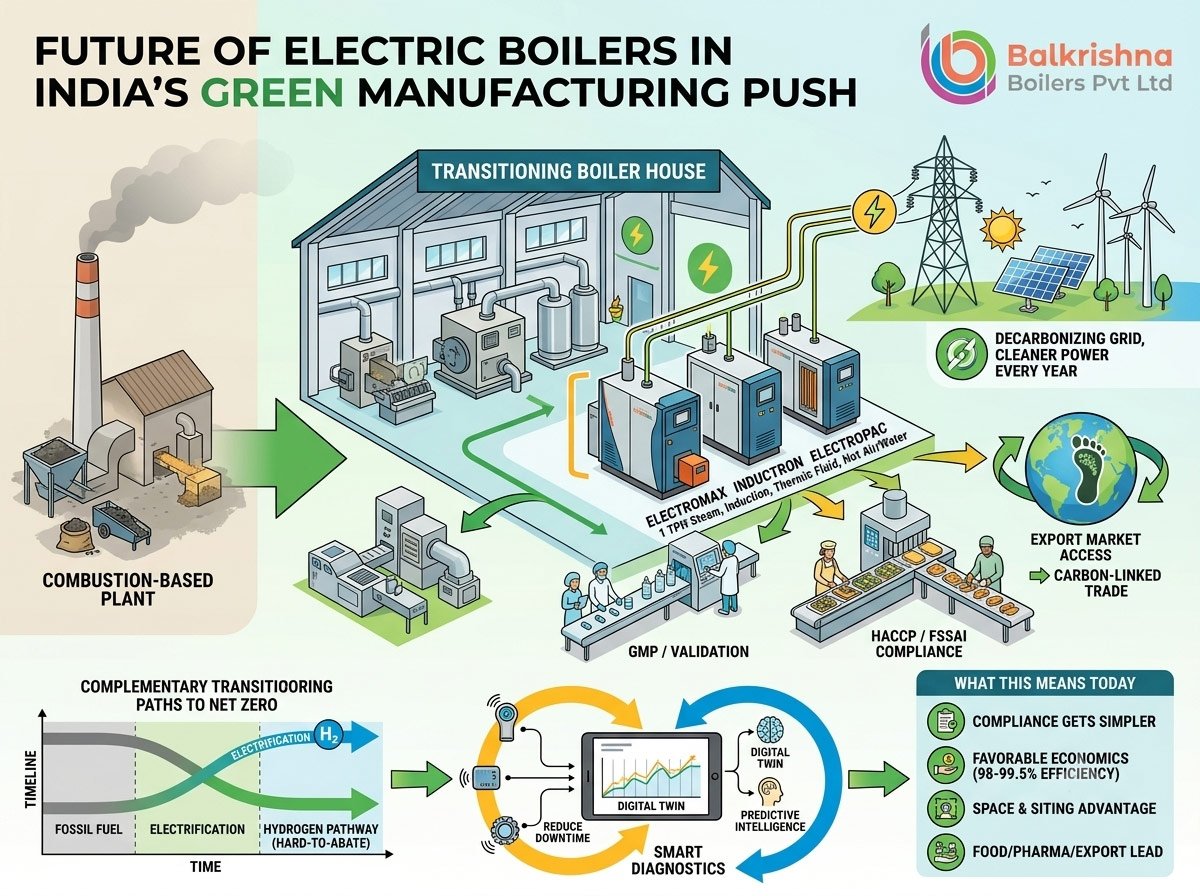
India’s industrial sector is at an inflection point. The government’s Net-Zero 2070 commitment, tightening emission norms from state Pollution Control Boards, carbon-linked trade pressure from export markets, and a power grid that adds renewable capacity every year are all converging on the same piece of factory equipment: the boiler house. For over a century, industrial heat generation meant combustion. That default is changing, and electric boilers are emerging as one of the clearest paths forward.
At Balkrishna Boilers Pvt Ltd, we’ve watched this shift accelerate in real time — inquiries for electric heating solutions have grown steadily as manufacturers move from “considering” decarbonization to actively budgeting for it. This article looks at where electric boiler technology is heading in India, what’s driving the shift, and how manufacturers can position themselves ahead of the regulatory curve rather than scrambling to catch up.
Why Green Manufacturing Has Become Non-Negotiable
Three forces are converging to make industrial decarbonization a business necessity rather than an optional initiative:
Regulatory tightening. State Pollution Control Boards and the CPCB are steadily lowering permissible emission thresholds, and older combustion units are finding it progressively harder to renew their Consent to Operate. We’ve covered this pressure in detail in our guide on how boilers impact carbon emissions and how to reduce them — for manufacturers in industrial hubs from Gujarat’s chemical corridors to Maharashtra’s pharma parks, understanding and managing this carbon footprint is now a regulatory and financial mandate, not a sustainability talking point.
Export competitiveness. Manufacturers selling into the EU and other markets with carbon border adjustment mechanisms are discovering that the carbon intensity of their manufacturing process now directly affects market access. A boiler house running on coal or furnace oil is increasingly a competitive liability for export-oriented businesses, not just a compliance risk.
Grid decarbonization. As India’s electricity grid adds more solar, wind, and hydro capacity every year, the emissions profile of anything running on electricity improves automatically, without the plant having to do anything further. We made this exact point in our article on why electric boilers are the best choice for low-emission plants: investing in electric heating today guarantees your process heating gets cleaner every year the grid does, something a fossil-fuel boiler can never offer.
Where Electric Boiler Technology Is Headed
1. Higher-Capacity Electric Steam Systems
Electric boilers were once seen as a niche solution for smaller, low-pressure applications. That’s no longer accurate. Balkrishna Boilers’ 1000 kg/hr (1 TPH) ELECTROMAX Electric Steam Boiler (EM-648) demonstrates that electric systems can now deliver genuinely industrial-scale steam volumes — engineered with high-grade Incoloy or ceramic bobbin heating elements for continuous, heavy-duty operation — without sacrificing the simplicity and cleanliness that make electric heating attractive in the first place. Expect this trend toward larger-capacity electric ranges to continue as more manufacturers look to electrify high-demand processes entirely, not just supplementary or low-load applications.
2. Induction and Electrode Technology Maturing Further
Beyond standard resistance heating, two more advanced electric technologies are gaining ground. Induction boilers like the INDUCTRON separate the heating coil from direct water contact, reducing scaling risk and sustaining high efficiency over longer duty cycles — technology we detailed in our guide on electric boiler technology, from immersion elements to electrode types. Electrode boilers represent another maturing branch of the same shift, using water itself as the conductor to reach high-pressure steam output with a genuinely fail-safe design — current simply cannot flow if water levels drop, which is a meaningful safety advantage as electric systems scale up in capacity. Expect continued refinement of both these technologies as manufacturers push electric heating into higher-pressure, higher-capacity territory that was once considered fuel-fired-only.
3. Smart, Connected Boiler Operations
The broader industrial heating sector is moving toward predictive, sensor-driven operation, and electric boilers are particularly well positioned to benefit. Digital twin technology — creating a live, data-driven model of boiler performance — is shifting boiler management from reactive maintenance to predictive intelligence across the industry. For electric systems specifically, this means real-time tracking of element condition, water quality drift, and energy consumption patterns, catching efficiency loss (from scaling, for instance) long before it becomes a costly failure. Combined with IoT-enabled monitoring, predictive diagnostics are already reducing unplanned downtime significantly across the boiler industry, and electric systems — with fewer moving mechanical parts than combustion units — are a natural fit for this kind of monitoring.
4. Electric Thermic Fluid Heating for High-Temperature Processes
One of the more significant recent developments is the extension of electric heating into high-temperature, low-pressure thermic fluid applications, traditionally the exclusive domain of fuel-fired systems. The ELECTROPAC electric thermic fluid heater delivers the high-temperature, low-pressure heat profile that reactors, presses, and curing lines need, without a flame or fuel train. As this technology matures further, expect it to close the gap on the last major category of industrial heat that electric systems have historically struggled to serve economically.
5. Hybrid and Transitional Pathways
Full electrification isn’t always immediately practical for every plant — particularly those with very high, continuous, high-temperature loads. For manufacturers in “hard-to-abate” sectors like refineries, petrochemicals, and specialized metallurgical processing, hydrogen combustion is emerging as a parallel decarbonization pathway, producing only water vapor as a byproduct when using green hydrogen fuel. Many manufacturers are pursuing a hybrid strategy: electrifying the loads that fit cleanly today while planning hydrogen-ready or hydrogen-retrofittable capacity for the segments that need more time. Both paths point toward the same destination — a boiler house with dramatically lower, and eventually zero, direct carbon emissions.
What This Means for Manufacturers Today
Compliance Gets Simpler, Not Just Cleaner
Zero direct emissions means no stack testing, simplified Consent to Operate renewals, and no fuel storage or handling violations to manage. This is a genuine operational benefit that compounds every renewal cycle, not a one-time gain.
The Economics Are Already Favorable for Many Plants
The idea that going green means paying a permanent cost premium is increasingly outdated. Electric boilers routinely achieve 98–99.5% thermal efficiency against 75–90% for well-run fossil fuel systems, and most clients see full return on investment within 12 to 18 months based on fuel and energy savings alone. Add in reduced installation costs (no chimney, no fuel yard) and lower long-term maintenance overhead, and the “green premium” narrative doesn’t hold up the way it used to.
Food, Pharma, and Export-Oriented Manufacturing Lead the Curve
Sectors where product purity, validation, and international market access intersect are moving fastest. Electric heating naturally aligns with the rigorous demands of GMP, HACCP, and FSSAI compliance in food and pharma processing, while simultaneously addressing the carbon-intensity scrutiny that export-oriented manufacturers now face. These sectors are a useful preview of where the broader industrial base is headed.
Space and Siting Advantages Compound Over Time
As urban and semi-urban industrial zones tighten restrictions on new combustion-based installations, electric boilers’ compact footprint and lack of chimney or fuel storage requirements increasingly become a siting advantage, not just an operational one — a genuine factor in where and how quickly a plant can expand.
Preparing Your Plant for the Transition
A few practical steps put manufacturers ahead of the curve rather than reacting to it under regulatory pressure:
- Audit your current boiler house’s carbon footprint and real-world efficiency — many older combustion units run well below their rated efficiency, understating the true cost of staying on the current path.
- Identify which loads are ready for full electrification now versus which need a longer-term hybrid or hydrogen-ready pathway, based on temperature, pressure, and continuous-load requirements.
- Build water treatment into the electrification plan from day one, since sustained efficiency on electric systems depends directly on feedwater quality — a detail worth budgeting for properly rather than adding as an afterthought.
- Model the actual ROI using your specific tariff, utilization hours, and current system’s real efficiency, rather than relying on generic industry averages.
- Plan for smart monitoring from the outset — predictive, sensor-driven operation is quickly becoming standard practice, and it’s far easier to design in from the start than retrofit later.
Balkrishna Boilers’ Electric Range for the Green Manufacturing Transition
Our Electric Boiler range is built to support manufacturers at every stage of this transition:
- ELECTRON — Electric Steam Boiler for compact, efficient steam generation.
- ELECTROMAX — IBR-approved Electric Steam Boiler, including our 1 TPH EM-648 for heavier industrial-scale loads.
- INDUCTRON — Induction Boiler for scale-resistant, sustained efficiency in continuous operations.
- ELECTRO AQUA — Electric Hot Water Boiler for process and utility applications.
- ELECTROAIR — Electric Hot Air Generator for clean, combustion-free drying and curing.
- ELECTROPAC — Electric Thermic Fluid Heater, extending electrification into high-temperature process heat.
Frequently Asked Questions
Is India’s grid clean enough to make electric boilers genuinely “green”? The grid mix is improving every year as renewable capacity expands, and unlike a fossil-fuel boiler, an electric boiler’s emissions profile improves automatically alongside it — with zero direct emissions at the point of use regardless of grid mix.
Are electric boilers ready to replace large, continuous industrial loads, or just smaller applications? Electric boiler capacity has grown substantially — units like the 1 TPH ELECTROMAX EM-648 demonstrate genuinely industrial-scale output, and induction and electrode technologies continue to push electric systems into higher-pressure, higher-capacity territory.
What role will hydrogen play alongside electrification? For very high-temperature, continuous, hard-to-abate processes, hydrogen combustion is emerging as a complementary decarbonization pathway. Many manufacturers are pursuing electrification where it fits today while planning hydrogen-ready capacity for the segments that need more time.
Does going electric mean giving up smart, connected operation? Not at all — electric boilers, with fewer moving mechanical parts than combustion systems, are particularly well suited to digital twin and IoT-based predictive monitoring, which is increasingly standard practice across the industry.
How do I know if my plant is ready to electrify now? It depends on your temperature and pressure requirements, utilization hours, and available electrical infrastructure. Our engineering team can assess your current boiler house and build a load-specific electrification roadmap.
Final Word
The direction of travel for Indian manufacturing is clear: emission norms will keep tightening, the grid will keep getting cleaner, and electric boiler technology will keep closing the gap on the applications that once required combustion. Manufacturers who start planning their transition now — rather than waiting for a compliance deadline to force the decision — consistently end up with a better-engineered, better-costed outcome.
Explore Balkrishna Boilers’ full Electric Boiler range, or contact our engineering team for a load assessment and a roadmap tailored to your plant’s green manufacturing goals.