
Ask any process engineer working with high-temperature industrial heat, and thermic fluid heaters will come up early in the conversation. They’re one of the most widely used, and least understood outside specialist circles, pieces of industrial heating equipment — quietly running behind the scenes in textile mills, chemical plants, food processing units, and plywood factories across India.
This guide explains exactly what a thermic fluid heater is, how it actually works, why industries choose it over a conventional steam boiler, and where it fits in a modern industrial heating setup. Balkrishna Boilers Pvt Ltd has manufactured thermic fluid heating systems for over two decades, so this is written from direct engineering experience, not just theory.
What Exactly Is a Thermic Fluid Heater?
A thermic fluid heater — also called a hot oil heater or thermal oil heater — is a closed-loop industrial heating system that heats a specialized heat-transfer fluid (the thermic fluid, or thermal oil) rather than water. That heated fluid is then circulated through pipelines to wherever the process needs heat, releasing its thermal energy through heat exchangers before returning to the heater to be reheated. As we explained in our detailed walkthrough of what a thermic fluid heater is and its working principle, it’s fundamentally a different approach to industrial heating than a steam boiler, even though both ultimately deliver process heat.
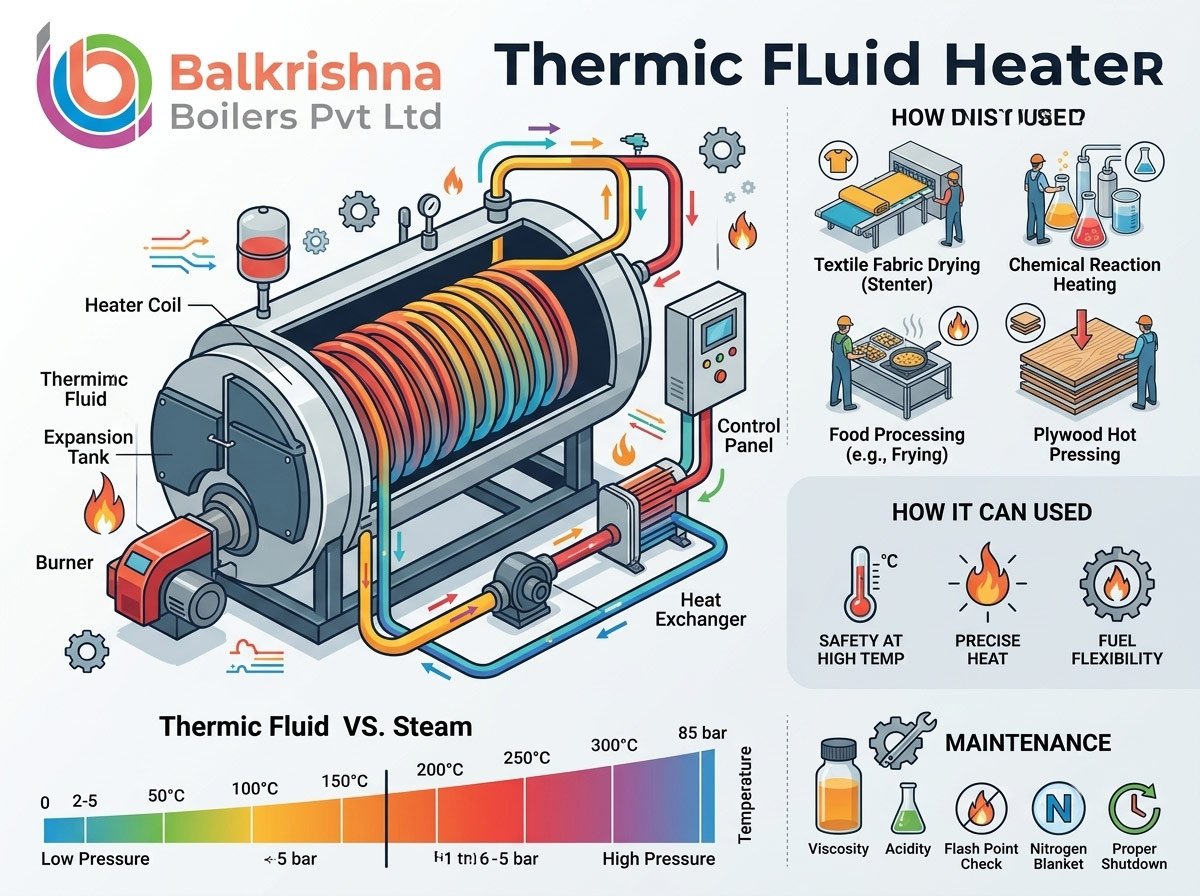
The core distinction comes down to physics. Water boils at 100°C at atmospheric pressure, so reaching high process temperatures with steam means generating very high pressure — getting steam to 300°C requires pressure approaching 85 bar. Thermal fluids, by contrast, have a much higher boiling point at atmospheric pressure, so they can deliver 300°C+ process heat at pressures typically between 2 and 5 bar. This “high heat, low pressure” characteristic is the entire reason thermic fluid heaters exist as a category, as our Thermic Fluid Heater product category page explains in detail.
How a Thermic Fluid Heater Actually Works
The system operates as a continuous, closed loop with a handful of core components:
- Heater Coil — where fuel combustion (or in the case of an electric variant, resistance elements) transfers heat to the circulating thermic fluid.
- Thermic Fluid Pump — keeps the fluid circulating continuously through the system; flow must be established before the burner fires.
- Expansion Tank — accommodates the fluid’s volume expansion as it heats, and is a critical point for managing oxidation risk (more on that below).
- Fuel System — supplies gas, oil, biomass, or coal depending on the configuration.
- Control Panel — monitors temperature, pressure, and safety interlocks throughout operation.
- Heat Exchanger / Process Equipment — where the fluid actually delivers its heat to the process.
The operating cycle is straightforward: fuel is combusted (or electricity is applied) to heat the fluid in the heater coil, the pump circulates the hot fluid through pipelines to process equipment, heat is transferred to the process via heat exchangers, and the cooled fluid returns to the heater to begin the cycle again. It’s a genuinely simple design at its core, which is part of why thermic fluid systems have proven so reliable across decades of industrial use.
Why Industries Choose Thermic Fluid Heaters Over Steam Boilers
Safety at High Temperature
Because thermic fluid heaters operate at low pressure even when delivering very high temperatures, the risk profile associated with a pressure vessel failure is dramatically reduced compared to a high-pressure steam system delivering the same temperature. This is consistently the first reason process engineers cite when specifying a thermic fluid system for a high-temperature application.
Uniform, Precise Heat Delivery
A single thermic fluid heater can supply multiple process points simultaneously through a piped loop, each drawing exactly the heat it needs. This makes temperature control more consistent across a process than trying to manage multiple smaller heat sources independently, which matters enormously in applications like textile heat-setting or food-grade oil processing where uniformity directly affects product quality.
Lower Capital Infrastructure for High Temperature
Reaching 300°C+ with steam requires a pressure vessel rated for extreme pressure, along with all the associated safety systems, IBR compliance requirements, and structural reinforcement that come with it. A thermic fluid heater reaches the same temperature at a fraction of the pressure, which simplifies the engineering and compliance burden considerably.
Fuel Flexibility
Thermic fluid heaters can be configured for gas, oil, biomass, or coal firing — and, increasingly, electric heating — giving plants the flexibility to choose whichever fuel source makes the most economic and logistical sense for their location. Our Vertical Four Pass FBC Thermic Fluid Heater, for example, is purpose-built for challenging solid fuels using Fluidized Bed Combustion technology, achieving 82–85% thermal efficiency on biomass or coal.
Where Thermic Fluid Heaters Are Actually Used
Thermic fluid heating shows up across a wide range of Indian industries, each drawing on the same underlying “high heat, low pressure” advantage:
- Textile Industry: Heating stenter frames for fabric drying, curing, and heat-setting processes, where consistent temperature is essential for fabric quality.
- Chemical and Petrochemical: Heating reactors, distillation columns, and storage tanks for polymerization, distillation, and other reaction-heating processes.
- Food and Beverage: Powering fryers, ovens, and deodorizers, particularly for edible oil refining, where precise, uniform heat is critical for product consistency.
- Wood Processing (Plywood and Laminates): Heating hot presses for plywood and MDF production, where consistent panel temperature affects bonding quality.
- Rubber and Tyre Industry: Vulcanization and molding processes that demand stable, high-temperature heat over extended cycle times.
- Asphalt and Bitumen Plants: Maintaining temperature in storage tanks and mixing plants for road construction materials.
Safety and Maintenance Considerations Unique to Thermic Fluid Systems
Thermic fluid heaters are safer than high-pressure steam systems by design, but they come with their own maintenance discipline that’s essential to understand before installation. Our detailed guide on thermic fluid heaters in the chemical industry: the ultimate safety guide covers this in depth, but the essentials are:
- Thermal degradation: Overheating the fluid causes thermal cracking, forming volatile fractions and carbon deposits (coke) inside the system. Maintaining correct flow rates and using flow-differential interlocks that shut down the burner if flow drops are standard protective measures.
- Oxidation: When hot fluid contacts air in the expansion tank, it oxidizes, forming organic acids and sludge over time. Nitrogen blanketing of the expansion tank is a common solution for systems operating at high temperatures.
- Fluid condition monitoring: Every thermic fluid has a specific flash point that can drop as the fluid degrades, increasing fire risk. Annual fluid analysis — checking viscosity, acidity, and flash point — catches this before it becomes a safety issue.
- Proper shutdown procedure: Stopping the circulating pump abruptly right after the burner shuts off is a common cause of coil damage. The pump should keep running until fluid temperature drops below 100°C to dissipate residual furnace heat.
None of this maintenance is difficult, but it requires a trained team following a consistent schedule — cutting corners here is where most thermic fluid heater problems actually originate.
Thermic Fluid Heater vs Steam Boiler: The Core Trade-off
The decision between the two technologies usually comes down to your process temperature requirement. Below roughly 150–180°C, steam boilers remain a practical, well-understood choice. Above that — particularly moving into the 250°C to 350°C range — a thermic fluid heater becomes the more sensible engineering choice, delivering the required heat without the extreme pressures and associated safety infrastructure a steam system would need at that temperature. We’ve explored this trade-off, and the broader question of electric versus combustion-based heating, in our comparison of electric boilers vs thermic fluid heaters for readers weighing both technologies against their specific process.
The Electric Alternative: ELECTROPAC
For plants that want the high-temperature, low-pressure profile of a thermic fluid heater without a combustion system’s fuel logistics and emissions, Balkrishna Boilers manufactures the ELECTROPAC electric thermic fluid heater. It uses resistance elements immersed directly in the thermal fluid rather than a burner — and because thermal fluid is non-corrosive and non-conductive, it sidesteps the scaling issues that resistance elements face in water-based systems entirely, making it a genuinely efficient electric option for reactors, paint curing lines, and specialty manufacturing processes needing heat up to 350°C.
Balkrishna Boilers’ Thermic Fluid Heater Range
Balkrishna Boilers’ Thermic Fluid Heater category covers a full range of capacities and fuel types on balkrishn.com:
- THERMPAC — Three-pass, coil-type thermic fluid heater for general industrial applications.
- DELTAPAC — Compact, high-efficiency design for space-constrained installations.
- PELLEPAC — Solid-fuel-fired option for plants looking to reduce running costs with biomass or pellet fuel.
- VFF Series, VTF Series, and VTM Series — Vertical configurations engineered for specific fuel and capacity requirements, including Fluidized Bed Combustion designs for biomass and coal.
- EDOPAC — Built for demanding, continuous-process applications requiring stable high-temperature output.
Choosing the Right Type of Thermic Fluid Heater
Not every thermic fluid heater is built the same way, and picking the right configuration matters as much as picking the right capacity. A few key distinctions worth understanding before you specify a system:
Horizontal, coil-type designs (like THERMPAC) are the most common configuration for gas, oil, and FO-fired applications, offering a compact footprint and straightforward maintenance access to the coil for inspection and cleaning.
Vertical, multi-pass designs (like the VFF, VTF, and VTM series) are typically chosen when floor space is at a premium, or when the fuel type — particularly solid fuels like biomass or coal — requires a furnace geometry that a horizontal coil design can’t accommodate efficiently.
Fluidized Bed Combustion (FBC) systems, such as our Vertical Four Pass FBC unit, are specifically engineered for challenging solid fuels. FBC technology ensures more complete, controlled combustion of biomass and coal than a conventional grate, which translates into higher overall thermal efficiency — typically 82% to 85% on NCV basis, and higher still with an Air Pre-Heater added to recover waste heat from the flue gas.
Capacity range matters just as much as configuration. Thermic fluid heaters are commonly available from roughly 4 lakh kcal/hr up to 100 lakh kcal/hr (10 million kcal/hr), which means the same underlying technology scales from a mid-sized textile unit to a large industrial complex — the right starting point is always your actual process heat demand, not a generic “popular” capacity.
The practical takeaway: fuel availability, footprint constraints, and process temperature should drive the configuration choice, not the other way around. Our engineering team typically starts any thermic fluid heater conversation with exactly these three questions before recommending a specific model.
Frequently Asked Questions
What temperature can a thermic fluid heater reach? Most standard units operate up to 300°C, with specialized designs using synthetic thermal oils capable of reaching 350°C for particularly demanding high-temperature processes.
Is a thermic fluid heater safer than a steam boiler? Because it operates at low pressure (typically 2–5 bar) even at very high temperatures, a thermic fluid heater carries a significantly lower catastrophic-failure risk than a high-pressure steam system delivering the same temperature.
What fuels can a thermic fluid heater run on? Gas, oil, biomass, and coal are all common configurations, and electric variants like the ELECTROPAC are increasingly available for plants prioritizing zero direct emissions.
How often does the thermic fluid itself need to be checked or replaced? Annual fluid analysis — checking viscosity, acidity, and flash point — is standard practice to catch degradation before it becomes a safety issue. Actual fluid replacement intervals depend on operating temperature and duty cycle.
Which industries use thermic fluid heaters the most? Textiles, chemicals and petrochemicals, food and edible oil processing, plywood and wood products, rubber and tyre manufacturing, and asphalt/bitumen plants are among the heaviest users, all drawing on the same high-temperature, low-pressure advantage.
Final Word
A thermic fluid heater solves a problem steam boilers were never well suited for: delivering very high, uniform process heat without the extreme pressures that come with high-temperature steam. For any plant running reactors, presses, dryers, or curing lines above roughly 200°C, it’s usually the more practical and safer engineering choice — and with proper fluid maintenance, a genuinely reliable one over decades of operation.
Explore Balkrishna Boilers’ full Thermic Fluid Heater range, or contact our engineering team with your process temperature and capacity requirements — we’ll help you specify the right system, fuel type, and safety setup for your application.