
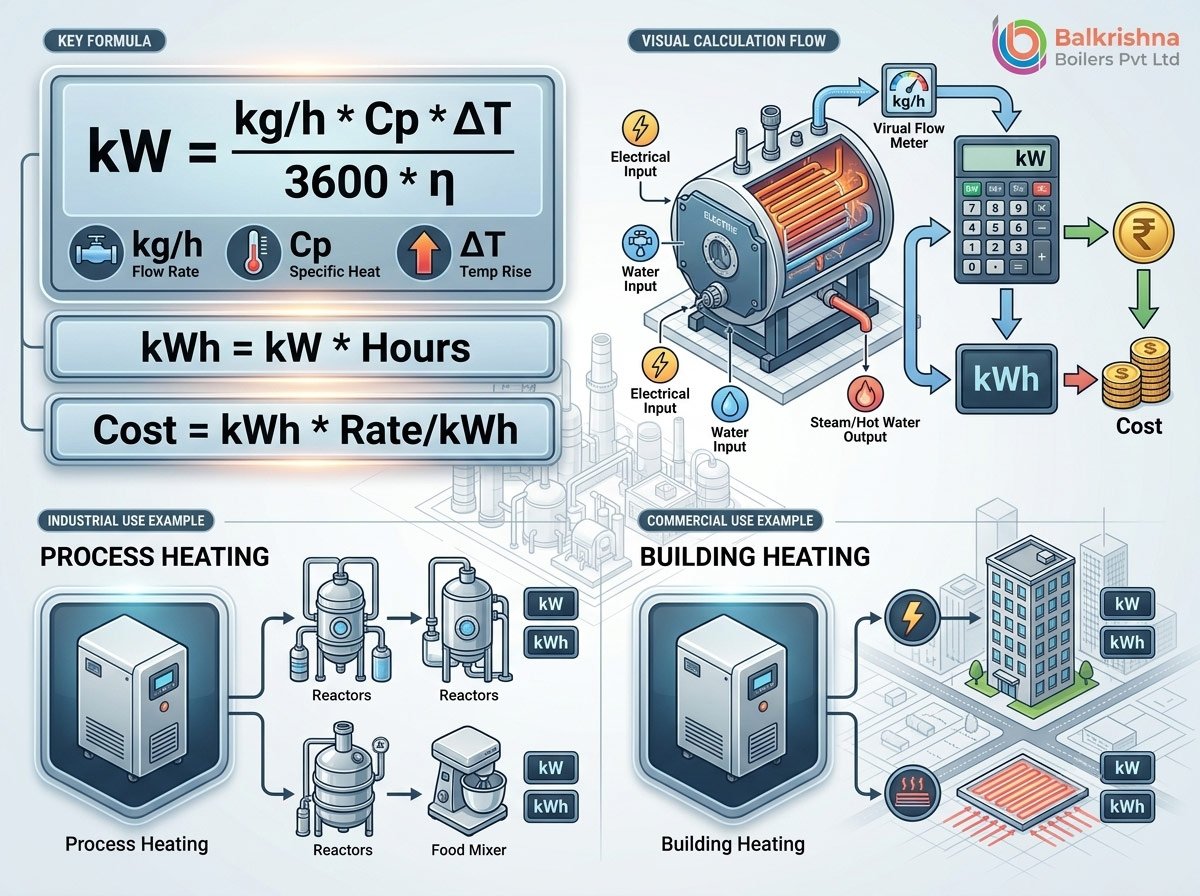
One of the most common questions we get from buyers evaluating an electric boiler is a straightforward one: how much power will it actually draw, and what will that cost to run? It’s a fair question, and it’s answerable with a fairly simple set of formulas — you don’t need to be an energy engineer to work out a reliable estimate before you buy.
At Indian Boilers.com, part of Balkrishna Boilers Pvt Ltd, our engineers use these same calculations to size and specify systems for clients every week. This guide walks through the actual formulas for both steam and hot water applications, with worked examples using realistic industrial figures, so you can estimate power consumption and running cost for your own facility.
Why This Calculation Matters Before You Buy
Power consumption isn’t just a running-cost question — it directly determines your electrical infrastructure requirement. Confirming expected kW draw against your sanctioned load and transformer capacity before ordering avoids the single most common cause of installation delays: discovering after purchase that your facility’s electrical supply can’t support the unit. We cover this infrastructure-check step in more detail in our guide on how to size an electric boiler for your facility — this article focuses specifically on the power and cost calculation itself.
The Core Formula: Steam Boiler Power Consumption
The power required to convert water into steam depends on three things: how much steam you need per hour, how much energy it takes to convert water into steam at your operating conditions, and how efficient your boiler is at delivering that energy.
Formula:
Power (kW) = (Steam Output in kg/hr × ΔH in kcal/kg) / (860 × Efficiency)Where:
- Steam Output (kg/hr) is your required steam generation rate
- ΔH (kcal/kg) is the enthalpy difference — the heat energy needed to convert feedwater at its incoming temperature into saturated steam at your operating pressure. For typical low-pressure industrial steam generation from feedwater around 25–30°C, this figure is commonly approximated at 640–660 kcal/kg
- 860 is the standard conversion factor between kilocalories and kilowatt-hours (1 kWh = 860 kcal)
- Efficiency is your boiler’s thermal efficiency, expressed as a decimal — electric boilers typically run close to 0.98–0.99 (98–99%), since there’s no combustion loss
Worked Example: 500 kg/hr Steam Boiler
Let’s size the power draw for a boiler producing 500 kg/hr of steam, using an efficiency of 99% and an enthalpy difference of 650 kcal/kg (a reasonable approximation for standard atmospheric-pressure steam generation).
Power = (500 × 650) / (860 × 0.99)
Power = 325,000 / 851.4
Power ≈ 381.7 kW
This aligns closely with the power rating range you’ll typically see on electric boilers in this capacity class, such as our 0.5 Ton Electric Steam Boiler – 500 kg/hr.
Worked Example: 1,000 kg/hr Steam Boiler
Doubling steam output roughly doubles power draw, since the relationship is linear:
Power = (1,000 × 650) / (860 × 0.99)
Power ≈ 763.4 kW
This matches the expected range for a unit like our 1 Ton Electric Steam Boiler – 1000 kg/hr.
A Quick Reference Table
| Steam Output | Approx. Power Draw (99% efficiency, 650 kcal/kg) |
|---|---|
| 500 kg/hr | ~380 kW |
| 1,000 kg/hr | ~760 kW |
| 2,000 kg/hr | ~1,510 kW |
| 3,000 kg/hr | ~2,270 kW |
| 5,000 kg/hr | ~3,780 kW |
These figures are approximate and will vary slightly with actual operating pressure, feedwater temperature, and specific unit efficiency — always confirm exact power rating against the specific model’s datasheet rather than relying on this table alone for final electrical planning.
The Core Formula: Hot Water Boiler Power Consumption
For hot water applications, the calculation is based on flow rate and the temperature rise required, rather than a phase-change enthalpy figure.
Formula:
Power (kW) = (Flow Rate in Litres/hr × Temperature Rise in °C) / 860This works because raising the temperature of water by 1°C for every litre per hour of flow requires a fixed, well-established amount of energy, captured in that 860 conversion factor (based on water’s specific heat capacity).
Worked Example: Hot Water for a CIP System
Suppose a facility needs 2,000 litres/hr of hot water, raised from an incoming temperature of 20°C to a target of 80°C — a temperature rise of 60°C.
Power = (2,000 × 60) / 860
Power ≈ 139.5 kW
This is a realistic power requirement for a mid-sized unit in our Electric Hot Water Boiler range, commonly used for CIP cleaning and washing applications across food processing and pharmaceutical facilities.
Worked Example: Laundry Hot Water Supply
A commercial laundry needing 5,000 litres/hr of hot water, raised from 15°C to 70°C (a 55°C rise):
Power = (5,000 × 55) / 860
Power ≈ 319.8 kW
Calculating Running Cost From Power Draw
Once you know your boiler’s power draw, estimating running cost is straightforward — multiply power (kW) by hours of operation and your electricity tariff (₹/kWh).
Formula:
Running Cost per Hour (₹) = Power (kW) × Electricity Tariff (₹/kWh)Worked Example: Daily Running Cost
Using the 500 kg/hr steam boiler from above (≈381.7 kW), operating 8 hours per day, at an industrial electricity tariff of ₹8/kWh:
Cost per hour = 381.7 × 8 = ₹3,053.6
Cost per day (8 hrs) = ₹24,428.8
It’s worth noting this is a full-load calculation. In practice, most facilities don’t run at continuous 100% steam demand for the entire operating period — actual daily cost is usually lower once realistic load factor (average demand as a percentage of peak capacity) is applied. If your facility runs at roughly 60% average load rather than continuous full output, actual running cost would be closer to ₹14,657 per day in this example, not the full-load figure.
Why Load Factor Matters for Realistic Cost Estimates
This is where electric boilers show a genuine advantage over fuel-fired systems in intermittent-demand applications: because there’s no fire bed to maintain during idle periods, an electric boiler’s actual energy consumption tracks much more closely with genuine demand than a combustion system’s does. A fuel-fired boiler often consumes meaningful fuel just maintaining readiness between demand cycles; an electric boiler largely doesn’t. This is one reason SME and batch-process facilities — covered in our buyer’s guide for small and medium enterprises — often see running costs closer to their calculated average-load figure than a full-load worst case.
Factors That Affect Real-World Power Consumption
The formulas above give a reliable baseline estimate, but a few real-world factors shift actual consumption:
Feedwater temperature. Colder incoming feedwater requires more energy to reach operating temperature, increasing the effective ΔH in the steam formula. A facility recovering condensate for feedwater (warmer starting temperature) will see meaningfully lower power draw than one using fresh, cold makeup water throughout.
Operating pressure. Higher steam pressure requires slightly more enthalpy per kg to achieve, marginally increasing power draw for the same mass flow rate compared to low-pressure steam generation.
Insulation and standby losses. Even with no combustion, some heat loss occurs through vessel insulation, particularly on units left at standby temperature between operating cycles. Well-insulated units minimize this, but it’s a real factor worth confirming with your supplier for continuous-standby applications.
Water quality and scale. Scale buildup on heating elements — the result of inadequate water treatment — forces elements to work harder to transfer the same heat, increasing effective power draw for a given output over time. This is one of several reasons proper water treatment matters as much for running cost as for equipment life, a topic covered in depth in our electric boiler maintenance guide.
Load factor and duty cycle. As shown above, actual average consumption is almost always lower than full-load, continuous-operation figures — how much lower depends entirely on your specific demand pattern.
Comparing Power Consumption to Running Cost of Alternatives
These formulas are also useful when comparing electric against a fuel-fired alternative on genuine operating cost, rather than headline fuel price alone. Because electric boilers convert close to 99% of input energy into usable heat, the effective energy cost per kg of steam needs to be compared against a fuel-fired system’s real-world efficiency — typically 75–85% for a well-maintained biomass system — not just the raw price difference between electricity and fuel. Our detailed comparison of electric vs. biomass boilers on cost and efficiency walks through this full comparison, including where each technology wins depending on scale and fuel access.
Matching Power Requirements to Available Electrical Infrastructure
Once you’ve calculated expected power draw, confirm it against your facility’s sanctioned load and transformer capacity before finalizing a purchase. Industrial electric boilers typically require a 3-phase, 415V, 50Hz supply, and our range is engineered across low, medium, and high-voltage configurations specifically to match different site electrical realities — models like the 2 Ton Low Voltage Electric Boiler, 2.5 Ton Medium Voltage Electric Boiler, and 3 Ton High Voltage Electric Boiler reflect this. Our full sizing methodology, including how to check electrical infrastructure readiness, is covered in our guide on how to size an electric boiler for your facility.
On the Balkrishna Boilers side, our engineers run the same power and cost calculations for clients evaluating the Electric Boiler series, including ELECTROMAX, ELECTROAQUA, and ELECTROPAC, sized to match your specific power draw and infrastructure constraints.
Final Thoughts
Estimating electric boiler power consumption isn’t complicated — it comes down to a straightforward formula based on your required output, the energy needed to reach operating conditions, and your boiler’s efficiency. Working through the calculation before you buy gives you a realistic running-cost estimate and, just as importantly, confirms your electrical infrastructure can actually support the unit — avoiding the most common and most avoidable cause of installation delay.
If you’d like our engineers to calculate exact power consumption and running cost for your specific process, get in touch with our team with your steam or hot water requirements, or explore the full Electric Boiler range on Indian Boilers.com and Balkrishna Boilers for capacity-specific specifications.