
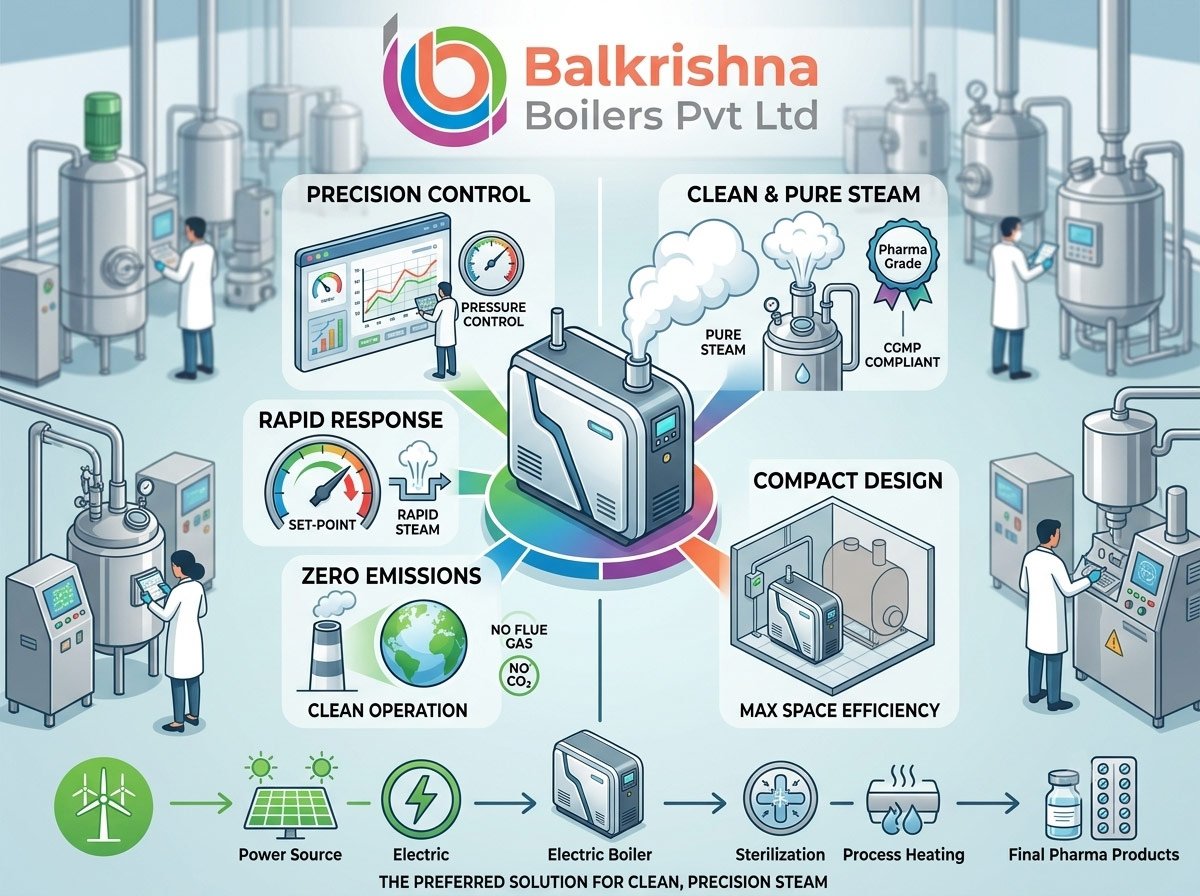
Few industries scrutinize their utilities as closely as pharmaceuticals. Every system that touches a product, a clean room, or a sterilization process is subject to validation, documentation, and audit — and the steam or hot water source feeding those systems is no exception. This is exactly why electric boilers have become the preferred choice for a growing share of pharmaceutical and API manufacturers, ahead of traditional fuel-fired systems that were once the industry default.
At Indian Boilers.com, part of Balkrishna Boilers Pvt Ltd, we work with pharmaceutical clients regularly, and the reasons they choose electric heating are consistent across the sector: contamination control, compliance simplicity, precision, and space efficiency. This piece walks through exactly why electric boilers fit pharmaceutical manufacturing so well, and where in a facility they’re typically deployed.
Why Steam Purity Is Non-Negotiable in Pharma
Steam used in pharmaceutical manufacturing isn’t just a utility — in many applications, it comes into direct or indirect contact with product, equipment, or the sterile environment itself. Autoclave sterilization, clean-in-place (CIP) systems, humidification in controlled environments, and certain formulation processes all depend on steam that is free of contamination risk. Any system that introduces even trace combustion by-products, fuel residues, or inconsistent water chemistry into that steam chain represents a genuine quality and regulatory risk, not just an operational inconvenience.
This is the underlying reason electric heating has become the preferred route for steam generation in pharma: it removes an entire category of contamination risk at the source, simply by removing combustion from the process.
1. Zero Combustion By-Products Near Sensitive Processes
A fuel-fired boiler, however well maintained, produces combustion by-products — flue gas, particulate matter, and trace compounds from the fuel itself. Even when steam distribution is engineered to keep these physically separated from the process, the presence of a combustion source anywhere in or near a facility with clean-room-adjacent operations adds a layer of risk and monitoring burden that regulators, auditors, and quality teams scrutinize closely.
Electric boilers eliminate this risk entirely. There is no combustion, no flue gas, and no fuel-related by-products anywhere in the system. For a facility pursuing GMP compliance or preparing for a regulatory audit, this is one less variable to document, monitor, and defend.
2. Consistent, High-Quality Steam for Validated Processes
Pharmaceutical processes are validated — meaning the equipment and utilities feeding them must perform consistently within defined parameters, every time, with documentation to prove it. Electric boilers are well suited to this requirement because heat generation is direct and highly controllable: resistance elements immersed in water respond predictably to control input, without the combustion variability (fuel quality fluctuation, burner tuning drift) that can affect a fuel-fired system’s output consistency over time.
This translates into steam quality — often described as “dry” steam, with minimal moisture carryover — that stays consistent across operating cycles, which matters directly for validated sterilization and processing steps where steam quality is itself a documented parameter.
3. Precise, Responsive Control for Batch Processes
Pharmaceutical manufacturing frequently runs in batches rather than continuous production, with steam demand that starts and stops in line with production schedules rather than running steadily around the clock. Electric boilers respond to this pattern naturally — heat transfer is close to instantaneous because elements are directly immersed in water, so the system reaches operating pressure quickly at the start of a batch and doesn’t waste energy maintaining a fire bed during idle periods between batches.
For smaller-batch or R&D-scale pharmaceutical operations specifically, our Electric Induction Boiler is a common choice, offering precise, responsive output well matched to variable, intermittent demand.
4. Simplified Compliance and Reduced Audit Burden
Fuel-fired boilers carry an ongoing regulatory documentation load — fuel consumption records, stack emission testing, Pollution Control Board consent renewals, and periodic combustion tuning verification. For a pharmaceutical facility already managing extensive GMP, quality, and environmental documentation, removing an entire compliance category tied to combustion emissions meaningfully simplifies the overall audit burden.
Electric boilers, having no stack and no combustion emissions, remove this reporting requirement outright. This doesn’t eliminate all boiler-related compliance — pressure vessel certification, IBR requirements where applicable, and safety testing still apply — but it removes the combustion-specific layer entirely. We cover this compliance simplification in more depth in our piece on how electric boilers support zero-emission manufacturing.
5. Space Efficiency for Facility Design
Pharmaceutical facilities are typically designed around strict zoning — clean rooms, controlled environments, and support utilities each have defined space allocations, and utility infrastructure competes for space with production and quality control areas. A fuel-fired boiler’s requirements — chimney, fuel storage, ash handling where applicable, and a dedicated boiler house — consume floor space and add design complexity that many pharma facility layouts would rather avoid.
Electric boilers, with their compact, skid-mounted design and no fuel storage or flue requirements, can often be positioned closer to the point of use, simplifying both facility layout and steam distribution design.
6. Reduced Fire and Combustion Risk in Controlled Environments
Fire safety is a serious design consideration in any pharmaceutical facility, particularly where solvents, certain APIs, or flammable process materials are present elsewhere on-site. Removing an open-flame combustion source from the utility room reduces overall facility fire risk — a benefit that extends beyond the boiler room itself into broader facility safety planning and insurance considerations.
Where Electric Boilers Are Typically Deployed in Pharma Facilities
Sterilization and autoclaving. Larger pharmaceutical manufacturing sites commonly use our IBR Electric Steam Boiler range for sterilization loads requiring higher pressure and IBR certification.
Clean-in-place (CIP) systems. Hot water for CIP cleaning cycles is commonly supplied by our Electric Hot Water Boiler, sized to match cleaning cycle demand.
Formulation and process heating. Smaller-capacity steam demand for formulation and process heating steps is often served by our Electric Steam Boiler 100 Kg/hr to 400 Kg/hr range, suited to Non-IBR pressure requirements.
R&D labs and pilot plants. Precision and compact footprint matter more than raw capacity here, making the Electric Induction Boiler a strong fit for pilot-scale sterilization and process development work.
On the Balkrishna Boilers side, this maps to our Electric Boiler series, including ELECTROMAX for steam applications, ELECTROAQUA for hot water and CIP systems, and INDUCTRON for induction-based generation suited to R&D and pilot-scale operations.
Water Quality: The One Area Pharma Buyers Should Never Compromise On
Because electric boiler heating elements sit in direct contact with water, feedwater quality directly affects both element life and, in pharma applications specifically, steam purity itself. Untreated water risks scale buildup on elements and can affect the mineral content of generated steam — a concern that matters more in pharma than in most other industries, given how closely steam quality is scrutinized in validated processes.
A properly specified water softening and treatment system isn’t optional for a pharmaceutical installation — it’s a core part of the utility design, protecting both equipment longevity and product quality simultaneously. Our guide to electric boiler maintenance for plant owners covers water treatment requirements in more detail, and our engineers factor this directly into system design for every pharma client.
Safety Standards Pharma Facilities Should Expect
Given the regulatory environment pharmaceutical facilities operate in, the safety architecture of any electric boiler installed should meet the same rigorous standard as the rest of the facility’s critical utilities — redundant low-water protection, independently rated pressure and temperature cut-off, and properly certified safety valves, at minimum. Our detailed breakdown of electric boiler safety features you shouldn’t compromise on is a useful reference when evaluating any supplier for a pharma-grade installation.
Electric vs. Fuel-Fired for Pharma: A Clear Case
Unlike some industries where the electric-versus-fuel-fired decision genuinely depends on scale and fuel access, pharmaceutical manufacturing tends to favour electric quite decisively — the contamination risk, compliance burden, and precision requirements of fuel-fired combustion rarely align well with the sector’s operating priorities, regardless of capacity. This is a meaningfully different calculation than, for example, a large-scale continuous industrial process where fuel cost at volume can outweigh electric’s other advantages — a trade-off we cover more generally in our comparison of electric vs. biomass boilers on cost and efficiency.
Working With Our Engineering Team on Pharma Installations
Pharmaceutical boiler installations typically involve closer coordination than a standard industrial project — validation documentation, specific pressure and purity requirements, and facility layout constraints all factor into system design. Our engineers work directly with pharma clients to size the right capacity, confirm IBR requirements where applicable, and design the water treatment system alongside the boiler itself, rather than treating it as a separate afterthought.
Final Thoughts
Electric boilers have become the preferred choice across pharmaceutical manufacturing for reasons specific to the industry’s priorities — contamination control, validated process consistency, simplified compliance, and space-efficient facility design. For a sector where steam purity and documentation rigor are non-negotiable, removing combustion from the utility chain entirely is a genuine, measurable advantage rather than just an environmental preference.
If you’re planning a pharmaceutical facility’s utility design or replacing an existing fuel-fired system, get in touch with our team to discuss your specific validation and capacity requirements, or explore the full Electric Boiler range on Indian Boilers.com and Balkrishna Boilers.