
Textile dyeing is one of the more heat-intensive processes in Indian manufacturing, and it’s also one of the more scrutinized right now — from Pollution Control Board consent conditions to export buyers demanding carbon and compliance data before placing orders. So it’s a reasonable question for any dyeing unit owner to ask: does an electric boiler actually make sense here, or is this one process where fuel-fired systems still win?
The honest answer, from years of supplying both technologies at Indian Boilers.com, part of Balkrishna Boilers Pvt Ltd, is: it depends on your unit’s scale and load pattern — but for a meaningful share of dyeing operations, particularly smaller and mid-sized units, electric is a genuinely strong fit, not just an environmental compromise. This piece walks through exactly where electric boilers work well in textile dyeing, where fuel-fired systems still have the edge, and how to think through the decision for your specific operation.
What Dyeing Units Actually Need From a Heat Source
Dyeing processes need steam or hot water for several distinct steps — dye bath heating, steaming/fixation, washing, and drying/curing further down the line. What matters for boiler selection isn’t just total heat demand, but the pattern of that demand: batch dyeing runs in cycles, with heat required intensely during specific stages and largely idle in between, while continuous processing lines run more steadily.
This distinction — batch versus continuous — is the single most important factor in whether electric or fuel-fired heating fits your operation better.
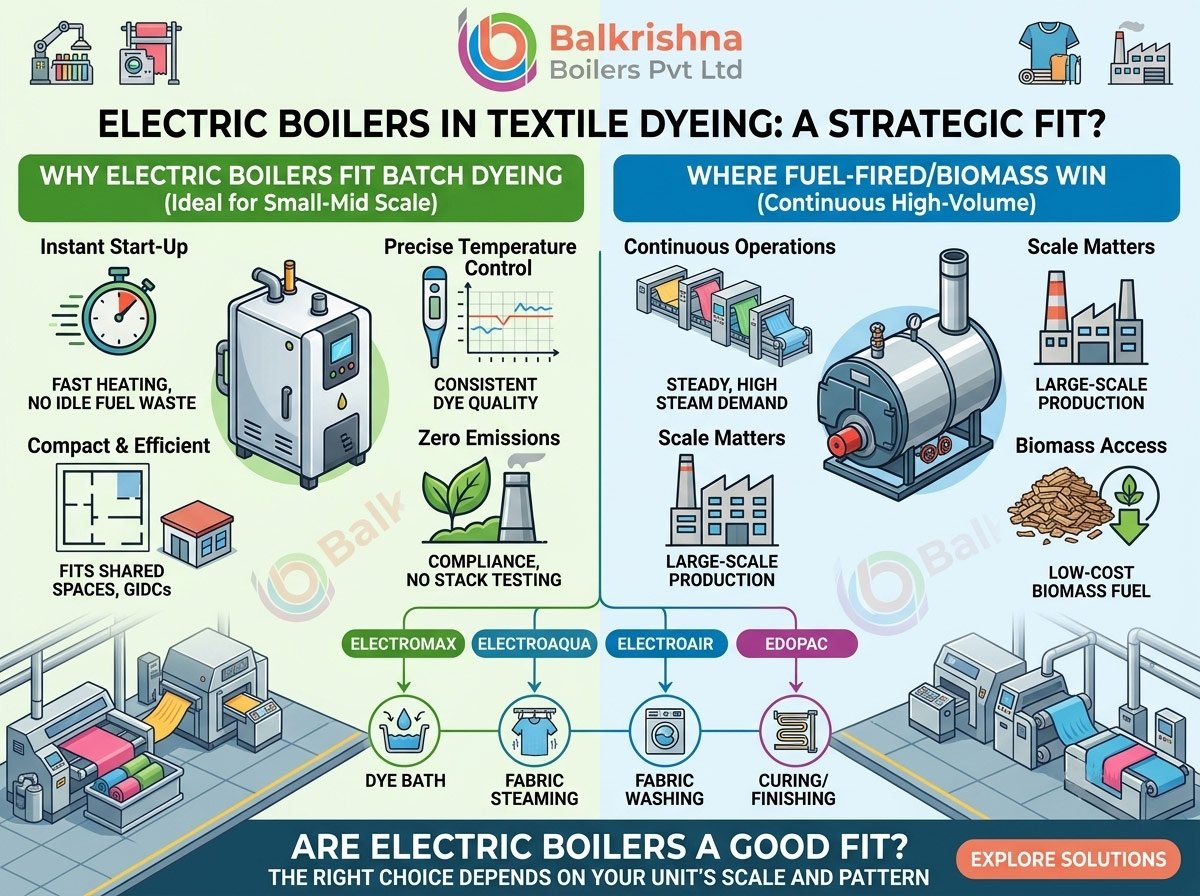
Why Batch Dyeing Units Are a Strong Fit for Electric
Most small and mid-sized dyeing units in India run batch processes — a defined dye lot goes through a cycle of heating, holding at temperature, and cooling, then the machine is reloaded for the next batch. This start-stop pattern plays directly to what electric boilers do best.
Instant start-up avoids wasted energy between batches. A fuel-fired boiler maintaining a fire bed between dye cycles burns fuel even when the machine isn’t actively demanding heat. An electric boiler draws essentially no energy when idle and reaches operating temperature almost instantly when the next cycle begins — a meaningful efficiency advantage for units with gaps between batches or overnight shutdowns.
Precise temperature control matters for dye quality. Many dyeing processes are sensitive to temperature overshoot — too much heat too quickly can affect dye uptake, shade consistency, or fabric handle. Electric boilers, with their responsive, closely modulated output, offer finer control over heating rate and hold temperature than a combustion system generally provides, which can translate into more consistent dye lot quality.
Lower infrastructure cost fits smaller unit economics. Many dyeing units operate in shared industrial sheds or GIDC-style estates with real space and capital constraints. An electric boiler’s compact footprint and lack of fuel yard or chimney requirement fits this reality far better than a fuel-fired system designed for continuous, high-volume operation.
Where Fuel-Fired or Biomass Still Wins: Large, Continuous Dyeing Operations
Larger textile processing houses running continuous dyeing lines — where fabric moves through a dyeing and fixation process steadily rather than in discrete batches — present a different load profile. Continuous, high-volume steam demand at industrial scale is exactly where biomass and fuel-fired systems’ lower per-unit fuel cost tends to outweigh electric’s efficiency and control advantages, provided the unit has reliable, low-cost biomass access.
Our detailed comparison of electric vs. biomass boilers on cost and efficiency covers this trade-off in depth — the short version is that scale and continuity of demand are the deciding factors, not the textile application itself.
Emissions and Compliance Pressure in Textile Hubs
Textile dyeing has faced particularly intense environmental scrutiny in India over the past decade, with several dyeing clusters facing tightened Pollution Control Board consent conditions or, in some cases, closure notices tied to emissions and effluent concerns. For units operating in or near these tightly regulated clusters, the compliance simplicity of an electric boiler — zero on-site combustion emissions, no stack testing, no fuel consumption reporting — is a genuine operational advantage, not just a marketing point.
Export-oriented dyeing units face an additional layer of pressure: international apparel and textile brands increasingly require supply chain carbon and compliance data as part of vendor audits. A dyeing unit that can demonstrate zero on-site combustion emissions from its steam generation has a straightforward, defensible answer to exactly the kind of question these audits ask. We cover this broader compliance angle in our piece on how electric boilers support zero-emission manufacturing.
Steam Quality and Fabric Handle
Beyond emissions, steam quality itself affects dyeing outcomes. Electric boilers produce consistently dry, high-quality steam because heat transfer is direct and doesn’t carry the variability that can come from fluctuating fuel quality or combustion tuning drift in a fuel-fired system. For processes like steaming and fixation, where uneven steam quality can show up as uneven dye fixation or handle inconsistency across a batch, this consistency is a practical quality benefit, not just a technical specification.
Matching Electric Boiler Types to Dyeing Process Steps
Different stages of a dyeing operation call for different equipment:
Dye bath heating and steam-based fixation. Our Electric Steam Boiler range, including the 1 Ton Electric Steam Boiler and 2 Ton Low Voltage Electric Boiler, commonly serves batch dye-bath heating and steam fixation stages for small-to-mid-sized units.
Washing and rinsing. The Electric Hot Water Boiler covers hot water demand for post-dye washing and rinsing cycles.
Drying, curing, and finishing. For high-temperature heat transfer without high pressure — often used in curing and finishing lines — our Electric Thermic Fluid Heater is frequently the better fit than a steam-based system.
Hot air for drying. Where drying is done via direct hot air rather than steam-heated cylinders, our Electric Hot Air Generator is a purpose-built alternative.
On the Balkrishna Boilers side, this maps to our Electric Boiler series — ELECTROMAX for steam, ELECTROAQUA for hot water, ELECTROAIR for hot air generation, and EDOPAC among our thermic fluid heater range for curing and finishing applications.
Sizing an Electric Boiler for a Dyeing Unit
Dyeing machine manufacturers typically specify steam or heat demand per machine, which makes sizing more straightforward than estimating from scratch — but the calculation still needs to account for how many machines run simultaneously during peak batch overlap, not just a single machine’s rated demand. Our guide on how to size an electric boiler for your facility walks through this calculation in detail, including how to handle simultaneous versus sequential machine operation, which is particularly relevant for dyeing units running multiple machines on a shared steam supply.
Water Treatment: Especially Important in Dyeing Applications
Water quality already matters significantly in dyeing itself — hardness and mineral content affect dye uptake and shade consistency, which is why many dyeing units already run water treatment for their process water. This existing awareness makes it a natural extension to ensure boiler feedwater is properly softened too, since untreated feedwater causes scale buildup on electric heating elements exactly the same way it affects dyeing outcomes. Units that already invest in water treatment for process quality are typically well positioned to protect their electric boiler’s element life with minimal additional investment — a topic covered further in our electric boiler maintenance guide.
Cost Comparison: What Dyeing Unit Owners Should Actually Calculate
Rather than comparing headline electricity versus fuel prices, dyeing unit owners evaluating electric should calculate real running cost using their actual batch pattern — steam demand per batch, number of batches per day, and idle time between cycles. Because electric boilers avoid the standby fuel consumption that a combustion system incurs between batches, the effective cost gap is often narrower than a straight per-unit energy price comparison suggests. Our guide on electric boiler power consumption formulas and examples walks through exactly how to run this calculation for your own batch pattern.
A Practical Way to Decide
If your dyeing unit fits most of the following, electric is likely a strong fit: batch-based operation with meaningful idle time between cycles, moderate rather than continuous high-volume steam demand, limited floor space for fuel storage and a chimney, and operation in or near a Pollution Control Board-sensitive cluster or export-facing supply chain with compliance reporting requirements.
If instead you’re running a continuous, high-volume dyeing line with steady steam demand around the clock and reliable access to low-cost biomass fuel, a fuel-fired or biomass system is worth evaluating on cost grounds even with the additional infrastructure and compliance burden it carries.
Final Thoughts
Electric boilers aren’t a universal answer for textile dyeing, but for the large share of Indian dyeing units running batch operations at small-to-mid scale — and particularly those facing tightening emissions scrutiny or export compliance requirements — they offer a genuinely strong combination of energy efficiency between cycles, precise temperature control for dye quality, compact footprint, and simplified compliance. The right decision comes down to your specific batch pattern and scale, not a blanket industry assumption either way.
If you’d like our engineers to review your dyeing unit’s steam demand and recommend the right electric boiler configuration, get in touch with our team, or explore the full Electric Boiler range on Indian Boilers.com and Balkrishna Boilers.