
Thermic Fluid Heaters for Rubber and Tyre Manufacturing
Rubber and tyre manufacturing is a temperature-sensitive business. Vulcanization — the chemical process that transforms soft, pliable rubber compound into a strong, elastic finished product — depends entirely on precise, uniform, and sustained heat. Too little heat and the rubber under-cures, leaving weak spots and poor durability. Too much heat, applied unevenly, and you get scorching, blistering, or inconsistent cure profiles that show up as rejected tyres and rubber components on the line.
This is exactly the kind of heating challenge a thermic fluid heater is built to solve. Unlike steam, which loses temperature control precision as pressure and demand fluctuate, a properly designed thermal fluid system delivers consistent, uniform heat across every press, autoclave, and curing line in the plant — at a fraction of the pressure and risk of a comparable high-pressure steam boiler.
This guide covers exactly where and how thermic fluid heaters are used across rubber and tyre manufacturing, what makes them the preferred choice over steam for this industry, and how to size and specify a system correctly for your production line.
1. Why Rubber and Tyre Manufacturing Needs Precise Heat
Vulcanization works by cross-linking rubber polymer chains using heat and a curing agent (typically sulfur-based). The quality of the final product depends heavily on:
- Uniform Temperature Distribution: Every point of the mold or press platen needs to reach and hold the same temperature — hot spots and cold spots both create defective cure zones within the same product.
- Precise Temperature Control: Cure time and cure temperature are directly linked; a few degrees of variance can shift optimal cure time significantly, affecting throughput and consistency.
- Sustained, Stable Heat: Curing cycles can run anywhere from a few minutes for small components to over an hour for large truck and off-road tyres — the heating system must hold temperature steady for the full cycle, not just at start-up.
Steam systems struggle to hold this level of precision consistently, particularly as pressure fluctuates with demand across multiple presses running simultaneously. Thermal fluid systems, operating at near-atmospheric pressure regardless of temperature, don’t carry that same pressure-dependent temperature variability.
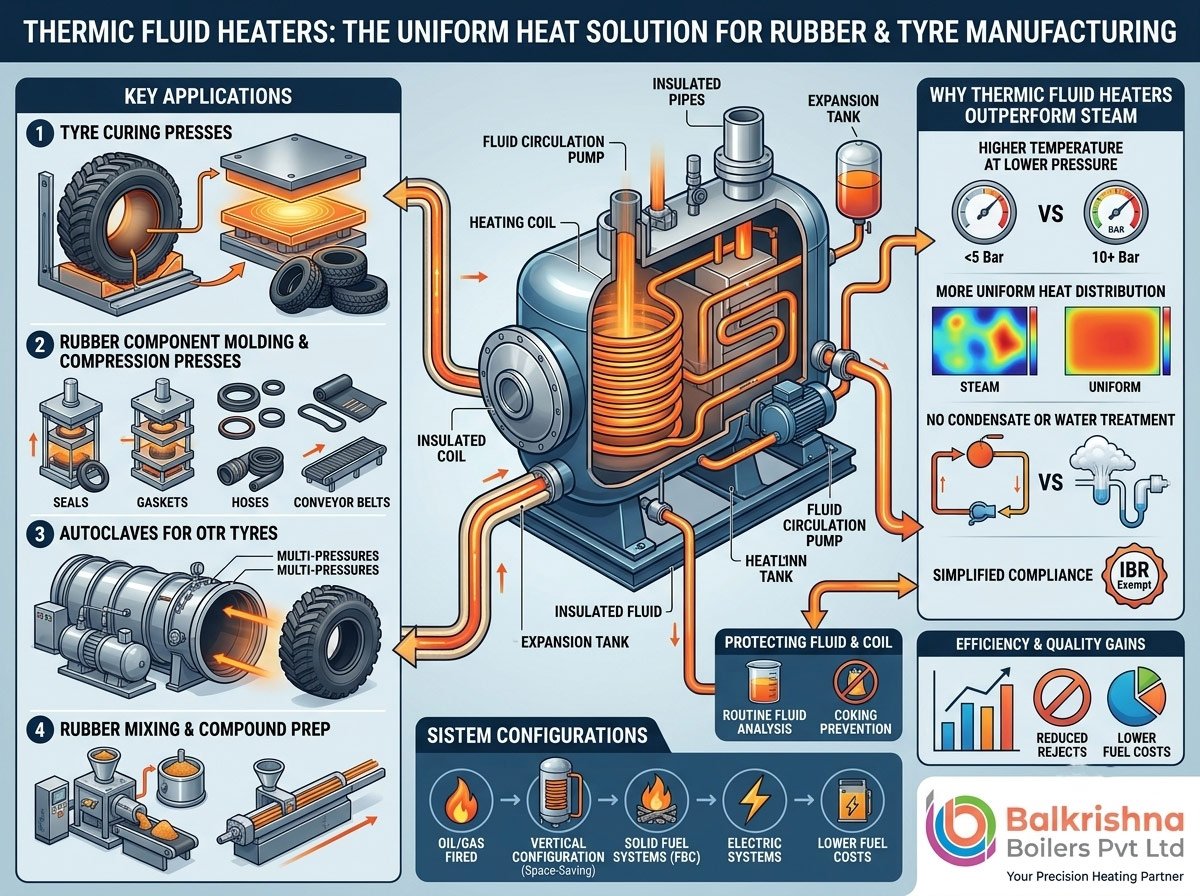
2. Key Applications Across the Rubber and Tyre Manufacturing Process
A. Tyre Curing Presses
The tyre curing press is the single largest thermal fluid consumer in most tyre plants. Green (uncured) tyres are placed in a mold and heated under pressure, typically in the 150-200°C range, for a defined cure cycle. Thermal fluid circulated through the press platens and, in many designs, through an internal bladder system, delivers the sustained, even heat required for a full, uniform cure across the entire tyre carcass.
B. Rubber Component Molding and Compression Presses
Beyond tyres, rubber manufacturing covers a huge range of molded components — seals, gaskets, hoses, conveyor belting, and automotive rubber parts. Compression and injection molding presses for these components rely on the same principle: uniform platen heating via circulating thermal fluid to achieve consistent cure across every cavity in a multi-cavity mold.
C. Autoclaves for Large and Off-the-Road (OTR) Tyres
Large truck, agricultural, and off-the-road tyres are often cured in autoclaves rather than individual presses, using thermal fluid-heated internal surfaces combined with steam or hot air to achieve the extended, uniform cure cycles these larger products require.
D. Rubber Mixing and Compound Preparation
Some stages of rubber compound preparation — particularly pre-heating raw rubber or maintaining consistent compound temperature before molding — also benefit from thermal fluid heating, ensuring the material enters the press at a stable, predictable starting temperature.
E. Calendering and Extrusion Lines
For rubber sheeting, conveyor belting, and extruded rubber profiles, thermal fluid-heated calendering rolls and extrusion dies maintain the consistent surface temperature needed for uniform material thickness and surface finish.
3. Why Thermic Fluid Heaters Outperform Steam for Rubber Curing
A. Higher Temperature at Lower Pressure
Tyre curing often requires temperatures in the 150-200°C range. Producing 180°C steam requires roughly 10 bar of pressure — a meaningful safety and infrastructure burden. A thermal fluid system reaches the same temperature at a fraction of that pressure, typically under 5 bar, dramatically simplifying piping, valve specification, and plant safety requirements.
B. More Uniform Heat Distribution
Steam systems lose latent heat as condensate forms, creating temperature gradients across large press platens or autoclave surfaces. Circulating thermal fluid maintains a far more consistent temperature profile across the entire heat transfer surface, which translates directly into more consistent cure quality — fewer rejects, less scrap, and more predictable cycle times.
C. No Condensate Handling or Water Treatment
Steam systems require condensate recovery, water treatment, and blowdown management — all recurring operational costs and potential failure points. A closed-loop thermal fluid system eliminates these entirely, an efficiency advantage covered in more detail in our article on how thermic fluid heaters improve energy efficiency.
D. Simplified Regulatory Compliance
Because thermal fluid systems operate at low pressure and don’t generate steam, they generally fall outside the scope of IBR (Indian Boiler Regulations) — meaning no certified boiler attendant requirement and no annual pressure vessel inspections, unlike an equivalent high-pressure steam system.
E. Multiple Press Support from a Single System
A single thermic fluid heater can supply multiple curing presses simultaneously through a distributed piping network, with each press drawing consistent-temperature fluid regardless of how many other presses are running — something steam systems struggle to match without significant pressure-drop related temperature variance.
4. Sizing a Thermic Fluid Heater for a Rubber or Tyre Plant
Correct sizing is critical in this industry specifically because undersized systems create the exact temperature inconsistency that vulcanization can’t tolerate. Key sizing factors include:
- Total Simultaneous Heat Load: Add up the heat demand of every press, autoclave, and heated line that could realistically run at the same time — not just the largest single unit.
- Cure Temperature Requirements: Most tyre and rubber curing falls in the 150-200°C range, well within the standard operating window of a mineral-oil-based thermal fluid system, though some specialized compounds may require higher temperatures suited to synthetic fluids.
- Cycle Time and Recovery: Presses cycling frequently (loading a new green tyre immediately after unloading a cured one) demand a heater with fast recovery capability to avoid temperature dips between cycles.
- Future Expansion: Given how directly production capacity ties to available thermal fluid capacity in this industry, sizing with headroom for additional presses is worth the modest upfront cost difference.
Our detailed guide on thermic fluid heater capacity: how to choose the right size walks through the full calculation methodology in more depth.
5. Recommended System Configurations for Rubber and Tyre Applications
A. Oil/Gas Fired Systems for Continuous, High-Capacity Demand
For large tyre plants running multiple presses continuously, a robust oil/gas fired thermic fluid heater delivers the high, sustained heat load these operations demand, with fast response to load changes as presses cycle in and out of production.
B. Vertical Configurations for Space-Constrained Plants
Rubber component manufacturers with limited floor space often benefit from a compact footprint without sacrificing capacity — our vertical three-pass oil/gas fired thermic fluid heater is engineered specifically for this constraint.
C. Solid Fuel Systems for Cost-Sensitive Operations
Plants looking to reduce fuel costs through biomass or coal firing can consider our vertical four-pass FBC thermic fluid heater, which uses fluidized bed combustion for stable, efficient heat output from solid fuels — well suited to plants near reliable biomass supply.
D. Electric Systems for Precision-Critical, Smaller-Scale Operations
For smaller rubber component manufacturers or specialty compound curing where precise, clean, combustion-free heat is prioritized, our electric thermic fluid heater offers tight temperature control without any combustion byproducts near the production floor.
Balkrishna Boilers offers equivalent proven ranges under DELTAPAC and THERMPAC for oil/gas fired systems, the VTF Series for compact vertical installations, VFF Series for solid-fuel operations, and EDOPAC for electric-fired requirements — all backed by decades of rubber and tyre industry installation experience.
6. Protecting Fluid and Coil Life Under Continuous Curing Loads
Rubber and tyre curing operations often run heaters continuously, sometimes 24/7 across multiple shifts, which places sustained thermal load on both the fluid and the coil. A few maintenance priorities matter more in this industry than most:
- Routine Fluid Analysis: Continuous high-temperature operation accelerates fluid aging. Testing every 6 months for flash point, viscosity, and carbon residue catches degradation before it affects cure consistency — covered in depth in our article on signs of thermic fluid degradation and when to replace it.
- Coking Prevention: Continuous-duty operation, especially with frequent press-cycling load swings, increases coking risk if the system isn’t correctly designed for adequate fluid velocity and low heat flux. Our guide on how to prevent coking in thermic fluid heaters covers the design and operational practices that protect coil life under exactly this kind of continuous demand.
- Correct Installation Practices: Multi-press distribution piping needs careful design to ensure balanced flow and consistent temperature delivery to every press — our thermic fluid heater installation best practices guide covers piping layout considerations directly relevant to multi-user systems like this.
7. Safety Considerations Specific to Rubber and Tyre Plants
Rubber manufacturing environments often involve combustible dust, stored rubber compound, and continuous high-temperature operation — all factors that raise the stakes on proper thermal fluid system safety:
- Low-Flow Interlocks: Essential in multi-press systems where fluid demand can fluctuate as individual presses open and close throughout a shift.
- Nitrogen Blanketing: Protects fluid from oxidation during extended continuous-duty operation, which is the norm rather than the exception in tyre curing operations.
- Stack and High-Temperature Monitoring: Continuous operation means fewer natural opportunities for visual inspection, making automated monitoring and alarms especially important.
A full breakdown of these safety systems is available in our guide on thermic fluid heater safety precautions every operator should follow.
8. Real-World Impact: Efficiency and Quality Gains
Rubber and tyre manufacturers switching from steam to properly sized thermic fluid systems typically report:
- Reduced Reject Rates: More uniform curing temperature across press platens directly reduces scorching, under-cure, and inconsistent cure defects.
- Lower Fuel Costs Per Unit Produced: Closed-loop operation without condensate losses or blowdown typically delivers thermal efficiencies of 85-88%, rising further with waste heat recovery.
- Reduced Water Treatment Costs: No feedwater treatment chemicals, no condensate recovery infrastructure, and no blowdown disposal — a recurring operational saving that compounds over the system’s service life.
- Simplified Compliance Overhead: Falling outside IBR jurisdiction removes the need for a certified boiler attendant and annual pressure vessel inspection, freeing up operational resources.
9. Choosing the Right Partner for Your Rubber or Tyre Plant
Specifying a thermal fluid system for rubber and tyre manufacturing isn’t a one-size-fits-all decision — press count, cure temperature range, cycle frequency, and future expansion plans all shape the right configuration. At Indian Boilers.com, our technical team works directly with rubber and tyre manufacturers to size and specify systems around actual production data, not generic capacity assumptions.
Our parent company, Balkrishna Boilers Pvt Ltd, brings over 25 years of experience and more than 5,000 installations worldwide — including numerous rubber, tyre, and rubber-component manufacturing plants relying on continuous, precise thermal fluid heating every day.
- Explore Our Thermic Fluid Heater Range: indianboilers.com/product-category/thermic-fluid-heater
- View the Full Balkrishna Boilers Range: balkrishn.com/thermic-fluid-heater.php
- Get a Custom Quote for Your Plant: Contact our technical team with your press count, cure temperature, and cycle time requirements for a tailored system proposal.