


THERMPAC – Three Pass Oil / Gas Fired Thermic Fluid Heater
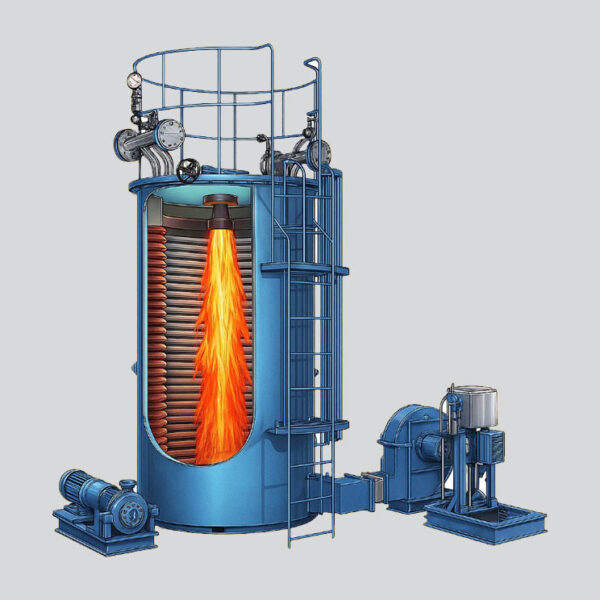
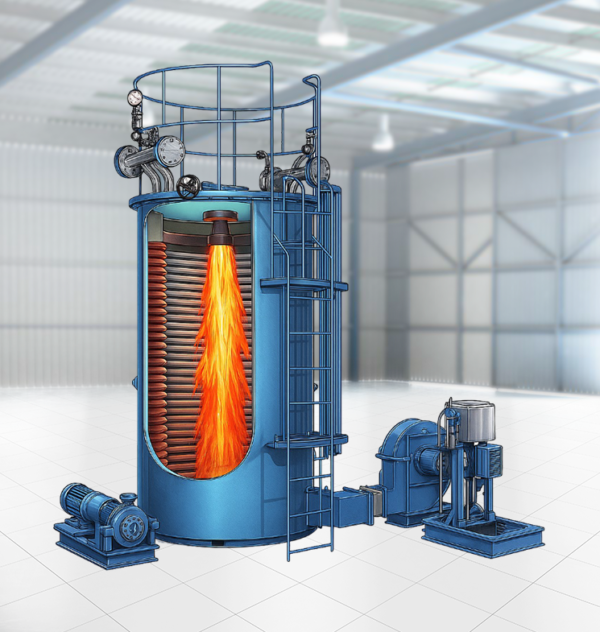
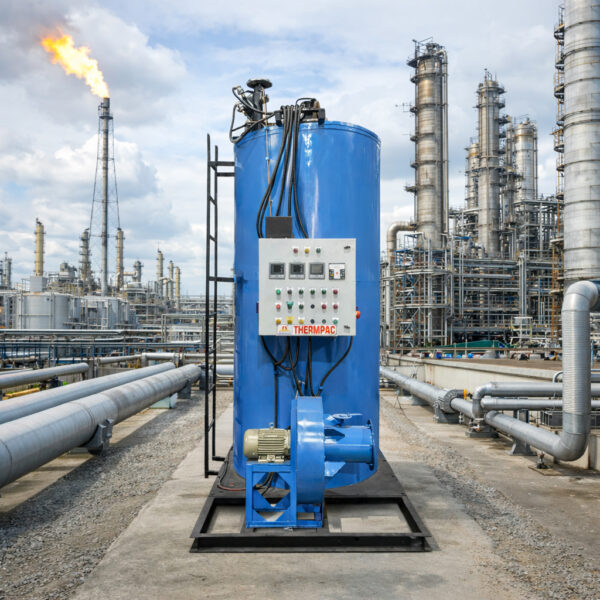
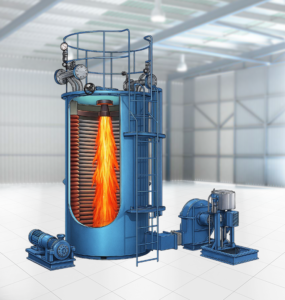
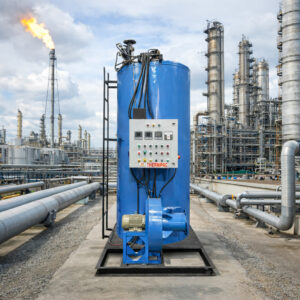
The THERMPAC series, vertical three pass thermic fluid/thermal oil heater is designed for maximum efficiency, using a variety of liquid and gaseous fuels. It is designed with fuel flexibility in mind and can fire a range of heavy oils, light oils and gases. It allows high process temperatures at low operating pressures.
The Vertical Three Pass Oil/Gas Fired Thermic Fluid Heater is the pinnacle of industrial heat transfer technology, engineered for operations that require high and precise temperatures without the burden of high pressure.
Utilizing a highly effective three-pass horizontal design (such as the DELTAPAC series), this heater maximizes contact time between hot flue gases and the heating coil. This optimized thermal path ensures exceptional efficiency, minimal thermal stress on the fluid, and a long operational lifespan for the entire system.
By firing easily controlled, clean fuels like oil and natural gas, this heater offers fully automatic operation, rapid heat-up times, and unparalleled temperature consistency for critical processes.
Key Features & Technical Advantages
| Feature | Operational Benefit | Technical Specifications (Typical) |
| Three Pass Design | Maximizes heat absorption from combustion gases, resulting in high thermal efficiency (up to 90% on Gas). | Efficiency: 88%-90% (+/-2%) |
| High Temp, Low Pressure | Safely achieve high process temperatures (up to 300℃) without the high pressure and regulatory oversight required by steam boilers. | Max Temp: 280℃ to 300℃ |
| Multi-Fuel Flexibility | Equipped with a Pressure jet Monoblock Burner capable of handling various fuels, allowing for cost optimization. | Fuel: Diesel, LDO, FO (Furnace Oil), LPG, Natural Gas (NG), PNG |
| Longevity & Safety | The closed-loop system minimizes corrosion, scale formation, and fouling, ensuring long equipment life and operational safety. | Capacity Range: 0.1 Million kcal/hr to 10.0 Million kcal/hr |
Applications: Industries Relying on Hot Oil Systems
Thermic Fluid Heaters are preferred in processes requiring stable, indirect heat at temperatures exceeding $150℃, where water/steam systems become complex or dangerous due to high pressure.
| Industry | Specific Applications |
| Chemical & Petrochemical | Heating of jacketed reactors, distillation columns, polymerization, drying, and general process heating. |
| Textile Industry | Providing high, uniform heat for stenters (drying/setting), aging machines, and dyeing processes. |
| Food Processing | Supplying stable, indirect heat for large-scale industrial frying (potato chips, snacks), baking ovens, and deodorization. |
| Plywood & Laminates | Heating platen presses for curing and bonding wood veneers and laminates, demanding consistent surface temperature. |
| Oil & Lubricant | Heating storage tanks (e.g., bitumen heating) and process heat for refining, blending, and recycling plants. |
| Pharmaceutical | Providing clean, controlled heat for reaction vessels, drying processes, and sterilization in drug manufacturing. |
| Paper & Packaging | Drying of specialty papers, converting, and manufacturing of corrugated boxes. |
Operating Range
- Capacity – 0.1 million kcal/hr. to 2.0 million kcal/hr.
- Fuel- Heavy oils, light oils and gases
- Temperature – 300℃
Technical Specifications
| Specification | Unit | TP-10 | TP-20 | TP-40 | TP-60 | TP-80 | TP-100 | TP-150 | TP-200 |
|---|---|---|---|---|---|---|---|---|---|
| General | |||||||||
| Maximum heat output | M. Kcal/hr | 0.1 | 0.2 | 0.4 | 0.6 | 0.8 | 1.0 | 1.5 | 2.0 |
| maximum working temperature | °C | 280 | 280 | 280 | 280 | 280 | 280 | 280 | 280 |
| thermic fluid heater Rise temperature | °C | 30 | 30 | 30 | 30 | 30 | 30 | 30 | 30 |
| Hot Oil Inlet/ Outlet | MM | 40 | 50 | 80 | 100 | 125 | 150 | 150 | 200 |
| Heating surface area of heater | M² | 6 | 12 | 24 | 36 | 54 | 60 | 90 | 120 |
| Oil holding capacity of heater | liter | 30 | 78 | 223 | 333 | 666 | 741 | 1398 | 1863 |
| Burner | Pressurejet top Mounted Burner | ||||||||
| Type of Fuel | Fuel | DIESEL, LPG, NG., PNG, FO,LDO | |||||||
| Boilers Efficiency | |||||||||
| On Gas | % | 87 +/-2 | 87 +/-2 | 87 +/-2 | 87 +/-2 | 87 +/-2 | 87 +/-2 | 87 +/-2 | 87 +/-2 |
| On Oil | % | 88 +/-2 | 88 +/-2 | 88 +/-2 | 88 +/-2 | 88 +/-2 | 88 +/-2 | 88 +/-2 | 88 +/-2 |
| Fuel Consumption | |||||||||
| Diesel (10500) | Kg/hr | 11 | 22 | 43 | 65 | 87 | 108 | 162 | 216 |
| Furnace Oil (9600) | Kg/hr | 12 | 24 | 47 | 71 | 95 | 118 | 178 | 237 |
| LDO (10200) | Kg/hr | 11 | 22 | 45 | 67 | 89 | 111 | 167 | 223 |
| LPG (11000) | Kg/hr | 10 | 21 | 42 | 63 | 84 | 104 | 157 | 209 |
| Natural gas(8900) | M³/hr | 13 | 26 | 52 | 77 | 103 | 129 | 194 | 258 |
| Electrical Load | |||||||||
| Circulation Oil Pump | H.P. | 5.00 | 7.50 | 10.00 | 15.00 | 20.00 | 25.00 | 30.00 | 40.00 |
| Burner Blower (oil) | H.P. | 1.00 | 2.00 | 5.00 | 7.50 | 7.50 | 10.00 | 12.5 | 15 |
| Fuel Pump | H.P. | 0.50 | 0.50 | 1.00 | 1.50 | 1.50 | 2.00 | 2.0 | 2.0 |
| Total Electric Load | H.P. | 6.50 | 10.00 | 16.00 | 24.00 | 29.00 | 37.00 | 44.50 | 57.00 |
| Overall Daimention and weight | |||||||||
| LX WX H | Miter | 1.2X1.8X2.5 | 1.5X2.0X2.8 | 2.0X2.6X3.2 | 2.7X2.6X3.6 | 3.0X2.7X4.0 | 3.4X2.8X4.5 | 3.6X3.3X5.3 | 4.0X3.5X6.0 |
| Dry Weight | Kg | 1200 | 1600 | 2100 | 2300 | 3200 | 3600 | 5500 | 7000 |
| Chimney Top Diameter | mm | 200 | 200 | 300 | 400 | 450 | 450 | 550 | 600 |
| NOTE: In view of constant endeavors to improve our products, we reserve the right to alter or change above specifications without prior notice. | |||||||||
Frequently Asked Questions
How does the "Three Pass" design improve performance?
By forcing the flue gases through three distinct stages of the heat exchanger, we lower the exit temperature of the gases. This ensures that more heat is absorbed by the thermic fluid, leading to thermal efficiencies of 88% to 90%.
What are the advantages of a Vertical configuration?
- Space Saving: Takes up significantly less floor area than horizontal models.
- Uniform Heating: Natural upward flow of heat assists in uniform temperature distribution.
- Ease of Cleaning: Soot and dust particles naturally fall to the bottom, making maintenance easier.
What is the maximum temperature this heater can reach?
Our standard units at indianboilers.com are designed to reach 300°C. For special high-temperature applications, we can customize units to achieve up to 350°C using synthetic fluids.
Which fuels are compatible with this heater?
This model is highly versatile and can be fired with:
- Liquid Fuels: LDO (Light Diesel Oil), HSD (Diesel), and Furnace Oil.
- Gaseous Fuels: Natural Gas (PNG), LPG, and Biogas.
What is the capacity range of these heaters?
We offer a wide range starting from 1 Lac kcal/hr up to 25 Lac kcal/hr in the vertical configuration. Larger capacities are also available upon request.
Does this system operate under high pressure?
No. This is the primary benefit of thermic fluid heaters. They provide high-temperature heat (300°C) at near-atmospheric pressure (1 to 4 bar), whereas a steam boiler would require over 85 bar of pressure to reach the same temperature.
What kind of burner is used?
We equip our heaters with world-class, fully automatic burners (like Riello or Elco). These burners provide precise air-fuel mixing for clean, smokeless combustion.
What material is used for the heating coils?
We use high-grade Seamless Carbon Steel tubes (BS-3059/SA-210). The coils are precisely wound to ensure the correct velocity of the thermic fluid, preventing localized overheating and oil degradation.
How is the temperature controlled?
The system is managed by a high-precision Digital PID Controller or an optional PLC-based system, which automatically modulates the burner to maintain the fluid temperature within ±1°C.
Is this heater IBR certified?
Thermic fluid heaters generally do not generate steam and therefore do not fall under the Indian Boiler Regulations (IBR). This means you do not need a government-certified boiler attendant to operate the unit.
What safety interlocks are provided?
- High Temperature Cut-off: Prevents the oil from exceeding its safe limit.
- Low Flow Switch: Instantly shuts off the burner if oil circulation stops.
- Stack Temperature Alarm: Detects if excessive heat is being lost.
- Flame Sensor: Shuts off fuel if the burner flame is not detected.
How do you prevent "Thermal Cracking" of the oil?
We design for a Low Heat Flux. By maintaining a high turbulent flow of oil through the coils, we ensure the "Film Temperature" remains well below the oil's cracking point, extending the life of your thermic fluid.
What is the role of the Expansion Tank?
As thermic fluid heats up, it expands in volume. The expansion tank safely absorbs this extra volume and ensures the system remains at a constant pressure.
Which industries commonly use this vertical heater?
- Food Industry: For industrial frying and ovens.
- Chemicals: For heating reactors and distillation columns.
- Textiles: For stenters and curing ranges.
- Pharma: For clean heating in sensitive environments.
How long does the thermic fluid last?
With proper operation and our low-flux design, a high-quality mineral-based oil can last 3 to 5 years. We recommend testing the oil every 6 months for viscosity and flashpoint changes.
How often does the unit need cleaning?
Because oil and gas are clean fuels, soot buildup is minimal. A basic inspection of the burner and a visual check of the coils every 3 to 6 months is usually sufficient.
What is the price of a Vertical Three Pass Oil / Gas Fired Thermic Fluid Heater?
The cost varies based on kcal capacity and burner automation. For 2025, estimated prices at indianboilers.com are:
- 1 Lac to 4 Lac kcal/hr: ₹500,000.
- 6 Lac to 10 Lac kcal/hr: ₹8,50,000 – ₹16,00,000.
- 15 Lac to 25 Lac kcal/hr: ₹18,00,000 – ₹35,00,000.
What factors influence the final price?
Prices are affected by the Burner Type (Single stage vs. Modulating), Fuel Choice (Gas-only vs. Dual Fuel), and the inclusion of Waste Heat Recovery units or advanced PLC controls.
What is the typical ROI period?
Due to the high efficiency and low maintenance requirements, most customers achieve a complete Return on Investment within 10 to 14 months through fuel savings and reduced labor costs.