
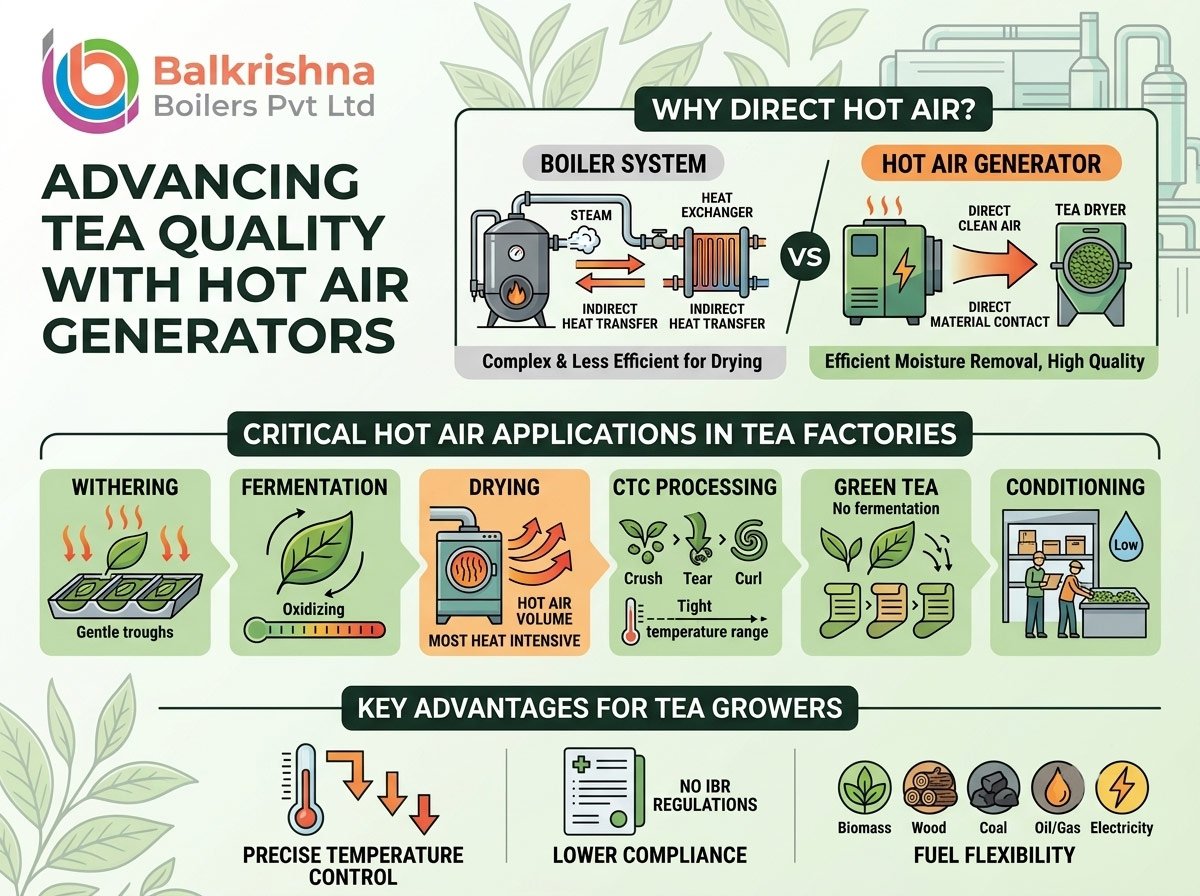
Tea manufacturing is one of the most heat-dependent processes in Indian agro-industry — and almost every stage of it depends on hot air, not steam or hot water. From the moment fresh green leaf arrives at the factory to the final firing stage that locks in flavor and shelf life, precise, consistent hot air delivery determines the quality grade of the finished tea. Too little heat at the wrong stage and the leaf under-processes; too much, too fast, and delicate flavor compounds are destroyed before they can develop.
This is exactly why hot air generators — not boilers in the traditional sense — are the backbone of tea factory heating systems across Assam, Darjeeling, the Nilgiris, and every other tea-growing region in India. This guide walks through every stage of tea processing where hot air plays a critical role, what makes a hot air generator the right technology for this industry, and how to specify the right system for a tea factory’s specific processing line.
1. Why Tea Processing Depends on Direct Hot Air
Unlike industries such as rubber curing or chemical processing, where a solid heat transfer surface (like a press platen or reactor jacket) is heated by a circulating fluid, tea processing needs hot air in direct contact with the leaf itself at almost every stage. The leaf needs to lose moisture, undergo enzymatic and thermal changes, and finally be dried and “fired” — all processes that depend on airflow, temperature, and humidity control acting directly on the material, not through an intermediate heat exchange surface.
This is the same fundamental principle explained in our guide on hot air generator vs boiler: when to use which — direct material processing, particularly drying and moisture-driven processes, is precisely where hot air generators outperform boiler-based systems that heat an intermediate liquid or steam medium.
2. Hot Air Applications Across Every Stage of Tea Processing
A. Withering
The first stage after leaf plucking, withering reduces the moisture content of fresh green leaf from around 75-80% down to 65-70%, softening the leaf and making it pliable for rolling. While withering troughs often rely primarily on ambient air circulation, factories in humid conditions or during monsoon season use gently heated air to maintain consistent withering rates regardless of outdoor humidity — critical for keeping production on schedule year-round.
B. Rolling and Fermentation (Oxidation)
For orthodox and CTC black tea processing, the fermentation (oxidation) stage requires carefully controlled temperature and humidity in the fermentation room. Hot air systems, often combined with humidification, maintain the narrow temperature band (typically 24-28°C) needed for proper oxidation without over- or under-fermenting the leaf — a stage where inconsistent temperature control directly shows up as inconsistent cup quality.
C. Drying (Firing)
This is the single largest hot air demand in any tea factory. After fermentation, leaf must be dried rapidly at controlled temperature — typically starting around 100-110°C and often stepping down through the drying cycle — to halt the oxidation process at exactly the right point and reduce moisture content to around 2-3% for stable storage. Uneven hot air delivery at this stage is one of the most common causes of inconsistent batch quality across a tea factory’s output.
D. CTC (Crush, Tear, Curl) Processing
For CTC tea, precise temperature control during the drying stage is even more critical than in orthodox processing, since CTC’s smaller particle size dries faster and is more sensitive to temperature swings — making consistent, well-distributed hot airflow essential to avoiding scorched or under-dried batches within the same drying run.
E. Green Tea Processing (Panning/Steaming and Drying)
Green tea processing, which skips fermentation entirely, relies on hot air (or steam, depending on style) to halt enzymatic activity immediately after plucking, followed by multiple hot-air drying passes to achieve the final moisture content — with temperature precision directly affecting the tea’s color retention and flavor profile.
F. Sorting and Grading Area Conditioning
Beyond direct leaf processing, many factories also use hot air systems to maintain low-humidity conditions in sorting and packing areas, protecting already-dried tea from reabsorbing moisture before packaging.
3. Why Hot Air Generators Are Preferred Over Steam in Tea Factories
A. Direct, Efficient Heat Delivery
Since tea drying is fundamentally a moisture-removal process, direct hot air contact with the leaf is more thermally efficient than heating an intermediate medium that then has to transfer heat to air anyway before it reaches the leaf.
B. Precise, Stepped Temperature Control
Modern tea drying often uses a stepped or declining temperature profile through the dryer — hot air generators paired with proper burner modulation and control systems can achieve this precision more directly than adjusting steam pressure across a heat exchanger.
C. Lower Compliance Burden
Since hot air generators don’t involve a pressurized water or steam vessel, tea factories avoid the IBR (Indian Boiler Regulations) compliance requirements that would apply to an equivalent steam system — a meaningful operational simplification for factories, particularly smaller or remote garden-based operations without easy access to certified boiler attendants.
D. Fuel Flexibility for Remote Locations
Many tea gardens are located in remote areas where fuel logistics matter enormously. Hot air generators are available across firewood, coal, biomass (including tea factory’s own waste — pruning material and fiber waste), and oil/gas fired configurations, letting factories use whatever fuel is most reliably available locally.
4. Fuel Options for Tea Factory Hot Air Generators
A. Firewood and Biomass-Fired Systems
Many established tea factories, particularly in Assam and North Bengal, run on firewood or biomass due to reliable local availability and lower fuel costs. Biomass-fired hot air generators can also make productive use of tea factory waste — pruning material and fiber byproduct — reducing both fuel cost and waste disposal needs simultaneously.
B. Coal-Fired Systems
Coal remains a common fuel choice for tea factories requiring consistent, high-capacity heat output, particularly in regions with reliable coal supply chains.
C. Oil and Gas Fired Systems
For factories prioritizing faster response time, cleaner combustion, and simpler fuel handling, oil and gas fired hot air generators offer more precise modulation, which can translate into more consistent drying quality across batches.
D. Electric Hot Air Generators
For smaller specialty tea operations or factories prioritizing the cleanest possible processing environment — particularly relevant for premium orthodox and specialty tea producers marketing on purity and process transparency — our electric hot air generator (ELECTROAIR) delivers combustion-free hot air with precise, stable temperature control and zero risk of combustion byproduct contamination reaching the leaf.
Balkrishna Boilers supports tea factories with proven ranges including AQUAJET and AQUAMAX for combustion-fired systems and EDOPAC for electric-fired applications, alongside dedicated hot air generator configurations suited to tea factory drying and withering demand.
5. Sizing a Hot Air Generator for a Tea Factory
Correct sizing depends heavily on a few tea-industry-specific factors:
- Daily Green Leaf Intake: The volume of fresh leaf processed daily directly determines drying capacity requirements — factories need to size for peak plucking season volume, not average daily throughput.
- Withering Trough Capacity: If withering assistance is required (particularly during monsoon season), trough size and airflow requirements factor into total system capacity.
- Dryer Type and Configuration: Different drying machine types (fluid bed dryers, conventional tray dryers) have different hot air volume and temperature requirements, affecting generator sizing.
- Seasonal Variation: Tea factories often run at significantly higher capacity during peak flush seasons — sizing decisions should account for this seasonal swing rather than average annual throughput alone.
For general sizing methodology applicable across our heating product range, our guide on thermic fluid heater capacity: how to choose the right size explains the core principles, many of which apply to hot air system sizing as well — matching capacity to actual peak demand, not just nameplate averages.
6. Maintaining Quality Consistency Through Proper Hot Air System Design
Tea quality — and the price it commands at auction — depends heavily on processing consistency, batch after batch. A few design and operational factors matter specifically for tea applications:
- Even Air Distribution: Ducting and air distribution design must ensure uniform temperature across the full width of the drying bed or withering trough — hot and cold spots directly translate into inconsistent leaf quality within the same batch.
- Responsive Temperature Control: Since drying often uses a stepped temperature profile, the hot air generator’s burner and control system need to respond quickly and accurately to setpoint changes throughout the drying cycle.
- Reliable, Consistent Operation During Peak Flush: Tea factories can’t afford unplanned downtime during peak plucking season, when fresh leaf arrives faster than it can be processed if equipment goes down — reliability and quick-service support matter as much as raw specifications.
7. Safety Considerations for Tea Factory Hot Air Systems
- Fire Safety: With biomass and firewood-fired systems especially common in tea factories, proper ash handling, spark arrestors, and clearance from stored fuel and finished tea are essential safety considerations.
- Temperature Interlocks: Automated high-temperature cutoffs protect against scorching entire batches of leaf in the event of a control system malfunction — a costly quality loss even without any safety incident involved.
- Dust and Combustible Material Management: Tea processing environments generate fine particulate matter (tea dust and fiber), requiring careful equipment placement and maintenance to avoid combustible dust accumulation near heat sources.
8. Choosing the Right Partner for Your Tea Factory
Tea processing demands a heating partner who understands the industry’s specific quality and reliability requirements — not just generic industrial heating specifications. At Indian Boilers.com, our technical team has supported tea factories across major growing regions with hot air systems sized and configured around actual leaf processing volumes and seasonal demand patterns.
Our parent company, Balkrishna Boilers Pvt Ltd, brings over 25 years of experience and more than 5,000 installations worldwide, including systems supporting agro-processing industries with the same demanding combination of reliability, precision, and fuel flexibility that tea manufacturing requires.
- Explore Our Hot Air Generator Range: indianboilers.com/product-category/hot-air-generator
- View the Full Balkrishna Boilers Range: balkrishn.com
- Get a Custom Quote for Your Tea Factory: Contact our technical team with your daily leaf intake and processing line details for a tailored system proposal.