
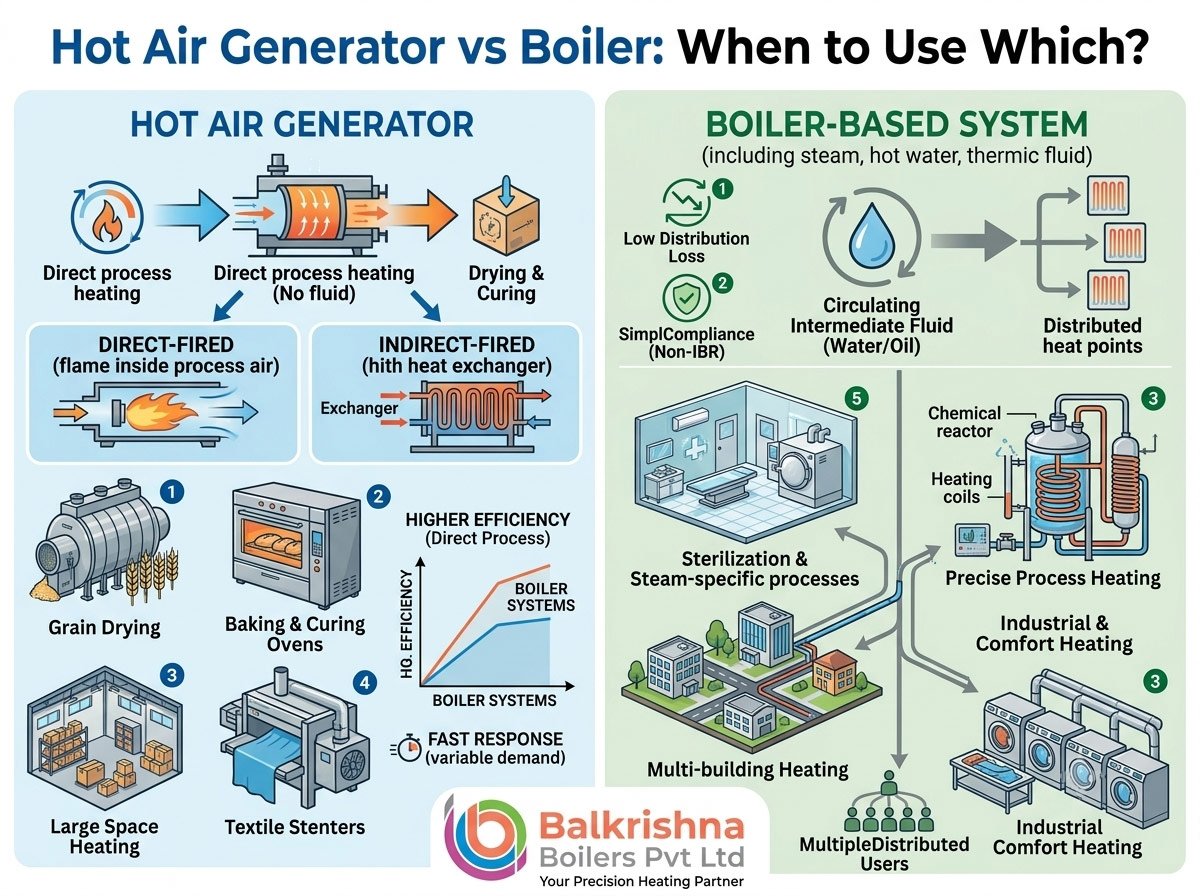
Not every industrial heating requirement needs water, steam, or thermal fluid as the heat-carrying medium. Some processes — drying, curing, and direct material heating in particular — are far better served by hot air delivered straight to the product, with no intermediate fluid loop at all. That’s the fundamental case for a hot air generator, and it’s a genuinely different engineering approach from a boiler-based system, not simply a smaller or cheaper alternative.
This guide compares hot air generators against the three boiler-based technologies — steam, hot water, and thermic fluid — so you can determine which is the right fit for your specific process, rather than defaulting to whatever technology your plant has traditionally used.
1. What Is a Hot Air Generator?
A hot air generator is a combustion or electrically heated system that produces a continuous stream of hot air, delivered directly to the process — a dryer, an oven, a kiln, or a curing chamber — rather than heating an intermediate fluid that then transfers heat elsewhere. Air is drawn in, heated across a heat exchanger (in indirect-fired designs) or heated directly by combustion gases (in direct-fired designs), and delivered via ducting to the point of use, typically assisted by a blower or fan system.
This is a fundamentally different heat-delivery mechanism from a thermic fluid heater, hot water boiler, or steam boiler — all three of which heat a liquid or vapor medium that then circulates through pipes to transfer heat at the point of use. A hot air generator skips that intermediate step entirely, which is exactly what makes it the right — or wrong — choice depending on your process.
2. Direct-Fired vs Indirect-Fired Hot Air Generators
A. Direct-Fired Hot Air Generators
In a direct-fired system, the combustion flame and flue gases mix directly with the process air stream. This delivers extremely fast, efficient heating since there’s no heat exchanger surface limiting heat transfer — but it also means combustion byproducts are present in the air reaching your product, making it suitable only for processes where this is acceptable (such as drying non-food, non-sensitive materials).
B. Indirect-Fired Hot Air Generators
In an indirect-fired system, combustion gases pass through a heat exchanger, transferring heat to a separate stream of clean process air without any direct contact between flue gases and the product. This is essential for food processing, pharmaceutical drying, and any application where air purity matters. Our electric hot air generator, marketed as ELECTROAIR, uses electric heating elements specifically to guarantee zero combustion contamination in the airstream — a natural fit for the cleanest processing environments.
3. Where Hot Air Generators Are the Right Choice
A. Direct Material Drying
Processes like grain drying, timber drying, textile drying, and mineral/ore drying benefit from direct hot air contact with the material, since the goal is moisture removal through direct evaporation — a job hot air performs more efficiently and directly than a boiler-based system heating an intermediate surface.
B. Curing and Baking Ovens
Powder coating curing ovens, paint curing, and industrial baking processes rely on consistent hot air circulation throughout an enclosed chamber — precisely the delivery method a hot air generator is designed around.
C. Spray Drying
Food powder, pharmaceutical, and chemical spray drying processes atomize liquid material into a hot air stream for near-instantaneous moisture evaporation — a process that fundamentally requires hot air as the direct medium, not a liquid or steam-based intermediate.
D. Space and Process Air Heating
Facilities needing to heat large volumes of ambient air — for warehouse heating, curing rooms, or process makeup air — often find a hot air generator simpler and more directly efficient than installing a boiler and separate air-handling heat exchanger.
E. Textile Stenter and Finishing Processes
While many textile finishing lines use thermic fluid-heated stenters (covered in our guide on thermic fluid heaters for textile processing), some finishing and drying stages use direct hot air circulation instead, depending on the specific fabric and finish requirements.
4. Where a Boiler-Based System Is the Better Choice
A. Multiple, Distributed Heat Users
If your plant needs to deliver heat to many different points — several presses, multiple process vessels, or distributed heating loops across a large facility — a centralized boiler (steam, hot water, or thermic fluid) circulating through a piping network is far more practical than trying to duct hot air to every point of use.
B. High-Temperature, Precise Process Heating
Applications like tyre curing, chemical reactor heating, and mold/die heating require sustained, uniform, precisely controlled temperatures at levels a hot air stream can’t consistently maintain across a solid heat transfer surface — this is exactly the territory where a thermic fluid heater excels, as detailed in our guide on thermic fluid heaters for rubber and tyre manufacturing.
C. Sterilization and Steam-Dependent Processes
Autoclave sterilization, certain cooking processes, and applications requiring steam’s specific latent heat properties simply cannot be replicated by hot air — steam remains the correct technology here, as explained in our article on industrial uses of steam boilers and how they work.
D. Space Heating Across Multiple Buildings
For campus or multi-building heating, a centralized hot water boiler system distributing heat via insulated piping is generally more efficient and easier to control than multiple standalone hot air units — see our guide on what is a hot water boiler: uses and working explained for a full breakdown of where hot water systems fit best.
5. Efficiency Comparison: Hot Air Generators vs Boiler-Based Systems
A. Thermal Efficiency
Direct-fired hot air generators can achieve very high thermal efficiency (often 90%+) specifically because there’s no intermediate heat exchange step losing energy — the combustion heat goes almost directly into the process air. Indirect-fired systems and boiler-based systems both introduce at least one heat exchange step, which, while still efficient, inherently carries a small additional loss compared to direct-fired hot air.
B. Distribution Losses
Boiler-based systems circulating fluid through piping to distant points of use will experience some heat loss along the distribution network, even with proper insulation. A hot air generator installed close to the point of use avoids this entirely — but conversely, ducting hot air over long distances introduces its own losses and pressure-drop inefficiencies, meaning the “winner” depends heavily on plant layout.
C. Turndown and Response Time
Hot air generators generally respond faster to load changes than large boiler systems with significant thermal mass, since there’s less stored thermal energy to modulate. This makes them well suited to processes with variable or intermittent demand.
6. Safety and Compliance Comparison
- Hot Air Generators: Generally operate at low pressure with minimal stored thermal energy, resulting in a comparatively simple compliance profile — no water-side pressure vessel regulations apply since there’s no pressurized liquid or vapor medium involved.
- Steam Boilers: Operate under significant pressure and typically fall under IBR (Indian Boiler Regulations), requiring certified attendants and periodic government inspection.
- Hot Water Boilers: Generally Non-IBR when operating below 100°C, offering a simpler compliance path than steam while still requiring standard safety devices like pressure relief valves and high-temperature cutoffs.
- Thermic Fluid Heaters: Operate at near-atmospheric pressure even at very high temperatures, generally placing them outside IBR jurisdiction — though they carry their own specific safety requirements around fluid oxidation, flow interlocks, and coking prevention, covered in our guides on thermic fluid heater safety precautions and how to prevent coking in thermic fluid heaters.
7. Fuel Flexibility Across Both Technologies
Both hot air generators and boiler-based systems are available across the same broad fuel categories — oil and gas fired, solid fuel (biomass/coal) fired, and electric. The choice of fuel typically comes down to available infrastructure, fuel cost, and emissions goals rather than the heating technology itself.
Balkrishna Boilers offers proven ranges across every configuration: DELTAPAC and THERMPAC for thermic fluid systems, AQUAJET and AQUAMAX for hot water boilers, and EDOPAC for electric-fired thermic fluid applications — giving plants the flexibility to standardize on a fuel type across multiple heating technologies where that simplifies plant operations.
8. A Practical Decision Framework
Use these questions to determine the right technology for your application:
- Does the heat need to reach a single, localized process (drying, curing, baking)? → A hot air generator is likely the simpler, more efficient choice.
- Does the heat need to be distributed to multiple points across the plant? → A boiler-based system (steam, hot water, or thermic fluid) circulating through piping is generally more practical.
- Does the process require very high, precise, sustained temperatures on a solid surface (press, mold, reactor)? → A thermic fluid heater is purpose-built for exactly this.
- Does the process require steam’s latent heat properties specifically (sterilization, certain cooking)? → A steam boiler remains the correct choice.
- Is the requirement primarily comfort heating or washing at moderate temperature? → A hot water boiler is typically the most cost-effective and lowest-compliance option.
9. Can a Plant Use Both?
Many industrial facilities don’t choose one technology exclusively — they use hot air generators for drying and curing processes alongside a thermic fluid or steam system for press heating, sterilization, or other centralized needs. Understanding each technology’s strengths lets you specify the right equipment for each specific process rather than forcing a single heating system to serve every need in the plant, often at the cost of efficiency somewhere in the operation.
10. Get Expert Guidance on the Right Heating Technology
Choosing between a hot air generator and a boiler-based system isn’t about which is universally “better” — it’s about matching the technology to your specific process, distribution requirements, and compliance priorities. At Indian Boilers.com, our technical team helps plants across India evaluate exactly this kind of decision, often recommending a combination of technologies for the most efficient overall plant design.
Our parent company, Balkrishna Boilers Pvt Ltd, brings over 25 years of experience and more than 5,000 installations worldwide across hot air, steam, hot water, and thermic fluid heating systems alike.
- Explore Our Hot Air Generator Range: indianboilers.com/product-category/hot-air-generator
- Explore Our Full Boiler Range: indianboilers.com/product-category/thermic-fluid-heater and indianboilers.com/product-category/hot-water-boiler
- View the Full Balkrishna Boilers Range: balkrishn.com
- Get Expert Recommendations: Contact our technical team with your process details for a tailored equipment recommendation.