
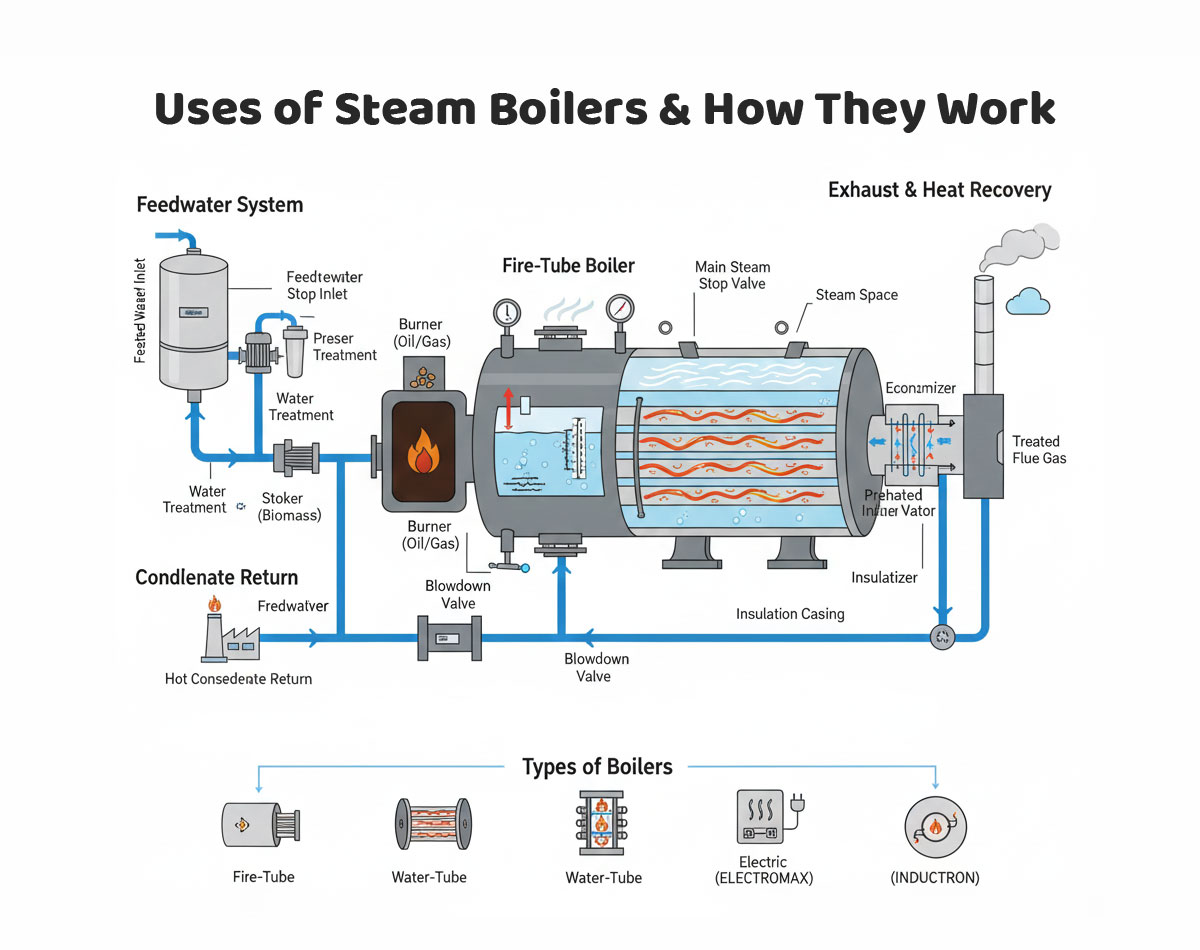
It’s easy to describe steam abstractly — hot, pressurized, carries latent heat — without ever explaining what that actually means on a plant floor. Steam doesn’t just sit in a pipe being hot; it does specific, mechanical work in every process it touches: spinning a turbine blade, forcing heat through a rubber mold, cooking a wood chip into pulp. Understanding that mechanical role is what separates a textbook definition of a steam boiler from actually knowing why your plant needs one sized and specified a certain way.
If you want the foundational explainer — what a boiler is, its components, the basic heat cycle — our companion post on what a steam boiler is covers that ground. This piece goes further: into the specific mechanics of how steam performs work across some of its largest and most demanding industrial roles, plus what that means for choosing between a STEAMJET – Oil/Gas Fired Steam Boiler, a STEAMGEN – Wood/Briquette Fired Steam Boiler, or electric alternatives like ELECTROMAX and INDUCTRON.
1. Power Generation: Steam’s Largest-Scale Job
This is the application that consumes more steam, at higher pressure, than any other industrial use — and it’s worth understanding mechanically, because the same underlying physics scales down into much smaller industrial cogeneration setups too.
How the energy conversion actually happens: A large water-tube boiler — the design that favors high pressure and high capacity over the larger water volume of a fire-tube unit — generates superheated steam, meaning steam heated well beyond its saturation point at a given pressure. That superheat matters specifically because it prevents condensation from forming inside the turbine as the steam expands and cools through the blade stages; wet steam erodes turbine blades over time, so superheating is a mechanical necessity, not just an efficiency nicety.
That high-energy steam is directed onto a series of turbine blades, and as it expands and loses pressure, it transfers kinetic energy to the blades, spinning the turbine shaft. The turbine shaft connects to a generator, which converts that rotational mechanical energy into electricity through electromagnetic induction. This is the mechanism behind thermal power plants running on coal, gas, or biomass, and it’s the same principle scaled down in captive power and waste-to-energy installations.
Where fuel choice matters most here: at this scale, capacity and fuel economics tend to dominate the decision — a STEAMJET system fits where gas or oil supply is reliable and combustion control needs to be precise, while a STEAMGEN – Wood/Briquette Fired Steam Boiler fits plants with access to affordable biomass fuel and sustainability targets to hit. Our guide on multi-fuel boilers and the future of industrial heating in India covers how some plants hedge fuel-supply risk by designing for more than one fuel source at this scale.
2. Rubber Curing: Where Steam Does Double Duty as Heat and Pressure
Vulcanization — the process that turns raw rubber into a durable, elastic finished product like a tire — needs both heat and pressure applied simultaneously, and steam is uniquely suited to deliver both at once inside an autoclave.
Uncured rubber compound is loaded into a mold inside a pressure vessel. Steam is introduced directly into that vessel, where it does two jobs simultaneously: its heat drives the chemical vulcanization reaction that cross-links the rubber’s polymer chains, and its pressure forces the compound fully into the mold cavity, ensuring the finished part has no voids or incomplete sections. Get the pressure or temperature profile wrong during this cycle, and the result is a rubber part with weak spots or inconsistent cure — which is exactly why this application demands the kind of precise, stable steam delivery that a well-specified boiler provides, and why cycle consistency across thousands of daily curing cycles matters more here than in almost any other industrial steam application.
3. Pulp and Paper: Steam as Both a Chemical Reagent Carrier and a Drying Medium
Paper manufacturing uses steam in two mechanically distinct ways within the same production line, which is worth separating out because they have almost opposite requirements.
Digestion — Wood chips are cooked under high-pressure steam inside a digester vessel, alongside chemicals that break down lignin and separate out the cellulose fibers that become pulp. This step needs sustained high pressure and volume, favoring high-capacity water-tube boiler designs similar to those used in power generation.
Drying — Once formed into a continuous sheet, paper passes over a series of steam-heated drying cylinders that evaporate remaining moisture before the paper is wound into rolls. This step is closer to a continuous, moderate-pressure process heat application — a different steam profile from the high-pressure digestion stage entirely, which is why paper mills often run more than one boiler configuration to serve both needs efficiently rather than oversizing a single system to cover both.
4. Where Precision Matters More Than Raw Volume
Not every industrial steam application is about scale — several of the most demanding uses of steam prioritize consistency and purity over sheer throughput, and that changes which boiler technology actually fits best.
Pasteurization relies on steam passed through a heat exchanger to bring milk or juice to an exact temperature for an exact holding time — the HTST process (High-Temperature Short-Time) — where the margin for error in temperature consistency is what separates a microbiologically safe product from a recalled one.
Retort sterilization for canned and packaged food takes this further: sealed vessels under high-pressure steam must hit a validated temperature-time profile precisely enough to guarantee pathogen elimination across an entire shelf life, not just at the moment of packaging.
Autoclave sterilization in pharmaceutical and healthcare settings runs the same logic with even less tolerance — instrument and material sterilization here is subject to GxP validation, meaning the steam supply itself needs to be provably consistent, batch after batch, not just adequate on average.
In all three of these applications, the reason electric systems like ELECTROMAX and INDUCTRON are increasingly preferred isn’t raw capacity — it’s that zero on-site combustion removes any risk of NOx or SOx byproducts reaching a clean room or contaminating a batch, and the tighter, near-instant modulation of electric heating holds temperature within a narrower band than a burner recovering from a demand spike. Our post on electric boilers for food, pharma & dairy goes deeper into exactly how that plays out across these three sectors.
5. Textile Processing: Where the Load Pattern Itself Is the Engineering Challenge
Dyeing, finishing, and sizing all draw on steam heavily, but the defining engineering challenge here isn’t the heat itself — it’s the load pattern. Heating a dye bath draws a sharp demand spike; the batch then soaks with demand tapering off; the next batch spikes again. That pulsating cycle, repeated across dozens of machines running on staggered schedules, is what high-capacity, IBR-certified systems like STEAMJET or ELECTROMAX are specifically built to absorb without pressure instability.
6. The Practical Choice: Fuel-Fired vs. Electric, by What You’re Actually Optimizing For
| You’re optimizing for… | Better fit |
|---|---|
| Maximum capacity at lowest fuel cost per unit energy | Fuel-fired (STEAMJET, STEAMGEN) |
| Zero on-site emissions and cleanest possible steam | Electric (ELECTROMAX, INDUCTRON) |
| Minimal maintenance downtime over the equipment’s life | Electric, especially INDUCTRON for its scale-resistant core |
| Tightest possible temperature/pressure consistency for validated processes | Electric |
| Very large continuous industrial or power-generation loads | Fuel-fired, typically water-tube design |
| Renewable/sustainability targets with access to biomass fuel | STEAMGEN |
This isn’t a universal ranking — it’s a reminder that the “best” boiler for power generation and the “best” boiler for pharmaceutical sterilization are answering completely different questions, even though both are technically “steam boilers.” Our electric steam boiler sizing guide and what is a biomass boiler posts go further into sizing and fuel-side decisions respectively, if you’re narrowing toward a specific technology.
Conclusion: The Mechanism Changes the Requirement
Steam’s role shifts dramatically depending on what job it’s actually doing — spinning a turbine, curing a tire, sterilizing a surgical tray, or drying a sheet of paper — and each of those mechanical roles pulls the boiler specification in a different direction. Understanding what steam is mechanically doing in your specific process, rather than treating “we need steam” as a single generic requirement, is what leads to a correctly specified system instead of an oversized or ill-suited one.
Balkrishna Boilers Pvt Ltd designs and installs across this full range — fuel-fired systems like STEAMJET and STEAMGEN, and electric systems like ELECTROMAX and INDUCTRON — matched to what your process actually needs steam to do. Browse the complete range on IndianBoilers.com or the full catalogue on Balkrishn.com.
Not sure which steam profile your process actually needs? Talk to our engineering team for an application-specific audit before you finalize a spec.