
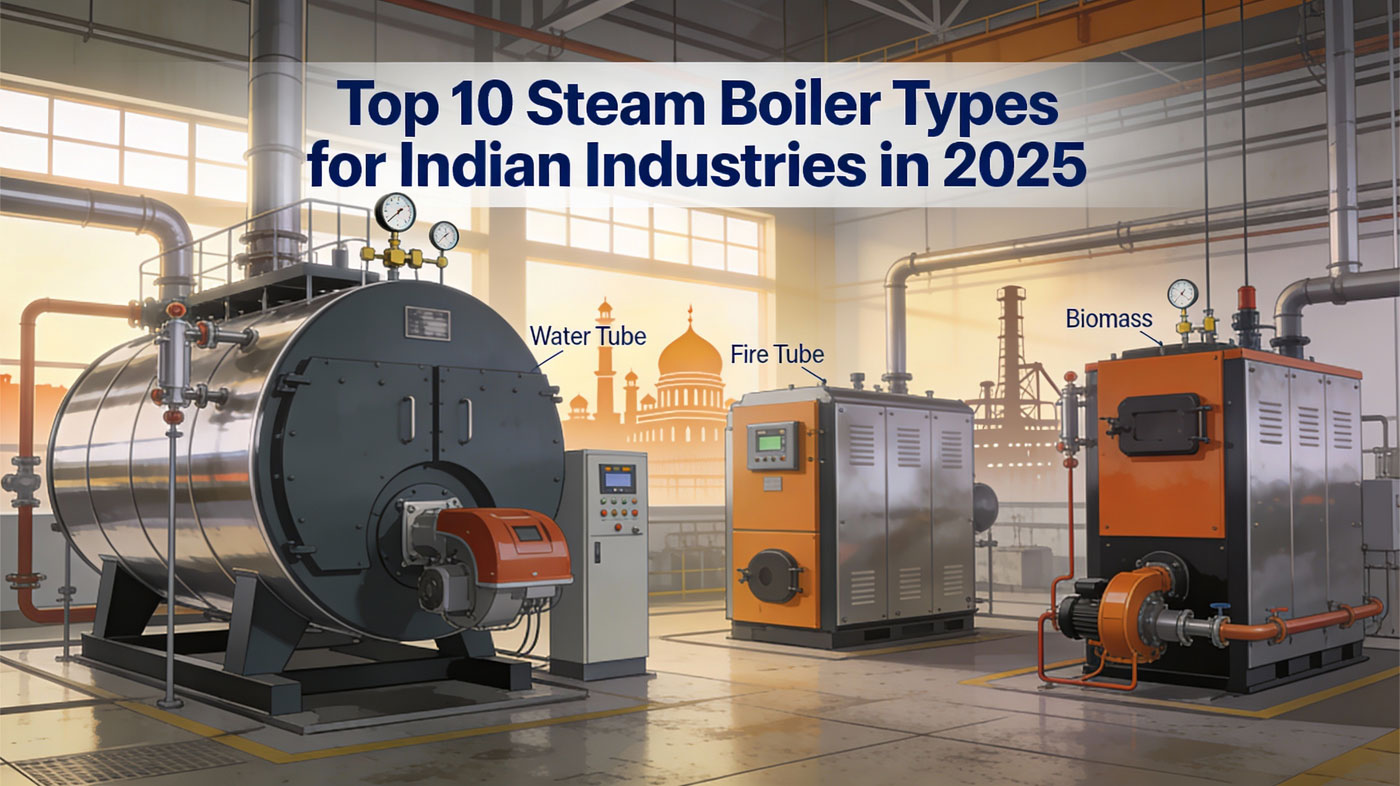
Steam is the invisible engine behind almost every large Indian factory. Whether it is a textile unit dyeing fabric in Surat, a pharmaceutical plant sterilising equipment in Ahmedabad, a sugar mill crushing cane in Uttar Pradesh, or a food processing unit pasteurising milk in Gujarat, the process almost always starts with one machine: the steam boiler.
Choosing the wrong type of boiler can quietly drain a plant’s profitability for years — through higher fuel bills, more downtime, and compliance headaches under the Boilers Act. Choosing the right one, on the other hand, can cut fuel costs, reduce emissions, and keep production running without interruption.
As Balkrishna Boilers Pvt Ltd, manufacturing under both the IndianBoilers.com and Balkrishn.com brands, we’ve engineered and installed boilers across pharmaceuticals, textiles, food processing, chemicals, sugar mills, and cement plants for over 25 years. In this guide, we break down the 10 steam boiler types Indian industries rely on most in 2026, what each is best suited for, and how to think about choosing between them.
1. Fire Tube Boilers
Fire tube boilers are the workhorse of small and mid-sized Indian manufacturing. In this design, hot combustion gases travel through tubes that are surrounded by water, transferring heat efficiently and generating steam relatively quickly compared to more complex designs.
Their simple construction makes them easier to install, operate, and maintain — which is exactly why they dominate in rice mills, textile dyeing units, and smaller food processing plants, typically up to around 25 tonnes per hour (TPH). Fully automatic fire tube models are available as agro-waste fired steam boilers, letting smaller units run on rice husk, groundnut shell, or other locally available biomass instead of costlier fossil fuel.
If you run a small-to-mid capacity unit and want dependable, low-maintenance steam without a large footprint, browse our full steam boiler range or the equivalent steam boiler catalogue on Balkrishn.com, which includes compact models like STEAMJET and STEAMAX.
2. Water Tube Boilers
Where fire tube boilers reach their limits, water tube boilers take over. Here, water circulates inside the tubes while hot gases surround them from the outside — a design that comfortably handles high pressures and large capacities, often well above 50 TPH.
This makes water tube boilers the natural fit for power plants, refineries, large chemical complexes, and pharmaceutical campuses that need to respond quickly to changing steam demand without compromising on safety margins. Our water-wall membrane panel FBC steam boiler is a good example of this category engineered specifically for high-capacity, high-pressure Indian industrial use. If your operation is scaling up production and outgrowing a fire tube unit, it’s worth reading our buyer’s guide before making the switch.
3. Biomass-Fired Boilers
Fuel cost is one of the biggest ongoing expenses for any boiler owner, and biomass-fired boilers are how many Indian MSMEs bring that cost down. Agricultural residues such as rice husk, bagasse, groundnut shell, and mustard straw are inexpensive, locally available, and — when burned in a properly engineered system — can cut fuel expenses dramatically compared to imported fuels.
Modern Fluidized Bed Combustion (FBC) and grate-fired designs allow multi-fuel flexibility, so plants aren’t locked into a single biomass source if local availability shifts seasonally. We’ve covered this fuel-flexibility question in detail in our guides on rice husk vs mustard straw ROI and biomass pellet vs briquette performance, and on the combustion side, our pieces on grate speed effects on fuel consumption and reciprocating grate performance explain how grate design changes what you can burn economically.
Explore our biomass boiler range, or the equivalent HUSKPOWER and PELLETAX models on Balkrishn.com, and pair the boiler with proper emission control systems to stay compliant with pollution norms — our pollution control equipment range covers bag filters, ESPs, and wet scrubbers designed for exactly this purpose.
4. Oil & Gas Fired Boilers
Not every plant has convenient access to biomass logistics, storage space, or a reliable fuel supply chain — especially units located in dense urban industrial clusters. For these situations, oil and gas-fired boilers remain the practical choice: clean-burning, capable of near-instant steam generation, and easy to control precisely, which matters a great deal in pharmaceutical and distillery applications where temperature stability is non-negotiable.
Efficiencies on well-maintained oil/gas units can reach the high 80s to low 90s percentage range, and compact footprints make them suitable for space-constrained facilities. Our oil & gas fired steam boiler is built for exactly this segment. For plants weighing biomass against oil/gas, our multi-fuel boilers article is a useful next read, since a multi-fuel configuration often lets you hedge between the two depending on price swings.
5. Coal-Fired Boilers
Coal-fired boilers remain relevant in industries like cement and steel manufacturing, where high, sustained capacity output and low operating cost matter more than fuel flexibility. Areas with strong local coal supply chains — parts of eastern and central India in particular — still find coal boilers economically attractive.
That said, environmental scrutiny on coal has increased significantly, and any new coal-fired installation today needs proper pollution control integrated from day one — electrostatic precipitators, bag filters, or FGD systems depending on scale. See our detailed waste heat recovery boiler guide for cement plants for how cement operations are increasingly pairing coal or alternate-fuel boilers with heat recovery to offset emissions and fuel cost simultaneously. Our ESP and FGD systems on Balkrishn.com are engineered for this class of installation.
6. Electric Boilers
For emission-sensitive zones — think pharmaceutical clean areas, labs, garment finishing units, or facilities operating in tightening urban emission zones like parts of Delhi-NCR — electric boilers offer a genuinely zero-emission-at-source alternative. They generate steam almost instantaneously, require comparatively little maintenance, and suit smaller-scale demand, typically under 1 TPH per unit, though multiple units can be banked together for larger loads.
Explore our electric boiler category, which mirrors the electric boiler range on Balkrishn.com featuring models like ELECTROMAX and ELECTROPAC — both well suited to labs, hospitals, and small process units that need clean, controllable steam without on-site combustion.
7. Wood-Fired Boilers
Furniture manufacturing and plywood units generate a steady stream of timber waste — offcuts, sawdust, and shavings — that would otherwise need disposal. Wood-fired boilers turn that waste stream into a usable, low-cost fuel source, which is precisely why they remain popular in decentralised manufacturing clusters where timber processing is a core activity.
Modern wood-fired systems use automatic fuel feed mechanisms to keep combustion — and therefore steam output — consistent, rather than relying on manual stoking. Our wood briquette fired steam boiler is designed to handle both raw wood waste and compressed briquettes, giving plants flexibility as their waste-fuel mix changes.
8. Waste Heat Recovery Boilers (WHRB)
Not every boiler burns fuel to make steam — WHRBs instead capture heat that would otherwise be lost from exhaust gases, furnace flue streams, or gas turbines, and convert it into usable steam. In cogeneration setups, this can lift overall thermal efficiency substantially, essentially generating “free” steam from heat that was previously wasted.
This makes WHRBs especially valuable in sugar mills, refineries, and any energy-intensive process pursuing genuine net-zero or lower carbon-intensity targets. Our waste gas fired single pass boiler is engineered for this exact recovery role, and our detailed guide on industries that benefit from waste heat recovery boilers breaks down sector-by-sector payback potential. We’ve also documented a real WHRB installation at Bluecraft Agro if you’d like to see this technology in action. On Balkrishn.com, the ENERPOWER series covers the same application segment.
9. Condensing Boilers
Traditional boilers release a meaningful amount of heat straight out through flue gas — condensing boilers reclaim that latent heat instead, pushing thermal efficiency as high as roughly 98% in the right application. This makes them particularly effective for lower-temperature process needs, such as sterilisation steam in pharma or process heating in green textile parks that are prioritising energy efficiency as part of sustainability certifications.
While condensing technology is a smaller share of the Indian industrial boiler market today compared to fire tube and water tube designs, adoption is growing steadily as energy costs rise and plants look for every efficiency gain available. For adjacent process heating needs, our thermic fluid heater range — matched by DELTAPAC and THERMPAC on Balkrishn.com — is worth considering alongside condensing steam options, especially for chemical process industries; see our thermic fluid heater safety guide for more.
10. Hybrid Boilers
Fuel prices — for biomass, oil, or gas — rarely stay stable year-round, and hybrid boilers exist to remove that uncertainty. By combining biomass and oil/gas firing in a single unit, hybrid boilers let plant operators switch fuel sources based on whatever is most cost-effective or available at a given time, without needing to install and maintain two separate boiler systems.
This flexibility is particularly valuable for seasonal industries like food processing, where fuel availability and production demand can both fluctuate through the year, and for any plant that wants a hedge against biomass supply disruptions during monsoon months. Our sector-specific breakdown in best boiler for textile, pharma, and food industries and boiler selection for food processing units go deeper into matching hybrid and other boiler types to specific industry needs.
How to Choose the Right Boiler Type for Your Plant
With ten legitimate options on the table, the right choice usually comes down to four questions:
- What’s your required steam capacity and pressure? Small units generally do well with fire tube designs; large, high-pressure operations need water tube systems.
- What fuel is realistically available and cost-effective near your plant? Biomass availability, gas pipeline access, and coal supply chains vary significantly by region in India.
- What are your emissions and compliance obligations? Urban or emission-sensitive zones may require electric or gas-fired systems paired with pollution control equipment, while rural biomass-rich regions have more flexibility.
- Is there waste heat on-site you aren’t currently capturing? If your process already generates exhaust or flue heat, a WHRB can often pay for itself faster than any other boiler category.
We’ve also written a broader look at how AI and IoT are transforming biomass boiler operations and digital twin technology for boiler reliability if you’re evaluating smart monitoring alongside a new boiler purchase, plus a forward-looking piece on hydrogen-ready boilers for plants planning a decade ahead.
Frequently Asked Questions
Which steam boiler type is cheapest to run in India? Biomass-fired boilers using rice husk, bagasse, or groundnut shell typically offer the lowest running cost for plants with reliable local fuel access, since agricultural residue is priced well below oil, gas, or imported coal. However, “cheapest” depends heavily on your region — a plant near a rice-milling belt will see very different economics than one in an urban industrial park with no biomass supply chain nearby.
Can one plant use more than one boiler type? Yes, and many mid-to-large Indian plants do exactly this. A common setup pairs a primary biomass or coal-fired boiler for base steam load with a smaller electric or oil/gas unit for backup, redundancy, or fast-start situations where instant steam is needed before the primary boiler reaches operating temperature.
How do I know if a waste heat recovery boiler makes sense for my plant? If your process already produces hot exhaust gas, flue gas, or turbine exhaust that is currently vented or cooled without being used, there’s a strong chance a WHRB can capture some of that value. Sugar mills, cement plants, and refineries are the most common beneficiaries, but any energy-intensive continuous process is worth evaluating.
Do biomass and coal boilers require separate pollution control equipment? Generally, yes. Combustion-based boilers — whether biomass, coal, or wood-fired — need particulate and emission control appropriate to the fuel and local regulatory limits, which can range from bag filters and cyclones for smaller biomass units to ESPs or FGD systems for larger coal-fired installations.
What capacity range does each boiler type typically cover? Fire tube boilers commonly serve up to roughly 25 TPH, water tube boilers scale well beyond 50 TPH for heavy industry, and electric boilers are typically used for loads under 1 TPH per unit, though banks of electric units can serve larger aggregate demand where emissions restrictions rule out combustion-based options entirely.
Get a Boiler Engineered for Your Industry
Every plant’s steam requirement is different, and the “best” boiler type is always the one matched to your specific fuel access, capacity needs, and compliance environment — not a generic top pick. With 25+ years of experience and installations across pharmaceuticals, textiles, food processing, chemicals, sugar, and cement industries, Balkrishna Boilers Pvt Ltd can help you evaluate the right configuration for your plant.
Browse our complete product range on IndianBoilers.com or Balkrishn.com, check what industries we serve on our Industries page, or get in touch for a customised, IBR-compliant recommendation for your facility.