
Spray drying looks deceptively simple from the outside — a liquid or slurry goes in, a fine powder comes out. Underneath that simplicity sits a process that lives or dies on one variable most people never think about: the quality and consistency of the hot air doing the drying. Get the air temperature, volume, or cleanliness wrong, and the result isn’t just inefficient — it’s off-spec product, inconsistent particle size, or contamination that can fail an entire batch.
This is why the Hot Air Generator feeding a spray dryer deserves as much engineering attention as the atomizer or the drying chamber itself. It’s not a background utility — it’s a core process input that directly determines product quality.
1. How Spray Drying Actually Works
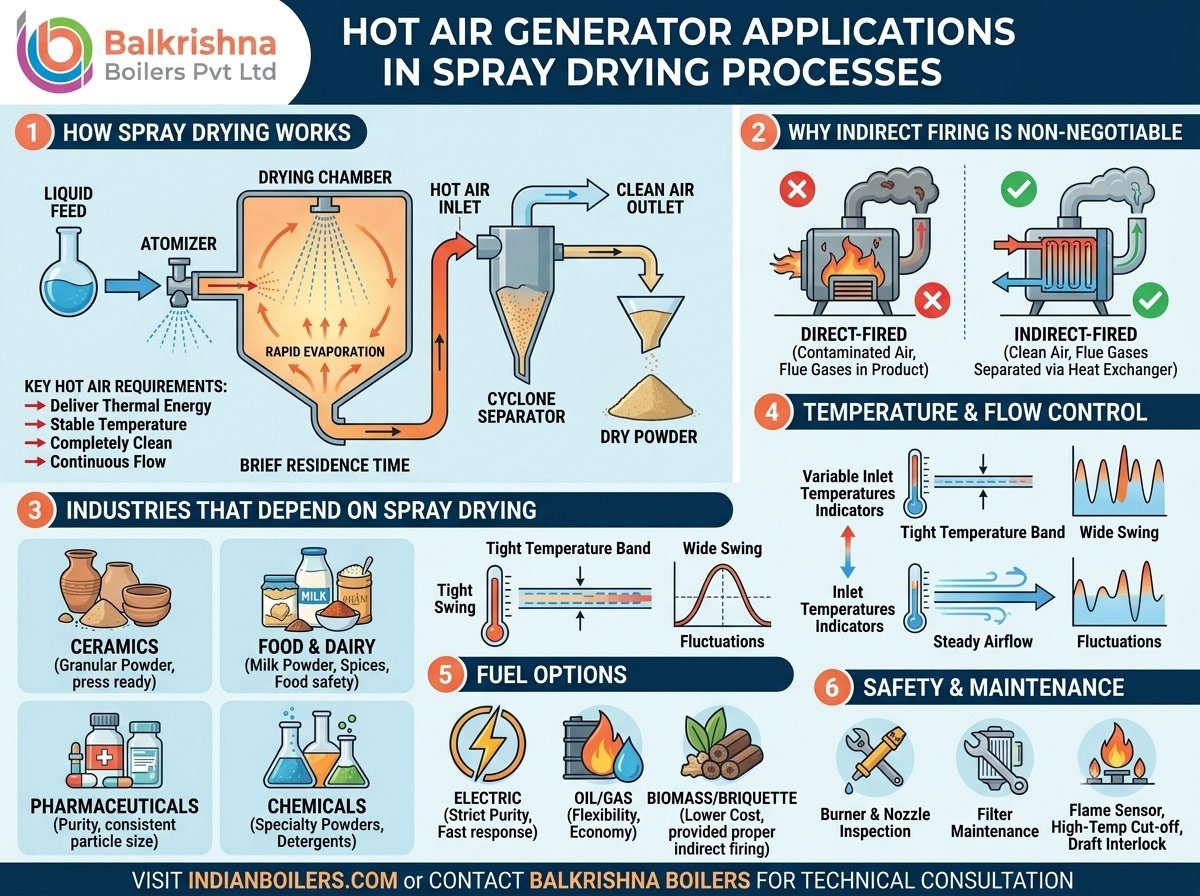
Spray drying atomizes a liquid feed — a slurry, solution, or suspension — into fine droplets inside a drying chamber, where a stream of hot air rapidly evaporates the moisture, leaving behind dry powder particles that are then separated from the air stream, typically via a cyclone separator. The entire process happens in seconds; droplets are exposed to hot air for only a brief residence time before moisture is driven off and the particle solidifies.
Because the drying happens so quickly, the hot air supply has to do several things simultaneously and consistently:
- Deliver enough thermal energy to evaporate the liquid content of every droplet within the short residence time available.
- Maintain a stable, uniform temperature — fluctuations translate directly into inconsistent particle moisture content and quality.
- Arrive completely clean, since the air comes into direct contact with the product inside the drying chamber.
- Sustain high, continuous volume flow, since spray dryers typically run continuously rather than in batches.
A hot air generator that can’t hold these four things steady doesn’t just underperform — it directly compromises the product coming out the other end.
2. Why Indirect Firing Is Non-Negotiable for Spray Drying
In spray drying, the hot air isn’t just heating a chamber from a distance — it’s in direct physical contact with the atomized product throughout the entire drying process. This makes indirect firing an absolute requirement, not a nice-to-have.
In an indirect-fired hot air generator, combustion happens in a separate furnace chamber, and heat is transferred to the process air through a heat exchanger — the flue gases from combustion never mix with the air that reaches the drying chamber. With indirect-fired models, the air delivered is 100% clean and free of combustion by-products, which is exactly why this design is standard for drying spices, milk powder, and other food and pharmaceutical products where the smallest trace of soot or combustion residue would contaminate the batch.
A direct-fired system, by contrast, would introduce flue gases straight into the drying air stream — acceptable in some low-sensitivity industrial applications, but a non-starter anywhere spray-dried product quality, purity, or food/pharma compliance matters.
3. Industries That Depend on Spray Drying — and Their Hot Air Needs
Ceramics — spray drying is widely used to convert clay slip into a free-flowing granular powder ready for pressing, and the process depends on precisely controlled hot air volume and temperature to achieve consistent granule size and moisture content across a continuous production run.
Food and dairy processing — milk powder, instant coffee, protein powders, and flavoring agents are all produced through spray drying, where indirect-fired, contamination-free air isn’t optional — it’s a food-safety requirement. Coffee processing in particular relies heavily on spray drying for instant coffee production, where consistent heat and clean air directly affect flavor retention.
Pharmaceuticals — spray drying is used for producing consistent particle-size active ingredients and excipients, where product purity requirements are amongst the strictest of any industry, making electric or clean-combustion hot air generation especially relevant.
Chemicals and specialty powders — detergents, pigments, catalysts, and industrial powders are commonly spray dried, where consistent particle characteristics depend on stable hot air supply just as much as on the atomization equipment itself.
For a broader look at how hot air generators support food and process industries beyond spray drying specifically, our post on What is a Hot Air Generator and How Does It Work? covers the underlying technology and applications range in more detail.
4. Temperature Requirements in Spray Drying
Spray drying inlet air temperature varies significantly by product and material sensitivity:
- Heat-sensitive products (certain food ingredients, some pharmaceutical compounds) require carefully controlled, moderate inlet temperatures to avoid thermal degradation of the product.
- Ceramic and mineral slurries can tolerate — and often require — higher inlet temperatures to achieve efficient drying rates for heavier, less heat-sensitive material.
- Chemical and industrial powders span a wide range depending on the specific chemistry involved.
Because inlet air temperature directly shapes the final particle characteristics — moisture content, particle density, and even flow properties of the finished powder — the hot air generator’s temperature control precision matters as much as its raw capacity. A generator that can hold a tight temperature band, rather than one that swings several degrees around a set-point, produces a more consistent batch-to-batch product.
5. Fuel Choice for Spray Drying Applications
Electric hot air generators, such as the Electric Hot Air Generator, deliver precisely controlled, completely clean air up to 350°C with no combustion involved whatsoever. For pharmaceutical spray drying or any application with the strictest purity requirements, electric systems remove any question of combustion-related contamination entirely, and their fast, precise response supports the tight temperature control that heat-sensitive product formulations often demand.
Oil/gas-fired hot air generators, like the Oil/Gas Fired Hot Air Generator, are widely used across ceramics (spray drying of clay slip), textiles, and general chemical powder processing, where indirect-fired combustion delivers reliably clean air above 200°C more efficiently than a steam-to-air heat exchanger would achieve, with the fuel flexibility to run on a range of liquid and gaseous fuels.
Biomass and briquette-fired hot air generators, such as the Wood/Briquette Fired Hot Air Generator, are used in chemical spray drying and powder processing operations where continuous, high-volume drying makes lower fuel cost the dominant economic factor, provided the application’s purity requirements allow for solid-fuel combustion (with proper indirect firing still keeping the process air itself clean).
6. Why Consistent Airflow Matters as Much as Temperature
Temperature gets most of the attention in spray drying discussions, but airflow consistency is just as critical. Spray dryers depend on a steady, predictable volume of hot air moving through the chamber to carry moisture away from atomized droplets efficiently. A hot air generator with an undersized or poorly matched blower can create airflow fluctuations that show up as inconsistent particle drying — some droplets over-dried, others under-dried — even when the temperature reading at the outlet looks correct.
This is why blower-burner interlocks are a standard safety and performance feature on quality hot air generators — burners won’t fire without confirmed airflow, which protects both equipment safety and the consistency of the air delivered downstream to the dryer.
7. Capacity Sizing for Spray Drying Operations
Sizing a hot air generator for a spray drying application depends on several factors specific to the process:
- Feed rate and moisture content of the liquid being dried — higher moisture content requires proportionally more thermal energy to evaporate per unit of throughput.
- Desired inlet and outlet air temperatures — the temperature differential drives how much heat energy needs to be delivered per unit of airflow.
- Chamber size and residence time — larger chambers with longer residence times can operate with somewhat lower inlet temperatures for the same drying outcome.
- Continuous vs batch operation — most industrial spray dryers run continuously, requiring sustained output capacity rather than intermittent bursts.
Because these variables interact closely with the specific product being dried, our engineering team typically works from actual feed rate, target moisture reduction, and desired particle characteristics to recommend appropriately sized capacity, rather than relying on generic capacity tables that don’t account for product-specific drying behavior.
8. Maintenance Considerations Specific to Spray Drying Duty
Spray dryers typically run continuously across long production campaigns, which puts hot air generators serving them into sustained, heavy-duty operation. A few maintenance points matter specifically in this context:
- Regular burner and nozzle inspection — continuous operation accelerates wear compared to intermittent-duty applications, so servicing intervals should be tightened accordingly rather than left on a generic schedule.
- Heat exchanger inspection for soot or scale build-up — any degradation here reduces heat transfer efficiency and can eventually affect delivered air temperature consistency, directly impacting product quality.
- Filter and intake maintenance — since process air draws from ambient conditions before heating, keeping intake filtration clean protects both the generator and, ultimately, product cleanliness downstream.
- Ducting insulation checks — heat lost between the generator and the spray drying chamber affects both efficiency and the actual inlet temperature reaching the product, a concern covered in more depth in our guide on Hot Water Boiler Insulation: Why It Matters for Efficiency, where the same insulation principles apply directly to hot air ducting.
9. Safety Systems for Continuous Spray Drying Operation
Because spray dryers often run around the clock during production campaigns, the hot air generator feeding them needs safety systems built for sustained, largely unattended operation:
- Flame sensors (photocells) to prevent fuel build-up if ignition fails.
- High-temperature safety cut-offs, protecting both the equipment and the product from excessive inlet temperature excursions.
- Blower-burner interlocks, ensuring the burner cannot fire without confirmed airflow.
- Chimney venting for indirect-fired units, safely exhausting combustion gases entirely separate from the clean process air stream.
These principles echo the broader safety architecture covered in our guide on Hot Water Boiler Safety Standards You Should Know — while that article focuses on water-based systems, the same layered-safety philosophy (independent cut-offs, interlocks, automated shut-off) applies directly to hot air generation equipment running continuous spray drying duty.
10. Where to Explore Suitable Systems
The full Hot Air Generator category at IndianBoilers.com covers electric, oil/gas, and biomass-fired systems suited to spray drying across ceramics, food, chemicals, and pharmaceutical applications. The same engineering carries through on our flagship manufacturing site, where the Balkrishna Boilers Hot Air Generator range includes the AIRFORCE, AIRJET, AIRMAX, AIRPAC, AIRPOWER, and AIRTHERM series.
Frequently Asked Questions
Why can’t a direct-fired hot air generator be used for spray drying? Direct-fired systems mix combustion flue gases with the process air itself. Since spray drying air comes into direct contact with the product, any combustion byproducts would contaminate the finished powder — indirect firing keeps the process air completely clean.
What temperature range is typical for spray drying inlet air? It varies significantly by product — heat-sensitive food and pharmaceutical materials require lower, tightly controlled temperatures, while ceramic slurries and industrial powders can tolerate higher inlet temperatures, often above 200°C.
Is electric hot air generation better than fuel-fired for spray drying? Not universally better — electric offers the highest purity assurance and precise temperature control, making it well suited to pharmaceutical and sensitive food applications, while fuel-fired systems remain economical and effective for ceramics, chemicals, and less purity-sensitive powder processing.
How does airflow affect spray-dried product quality, not just temperature? Inconsistent airflow can cause uneven drying across atomized droplets even when temperature readings look correct — steady, well-matched airflow is essential for uniform particle moisture content and consistent product quality batch to batch.
Final Word
Spray drying is a process where the hot air supply isn’t a supporting utility — it’s a direct input to product quality. Indirect firing keeps the air genuinely clean, precise temperature control protects sensitive formulations, and consistent airflow ensures uniform drying across every atomized droplet. Getting the hot air generator specification right is as much a product-quality decision as it is an equipment purchase.
If you’re specifying or upgrading hot air generation for a spray drying line, our engineering team can help match capacity, temperature range, and fuel type to your specific product and throughput requirements. Get in touch with IndianBoilers.com or reach out to Balkrishna Boilers for a technical consultation.