
A hot water boiler has a reputation for being the “safe cousin” of the steam boiler — and in relative terms, it is. Operating below 100°C and often outside the scope of the Boilers Act, it doesn’t carry the same explosion risk as a high-pressure steam vessel. But “safer” is not the same as “safe by default.” Every year, plants across India lose production time — and occasionally far more — to incidents that trace back to a skipped inspection, a bypassed cut-off switch, or a control panel nobody trusted enough to actually read.
Whether you run an Oil/Gas Fired Hot Water Boiler, a Biomass Fired Hot Water Boiler, or an Industrial Electric Hot Water Boiler, the safety fundamentals are the same: know the regulation that applies to you, install the right protective devices, and follow a maintenance discipline that doesn’t get skipped when the plant is busy. This guide walks through all three.
1. Where Hot Water Boilers Stand Under Indian Regulation
The first safety question any plant manager should ask isn’t “what pressure relief valve do I need” — it’s “does this equipment fall under the Boilers Act, 1923 at all?”
In India, classification hinges almost entirely on temperature, not just pressure:
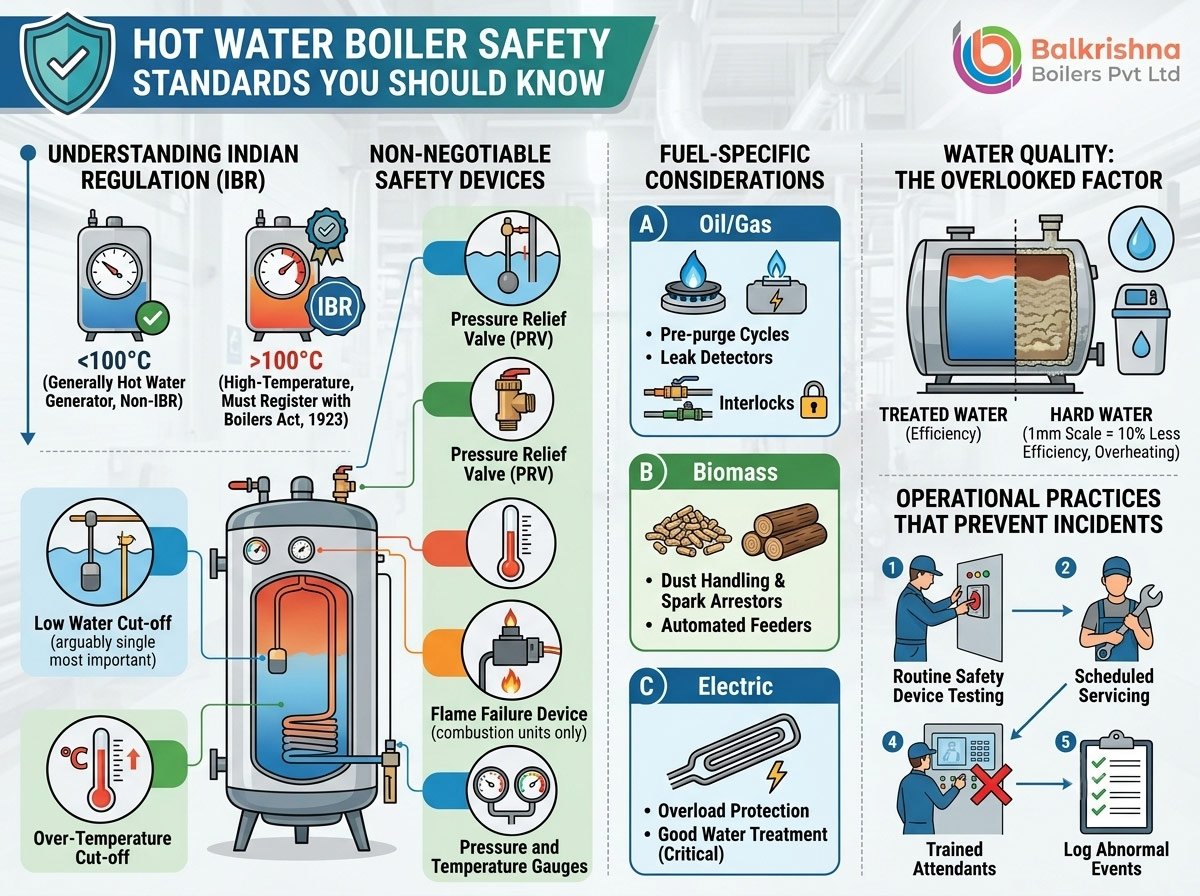
- If the outlet water temperature stays below 100°C, the unit is generally treated as a “Hot Water Generator” and does not require IBR (Indian Boiler Regulations) registration.
- If the temperature exceeds 100°C — common in High-Temperature Hot Water (HTHW) systems used for district heating or heavy process loads — the unit crosses into pressurized territory and must be registered under the Boilers Act.
This single line determines a lot of your compliance roadmap: annual government inspection cycles, whether you need a certified boiler attendant, and how your insurance provider classifies the asset. If your process genuinely needs water above 100°C, it is worth comparing that requirement against a Thermic Fluid Heater, which delivers much higher temperatures without the pressure penalties of superheated water — a trade-off explained in more detail in our post on Thermic Fluid Heater vs Hot Water Boiler: Key Differences.
For plants in regulated sectors like pharma, textiles, or food processing, compliance obligations often go beyond just the boiler itself — auditors also look at attendant certification, water treatment records, and pollution board clearances. Our guide on the Best Boiler for Textile, Pharma, and Food Industry covers how these industry-specific requirements layer on top of the base IBR framework.
2. The Non-Negotiable Safety Devices
Regardless of fuel type or IBR status, a properly engineered hot water boiler is never running on a single layer of protection. Reputable manufacturers build in overlapping, independent safeguards so that if one system fails silently, another catches it.
Low Water Level Cut-off
This is arguably the single most important safety device on any boiler. If the water level inside the shell drops below a safe threshold — due to a leak, pump failure, or valve left open — the low water cut-off immediately kills the burner or the electrical supply. Without it, a boiler can “dry fire,” where metal surfaces designed to be constantly cooled by water are suddenly exposed to flame or electrical heating elements, leading to rapid, catastrophic tube failure.
Pressure Relief Valve (PRV) / Safety Valve
Even non-pressurized, low-temperature systems are fitted with a relief valve as a secondary line of defense. If the primary temperature controls fail and pressure builds beyond the design limit, the PRV vents automatically before the vessel is stressed beyond its rating.
Over-Temperature Cut-off
A dedicated high-limit thermostat, separate from the operating controller, shuts down the heat source the moment water temperature exceeds the safe set-point — protecting against runaway heating even if the primary digital controller malfunctions.
Flame Failure / Flame Supervision Device (for combustion units)
On oil, gas, and biomass-fired systems, a flame sensor continuously confirms that combustion is actually taking place. If the flame is lost mid-cycle, fuel supply is cut instantly to prevent unburnt fuel from accumulating inside the combustion chamber — a critical safeguard against delayed ignition and flashback.
Pressure and Temperature Gauges
Simple, but essential — visible, calibrated gauges let operators catch a developing problem visually, long before an automated cut-off would need to intervene.
These aren’t optional add-ons; they’re standard across every unit in the Hot Water Boiler range at IndianBoilers.com, whether it’s a compact electric model or a large solid-fuel system rated for continuous industrial duty.
3. Safety Considerations by Fuel Type
Fuel choice changes which risks dominate, even though the underlying safety architecture stays consistent.
Oil and Gas-Fired Hot Water Boilers
The primary risks here are fuel leaks and delayed ignition. Look for automatic fuel shut-off valves, gas leak detectors on LPG/PNG systems, and pre-purge cycles that clear the combustion chamber of any residual fuel vapor before ignition is attempted. Dual-fuel and multi-fuel burners — increasingly common on units like the Oil/Gas Fired Hot Water Boiler — need interlocks that prevent both fuel lines from opening simultaneously.
Biomass and Solid Fuel Systems
Solid-fuel boilers, including Biomass Fired Hot Water Boilers and Briquette / Wood Fired Hot Water Boilers, carry two additional risk categories: fuel storage (dust and spontaneous combustion risk in biomass yards) and ash handling (burn hazards, dust exposure). Automated fuel feeders help reduce manual handling near the combustion zone, and multi-cyclone dust collectors or bag filters — standard on compliant systems — keep particulate emissions within pollution board limits while also reducing fire risk in the fuel yard itself.
Electric Hot Water Boilers
Without combustion, Industrial Electric Hot Water Boilers remove flame and fuel-leak risk entirely, but they introduce electrical safety requirements: proper earthing, overload and short-circuit protection, and — critically — good water treatment. Because heating elements sit in direct contact with water, scale buildup from hard water can cause localized overheating and premature element failure. A softener or dosing system isn’t cosmetic maintenance here; it’s a safety-relevant control.
Boilers Serving Specialized or Gaseous Fuel Streams
Plants running on biogas or byproduct fuel streams — such as units built for CBG (Compressed Biogas) plants — face variable calorific value and higher flammability handling requirements. Purpose-built systems like the Hot Water Boiler For CBG Plant are engineered with burner controls calibrated for that specific fuel behavior, rather than adapted from a standard oil/gas package.
4. Water Quality: The Overlooked Safety Factor
Water treatment doesn’t sound like a “safety” topic, but it is one of the leading causes of preventable boiler failure. Even in a closed loop, hard water deposits limescale on heat-exchange surfaces. Once scale builds up, the metal beneath it stops transferring heat efficiently and starts absorbing it instead — leading to localized overheating, stress cracking, and eventually tube failure, sometimes well before any pressure-related warning sign appears.
As a rule of thumb, just 1mm of scale buildup can reduce thermal efficiency by roughly 10%, and left unaddressed, it shortens the working life of the boiler considerably. A basic water softener, paired with periodic blowdown to remove sediment, is one of the cheapest safety investments a plant can make relative to the cost of an unplanned shutdown or tube replacement.
5. Operational Practices That Prevent Incidents
Devices alone don’t guarantee safety — they only work if the people operating the boiler use and trust them. A few practices separate well-run boiler rooms from accident-prone ones:
- Routine testing of the low water cut-off, commonly done through a “slow drain test,” where water is deliberately drained at a controlled rate to confirm the cut-off engages and shuts the burner before the level becomes unsafe.
- Scheduled servicing — a monthly visual inspection plus a deeper service roughly every six months, covering burner cleaning, pump seal checks, and sediment flushing.
- Never bypassing safety interlocks to “get through a shift” — a habit that quietly erodes every layer of protection built into the system.
- Trained attendants, even on non-IBR units where a certified attendant isn’t legally mandatory. Someone on-site should genuinely understand what each gauge and alarm means.
- Logging abnormal events — a controller that trips occasionally is telling you something before it becomes a bigger failure.
6. How This Compares Across Equipment Types
It helps to see hot water boiler safety in context against the other systems in a typical boiler house. Steam Boilers operate at far higher pressures and almost always require IBR registration, certified attendants, and a stricter inspection regime. Thermic Fluid Heaters, on the other hand, avoid high pressure entirely by heating oil instead of water, but introduce fire-point and fluid-degradation risks of their own — covered in depth in our article on Thermic Fluid Heater Safety Precautions Every Operator Should Follow. Hot water systems sit in between: simpler than steam, but not risk-free, and the right choice ultimately depends on your process temperature, not just on which system looks “easiest” to run.
7. Choosing a Compliant, Well-Engineered Boiler
Safety starts at the design and manufacturing stage, long before a unit reaches your plant. When evaluating suppliers, look for IBR-compliant material sourcing (boiler-quality steel such as SA 515/516 grade), documented hydro-testing, and a track record of installations in your specific industry.
Balkrishna Boilers Pvt Ltd manufactures across this entire spectrum through both its brands. Under the IndianBoilers.com Hot Water Boiler range, you’ll find fuel-flexible options from electric to biomass to oil/gas. On our flagship site, Balkrishna Boilers’ Hot Water Boiler series includes the AQUAJET and AQUAMAX packaged models, along with the VST SERIES, VTFH SERIES, and VTMH SERIES — each engineered with the low water cut-offs, over-temperature protection, and pressure relief systems discussed above as standard, not optional, features.
With over 25 years of manufacturing experience and 5,000+ installations across India and overseas, our engineering team designs every hot water boiler to meet — and where the application demands it, exceed — the applicable IBR and safety benchmarks. You can read more about our design and quality process on the About Us page.
8. A Quick Safety Checklist
Before your next audit or annual shutdown, run through this list:
- Is the low water cut-off tested and logged?
- Are pressure relief valves within their calibration/testing schedule?
- Is the over-temperature cut-off independent of the main controller?
- Is feed water treated, and is a softener or dosing system in place?
- Are fuel shut-off valves and flame sensors (for combustion units) functioning correctly?
- Is the electrical earthing and overload protection intact (for electric units)?
- Has ash/dust handling equipment been inspected (for solid-fuel units)?
- Is your attendant trained on emergency shutdown procedures?
Frequently Asked Questions
Does every hot water boiler in India need IBR registration? No. If the water temperature stays below 100°C, the unit is typically classified as a Hot Water Generator and is exempt from IBR registration. Above 100°C, it falls under the Boilers Act, 1923 and must be registered.
What is the most common cause of hot water boiler failure? Scale buildup from untreated water and a bypassed or malfunctioning low water cut-off are the two leading causes of preventable failure and safety incidents.
Are electric hot water boilers inherently safer than fuel-fired ones? They remove combustion-related risks (flame failure, fuel leaks, flue gas hazards) but still require rigorous electrical safety practices and water treatment to prevent element failure.
How often should safety devices be tested? Low water cut-offs should be tested via a slow drain test periodically, alongside a full service roughly every six months, with monthly visual inspections in between.
Final Word
A hot water boiler’s relative simplicity compared to a steam system is a genuine advantage — but it isn’t a substitute for disciplined safety practice. The right combination of IBR awareness, properly specified safety devices, fuel-appropriate precautions, and consistent maintenance is what actually keeps a boiler room incident-free, year after year.
If you’re evaluating a new installation or upgrading an ageing unit, our engineering team can help you match the right hot water boiler — and the right safety package — to your process. Get in touch with IndianBoilers.com or reach out to Balkrishna Boilers for a technical consultation.