
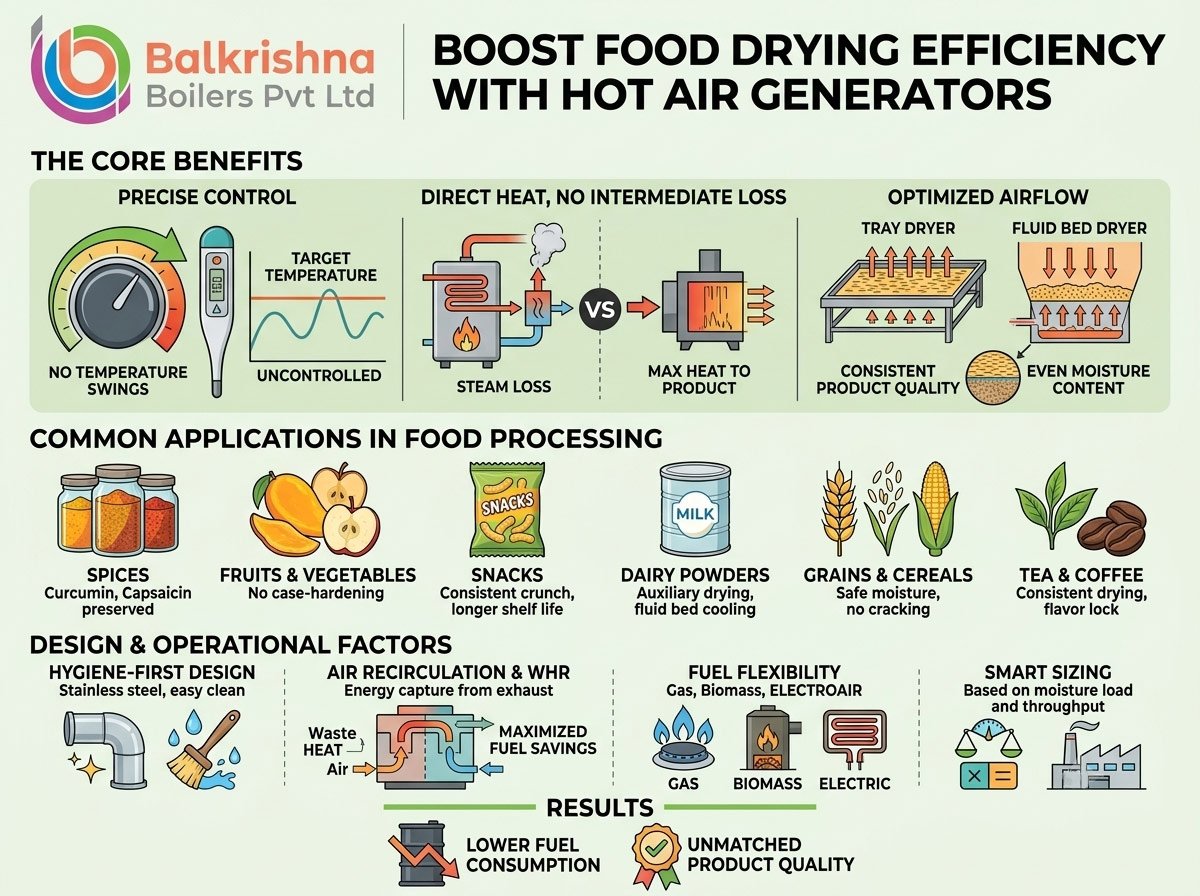
Drying is one of the oldest food preservation methods — and one of the most energy-intensive processes in modern food manufacturing. Whether it’s dehydrating fruit, drying spices, roasting snacks, or processing dairy powders, the efficiency of the hot air system driving that process has a direct, measurable impact on product quality, throughput, and operating cost. A poorly designed or undersized system doesn’t just waste fuel — it produces inconsistent moisture content, uneven color and texture, and batches that fail quality checks.
This guide explains exactly how a properly specified hot air generator improves drying efficiency in food processing plants, the design factors that separate an efficient system from a wasteful one, and how to think about hot air system selection across the range of food drying applications common in Indian food manufacturing.
1. Why Drying Efficiency Matters So Much in Food Processing
Food drying is fundamentally a moisture-removal process, and moisture removal is energy-intensive — it takes roughly 540 kcal to evaporate just one kilogram of water at 100°C. Multiply that across tons of daily product throughput, and even small efficiency losses compound into significant fuel cost over a year of operation.
Beyond cost, drying efficiency directly affects product quality:
- Uneven Drying leads to inconsistent moisture content across a batch, causing some product to be under-dried (shortening shelf life and risking spoilage) while other portions are over-dried (affecting texture, color, and yield).
- Slow Drying can allow microbial growth or enzymatic browning to continue longer than desired, particularly in fruit and vegetable drying.
- Excessive Drying Temperature can destroy heat-sensitive nutrients, flavor compounds, and color pigments — a serious quality issue in premium spice and fruit products.
A correctly designed hot air system addresses all three of these simultaneously, which is why drying efficiency isn’t just a cost question — it’s a quality and food-safety question too.
2. How Hot Air Generators Improve Efficiency: The Core Mechanisms
A. Direct Heat Delivery Without Intermediate Loss
Unlike a boiler-based system that heats water or thermal fluid, which then transfers heat to air via a separate heat exchanger, a hot air generator delivers heated air directly to the drying chamber. This eliminates one full heat exchange step and its associated losses — as explained in more depth in our comparison guide, hot air generator vs boiler: when to use which.
B. Precise Temperature Modulation
Modern hot air generators paired with modulating burners (rather than simple on/off firing) maintain much tighter temperature control around the setpoint, avoiding the temperature swings that force conservative, overly cautious drying cycles just to avoid scorching product at the peak of each swing.
C. Optimized Airflow Design
Efficiency isn’t just about how the air is heated — it’s about how evenly that heat reaches the product. Properly engineered ducting, plenum design, and airflow distribution across the drying bed ensure every part of the batch receives consistent hot air exposure, reducing the need to over-dry portions of a batch just to guarantee the slowest-drying section reaches target moisture.
D. Waste Heat Recovery Integration
Many food plants running continuous drying operations can integrate waste heat recovery — recapturing energy from exhaust air before it’s vented — to preheat incoming combustion air or ambient drying air, meaningfully reducing net fuel consumption per kilogram of moisture removed.
E. Recirculation of Drying Air
In many food drying applications, a portion of the exhaust air (which still carries usable heat and hasn’t yet reached full humidity saturation) can be recirculated and blended with fresh hot air, reducing the total fresh air volume that needs to be heated from ambient temperature.
3. Key Food Processing Applications for Hot Air Generators
A. Spice Drying
India’s spice processing industry — turmeric, chili, coriander, and a wide range of regional spices — depends heavily on controlled hot air drying to reduce moisture for stable storage while preserving color, aroma compounds, and active ingredients like curcumin or capsaicin that are sensitive to excessive heat exposure.
B. Fruit and Vegetable Dehydration
Dried fruit, vegetable flakes, and dehydrated snack ingredients require carefully staged drying — often starting at a lower temperature to prevent case-hardening (where the surface dries too fast and traps moisture inside) before increasing temperature to complete the drying cycle.
C. Snack Food Processing
Extruded and fried snack products often require a post-processing hot air drying or cooling stage to achieve final moisture content and shelf-stable texture, with consistent airflow directly affecting crunch texture and shelf life.
D. Dairy Powder Processing
While large-scale spray drying for milk powder typically uses dedicated spray dryer systems, many dairy processing facilities also rely on hot air systems for auxiliary drying, fluid bed cooling, and agglomeration processes downstream of the primary spray dryer.
E. Grain and Cereal Processing
Post-harvest grain drying and cereal processing (including breakfast cereal manufacturing) depend on consistent, well-distributed hot air to bring moisture content down to safe storage levels without cracking or discoloring the grain.
F. Tea and Coffee Processing
Tea processing in particular depends on hot air at nearly every production stage — our detailed guide on hot air generators for the tea processing industry covers this application in full depth, and many of the same drying-efficiency principles apply directly to coffee bean drying and roasting operations.
4. Direct-Fired vs Indirect-Fired: Which Is Right for Food Applications?
This choice matters more in food processing than almost any other industry, since it directly determines whether combustion gases contact the food product.
- Indirect-Fired Systems: Heat exchangers keep combustion gases completely separate from the process air stream, making this the standard, food-safe choice for the vast majority of food drying applications where product purity is non-negotiable.
- Direct-Fired Systems: Used only in specific, approved applications where combustion gas contact with the product is acceptable and regulatory-compliant — this is the exception rather than the rule in food processing, and should only be used where explicitly validated for the specific product and regulatory context.
For facilities wanting to eliminate any question of combustion contamination entirely, our electric hot air generator (ELECTROAIR) provides completely combustion-free hot air, guaranteeing zero risk of flue gas contact with the product — a strong fit for premium, export-oriented, or certification-sensitive food operations.
5. Fuel Selection for Food Plant Hot Air Systems
- Electric Hot Air Generators: Best suited for facilities prioritizing absolute product purity, precise control, and minimal on-site combustion infrastructure — particularly relevant for pharmaceutical-grade nutraceutical drying or premium branded food products.
- Gas-Fired Systems (Natural Gas, LPG, PNG): Offer clean combustion, fast response, and precise modulation, making them a popular choice for food plants with reliable gas infrastructure.
- Biomass-Fired Systems: Increasingly popular for cost-conscious food processors, particularly where agricultural waste or biomass is locally available — provided the system uses an indirect-fired design to keep combustion gases isolated from the food-contact air stream.
Balkrishna Boilers supports food processing applications with proven combustion-fired ranges including AQUAJET and AQUAMAX, alongside the EDOPAC electric range for facilities prioritizing combustion-free operation.
6. Sizing a Hot Air Generator for a Food Drying Application
Correct sizing requires understanding the actual drying load, not just guessing based on chamber size:
- Moisture Load Calculation: Determine the actual mass of water that needs to be evaporated per hour, based on incoming and target moisture content and throughput volume — this is the true driver of required heat input, not just floor area or chamber volume.
- Product-Specific Temperature Limits: Heat-sensitive products (certain spices, fruits, nutraceuticals) require lower maximum temperatures, which affects both drying time and the airflow volume needed to compensate.
- Batch vs Continuous Processing: Continuous drying lines have different heat demand profiles than batch dryers, affecting both generator sizing and control system design.
- Seasonal and Ambient Variation: Incoming air humidity and temperature vary seasonally, affecting the total heat input required to reach target drying conditions — a factor often underestimated in initial sizing calculations.
Our general sizing methodology, detailed in thermic fluid heater capacity: how to choose the right size, covers core principles — matching capacity to actual peak demand rather than average throughput — that apply equally to hot air system sizing.
7. Hygiene and Food-Safety Design Considerations
Beyond pure thermal efficiency, food plant hot air systems need specific hygiene-focused design features:
- Food-Grade Air Contact Surfaces: Ducting and chamber surfaces in contact with process air should use food-grade stainless steel or equivalent materials that resist corrosion and are easy to clean.
- Filtration: Intake air filtration prevents airborne contaminants from entering the drying chamber, particularly important for open-tray or fluid-bed drying systems.
- Cleanability: System design should allow for regular cleaning and inspection access, since residue buildup in ducting or chambers can become a contamination and pest risk over time.
- Validated Temperature Uniformity: For regulated food categories, documented temperature mapping across the drying chamber may be required to demonstrate consistent processing — a design consideration that should be built in from the specification stage, not retrofitted later.
8. Measuring and Improving Ongoing Drying Efficiency
Once a system is installed, a few operational practices help maintain — and improve — efficiency over time:
- Monitor Specific Energy Consumption: Track fuel or electricity consumed per kilogram of moisture removed as an ongoing efficiency benchmark, and investigate any upward trend promptly.
- Regular Maintenance: Clean heat exchanger surfaces (for indirect-fired systems), inspect ducting for leaks, and verify burner combustion efficiency on a routine schedule.
- Airflow Balancing: Periodically verify that airflow distribution across the drying bed remains even, since ducting or damper drift over time can quietly reduce uniformity and force conservative over-drying to compensate.
- Insulation Integrity: Check chamber and ducting insulation regularly — degraded insulation increases both energy consumption and processing time inconsistency.
9. Partner With Experts in Food Plant Hot Air Systems
Efficient food drying isn’t just about buying a bigger hot air generator — it’s about correctly sizing, configuring, and hygienically designing a system around your specific product, throughput, and quality requirements. At Indian Boilers.com, our technical team works directly with food processors to specify systems that balance drying efficiency, product quality, and food-safety compliance.
Our parent company, Balkrishna Boilers Pvt Ltd, brings over 25 years of experience and more than 5,000 installations worldwide, including extensive experience supporting food and agro-processing industries with hygienic, efficient hot air heating systems.
- Explore Our Hot Air Generator Range: indianboilers.com/product-category/hot-air-generator
- View the Full Balkrishna Boilers Range: balkrishn.com
- Get a Custom Quote for Your Food Plant: Contact our technical team with your product type and moisture reduction requirements for a tailored system proposal.