
Choosing a hot air generator involves more than just picking a capacity and a fuel type. One of the most consequential decisions — often overlooked until it causes a compliance or quality problem later — is whether to specify a direct-fired or indirect-fired system. The two designs look similar from the outside, but they work on fundamentally different principles, and choosing the wrong one for your process can mean anything from reduced efficiency to a serious product contamination risk.
This guide breaks down exactly how each type works, where each is the right — or wrong — choice, and how to make this decision correctly for your specific application. If you’re still deciding whether a hot air generator is the right technology at all, our broader guide on hot air generator vs boiler: when to use which is a useful starting point before diving into this direct-vs-indirect comparison.
1. What Is a Direct-Fired Hot Air Generator?
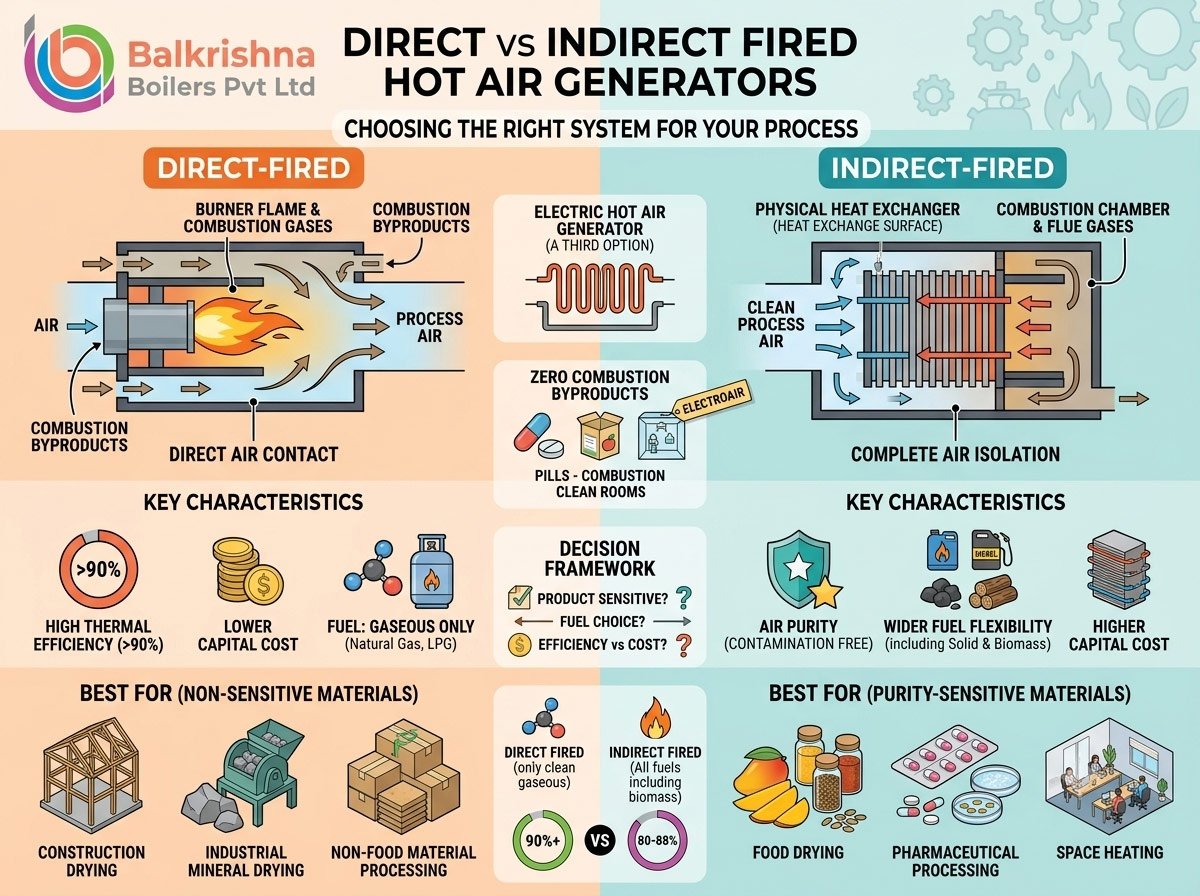
In a direct-fired hot air generator, the burner flame and its combustion gases mix directly with the process air stream that will be delivered to your application. There is no barrier or heat exchanger between the flame and the air reaching your product — the combustion byproducts (carbon dioxide, water vapor, and trace combustion gases) become part of the air stream itself.
How It Works
- Fuel is combusted in a burner positioned directly in the airflow path.
- Process air is drawn through or around the flame, absorbing heat directly from the combustion reaction.
- The heated air — now containing combustion byproducts — is delivered to the drying chamber, oven, or process point.
Key Characteristic
Because there’s no heat exchanger limiting heat transfer, direct-fired systems achieve very high thermal efficiency — often 90% or higher — since essentially all the heat released by combustion ends up in the delivered air stream, with minimal loss.
2. What Is an Indirect-Fired Hot Air Generator?
In an indirect-fired hot air generator, combustion happens in a separate, sealed combustion chamber. The hot combustion gases pass through a heat exchanger, transferring their heat to a completely separate stream of clean process air — with no physical contact or mixing between the two air streams. The combustion gases are then vented separately through a chimney or flue, just as they would be in a conventional boiler.
How It Works
- Fuel is combusted in an isolated combustion chamber.
- Hot flue gases pass through one side of a heat exchanger.
- Clean process air, drawn from a separate source, passes through the other side of the heat exchanger, absorbing heat without any contact with combustion gases.
- The heated, contamination-free process air is delivered to the application; flue gases are vented separately.
Key Characteristic
Because heat has to pass through a physical heat exchanger surface rather than transferring directly, indirect-fired systems carry a small efficiency penalty compared to direct-fired designs — typically landing in the 80-88% range depending on heat exchanger design — but this trade-off buys complete air purity.
3. The Core Trade-Off: Efficiency vs Air Purity
The entire direct-vs-indirect decision comes down to one central trade-off:
| Factor | Direct-Fired | Indirect-Fired |
|---|---|---|
| Thermal Efficiency | Higher (often 90%+) | Slightly lower (typically 80-88%) |
| Air Purity | Combustion gases present in process air | Completely isolated, contamination-free |
| Capital Cost | Generally lower (simpler construction) | Generally higher (heat exchanger required) |
| Suitable Fuels | Cleaner-burning fuels only (gas, LPG) | Wider fuel flexibility, including solid fuels |
| Best For | Non-food, non-sensitive material drying | Food, pharma, and any purity-sensitive process |
Neither design is universally “better” — the right choice depends entirely on whether your process can tolerate combustion byproducts in the airstream reaching your product.
4. When to Choose a Direct-Fired System
Direct-fired hot air generators are the right choice when:
- The product being processed is not sensitive to combustion contact — such as certain construction materials, non-food minerals, or industrial drying applications where air purity isn’t a regulatory or quality concern.
- Maximum thermal efficiency is the priority, and the process can only use clean-burning fuels like natural gas or LPG (since solid or liquid fuels typically aren’t suitable for direct-fired designs due to particulate and byproduct concerns).
- Fast heat-up and high turndown response matters more than absolute air purity — direct-fired systems generally respond very quickly to load changes since there’s no heat exchanger thermal mass to overcome.
- Capital cost is a significant constraint, since direct-fired systems are mechanically simpler and typically less expensive than an equivalent-capacity indirect-fired unit.
5. When to Choose an Indirect-Fired System
Indirect-fired hot air generators are the right — and often the only acceptable — choice when:
- The process involves food, pharmaceutical, or any product requiring guaranteed air purity. Our detailed guide on how hot air generators improve drying efficiency in food plants explains why indirect-fired design is the standard, food-safe choice for the vast majority of food drying applications.
- Regulatory or certification requirements mandate that process air cannot contain combustion byproducts — common in pharmaceutical drying, certain export food certifications, and specific industrial quality standards.
- Solid fuel or biomass firing is required, since the particulate and byproduct load from solid fuel combustion makes direct air contact unsuitable for almost any application where product quality matters.
- The application involves an enclosed or occupied space, such as space heating or curing rooms where personnel may be present, and combustion byproduct buildup would pose an air-quality or safety concern.
Tea processing is a useful real-world example of this decision point — our guide on hot air generators for the tea processing industry covers how indirect-fired design protects leaf quality and flavor purity throughout the drying and firing stages.
6. Fuel Compatibility Differences
One of the most practically important differences between the two designs is fuel flexibility:
- Direct-Fired Systems: Generally limited to clean-burning gaseous fuels (natural gas, LPG, PNG) since any particulate matter or incomplete combustion byproducts go directly into the process air stream.
- Indirect-Fired Systems: Can use virtually any fuel — natural gas, LPG, diesel, furnace oil, coal, or biomass — since combustion gases never contact the process air, and only the heat exchanger’s material rating limits fuel choice, not air-quality concerns.
This makes indirect-fired systems the default choice whenever solid fuel or biomass firing is desired, regardless of whether air purity itself is a strict requirement for the application.
7. Electric Hot Air Generators: A Third Option
Worth noting alongside the direct/indirect comparison is a third category: electric hot air generators, which eliminate combustion entirely. Our electric hot air generator (ELECTROAIR) heats process air using electric resistance elements, guaranteeing zero combustion byproducts with none of the trade-offs involved in choosing between direct and indirect fired designs. This makes electric systems an increasingly popular choice for the most purity-sensitive applications, or for facilities pursuing a broader decarbonization strategy across their thermal energy systems.
8. Maintenance and Reliability Differences
- Direct-Fired Systems: Generally simpler mechanically, with fewer components subject to wear — but burner tuning and combustion quality require more careful ongoing attention, since combustion quality directly determines process air quality.
- Indirect-Fired Systems: The heat exchanger is the critical maintenance component — fouling, corrosion, or leaks in the heat exchanger over time can both reduce efficiency and, in a worst-case scenario, compromise the air-purity barrier the system exists to provide. Routine heat exchanger inspection is essential for indirect-fired systems specifically.
9. Making the Right Decision for Your Application
Use this simple framework to guide the decision:
- Does your product need to be completely free of combustion contact? If yes, indirect-fired (or electric) is mandatory — this isn’t a trade-off decision, it’s a requirement.
- Do you need to use solid fuel or biomass? If yes, indirect-fired is required, since direct-fired designs aren’t suitable for these fuel types.
- Is maximum thermal efficiency the top priority, and your product isn’t purity-sensitive? Direct-fired offers a genuine efficiency and cost advantage in this scenario.
- Are you prioritizing the cleanest, most controllable heat with zero combustion involvement at all? An electric hot air generator removes the direct-vs-indirect question entirely.
10. Get Expert Guidance on the Right Configuration
Choosing between direct-fired, indirect-fired, and electric hot air generators has real consequences for product quality, compliance, and operating cost — it’s a decision worth getting right at the specification stage rather than discovering a mismatch after installation. At Indian Boilers.com, our technical team helps plants across food, pharma, tea, textile, and general industrial applications specify the correct configuration for their exact process requirements.
Our parent company, Balkrishna Boilers Pvt Ltd, brings over 25 years of experience and more than 5,000 installations worldwide across direct-fired, indirect-fired, and electric heating technologies.
- Explore Our Hot Air Generator Range: indianboilers.com/product-category/hot-air-generator
- View the Full Balkrishna Boilers Range: balkrishn.com
- Get Expert Recommendations: Contact our technical team with your product and purity requirements for a tailored equipment recommendation.