
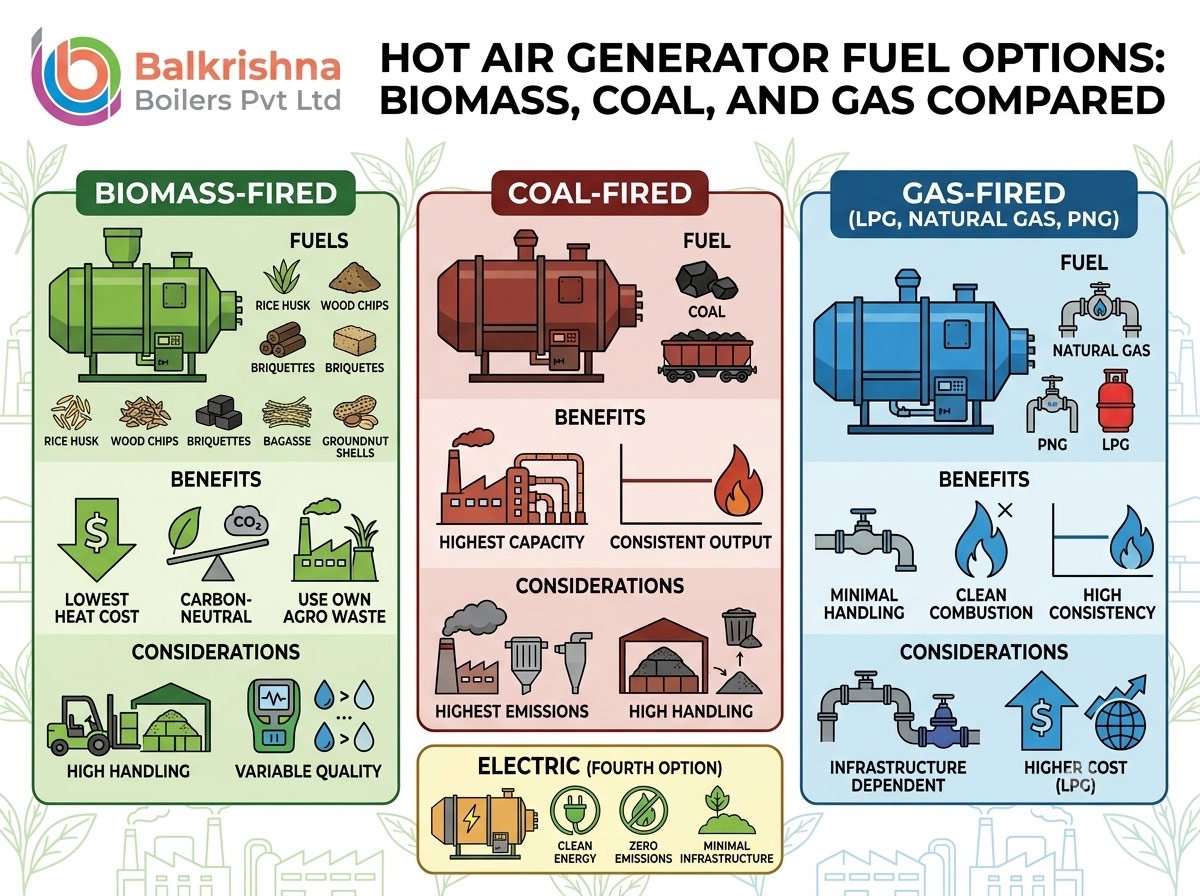
Once you’ve decided a hot air generator is the right technology for your process — and whether a direct-fired or indirect-fired design fits your purity requirements — the next major decision is fuel. This choice affects everything from day-to-day running cost to long-term compliance, infrastructure investment, and how resilient your heating supply is to fuel price volatility.
This guide compares the three most common fuel categories for industrial hot air generators — biomass, coal, and gas — across cost, efficiency, emissions, handling complexity, and availability, so you can make a fuel decision based on your plant’s actual constraints rather than habit or convenience.
1. Why Fuel Choice Matters More Than It Seems
Fuel isn’t just an operating cost line item — it shapes your entire plant infrastructure. Solid fuels require storage yards, handling equipment, and ash disposal systems. Gas requires reliable pipeline or cylinder supply and pressure regulation infrastructure. Each choice also carries different compliance obligations, different emissions profiles, and different sensitivity to price fluctuations in national and global commodity markets.
Getting this decision right at the specification stage avoids costly retrofits later — switching a hot air generator’s fuel type after installation is rarely a simple swap, particularly between solid fuel and gas-fired designs.
2. Biomass-Fired Hot Air Generators
A. How It Works
Biomass-fired systems burn organic material — wood chips, rice husk, groundnut shells, briquettes, bagasse, or other agricultural residue — in a combustion chamber, typically paired with an indirect-fired heat exchanger design to keep combustion byproducts out of the process air stream (essential for food and other purity-sensitive applications).
B. Cost Profile
Biomass is generally the lowest-cost fuel option per unit of heat generated, particularly for plants located near agricultural regions with reliable local biomass supply. Many food and agro-processing plants can even use their own process waste (husk, shells, pruning material) as fuel, effectively reducing both fuel cost and waste disposal cost simultaneously.
C. Emissions Profile
Biomass is generally considered carbon-neutral on a lifecycle basis, since the CO2 released during combustion roughly equals the CO2 absorbed by the plant material during its growth cycle — a meaningful sustainability advantage for plants pursuing environmental certifications or export market requirements.
D. Handling Complexity
Biomass requires the most handling infrastructure among the three fuel types: storage yards or silos, fuel feeding systems, and regular ash removal. Fuel quality and moisture content also vary more than with coal or gas, requiring more attentive combustion management to maintain consistent heat output.
E. Best Suited For
Plants located near reliable biomass supply chains, agro-processing facilities that can use their own waste as fuel, and operations prioritizing lower fuel cost and sustainability credentials over operational simplicity.
3. Coal-Fired Hot Air Generators
A. How It Works
Coal-fired systems burn coal in a furnace, with heat transferred to process air via an indirect-fired heat exchanger. Coal offers a higher, more consistent energy density than most biomass fuels, making it well suited to high-capacity, continuous-duty applications.
B. Cost Profile
Coal has historically offered stable, moderate fuel costs in India, with well-established supply chains in most industrial regions — though pricing has become more volatile in recent years due to regulatory changes and supply chain shifts.
C. Emissions Profile
Coal carries the highest emissions profile of the three options, including particulate matter, sulfur dioxide, and a meaningfully higher carbon footprint than biomass or gas. Plants using coal typically need appropriate emissions control equipment (cyclones, bag filters) to meet pollution control board requirements.
D. Handling Complexity
Similar to biomass, coal requires storage, handling, and ash disposal infrastructure, though coal’s more consistent fuel quality generally simplifies combustion management compared to variable-moisture biomass.
E. Best Suited For
High-capacity, continuous-duty operations in regions with established coal supply chains, where regulatory and emissions control requirements can be adequately met — though many plants are increasingly transitioning away from coal toward biomass or gas due to tightening emissions regulations and evolving compliance requirements.
4. Gas-Fired Hot Air Generators (Natural Gas, LPG, PNG)
A. How It Works
Gas-fired systems burn natural gas, LPG, or piped natural gas (PNG) in a burner, either in a direct-fired configuration (where combustion gases mix directly with process air) or indirect-fired (where a heat exchanger isolates the two streams). Gas’s clean-burning nature makes it the only fuel type suitable for direct-fired systems where maximum thermal efficiency is the priority and product purity requirements allow it — a distinction covered in depth in our direct vs indirect fired hot air generators guide.
B. Cost Profile
Gas pricing varies significantly by region and supply source (piped natural gas is generally more cost-stable than LPG, which is more exposed to global price volatility), but gas-fired systems typically offer the lowest total cost of ownership when reliable pipeline infrastructure is available, due to minimal handling costs and high combustion efficiency.
C. Emissions Profile
Natural gas and LPG burn considerably cleaner than coal, with lower particulate matter, no ash byproduct, and generally lower CO2 emissions per unit of heat generated — though still a fossil fuel with a higher carbon footprint than biomass on a lifecycle basis.
D. Handling Complexity
Gas-fired systems require the least on-site handling infrastructure — no storage yard, no ash disposal, no fuel feeding system — just a properly regulated supply line. This significantly simplifies plant layout and reduces labor requirements compared to solid fuel systems.
E. Best Suited For
Plants with access to reliable pipeline gas or LPG supply, operations prioritizing minimal handling infrastructure and labor, and applications where direct-fired efficiency gains are valuable and product purity requirements allow it.
5. Side-by-Side Comparison
| Factor | Biomass | Coal | Gas |
|---|---|---|---|
| Typical Fuel Cost | Lowest | Moderate | Moderate to higher (region-dependent) |
| Emissions Profile | Lowest (near carbon-neutral) | Highest | Low to moderate |
| Handling Infrastructure | High (storage, feeding, ash) | High (storage, handling, ash) | Minimal |
| Fuel Availability | Region-dependent | Regionally established | Pipeline/cylinder-dependent |
| Suitable for Direct-Fired Design | No | No | Yes |
| Combustion Consistency | Variable (moisture-dependent) | Consistent | Highly consistent |
| Best Fit | Agro-processing, cost-sensitive plants | High-capacity continuous duty | Clean, low-handling operations |
6. Multi-Fuel and Dual-Fuel Flexibility
Many modern hot air generators are designed with multi-fuel or dual-fuel flexibility, allowing plants to switch between fuel types based on availability and pricing — a valuable hedge against fuel supply disruption or price volatility in any single fuel market. This flexibility is particularly valuable for plants in regions where biomass availability fluctuates seasonally, or where gas supply reliability varies.
Balkrishna Boilers’ proven ranges, including AQUAJET and AQUAMAX, are engineered with fuel flexibility in mind, and our technical team can advise on multi-fuel configurations suited to your plant’s specific supply situation.
7. Electric as a Fourth Option
Beyond the three combustion fuel types, electric hot air generators eliminate fuel handling, combustion emissions, and supply chain dependency entirely. Our electric hot air generator (ELECTROAIR) is worth considering alongside biomass, coal, and gas — particularly for plants prioritizing zero on-site emissions, minimal infrastructure, or a broader decarbonization strategy, provided the local electricity supply and cost structure make it economically viable for the required capacity. Balkrishna Boilers offers the equivalent EDOPAC range for electric-fired thermal applications.
8. How Fuel Choice Interacts With Application Requirements
Fuel selection shouldn’t happen in isolation from your process requirements:
- Food and Purity-Sensitive Applications: Generally require indirect-fired design regardless of fuel choice, as detailed in our guide on how hot air generators improve drying efficiency in food plants — this makes biomass, coal, and indirect-fired gas all viable, while direct-fired gas is typically excluded.
- Agro-Processing Applications (Tea, Spices, Grain): Often well suited to biomass, particularly when the plant’s own agricultural waste can serve as fuel — our guide on hot air generators for the tea processing industry explores this in detail.
- High-Capacity, Continuous-Duty Industrial Applications: May favor coal or gas depending on regional supply and emissions compliance requirements.
9. Making the Right Fuel Decision for Your Plant
Consider these questions when finalizing fuel choice:
- What fuel infrastructure is reliably available at your location? Availability often narrows the decision before cost or efficiency even enter the conversation.
- Does your process require direct-fired efficiency, or must it be indirect-fired for purity reasons? This immediately determines whether gas-only direct-fired options are even on the table.
- What are your emissions compliance requirements and sustainability goals? These increasingly favor biomass or gas over coal in most Indian states.
- Can your process use its own waste material as biomass fuel? This can meaningfully change the economics of an agro-processing operation’s fuel decision.
- How much on-site handling infrastructure and labor can your plant support? Gas minimizes this; solid fuels require dedicated investment and manpower.
10. Get Expert Fuel and Equipment Guidance
Choosing the right fuel for your hot air generator is a decision that shapes your plant’s operating cost, compliance profile, and infrastructure investment for years to come. At Indian Boilers.com, our technical team helps plants evaluate fuel options against their actual local supply situation, process requirements, and long-term cost projections — not just generic fuel comparisons.
Our parent company, Balkrishna Boilers Pvt Ltd, brings over 25 years of experience and more than 5,000 installations worldwide across biomass, coal, gas, and electric-fired heating systems.
- Explore Our Hot Air Generator Range: indianboilers.com/product-category/hot-air-generator
- View the Full Balkrishna Boilers Range: balkrishn.com
- Get Fuel-Specific Guidance: Contact our technical team with your location and fuel availability details for a tailored recommendation.