
India is one of the world’s largest rice producers and exporters, and behind every bag of milled rice lies a heat-intensive processing chain — paddy drying, parboiling, and post-processing — almost entirely dependent on hot air. Rice millers who get this heating process right achieve higher head rice yield (the percentage of unbroken grains, which directly determines profitability), lower moisture-related spoilage, and more consistent quality across every batch. Millers who don’t get it right lose margin to broken grains, discoloration, and rejected export shipments.
This guide walks through exactly where hot air generators are used across the rice milling process, why heat precision matters so much to rice quality and yield, and how to specify the right system for a mill’s specific capacity and processing method.
1. Why Rice Milling Is So Heat-Dependent
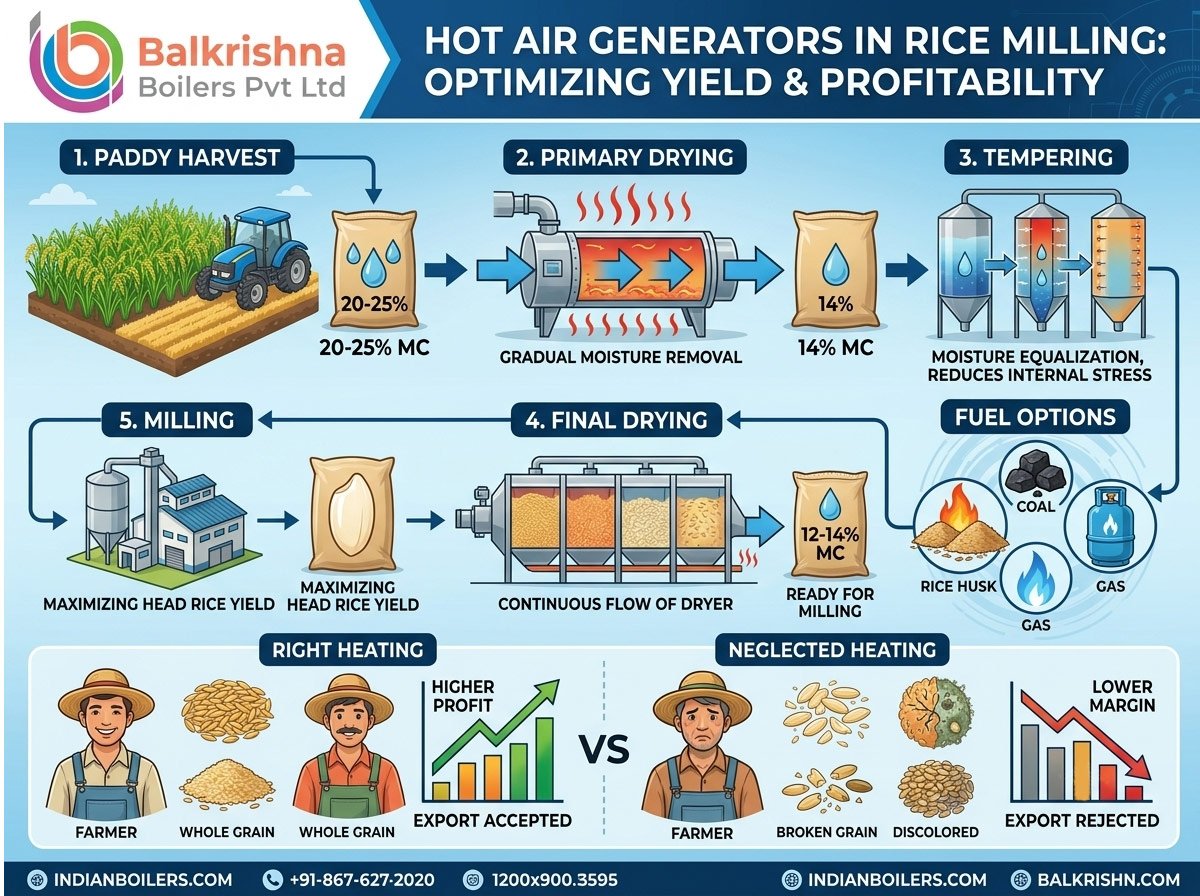
Freshly harvested paddy typically arrives at the mill with moisture content between 20-25%, but safe long-term storage and milling require moisture content around 12-14%. Removing that moisture — without cracking the grain, which directly reduces head rice yield — is one of the most technically demanding drying challenges in food processing, because rice kernels are genuinely fragile to thermal stress.
Beyond drying, many rice varieties (particularly for parboiled rice production, common across much of India and a major export category) undergo a heat-intensive parboiling process before milling, adding another layer of hot air and steam dependency to the production chain.
2. Key Hot Air Applications in Rice Milling
A. Paddy Drying
The single largest and most critical hot air application in any rice mill. Freshly harvested paddy is dried in batch or continuous flow dryers using controlled hot air to reduce moisture content gradually — rushing this process with excessively high temperatures is one of the leading causes of grain cracking and reduced head rice yield.
B. Parboiled Rice Drying
After the parboiling process (soaking, steaming, and partial cooking of paddy before milling), the grain carries significantly higher moisture content than raw paddy and requires substantial hot air drying capacity to bring it back down to safe milling moisture — typically the highest-volume drying stage in mills that process parboiled rice.
C. Post-Milling Moisture Adjustment
Even after primary drying and milling, some rice requires final moisture adjustment or conditioning using controlled hot air to meet precise export or premium market moisture specifications.
D. Bran and By-Product Drying
Rice bran, a valuable by-product used for oil extraction and animal feed, also requires drying to prevent rancidity and spoilage — an often-overlooked but economically meaningful hot air application within an integrated rice mill.
E. Storage Facility Aeration
Some larger milling and storage operations use gently heated air for aeration and moisture control within storage silos, helping maintain grain quality during extended storage periods between harvest and processing or shipment.
3. Why Drying Temperature Precision Directly Affects Profitability
Rice milling economics are dominated by head rice yield — the percentage of kernels that remain whole through the milling process, since broken rice sells at a significant price discount compared to whole grain. Drying temperature and rate directly affect this yield:
- Too-Fast Drying: Rapid moisture removal creates internal stress within the kernel due to uneven moisture gradients between the surface and core, leading to fissuring — microscopic cracks that don’t show up until the milling stage, where they cause the kernel to break.
- Too-Slow Drying: While gentler on the grain, excessively slow drying increases the risk of mold growth, discoloration, and quality deterioration, particularly in humid storage conditions before drying is complete.
- Uneven Drying: Inconsistent hot air distribution across a drying batch leaves some grain over-dried while other portions remain under-dried, both of which reduce overall milling yield and quality grade.
This is precisely why hot air generator design — airflow uniformity, temperature stability, and staged temperature control — has such a direct, measurable impact on a rice mill’s bottom line, not just its energy bill.
4. Multi-Stage Drying: The Industry Best Practice
Modern rice drying increasingly uses a multi-pass or multi-stage drying approach rather than attempting to dry paddy to final moisture content in a single continuous pass:
- Initial Drying Pass: Reduces moisture content moderately, often from 22-24% down to around 18%, using moderate temperature to avoid thermal shock to the freshly harvested grain.
- Tempering Period: Grain rests between drying passes, allowing internal moisture to equalize from the core toward the surface, reducing stress on the kernel before the next drying pass.
- Subsequent Drying Passes: Additional passes gradually bring moisture content down to the final 12-14% target, with tempering periods between each pass.
This staged approach, while requiring more total processing time than single-pass drying, significantly improves head rice yield — making it the preferred method among quality-focused mills, particularly those serving export or premium domestic markets where yield and grain integrity directly determine pricing.
5. Fuel Options for Rice Mill Hot Air Systems
A. Rice Husk-Fired Systems
One of the most elegant fuel solutions in industrial processing: rice husk, a by-product of the milling process itself, is an excellent biomass fuel for drying the next batch of paddy. This creates a highly efficient closed-loop fuel cycle, dramatically reducing both fuel cost and husk disposal requirements simultaneously — a major reason rice husk-fired hot air generators are so widely adopted across Indian rice mills.
B. Other Biomass Fuels
Where rice husk supply doesn’t fully meet drying demand, other agricultural biomass — wood chips, other crop residues — can supplement or substitute, depending on regional availability.
C. Coal-Fired Systems
Some larger mills, particularly those requiring high, consistent drying capacity beyond what husk supply alone can support, use coal-fired systems for reliable, high-capacity heat output.
D. Gas-Fired Systems
For mills prioritizing precise temperature modulation and faster response — valuable for multi-stage drying protocols requiring accurate temperature control between passes — gas-fired systems offer cleaner combustion and tighter control than solid fuel alternatives.
Since rice husk and other biomass fuels require indirect-fired designs to keep combustion byproducts isolated from food-contact air, our guide on direct vs indirect fired hot air generators explained is a useful reference for understanding why this design choice matters specifically for food-grade drying applications like rice.
Balkrishna Boilers supports rice milling operations with proven ranges including AQUAJET and AQUAMAX for combustion-fired systems, well suited to rice husk and biomass fuel configurations common across Indian rice milling clusters.
6. Sizing a Hot Air Generator for a Rice Mill
Correct sizing depends on several rice-industry-specific factors:
- Daily Paddy Intake Volume: The core driver of drying capacity requirements, which should be sized for peak harvest-season intake rather than average annual throughput.
- Initial and Target Moisture Content: The moisture reduction required (e.g., from 22% down to 13%) directly determines total heat energy needed per ton of paddy processed.
- Parboiling Volume (If Applicable): Mills processing parboiled rice need substantially more drying capacity than raw rice mills, given the higher post-parboiling moisture content requiring removal.
- Drying Method: Batch dryers and continuous flow dryers have different heat demand profiles and capacity requirements, affecting overall system sizing.
- Seasonal Harvest Peaks: Rice mills often face extreme seasonal demand swings around harvest season — sizing for this peak, not average annual volume, prevents bottlenecks during the mill’s busiest and most profitable period.
For general sizing methodology applicable across our heating product range, our guide on thermic fluid heater capacity: how to choose the right size explains core principles that apply equally to hot air drying system sizing.
7. Maintenance Priorities Specific to Rice Milling
Rice mill hot air systems face specific operational stresses that deserve particular maintenance attention:
- Husk Ash and Silica Content: Rice husk ash has a notably high silica content, which can be more abrasive to combustion chamber refractory than other biomass fuels — more frequent refractory inspection is a worthwhile precaution.
- Dust Management: Rice milling generates significant fine dust, requiring careful filter maintenance and combustible dust control around heat sources.
- Seasonal Intensive-Use Periods: Since mills often run at peak capacity for extended periods during harvest season, pre-season maintenance inspection — rather than waiting for an in-season breakdown — protects against costly downtime during the mill’s most critical operating window.
Our broader guide on maintenance tips to extend hot air generator life covers the complete maintenance framework that applies across all hot air generator applications, including rice milling.
8. Sustainability and Cost Advantages of Husk-Fired Drying
Beyond the direct cost savings of using a by-product fuel, husk-fired rice drying offers meaningful sustainability advantages that increasingly matter to export-focused mills:
- Waste Reduction: Converting husk (which would otherwise require disposal) into productive fuel eliminates a significant waste management burden.
- Lower Carbon Footprint: Biomass fuel combustion is generally considered carbon-neutral on a lifecycle basis, an increasingly important consideration for mills supplying environmentally conscious export markets.
- Reduced Dependency on External Fuel Supply: A closed-loop husk-fuel cycle insulates the mill from external fuel price volatility to a meaningful degree, since a significant portion of drying fuel is generated on-site.
9. Partner With Experts in Rice Milling Heat Systems
Rice milling profitability depends heavily on getting the drying process right — and that starts with correctly specified, precisely controlled hot air generation. At Indian Boilers.com, our technical team has supported rice milling operations across India’s major rice-growing regions with systems sized and configured around actual paddy intake volumes and seasonal demand patterns.
Our parent company, Balkrishna Boilers Pvt Ltd, brings over 25 years of experience and more than 5,000 installations worldwide, including extensive experience supporting agro-processing industries with the reliability and fuel efficiency rice milling operations depend on.
- Explore Our Hot Air Generator Range: indianboilers.com/product-category/hot-air-generator
- View the Full Balkrishna Boilers Range: balkrishn.com
- Get a Custom Quote for Your Rice Mill: Contact our technical team with your daily paddy intake and moisture reduction requirements for a tailored system proposal.