
India’s poultry industry has grown into one of the largest in the world, and behind every tonne of finished feed lies a heat-dependent manufacturing process that directly determines feed quality, nutritional integrity, and shelf stability. From conditioning raw ingredients before pelleting to drying and cooling the finished pellet, hot air generators play a central role at multiple stages of the poultry feed production line — and getting the heat wrong at any one of these stages shows up directly in feed quality, pellet durability, and ultimately, bird performance on the farm.
This guide covers exactly where hot air generators are used across poultry feed processing, why temperature and moisture precision matter so much to feed quality, and how to specify the right system for a feed mill’s capacity and product mix.
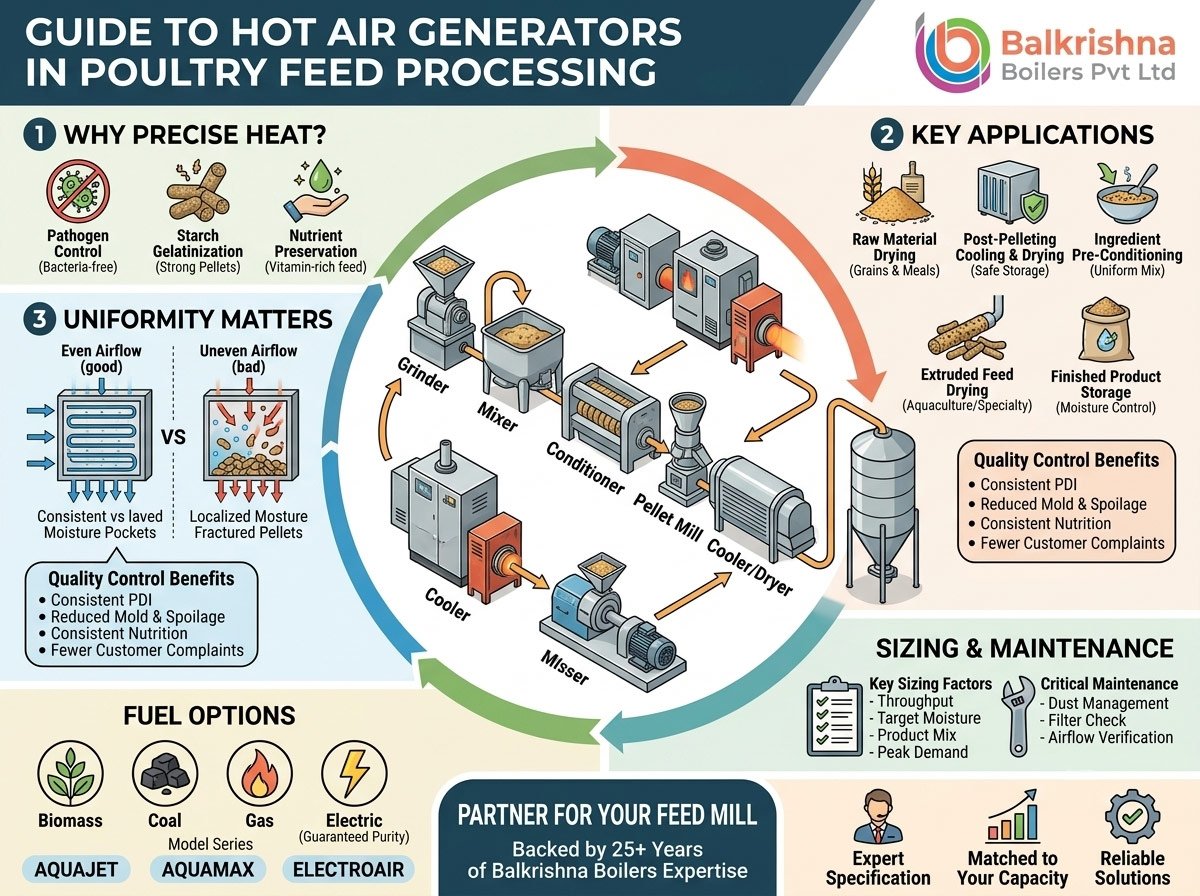
1. Why Poultry Feed Processing Depends on Precise Heat Control
Poultry feed manufacturing involves grinding, mixing, conditioning, pelleting, and drying a combination of grains, protein meals, vitamins, and additives into a stable, nutritionally consistent finished product. Heat plays multiple, sometimes competing roles throughout this process:
- Pathogen Control: Adequate heat exposure during conditioning and pelleting helps reduce pathogenic bacteria (such as Salmonella) in the finished feed — a critical food-safety consideration for the poultry supply chain.
- Starch Gelatinization: Controlled heat and moisture during conditioning improves starch gelatinization, which directly improves pellet binding quality and durability.
- Nutrient Preservation: Excessive heat exposure can degrade heat-sensitive vitamins and certain amino acids, meaning the process must balance adequate pathogen control against nutrient preservation.
- Moisture and Shelf Stability: Final moisture content after drying directly determines how long finished feed remains stable in storage before mold growth or nutrient degradation becomes a risk.
This balance — enough heat for safety and pellet quality, not so much that nutritional value is compromised — is exactly why precise, well-controlled hot air systems matter so much in this industry.
2. Key Hot Air Applications in Poultry Feed Processing
A. Post-Pelleting Cooling and Drying
Immediately after pelleting, feed pellets emerge hot (often 80-90°C) and with elevated moisture content from the steam conditioning process. Controlled airflow — typically ambient or gently warmed air rather than high-temperature heating — cools and dries pellets to safe storage temperature and moisture content before packaging. Poor airflow distribution at this stage is one of the most common causes of inconsistent pellet moisture and reduced shelf stability.
B. Raw Material Drying
Incoming raw ingredients — particularly grains and certain protein meals — sometimes arrive with moisture content too high for stable storage or optimal processing, requiring hot air drying before they enter the main production line.
C. Ingredient Pre-Conditioning
Some feed formulations benefit from pre-conditioning specific ingredients with controlled heat before they’re blended into the main mash, improving downstream processing consistency.
D. Extruded Feed Drying (Aqua and Specialty Feed)
For extruded feed products, including specialty and aquaculture feed often produced on shared processing lines, post-extrusion drying requires more substantial and precisely controlled hot air than standard pelleted poultry feed, given the different moisture profile extrusion produces.
E. Finished Product Storage Conditioning
Some larger feed mills use controlled hot air for silo or storage area conditioning, helping maintain consistent moisture and preventing condensation-related quality issues during storage before dispatch.
3. Why Airflow Uniformity Matters as Much as Temperature
In feed pellet cooling and drying specifically, even airflow distribution across the full cross-section of the cooling column or drying bed is just as important as the temperature setpoint itself. Uneven airflow leaves some pellets over-dried and brittle (reducing pellet durability index, a key quality metric feed buyers measure) while others remain under-dried, creating localized moisture pockets that can trigger mold growth during storage or transport — even when the average moisture reading for the batch appears acceptable.
This is a similar principle to the cross-width uniformity challenge described in our guide on hot air generators for textile stenter machines — in both industries, average performance across a batch matters far less than consistency at every point within that batch.
4. Direct-Fired vs Indirect-Fired for Feed Processing
Because poultry feed is a consumable product entering the animal (and ultimately human) food chain, air purity in any hot air process directly touching the feed is a meaningful consideration:
- Indirect-Fired Systems are the standard choice wherever hot air will have direct contact with feed material, ensuring combustion byproducts never contaminate the product — particularly important for feed destined for export markets or premium, certified feed programs.
- Direct-Fired Systems may be considered only for auxiliary applications with no direct feed contact, such as space heating within processing facilities.
Our detailed guide on direct vs indirect fired hot air generators explained breaks down this distinction and its implications in full technical depth.
5. Fuel Options for Poultry Feed Mills
A. Biomass-Fired Systems
Many feed mills, particularly those located near agricultural processing hubs, use biomass fuel — wood chips, agricultural residue, or rice husk where available — for cost-effective heat generation, always paired with indirect-fired design to protect feed purity.
B. Coal-Fired Systems
For larger feed milling operations requiring high, consistent capacity, coal-fired hot air generators remain a common choice in regions with established coal supply infrastructure.
C. Gas-Fired Systems
Feed mills prioritizing precise, quickly responsive temperature control — valuable when running multiple feed formulations with different processing requirements through the same line — often favor gas-fired systems for their combustion consistency and modulation accuracy.
D. Electric Systems
For premium or specialty feed operations prioritizing guaranteed purity with zero combustion involvement at any stage, our electric hot air generator (ELECTROAIR) provides combustion-free hot air with precise, stable control.
Balkrishna Boilers supports feed processing operations with proven ranges including AQUAJET and AQUAMAX for combustion-fired systems, and EDOPAC for electric-fired applications.
6. Sizing a Hot Air Generator for a Feed Mill
Feed mill capacity sizing follows the same core principles outlined in our comprehensive guide on how to choose capacity for a hot air generator, with a few industry-specific factors to account for:
- Production Throughput (Tonnes/Hour): The primary driver of total airflow and heat capacity requirements for the cooling/drying stage.
- Post-Pelleting Moisture Reduction Target: The moisture difference between freshly pelleted feed and target storage moisture directly determines the latent heat load for the drying/cooling stage.
- Product Mix Variability: Mills producing multiple feed types (broiler starter, layer feed, specialty formulations) with different pellet sizes and moisture profiles should size around the most demanding product in their regular production mix.
- Peak Production Scheduling: Feed demand often follows predictable but variable patterns tied to regional poultry production cycles — sizing should reflect actual peak operating periods, not simple annual averages.
7. Quality Control Benefits of Properly Sized Hot Air Systems
Feed mills that invest in correctly specified, well-controlled hot air systems typically see measurable improvements in:
- Pellet Durability Index (PDI): More consistent, controlled drying reduces pellet breakage and fines generation during subsequent handling and transport.
- Reduced Mold and Spoilage Complaints: Even, reliable moisture reduction across every batch minimizes the localized moisture pockets that lead to storage-related spoilage.
- Consistent Nutritional Value: Balanced heat exposure — sufficient for pathogen control without excessive nutrient degradation — helps maintain the nutritional consistency feed formulations are designed to deliver.
- Reduced Customer Complaints and Returns: Consistent feed quality directly reduces disputes and returns from poultry farm customers, protecting the mill’s reputation and repeat business.
8. Maintenance Considerations for Feed Mill Hot Air Systems
Feed processing environments generate significant fine dust and particulate matter, making certain maintenance practices especially important:
- Combustible Dust Management: Grain and feed dust is highly combustible; regular cleaning of ducting, filters, and equipment surfaces near heat sources is essential for fire safety.
- Filter Maintenance: Frequent filter inspection and replacement prevents dust-related airflow restriction, which directly affects drying/cooling consistency.
- Routine Airflow Verification: Periodic checks confirm that airflow distribution across the cooling column or drying bed remains even, since ducting or damper drift can quietly reduce the batch consistency feed quality depends on.
Our comprehensive guide on maintenance tips to extend hot air generator life covers the complete maintenance framework applicable across all hot air generator applications, including feed processing.
9. Choosing the Right Partner for Your Feed Mill
As India’s poultry industry continues to scale, feed mills increasingly compete on consistency, pellet quality, and reliability — all of which trace back in part to how well the plant’s hot air systems are specified and maintained. At Indian Boilers.com, our technical team works directly with feed processors to specify systems matched to actual throughput, moisture reduction targets, and product mix requirements.
Our parent company, Balkrishna Boilers Pvt Ltd, brings over 25 years of experience and more than 5,000 installations worldwide, including experience supporting agro-processing and feed industries with the reliability and precision this sector depends on.
- Explore Our Hot Air Generator Range: indianboilers.com/product-category/hot-air-generator
- View the Full Balkrishna Boilers Range: balkrishn.com
- Get a Custom Quote for Your Feed Mill: Contact our technical team with your production throughput and product mix for a tailored system proposal.