
Different Types of Thermic Fluid Heaters and How to Choose the Right One
“Thermic fluid heater” isn’t a single product — it’s a category that spans several genuinely different combustion approaches, circulation designs, and physical configurations, each suited to different fuel availability, space constraints, and process requirements. Picking the wrong type isn’t usually catastrophic, but it does mean living with avoidable inefficiency or maintenance headaches for the life of the equipment. This guide organises the real distinctions clearly — by fuel source first, since that’s the decision with the biggest downstream impact, then by circulation design and physical configuration — and walks through the selection factors that actually matter.
What a Thermic Fluid Heater Is, Briefly
A thermic fluid heater is a closed-loop indirect heating system that heats a specialised oil and circulates it to deliver process heat at high temperature without the high pressure a steam system would require to reach the same temperature. Our beginner’s guide to how thermic fluid heaters work covers the underlying mechanics if you need that foundation first.
Classification by Fuel Source — The Decision That Matters Most
This is the primary distinction, because fuel source determines your ongoing operating cost, combustion equipment design, and regional practicality more than any other single choice.
Oil and Gas-Fired Thermic Fluid Heaters
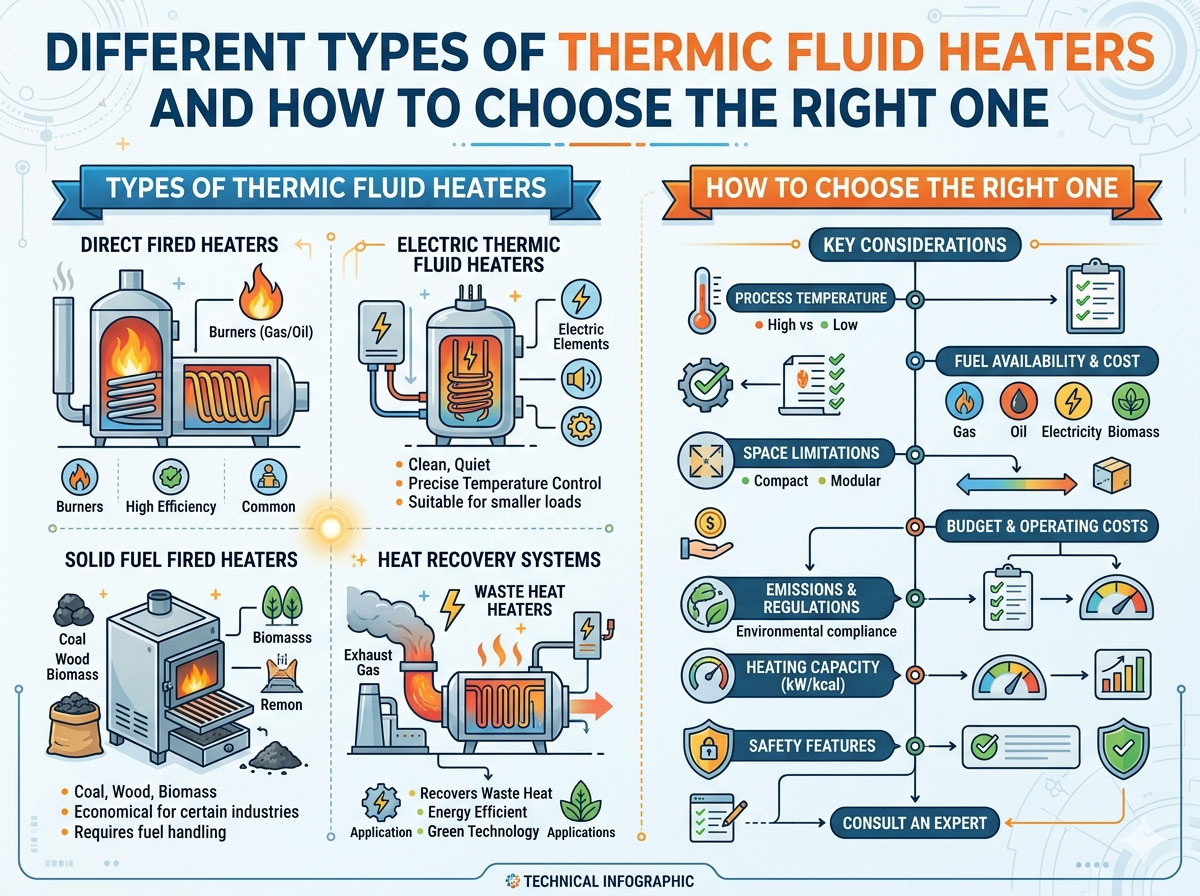
These systems burn diesel, furnace oil, natural gas, or LPG, offering fast heat-up time, precise combustion control, and generally the simplest fuel-handling infrastructure of any type — no fuel storage yard, no ash management, just a fuel line and burner. This makes them a strong fit for urban or space-constrained facilities where gas infrastructure is available, and for processes needing rapid response to demand changes given the quick startup and shutdown these systems allow.
Solid Fuel-Fired Thermic Fluid Heaters
These burn coal, wood, briquettes, or agro-waste — and increasingly, biomass specifically, following the same combustion engineering principles covered in our Complete Guide to Biomass Boilers for Steam Generation. Solid fuel systems generally offer meaningfully lower operating cost per unit of delivered heat than oil or gas, particularly in regions with good biomass availability, but require more furnace and grate engineering to manage ash and combustion consistency, along with genuine yard space for fuel storage. Our comparisons of Rice Husk vs Mustard Straw ROI and Biomass Pellet vs Biomass Briquette performance apply directly if you’re evaluating solid fuel options for a thermic fluid system.
Electric Thermic Fluid Heaters
Powered by electrical resistance elements rather than combustion, these systems eliminate flue gas emissions entirely and offer highly precise temperature control with a compact footprint — genuinely valuable in laboratories, pharmaceutical cleanroom-adjacent areas, or any facility facing strict local emission norms where a combustion source isn’t practical. The trade-off is operating cost: electricity is generally the most expensive energy input per unit of delivered heat among the options here, so electric systems tend to make the most sense for smaller heat loads or applications where emission compliance outweighs the fuel-cost premium.
Waste Heat Recovery Thermic Fluid Systems
Rather than burning fuel directly, these systems capture heat from exhaust gases or another industrial process — a cement kiln, a furnace exhaust, a large combustion process elsewhere in the plant — and use that otherwise-wasted heat to raise the thermic fluid to operating temperature. This is genuinely one of the highest-value options where a qualifying waste heat source already exists on-site, since the “fuel” cost approaches zero beyond the capital and integration cost of the recovery equipment itself. Our overview of top industries that benefit from waste heat recovery boilers and the cement-specific waste heat recovery engineering guide cover the principles that apply equally to thermic fluid waste heat recovery.
Classification by Circulation Design
Forced circulation (coil-type) systems — the standard design for the vast majority of modern installations — use a dedicated pump to push fluid through a helical coil at controlled velocity, ensuring consistent heat transfer and avoiding the localised overheating that can occur if fluid isn’t kept moving at an adequate rate past the hottest parts of the furnace. This design generally offers faster response to load changes and more predictable performance than older natural-circulation approaches, which relied on convection alone to move fluid and are largely superseded in new industrial installations.
Classification by Physical Configuration
Vertical configuration heaters have a smaller footprint, which matters in facilities where floor space is genuinely constrained, and can simplify installation in tight mechanical rooms.
Horizontal configuration heaters generally offer easier maintenance access to the coil and internals, and tend to be the more practical choice as capacity scales up, since a horizontal layout accommodates larger heat-transfer surface area without the height constraints a tall vertical unit would face.
Neither orientation changes the underlying combustion or circulation engineering — this is purely a footprint-versus-maintenance-access trade-off, worth deciding based on your actual facility layout rather than any performance difference between the two.
How to Actually Choose: A Selection Framework
1. Fuel Availability and Delivered Cost — Not Just Regional Assumptions
Rather than defaulting to “biomass is cheap in rural India, gas is preferred in cities” as a blanket rule, get an actual delivered-cost comparison for your specific location across the fuel types genuinely available to you. Urban plants increasingly have biomass supply chains available through aggregators, and rural plants near industrial gas pipeline infrastructure aren’t locked into solid fuel by default — check your actual options rather than assuming based on general geography.
2. Temperature Requirements
Confirm the heater you’re evaluating can sustain your required process temperature reliably under your actual load pattern, not just its rated maximum under ideal test conditions — a system rated for 300°C at low load may behave differently once you factor in your real duty cycle and heat exchanger losses downstream.
3. Heat Load Capacity — Calculate, Don’t Estimate
Calculate your genuine total heat requirement in kcal/hr or kW based on actual process demand, including a reasonable margin for peak load — not a rounded-up historical guess. Oversizing leads to inefficient part-load operation and unnecessary capital cost; undersizing chokes production during peak demand periods. This single step is where a surprising number of thermic fluid installations underperform their potential, independent of which type is chosen.
4. Space Availability
If your facility has genuine floor-space constraints, a vertical configuration is worth prioritising; if maintenance access and future capacity scaling matter more, horizontal is generally the better long-term choice.
5. Operational Efficiency and Control Sophistication
Look specifically at combustion control quality (oxygen trim, automated air-fuel ratio control) and insulation specification, not just a headline efficiency percentage — as covered in our efficiency-focused guide with proven retrofit tips, the auxiliary equipment and control quality determine actual achieved efficiency as much as the base technology.
6. Environmental Compliance
Solid fuel systems require proper particulate emission control — cyclone separators, bag filters, or ESPs — to meet CPCB and state pollution control norms; our biomass boiler emission control systems guide and Pollution Control Equipment range cover what a compliant setup requires. Electric and gas-fired systems generally face a lighter emission compliance burden, though gas combustion still requires proper flue gas handling.
7. Maintenance and Serviceability
Beyond the technology-level maintenance discipline described in our advantages guide, confirm your chosen manufacturer offers genuine local service support and spare parts availability — a technically superior system with a six-week wait for a critical spare part is a worse practical choice than a well-supported alternative.
8. Total Cost of Ownership, Not Just Upfront Price
Balance initial capital cost against realistic operating cost over the system’s working life, factoring in fuel type, maintenance requirements, and — for solid fuel systems — the value of any biomass fuel flexibility you’re building in. A higher upfront investment in a more efficient or more automated system frequently pays back within a few years through lower fuel and labour cost, but this should be modelled against your specific numbers rather than assumed universally.
Fuel-Specific Safety Considerations
Each fuel type brings a distinct safety profile worth planning around specifically: solid fuel systems need proper ash handling and particulate control to avoid both fire risk from ash accumulation and emission non-compliance; oil and gas systems need standard combustion safety interlocks and leak detection on fuel lines; electric systems, while eliminating combustion risk entirely, still require the same thermic fluid degradation monitoring as any other type, since the fire risk from the fluid itself doesn’t depend on how it was heated. Our thermic fluid heater safety guide for the chemical industry covers this fluid-specific risk in more depth regardless of which fuel type you select.
A Worked Example: Comparing Two Realistic Options
Consider a mid-sized textile unit weighing a gas-fired versus a briquette-fired thermic fluid heater for a stentering process needing roughly 300°C process heat. The gas-fired option offers faster commissioning, no yard space requirement, and simpler operator training, but carries meaningfully higher fuel cost per unit of delivered heat and exposes the plant to gas price volatility. The briquette-fired option requires more upfront engineering around ash handling and grate design, plus genuine fuel storage space, but typically delivers a lower cost per unit of heat and more price stability given briquette pricing tracks local agricultural cycles rather than international gas markets. Neither is universally correct — the right choice depends on whether the plant values faster deployment and simpler operation over long-term fuel cost stability, and on whether adequate yard space and fuel logistics genuinely exist on-site. This is exactly the kind of trade-off worth working through with an engineering team against your specific numbers rather than defaulting to either option based on general reputation.
Our Product Range Across Types
Balkrishna Boilers Pvt Ltd — IndianBoilers.com and Balkrishn.com — manufactures across multiple thermic fluid heater configurations, so the recommendation you get is based on your actual fuel access and process requirement rather than a single product line. Our Thermic Fluid Heater range includes THERMPAC, DELTAPAC, and the VTF Series, engineered around the fuel-flexibility and forced-circulation principles described above.
Frequently Asked Questions
Is biomass always cheaper than gas for a thermic fluid heater? Generally yes on a per-unit-heat basis in most Indian regions, but always confirm with an actual delivered-cost quote for your specific location rather than assuming — urban gas infrastructure and rural biomass supply chains have both expanded, changing the calculation in some areas.
Can I switch fuel types on an existing thermic fluid heater? Generally no without significant modification — combustion chamber and burner design are engineered around a specific fuel type’s combustion characteristics, so switching typically means a new or substantially retrofitted unit rather than a simple fuel swap.
Is an electric thermic fluid heater worth the higher running cost? It depends on your priorities — if emission compliance or precise, clean operation in a sensitive environment (lab, cleanroom-adjacent space) matters more than minimising fuel cost, electric can be the right choice despite the operating cost premium.
How do I size a thermic fluid heater correctly? Calculate your genuine process heat demand in kcal/hr or kW based on actual load, not a rounded estimate, and request a proper technical proposal sized to that figure — this single step affects achieved efficiency and reliability more than the type selection itself.
Talk to Our Engineering Team
If you’re unsure which fuel type, circulation design, or configuration fits your specific process and site constraints, get in touch with our engineering team for a tailored recommendation, or browse our complete product range.
Further reading: What Is a Thermic Fluid Heater? Working Principle Explained for Beginners · 7 Genuine Advantages of Thermic Fluid Heaters · Thermic Fluid Heater vs Steam Boiler: Which Is Better for Your Industry? · Thermic Fluid Heaters in the Chemical Industry: The Ultimate Safety Guide