
A thermic fluid heater is only as good as the fluid running through it. The heater coil, pump, and control panel get most of the attention during a purchase decision, but the thermic fluid itself — the medium actually carrying heat to your process — is the component that determines your system’s safety margin, service life, and long-term running cost. Choosing the wrong oil for your application, or neglecting it once it’s in service, is one of the most common and most avoidable causes of thermic fluid heater problems.
At Balkrishna Boilers Pvt Ltd, fluid selection is part of every thermic fluid heater specification we do, not an afterthought left to the customer post-installation. This guide walks through how thermic fluids actually work, the difference between mineral and synthetic oils, how to choose the right one for your process, and how to keep it in good condition for years of reliable service.
Why the Fluid Itself Is a Design Decision, Not Just a Consumable
A thermic fluid heater is a closed-loop system built around the physical properties of the fluid inside it, as we explained in our guide on what a thermic fluid heater is and how it works. The entire “high heat, low pressure” advantage that makes thermic fluid heating attractive depends on the fluid remaining liquid and thermally stable well beyond water’s boiling point — typically from 250°C up to 350°C, depending on the oil grade, as covered in our Thermic Fluid Heater product category page.
Get the fluid selection wrong for your actual operating temperature, and you’re not just looking at reduced efficiency — you’re looking at accelerated thermal degradation, a shortened fluid life, and in the worst case, a genuine safety issue. This is why fluid type belongs in the same conversation as heater sizing and fuel selection from day one, not as a decision deferred until after commissioning.
Mineral Oil vs Synthetic Fluid: The Core Trade-off
Mineral (Petroleum-Based) Thermic Fluid
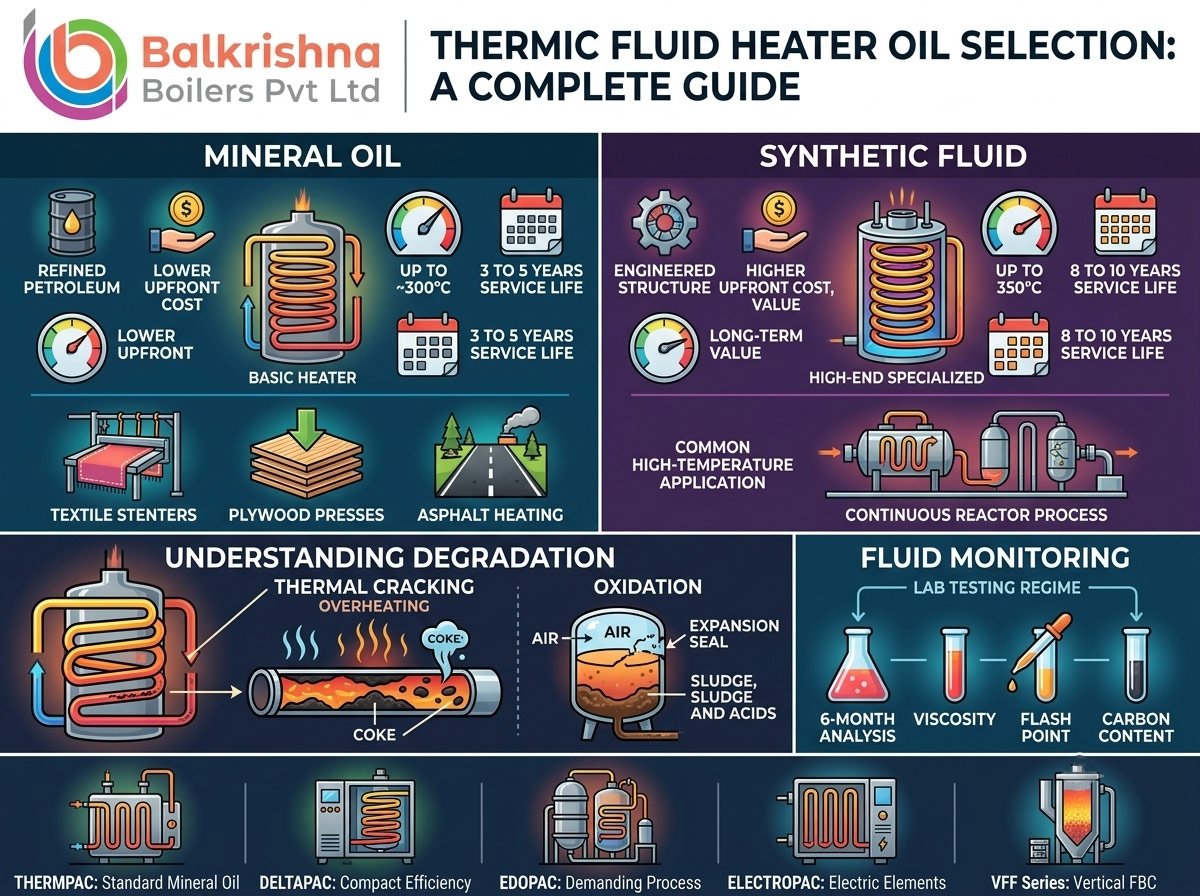
Mineral thermic fluids are refined petroleum-based oils, and they remain the most common choice across Indian industry for good reason: lower upfront cost, wide availability, and proven performance across a broad range of moderate-to-high temperature applications. With proper maintenance, high-quality mineral oil typically delivers 3 to 5 years of service life before requiring replacement.
Mineral oils are generally well suited to applications operating up to roughly 300°C. Beyond that, thermal stability starts to become a genuine constraint, and running mineral oil consistently near or above its design limit accelerates degradation significantly.
Synthetic Thermic Fluid
Synthetic fluids are engineered specifically for thermal stability at higher temperatures and offer a meaningfully longer service life — typically 8 to 10 years with proper maintenance, roughly double that of mineral oil. They’re the standard choice for applications pushing toward the upper end of the thermic fluid heating range, up to 350°C, as noted in our guide to the Vertical Four Pass FBC Thermic Fluid Heater, which specifies synthetic thermal oils for its specialized high-temperature configurations.
The higher upfront cost of synthetic fluid is usually offset over the system’s lifetime by the extended replacement interval and the reduced risk of unplanned downtime from premature fluid degradation — particularly relevant for continuous, high-temperature processes where a fluid change means a planned shutdown either way.
How to Choose the Right Fluid for Your Application
1. Start With Your Actual Operating Temperature — Not Your Nameplate Rating
The single biggest driver of fluid selection is the temperature your process genuinely needs, including any margin for temperature spikes during startup or load changes. Selecting a fluid rated close to your operating temperature, rather than comfortably above it, is the most common way plants shorten their own fluid life unnecessarily.
2. Match Fluid Type to Duty Cycle
Continuous, high-utilization processes — reactors running around the clock, or presses in constant production — benefit disproportionately from synthetic fluid’s extended service life, since the cost of an unplanned shutdown for fluid replacement is higher on a continuously running line. Intermittent or lower-temperature applications often get excellent value from mineral oil without needing the synthetic premium.
3. Consider Your Industry’s Specific Requirements
Different applications place different demands on the fluid beyond pure temperature tolerance:
- Textile stenters and curing ranges: Require stable, uniform heat delivery over long operating cycles, where consistent fluid viscosity matters for even heat distribution across the stenter frame.
- Chemical jacketed reactors: Often run close to the fluid’s upper temperature limit for extended periods, making thermal stability and resistance to cracking a priority.
- Plywood and laminate hot presses: Need consistent, high-temperature heat across large press platens — uniformity here directly affects panel bonding quality.
- Food processing (frying and ovens): Where indirect heating via thermic fluid keeps the process free of direct combustion contact, fluid purity and stability matter for both safety and product consistency.
- Asphalt and bitumen heating: Typically runs at sustained high temperature over long periods, again favoring fluids with strong thermal stability margins.
4. Factor In Your Maintenance Capacity
Mineral oil’s shorter service life means more frequent (though individually cheaper) replacement cycles and slightly more attentive monitoring. Synthetic fluid trades a higher upfront cost for a longer interval between major maintenance events. Neither is universally “better” — it depends on which pattern fits your plant’s maintenance planning and cash flow better.
Understanding Thermal Degradation: What Actually Damages the Fluid
Thermic fluid doesn’t fail suddenly — it degrades gradually through two main mechanisms, both of which are preventable with correct operation and monitoring.
Thermal cracking occurs when the fluid is overheated beyond its design tolerance, breaking down the oil’s molecular structure and forming volatile fractions and carbon deposits (coke) inside the system. Maintaining correct flow rates and ensuring the pump is always operational before the burner fires are the primary safeguards here, along with flow-differential interlocks that automatically shut down the burner if fluid flow drops.
Oxidation happens when hot fluid comes into contact with air, typically in the expansion tank, forming organic acids and sludge over time. For systems operating at higher temperatures, nitrogen blanketing the expansion tank prevents this oxygen exposure entirely. Both of these degradation mechanisms, and the safety protocols that prevent them, are covered in more depth in our guide to thermic fluid heaters in the chemical industry: the ultimate safety guide.
Fluid Monitoring: The Maintenance Schedule That Actually Protects Your Investment
Regular fluid analysis is the single most cost-effective maintenance practice for any thermic fluid system, catching degradation long before it becomes a performance or safety issue. A proper testing regime checks:
- Viscosity changes — a leading indicator of thermal degradation or contamination.
- Flash point reduction — a direct safety metric, since a dropping flash point signals increasing fire risk as the fluid degrades.
- Carbon content and acidity — indicators of thermal cracking and oxidation progressing inside the system.
We recommend a full fluid analysis roughly every 6 months for most operating conditions, with more frequent sampling for systems running consistently near their upper temperature limit. This is a small, predictable cost against the alternative — discovering fluid degradation only when it causes a coil failure or, worse, a safety incident.
A Note on Using Thermic Fluid to Generate Steam
For plants that need both high-temperature process heat and occasional steam, it’s worth knowing that a thermic fluid system doesn’t have to mean giving up steam entirely. An Unfired Steam Generator (USG) allows hot thermic fluid to pass through and boil water indirectly, producing steam for your process without requiring a separately fired, IBR-governed steam boiler. This is a genuinely useful option for plants trying to consolidate their heating infrastructure around a single thermic fluid loop — worth discussing with our engineering team if your process has this kind of mixed requirement.
Fluid Cost in the Context of Total System Investment
It’s worth putting thermic fluid cost in perspective against the system it runs in, so the fluid decision doesn’t get made in isolation from the bigger picture. Indicative starting rates for thermic fluid heater systems vary by capacity: small systems in the 1 to 2 lakh kcal/hr range typically start around ₹3.5–6 lakh, medium systems in the 5 to 10 lakh kcal/hr range run roughly ₹8–15 lakh, and large systems above 20 lakh kcal/hr start from approximately ₹25 lakh and up, depending on fuel type and configuration.
Against these figures, the incremental cost of choosing synthetic fluid over mineral oil is a relatively small percentage of total system investment — but the operational impact compounds over the fluid’s service life. A synthetic fluid’s roughly double lifespan means fewer planned shutdowns for fluid replacement over a 10-year system life, which matters more the more continuously your plant operates. For lower-utilization or lower-temperature applications, mineral oil’s lower upfront cost is usually the more sensible choice, since the extended service life of synthetic fluid delivers less relative value when the system isn’t running near its temperature or duty-cycle limits anyway.
The right way to frame this decision isn’t “mineral vs synthetic” in isolation — it’s matching fluid grade to your actual temperature and utilization profile, the same way you’d size the heater itself.
Balkrishna Boilers’ Thermic Fluid Heater Range
Whatever fluid type and temperature range your process needs, Balkrishna Boilers’ Thermic Fluid Heater category on balkrishn.com covers it:
- THERMPAC — Three-pass, coil-type heater suited to standard mineral oil applications.
- DELTAPAC — Compact, high-efficiency design for space-constrained installations.
- PELLEPAC — Solid-fuel-fired for plants prioritizing lower running costs.
- VFF Series, VTF Series, and VTM Series — Vertical configurations for high-capacity and specialized fuel requirements.
- EDOPAC — Built for demanding, continuous-process applications where fluid stability at sustained high temperature matters most.
- ELECTROPAC — Electric thermic fluid heater, using resistance elements immersed directly in the thermal fluid — since the fluid is non-corrosive and non-conductive, it avoids the scaling issues resistance elements face in water-based systems entirely.
Frequently Asked Questions
How long does thermic fluid actually last? High-quality mineral oil typically lasts 3 to 5 years with proper maintenance, while synthetic oils can last 8 to 10 years. Actual life depends heavily on operating temperature, duty cycle, and how consistently the system stays within its safety interlocks.
How often should I test my thermic fluid? A full fluid analysis roughly every 6 months is a reasonable standard for most operating conditions, checking flash point, viscosity, and carbon content. Systems running near their upper temperature limit benefit from more frequent testing.
Can I mix mineral and synthetic thermic fluid? This isn’t generally recommended without manufacturer guidance — different fluid chemistries can react unpredictably when mixed, and it complicates fluid analysis interpretation. If you’re switching fluid types, a proper system flush is the safer route.