
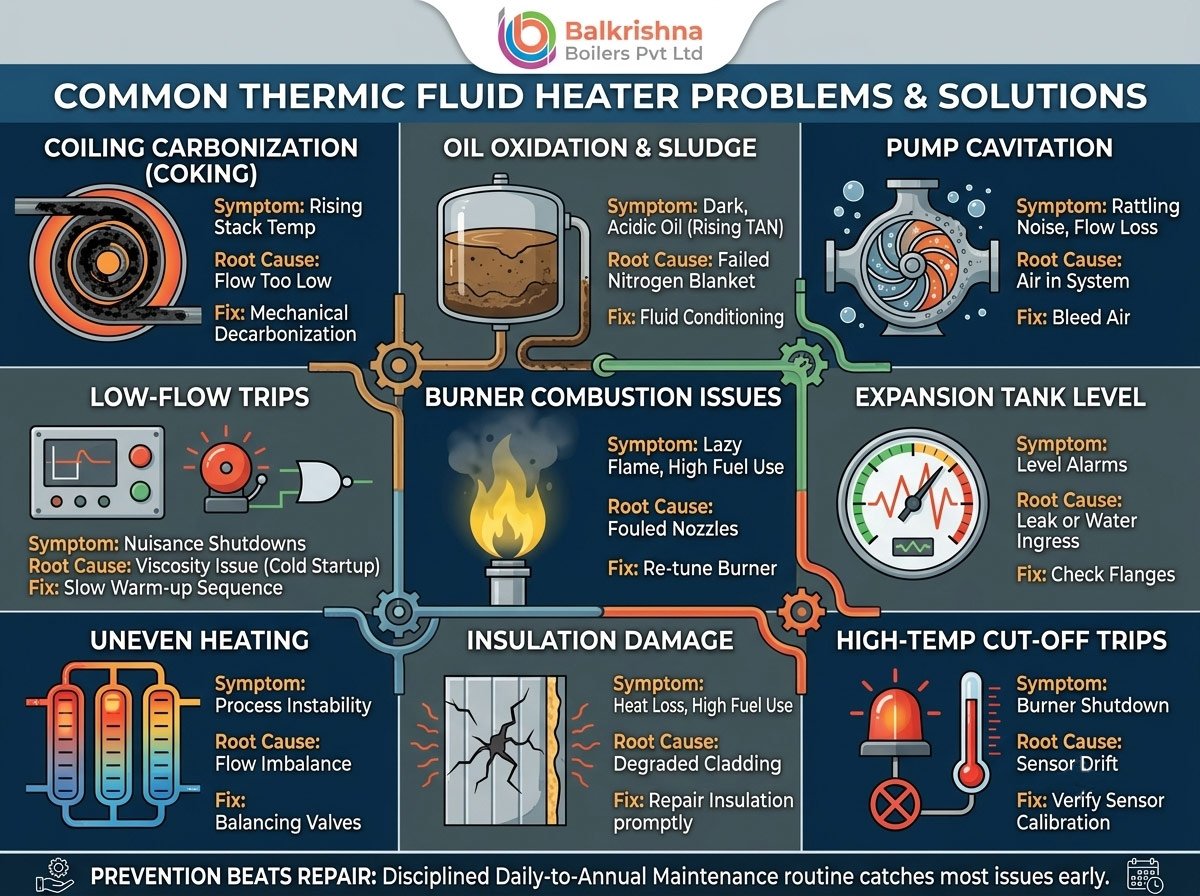
Call out enough thermic fluid heater breakdowns across enough plants, and you start seeing the same nine or ten problems again and again. The equipment changes — different capacities, different fuels, different industries — but the failure modes repeat because they all trace back to the same handful of root causes: fluid degradation, coil fouling, and instrumentation that got ignored one shift too long.
This guide walks through the problems our service team gets called for most often, what’s actually happening inside the system when they occur, and how to fix — and prevent — each one. If you’d rather stop these problems before they start, our companion piece on how to maintain a thermic fluid heater for long service life covers the full daily-to-annual maintenance schedule that catches most of these issues early.
1. Thermal Fluid Carbonization (Coking)
What’s happening: The oil is being heated past its safe film temperature, and the molecules at the tube wall break down, leaving behind a hard carbon deposit on the inside of the coil.
How it shows up: Outlet temperature drifting up for the same firing rate, rising stack temperature, and — in advanced cases — a burnt smell in the oil sample or visible black flakes when you drain a test port.
Root causes:
- Flow velocity too low through the coil (often from a partially worn pump or a closed bypass valve), which lets the film layer overheat even though the bulk fluid temperature looks normal.
- Using a mineral oil rated below your actual operating temperature.
- Local hot spots from uneven burner flame distribution.
The fix: A confirmed carbonization case almost always needs mechanical or chemical decarbonization of the coil — this isn’t a DIY job, since aggressive cleaning done wrong can score the tube surface and create new fouling sites. Once the coil is clean, address the root cause: verify flow rate against design specification, check burner flame shape, and confirm the fluid you’re using is actually rated for your process temperature. Our thermic fluid heater oil selection guide breaks down how to match fluid type to operating temperature so you don’t end up coking a fluid that was simply the wrong grade from day one.
2. Oil Oxidation and Sludge Formation
What’s happening: The thermal fluid is reacting with oxygen — usually because the nitrogen blanket on the expansion tank has failed or the system has a leak drawing in air — and forming sludge and acidic byproducts.
How it shows up: Dark, cloudy oil with a rising acid number (TAN) on fluid analysis, reduced heat transfer efficiency, and sometimes sediment collecting in low points of the piping or in filters.
The fix: Check and restore nitrogen blanket pressure on the expansion tank immediately — this is the single biggest lever against oxidation. Send a fluid sample for lab analysis to quantify how far the oxidation has progressed; a rising TAN with an otherwise stable flash point can often be managed with fluid conditioning or partial replacement, while a badly oxidized batch needs a full drain and system flush before refilling. This is exactly why a fluid analysis every six months matters — oxidation is gradual and invisible until it isn’t.
3. Pump Cavitation and Flow Loss
What’s happening: The circulating pump is drawing in vapor bubbles instead of pure liquid, usually because of low suction pressure, air trapped in the system, or the fluid running close to its vapor pressure at the operating temperature.
How it shows up: A rattling or knocking noise from the pump, fluctuating flow readings, reduced heat delivery to the process, and accelerated wear on the impeller and mechanical seal.
The fix: Bleed air from the highest points in the piping system and confirm the expansion tank is maintaining adequate static head above the pump suction. Check that the fluid isn’t being run too close to its boiling point for the installed pressure — sometimes cavitation is actually a symptom of running the system hotter than the design allows. If cavitation has already been happening for a while, inspect the impeller for pitting damage; cavitation erosion doesn’t reverse itself once it starts.
4. Low-Flow Trips and Nuisance Shutdowns
What’s happening: The low-flow safety switch is tripping the burner offline, either because flow genuinely has dropped below the safe threshold, or because the switch itself is faulty or mis-calibrated.
How it shows up: Repeated unexplained shutdowns, especially during startup when the fluid is still cold and viscous.
The fix: First confirm it’s a real trip and not a false one — check actual flow rate against the switch’s set point using an independent flow reading. If flow really is low, look for a partially closed valve, a clogged strainer, or coil fouling restricting flow (see problem #1). If the switch is tripping on a genuine but marginal flow reading only during cold startup, this is often a viscosity issue — cold thermal fluid is far more viscous than at operating temperature, and a slow, controlled warm-up sequence usually resolves it without touching the switch itself.
5. Burner Combustion Problems (Poor Flame, High Fuel Use)
What’s happening: The air-fuel ratio has drifted from its commissioned setting, fuel nozzles or electrodes are fouled, or fuel pressure/quality has changed.
How it shows up: A lazy, smoky, or unstable flame; rising fuel consumption for the same heat output; soot buildup on the fire side of the coil; and higher-than-normal CO readings on a flue gas analysis.
The fix: Clean or replace burner nozzles and electrodes, and re-tune the air-fuel ratio with a flue gas analyzer, targeting the O2/CO2/CO values from your commissioning report. If you’ve recently switched fuel source or supplier — common with furnace oil and biomass — recheck fuel specification, since combustion tuning is fuel-specific. Persistent soot on the coil fire side after re-tuning usually means physical cleaning of the fire-side surfaces is also needed, not just a burner adjustment.
6. Expansion Tank Level Fluctuations
What’s happening: The expansion tank level is either dropping steadily (fluid loss) or rising beyond the normal band (contamination or thermal expansion beyond design).
How it shows up: Level alarms, or a level that no longer settles at the same point during steady-state operation that it used to.
The fix: A steadily dropping level points to a leak somewhere in the circuit — check flange gaskets, pump gland packing, and valve stems systematically, since even a slow weep adds up over weeks. A rising level, especially combined with a milky or hazy appearance in the oil, can indicate water ingress, often through a leaking heat exchanger or steam-side interface if your system includes an unfired steam generator. Water contamination in thermal fluid is serious — it can flash to steam inside the hot coil and cause a pressure spike — so this warrants immediate fluid testing rather than a wait-and-watch approach.
7. Uneven Heating or Process Temperature Instability
What’s happening: The process equipment downstream (reactor jacket, stenter, press) isn’t getting consistent heat, even though the heater itself looks like it’s operating normally.
How it shows up: Batch-to-batch process variation, hot and cold spots on jacketed equipment, or a process that used to hold temperature tightly now drifting.
The fix: This is often a system-balance issue rather than a heater fault — check that flow is properly distributed across parallel heat users with balancing valves, and confirm no single branch is starving another of flow. Trapped air in a specific branch is a common, easy-to-miss cause. If the heater’s own outlet temperature is stable but the process still runs unevenly, the investigation should move downstream to the distribution piping and control valves rather than the heater itself.
8. Insulation Damage and Heat Loss
What’s happening: Cladding or lagging on the heater body or pipework has degraded, been damaged during other maintenance work, or was never properly sealed at joints.
How it shows up: Rising fuel or power consumption without a corresponding process change, hot spots detectable by hand or thermal camera on the exterior of pipework, and — over time — condensation or staining under damaged cladding that suggests a leak underneath.
The fix: Repair or replace damaged insulation sections promptly; beyond the efficiency loss, exposed hot surfaces are a safety hazard for personnel. Treat any wet patch under cladding as a possible leak indicator, not just an insulation problem, and inspect the joint underneath before simply re-lagging over it.
9. Frequent High-Temperature Cut-Off Trips
What’s happening: The high-temperature safety interlock is shutting the burner down because the fluid temperature at the sensor point is exceeding the set limit — or the sensor itself has drifted and is reading incorrectly.
How it shows up: Repeated trips, particularly under high process demand or after a change in firing rate.
The fix: Verify the temperature sensor against a calibrated reference — sensor drift after months of continuous high-temperature service is common and easy to mistake for a genuine overheating fault. If the reading is accurate and the system really is overheating, check for reduced flow (coil fouling, pump wear) or a control system fault holding the burner on longer than it should. Never reset a high-temperature trip repeatedly without identifying the cause — that interlock exists specifically to prevent the fluid degradation covered in problem #1.
Quick Diagnostic Table
| Symptom | Most Likely Problem | Where to Look First |
|---|---|---|
| Outlet temperature creeping up | Coil carbonization | Flow rate, fluid grade vs. temperature |
| Dark, sludgy, or acidic-smelling oil | Oxidation | Nitrogen blanket pressure, fluid analysis |
| Knocking noise from pump | Cavitation | Air in system, suction head, operating temperature |
| Repeated low-flow trips | Blockage, viscosity, or switch fault | Strainer, valve position, cold-start sequence |
| Smoky or unstable flame | Combustion drift | Nozzle condition, air-fuel ratio |
| Dropping tank level | Fluid leak | Flanges, pump gland, valve stems |
| Hazy or milky oil | Water contamination | Heat exchanger/USG interface |
| Uneven process temperature | Flow distribution | Balancing valves, trapped air in branches |
| Hot exterior surfaces | Insulation damage | Cladding joints, possible leak underneath |
| Repeated high-temp trips | Sensor drift or genuine overheat | Sensor calibration, flow rate |
Prevention Beats Repair, Every Time
Almost every problem on this list shows up first as a small deviation in your daily readings — a slightly higher outlet temperature, a flow rate that’s drifted, a stack temperature that’s crept up 15°C over a month. None of these are dramatic on their own, which is exactly why they get missed. A disciplined daily-to-annual maintenance routine, with someone actually reviewing the trend and not just logging the number, catches nearly all of these before they become a shutdown. We’ve laid out that full routine in how to maintain a thermic fluid heater for long service life.
It’s also worth revisiting whether thermic fluid is even the right technology for a process that’s giving you recurring grief — for some applications, a steam boiler or electric system may be a better operational fit. Our comparison, Thermic Fluid Heater vs Steam Boiler: Which Suits Your Process?, walks through that decision in detail.
When to Call a Specialist
Daily checks, leak inspection, and basic fluid sampling are safe for an in-house team. Coil decarbonization, fluid analysis interpretation, pump seal replacement, combustion tuning, and any work involving opening the pressure boundary should go to a specialist. At Balkrishna Boilers Pvt Ltd, our service team handles all of the above across our Electric Thermic Fluid Heater, Oil/Gas Fired Thermic Fluid Heater, Vertical Four Pass FBC Thermic Fluid Heater, and Vertical Three Pass Oil/Gas Fired Thermic Fluid Heater ranges — as well as units originally supplied by other manufacturers.
If you’re dealing with a recurring problem from this list, or planning a replacement for a unit that’s outlived its usefulness, get in touch with your capacity, fuel, and process temperature requirement, and our technical team will help you troubleshoot or scope a new system.