
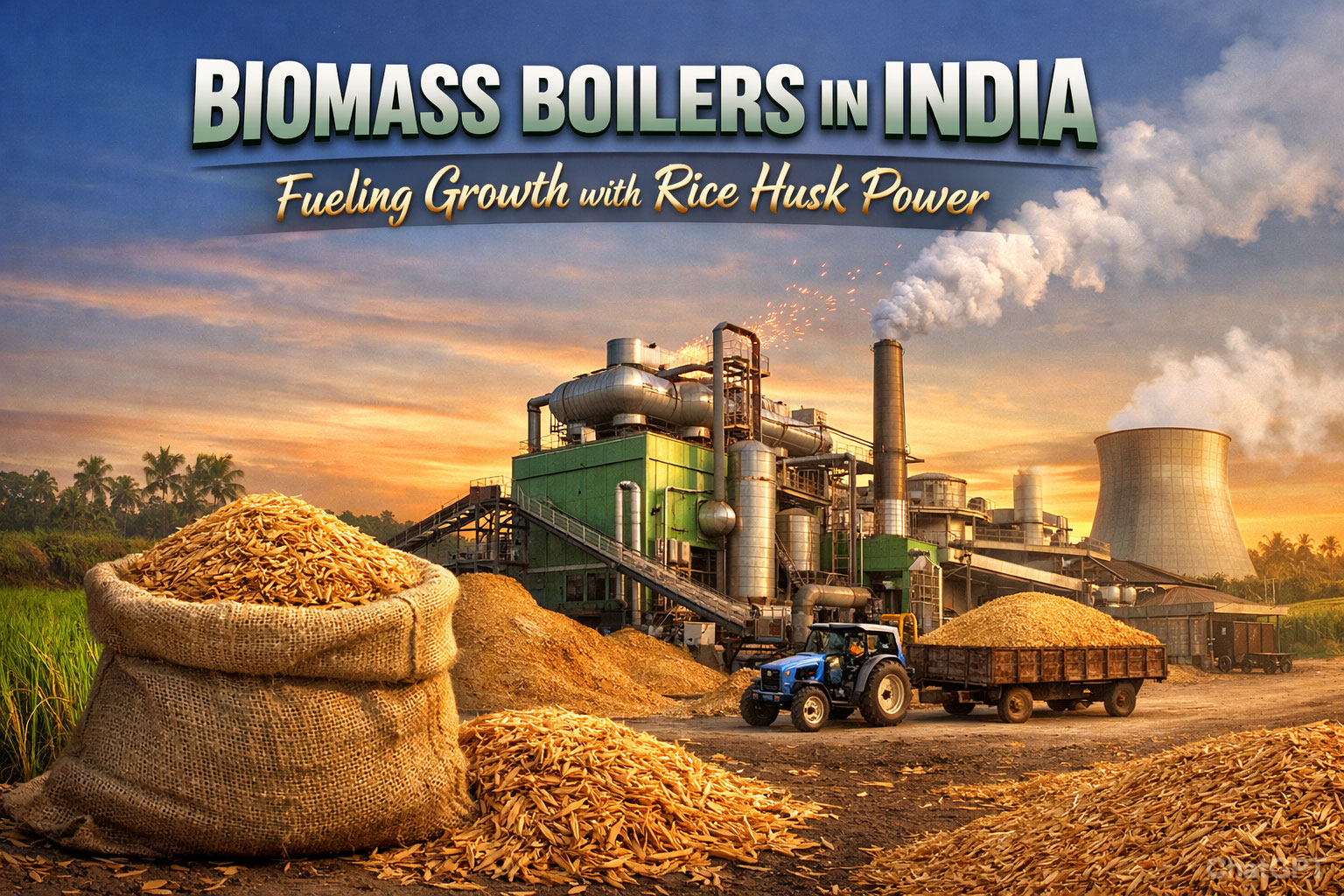
Rice Husk Power: India’s Built-In Biomass Advantage
Every country that wants to switch industrial heating to biomass has to solve the same problem first — where does the fuel actually come from, reliably, at scale, every year? India has an unusually good answer sitting in its own paddy fields. As one of the world’s largest rice producers, India generates enormous volumes of rice husk as a milling by-product every single harvest — a domestic, renewable fuel stream that doesn’t depend on imports, currency swings, or geopolitics. This is why rice husk has become the default biomass fuel for a large share of Indian industrial boiler installations, rather than one option among many.
Why Rice Husk Specifically Works So Well as Boiler Fuel
Rice husk isn’t just abundant — it happens to have genuinely favourable combustion properties compared to many other agricultural residues.
Calorific value. Rice husk typically offers a net calorific value in the range of roughly 3,000–3,500 kcal/kg — lower than coal by weight, but respectable for a biomass fuel and consistent enough to plan combustion around.
Physical uniformity. Unlike loose straw, wood chips, or mixed agro-waste, rice husk is granular and reasonably consistent in particle size and bulk density straight from the mill. That uniformity translates directly into more predictable fuel feeding and steadier combustion than many alternative biomass fuels, which tend to vary more in shape, moisture, and density batch to batch.
Genuine availability at scale. India’s paddy milling industry generates rice husk as an unavoidable by-product of rice processing — roughly a fifth of paddy weight becomes husk during milling, according to commonly cited industry estimates, which at India’s rice production volumes adds up to tens of millions of tonnes available annually. That volume is precisely why husk supply, unlike some other biomass fuels, has developed into a genuinely organised commercial market with established aggregators and dealers in most rice-growing regions, rather than remaining an informal, hard-to-source byproduct.
Carbon-neutral combustion cycle. As with other biomass fuels, the CO₂ released when rice husk burns is part of the same short-term carbon cycle the paddy crop absorbed during its own growth — a genuinely different accounting basis than fossil fuel combustion, which is why rice husk boilers are widely used across export-oriented Indian manufacturing where buyers increasingly ask about fuel-source carbon intensity.
The Engineering Challenge: Silica
Rice husk brings one significant combustion engineering challenge that other biomass fuels don’t share to the same degree: its ash content is overwhelmingly silica — commonly well above 90% of the ash by composition. Left unmanaged, this creates two specific problems: clinkering, where silica-rich ash fuses into hard deposits on grates and furnace surfaces, and erosion, where fine, abrasive ash particles wear away boiler tubes and internal surfaces over time, essentially sandblasting the equipment from the inside.
This is exactly why a rice husk boiler isn’t simply a generic biomass boiler with a different fuel loaded in — the furnace, grate, and gas-path design need to be specifically engineered around silica management from the start. Well-designed rice husk systems typically incorporate refractory lining to withstand sustained high combustion temperatures and carefully controlled gas velocities to minimise abrasive wear, alongside grate designs suited to husk’s particular burning characteristics.
Matching Combustion Technology to Rice Husk
Two combustion architectures dominate rice husk applications, each with a different trade-off:
Fluidized Bed Combustion (FBC) suspends husk within a hot, agitated bed of sand with upward-blowing air, achieving high heat transfer and thorough combustion even with variable fuel quality. This is often considered the reference technology for rice husk specifically, because the fluidized bed’s turbulence helps overcome husk’s low bulk density and ensures more complete burnout than static-bed designs typically achieve.
Reciprocating grate systems move fuel mechanically through distinct drying, ignition, and combustion zones, which handles variation in husk moisture particularly well — useful given that husk moisture can shift somewhat with storage conditions and season. Our detailed guides on grate speed’s effect on steam production and fuel consumption and Vibrating Grate vs Reciprocating Grate performance go deeper into how grate mechanism specifically affects burn completeness for husk and similar fuels.
Our rice husk-fired steam boiler range and the broader biomass-fired boiler category are engineered specifically around these silica-management principles, alongside the husk-specific HUSKPOWER range on Balkrishn.com built for the particular demands of husk combustion.
The Economics: Why SMEs Are Making the Switch
For a typical Indian SME, switching to rice husk is a straightforward operating-cost decision more than an environmental one. Rice husk generally costs meaningfully less per unit of delivered heat than imported coal, and considerably less than furnace oil or LDO — the exact multiple shifts with regional husk pricing and current fossil fuel rates, so always get a delivered-fuel quote for your specific location rather than relying on a generic national figure.
Capital expenditure for a rice husk boiler system typically runs higher than an equivalent gas or oil-fired unit, largely because of the additional engineering required for silica and abrasion management described above. That said, operating cost savings on fuel commonly bring the payback period for a genuine conversion into the 12 to 24 month range for many industrial applications — though this depends heavily on your current fuel type, utilisation hours, and site-specific husk pricing, so treat any single payback figure as directional until confirmed against your own numbers. Our comparison of Rice Husk vs Mustard Straw — which biomass fuel offers better ROI is a useful next read if you’re weighing husk against other regionally available biomass options.
The Wider Ripple Effect
Rice husk’s shift from agricultural waste to commercial fuel has knock-on effects beyond any single factory’s fuel bill. Creating genuine commercial value for husk gives millers and farmers a real alternative to disposing of residue through open burning — a practice that contributes meaningfully to seasonal air quality problems in parts of North India. It also supports a decentralised rural economy: collection, storage, and logistics around husk supply create ongoing local employment in rice-growing regions, keeping a portion of industrial energy spending circulating within those communities rather than flowing entirely to fuel importers.
Practical Challenges Worth Planning For
Seasonality and price fluctuation. Husk pricing and availability can shift around harvest cycles and during periods of heavy monsoon activity affecting drying and storage. A reasonable operating buffer — commonly cited as around a 60-day fuel reserve — combined with multi-fuel flexibility where feasible, helps plants avoid being caught short during a tight period. Our overview of multi-fuel boilers as the future of industrial heating in India covers this flexibility in more depth.
Ash disposal and value recovery. Rice husk ash (RHA), being predominantly silica, has genuine industrial value beyond disposal — it’s increasingly sold into the cement and steel industries as a reinforcing or pozzolanic material, turning what used to be pure waste-disposal cost into a modest secondary revenue stream for plants that arrange the right buyer relationships.
Emission compliance. Rice husk combustion, like any solid-fuel combustion, generates particulate matter that must be captured to meet state Pollution Control Board norms. Electrostatic precipitators (ESPs) or cyclone separators are standard equipment on a properly specified rice husk system — see our biomass boiler emission control systems guide and our Pollution Control Equipment range for what a compliant setup requires.
Government Support: What’s Actually Confirmed
The Ministry of New and Renewable Energy (MNRE) offers Central Financial Assistance (CFA) and related support for qualifying biomass energy projects under the National Bioenergy Programme framework, though the current phase of that programme runs through March 2026 with no confirmed extension as of this writing — always verify current scheme terms directly with MNRE before budgeting a project around a specific subsidy figure. On carbon credits specifically: India’s compliance carbon market (the Indian Carbon Market, or ICM) currently applies to obligated entities in a defined set of energy-intensive sectors above certain size thresholds, not automatically to every biomass boiler buyer — if you’re hoping to monetise emission reductions through carbon credits, confirm your specific eligibility with the Bureau of Energy Efficiency (BEE) or a carbon markets consultant rather than assuming it applies by default.
Where the Technology Is Headed
Two trends are shaping how rice husk is used industrially as the fuel market matures. Briquetting — compressing loose husk into denser, more uniform briquettes — improves transport economics and combustion consistency further, addressing husk’s naturally low bulk density. Digital combustion monitoring — real-time oxygen and CO sensing feeding automated air-fuel control — is increasingly standard on new installations, letting plant engineers catch combustion drift before it compounds into wasted fuel or excess emissions. Our pieces on how AI and IoT are transforming biomass boiler operations and digital twin technology for boiler efficiency and reliability cover this shift in more detail.
Industry Fit
Textile, food processing, and pharmaceutical operations each bring different steam quality and hygiene requirements to a rice husk conversion decision — our industry-wise guide to the best boiler for textile, pharma, and food industries and dedicated boiler selection guide for food processing units go deeper into these distinctions. If your plant is weighing rice husk against pellets, briquettes, or other regionally available biomass, our Biomass Pellet vs Biomass Briquette comparison is a useful companion read.
Sizing and Sourcing Before You Commit
Before finalising a rice husk boiler purchase, two pieces of homework pay off disproportionately: confirm your actual delivered husk cost and supply reliability from at least two local aggregators rather than a single quoted price, and size the boiler to your genuine steam or heat demand rather than a rounded-up estimate — oversizing against husk’s lower calorific value compared to coal is a common way plants end up with a system that’s inefficient at typical partial loads. Getting both of these right before installation, rather than adjusting after commissioning, is usually the difference between a rice husk conversion that hits its projected payback and one that quietly underdelivers.
Frequently Asked Questions
Is rice husk available year-round, or only at harvest? Husk is generated at milling, which follows harvest cycles, but the established commercial husk market means most regions have functioning supply through aggregators and dealers rather than requiring the buyer to stockpile a full year’s supply at once. A reasonable storage buffer during tight periods is still good practice.
Do all boilers need special engineering for rice husk, or can a standard biomass boiler burn it? Rice husk’s high silica ash content specifically demands furnace, grate, and gas-path design suited to clinkering and erosion resistance — a boiler designed generically for wood waste or other low-silica biomass may not hold up well under sustained husk firing without those specific design features.
What happens to rice husk ash after combustion? It’s increasingly sold into the cement and steel industries as a reinforcing material rather than simply landfilled, turning disposal cost into a modest secondary revenue stream where the right buyer relationships are arranged.
Can I earn carbon credits by switching to rice husk? Only if your plant falls within a sector and size threshold currently covered by India’s compliance carbon market, or if you separately register for a voluntary carbon crediting mechanism — it isn’t an automatic outcome of installing a biomass boiler. Confirm your specific eligibility with BEE or a carbon markets consultant.
Is a fossil-fuel boiler convertible to rice husk, or does it need replacement? Combustion architecture for solid biomass fuel differs fundamentally from oil or gas firing, so a genuine switch typically means a new boiler rather than a retrofit of an existing fossil-fuel unit, though auxiliary equipment like emission control systems can often be adapted.
Talk to Our Engineering Team
Balkrishna Boilers Pvt Ltd — IndianBoilers.com and Balkrishn.com — designs rice husk and broader biomass combustion systems engineered specifically around the silica, moisture, and supply-chain realities of Indian agricultural fuel. Get in touch with our team for a fuel-specific technical proposal, or browse our complete product range.
Further reading: Rice Husk vs Mustard Straw: Which Biomass Fuel Offers Better ROI · How Biomass Boilers Cut Costs and Emissions for Factories · Reduce Your Carbon Footprint with Biomass Boiler Technology · What is a Biomass Boiler?