
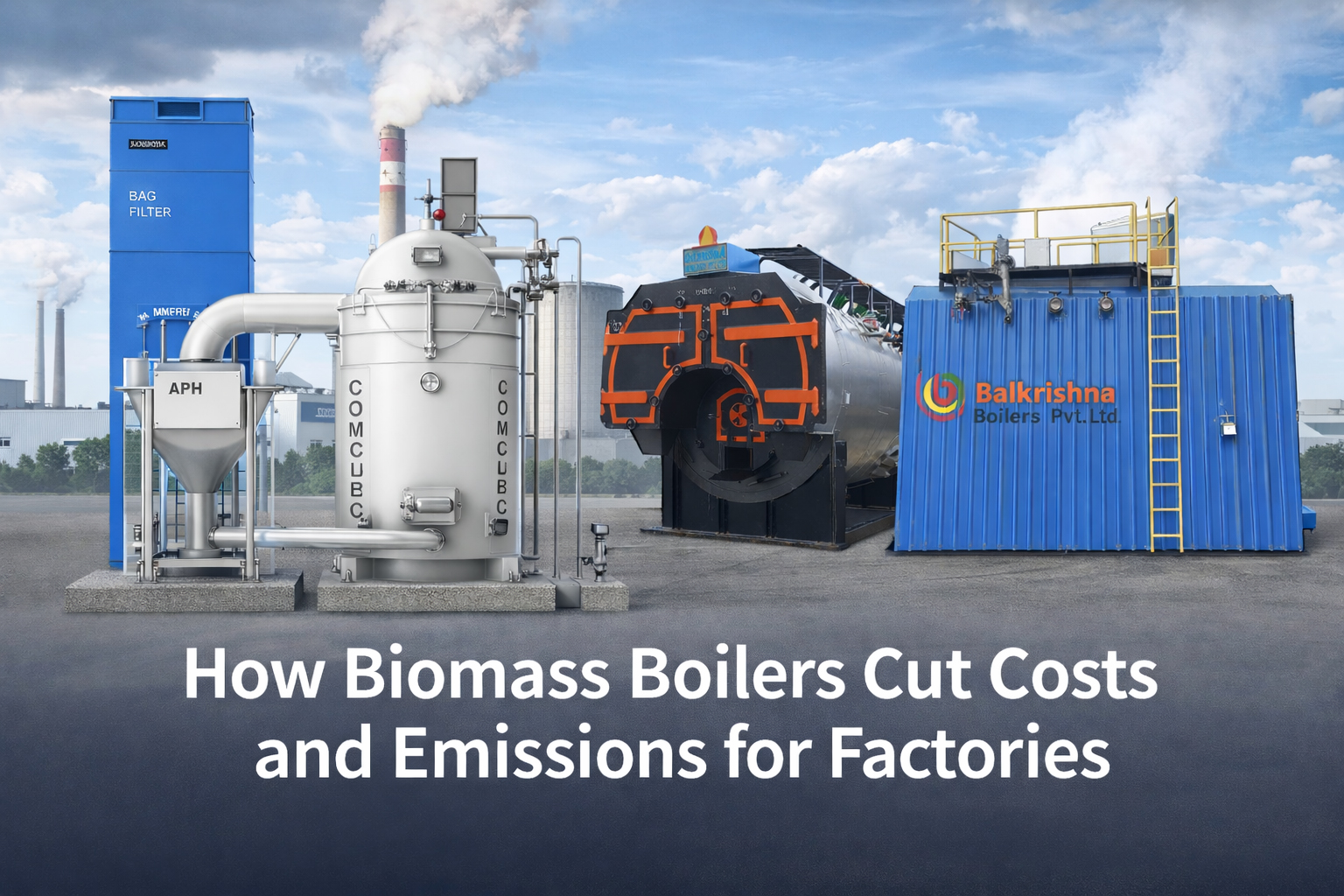
Every factory owner in India is asking the same question in 2026: how do we keep production running without fossil fuel prices and pollution penalties eating into margins? Furnace oil, diesel, and coal are no longer just expensive — they are becoming operationally risky, thanks to tightening emission norms and unpredictable global fuel markets.
Biomass boilers have quietly become the answer. By running on rice husk, wood waste, agricultural residue, and briquettes, factories are cutting fuel bills by more than half while staying compliant with pollution control norms. This article breaks down exactly how biomass boilers deliver that cost and emission advantage, and which system fits your process best.
If you’re new to the technology, our detailed primer on what a biomass boiler actually is is a good place to start before diving into the numbers below.
1. Why Factories Are Moving Away From Fossil Fuels
For years, furnace oil (FO) and light diesel oil (LDO) were the default choice for generating steam, hot water, or process heat. That is changing fast, for three clear reasons:
- Unpredictable fuel costs. Oil and diesel prices swing with global crude markets, making annual energy budgets almost impossible to forecast.
- Emission penalties. Regulatory bodies like the CPCB and state pollution control boards have sharply tightened particulate matter (PM) limits, especially for industrial clusters near residential zones.
- Carbon accountability. With carbon credit markets and export-linked carbon disclosure requirements gaining traction, high-emission manufacturing is starting to carry a direct financial cost, not just a reputational one.
Biomass, by contrast, is treated as carbon-neutral — the CO₂ released during combustion roughly equals what the plant absorbed while growing. Combined with the fact that agricultural and wood waste is abundant and cheap across India, biomass has moved from being a “sustainability nice-to-have” to a hard financial decision.
For a deeper comparison of which waste materials perform best, see our guide on rice husk vs. mustard straw as boiler fuel and our breakdown of biomass pellets vs. briquettes.
2. Where the Cost Savings Actually Come From
The economics of switching to biomass are straightforward once you look at cost per unit of heat delivered, rather than cost per litre or per kilogram of fuel.
| Parameter | Fossil Fuel (LDO) | Biomass (Briquette/Husk) |
|---|---|---|
| Approx. fuel price | ₹80–90 / litre | ₹8–10 / kg |
| Calorific value | ~10,200 kcal/kg | ~3,800–4,200 kcal/kg |
| Fuel needed for 2-TPH steam load | ~140 litres/hour | ~380–420 kg/hour |
| Approx. hourly running cost | ₹11,000–12,000 | ₹3,500–4,200 |
| Typical payback period on new equipment | — | 6–12 months |
The gap widens further once you factor in that biomass fuel is largely sourced locally, insulating the factory from import duties, currency fluctuation, and long supply chains. Most manufacturing units operating 18–20 hours a day recover their entire equipment investment within the first year of operation, with savings flowing straight to EBITDA after that.
Multi-shift plants also benefit from fuel flexibility. Many modern biomass systems can switch between husk, briquettes, and other agro-waste depending on local availability and pricing — a concept covered in detail in our article on multi-fuel boilers for industrial heating.
3. Matching the Right Biomass System to Your Process
Cost savings only materialise if the equipment is matched correctly to what your process actually needs — steam, hot water, thermic fluid, or hot air. Here’s how to think about it.
Steam-Driven Processes (Textiles, Pharma, Chemicals, Dyeing)
If your plant needs continuous, high-pressure steam, a dedicated biomass or briquette-fired steam boiler is the right fit. Compact “cube” style designs work well where floor space is limited, while larger briquette-fed units are built for high-volume, round-the-clock operation with automated fuel feeding to keep pressure stable.
- Explore the Steam Boiler range on IndianBoilers.com, including the compact COMCUBE biomass-fired steam boiler and the high-capacity STEAMAX briquette-fired steam boiler.
- The same models are available on our sister site as COMCUBE and STEAMAX under Balkrishna Boilers’ Steam Boiler category.
Hot Water Applications (Dairy, Laundry, Hospitality, Food Processing)
Where hot water — not steam — is the heat transfer medium, safety and consistency matter more than pressure. Four-pass smoke tube designs recover more heat from flue gases before they exit the stack, pushing efficiency above 80% on net calorific value.
- Browse the Hot Water Boiler category, including the VTFH-SERIES biomass-fired water boiler and the AQUAMAX briquette-fired water boiler.
- On Balkrishn.com, the same lineup sits under Hot Water Boiler, with model pages for VTFH SERIES and AQUAMAX.
Food and dairy plants in particular have specific hygiene and safety considerations — our boiler selection guide for food processing units covers this in more depth, and our earlier post on biomass boilers for food processing walks through real-world use cases.
Direct Heat & Drying (Food Dehydration, Ceramics, Chemical Powders)
For processes that need clean, contamination-free hot air rather than steam or water, an indirect-fired hot air generator keeps combustion gases completely separate from the process air stream. That matters enormously in food and pharma settings, where even trace smoke or ash can spoil a batch.
- See the Hot Air Generator category and the AIRMAX briquette-fired hot air generator, delivering temperatures up to 300°C at roughly 60% lower running cost than electric or diesel-fired alternatives.
- The equivalent model is listed on Balkrishn.com as AIRMAX under Hot Air Generator.
Thermic Fluid Systems
Where indirect heating via thermal oil is preferred — common in chemical processing and reactor heating — our Thermic Fluid Heater range (also on Balkrishn.com’s Thermic Fluid Heater page) offers biomass-compatible options as well. Safety is a key concern here — our guide to thermic fluid heaters in the chemical industry is essential reading before specifying a unit.
4. Meeting Emission Norms Without Slowing Down Production
Cost savings mean little if a plant can’t stay compliant. Fortunately, modern biomass systems are built around emission control from the ground up, not retrofitted as an afterthought. Three components typically work together:
- Multi-cyclone dust collectors to capture the heavier ash and particulate matter before flue gas reaches secondary filtration.
- Bag filters to bring final stack discharge below the 50 mg/Nm³ threshold most state boards now enforce.
- BEE star-rating compliant design, so the boiler itself is verified for efficiency, not just emissions.
For a full breakdown of how these systems work together — and how to choose the right configuration for your fuel and load profile — read our complete guide to biomass boiler emission control systems.
It’s also worth noting that grate design has a direct effect on both emissions and fuel efficiency. Plants using high-moisture agro-waste, for instance, often see better and more stable combustion with reciprocating grate technology compared to conventional fixed grates — a factor worth discussing with your supplier before finalising a boiler spec.
5. Keeping a Biomass Boiler Running at Peak Efficiency
Switching fuels is only half the equation — sustained savings depend on how well the system is operated and maintained. A few operational factors make an outsized difference:
- Fuel moisture control. Wet biomass burns less efficiently and increases ash carryover. Our article on fuel moisture vs. boiler efficiency explains the ideal range to target.
- Grate speed and fuel feed tuning. Getting this wrong is one of the most common causes of inconsistent steam pressure — covered in our piece on chain grate boiler speed and its effect on steam production.
- Preventive maintenance. Many performance complaints trace back to a handful of recurring issues. Our guide to common biomass boiler problems and solutions is a useful troubleshooting reference for plant engineers.
- Digital monitoring. Increasingly, plants are using sensors and analytics to catch inefficiencies before they show up on the fuel bill — a trend we explore in how AI and IoT are transforming biomass boiler operations.
6. A Realistic Payback Scenario
Consider a mid-sized textile dyeing unit running a 2-tonne-per-hour steam load, 18–20 hours a day, currently on LDO. At current fuel prices, switching to a briquette-fed steam boiler typically cuts hourly fuel cost by roughly 60–65%. For most Indian factories operating at this scale, that translates into a payback window of 6 to 12 months on the new equipment — after which the fuel savings drop straight into operating margin.
The exact numbers shift with local fuel availability and pricing, which is why it’s worth getting a site-specific fuel-cost comparison (for example, rice husk vs. sawdust briquettes in your region) before finalising equipment selection.
7. Industry-Specific Impact
Biomass conversion doesn’t play out the same way in every sector — the fuel, the boiler configuration, and the compliance pressure all vary by industry.
Textiles and dyeing: Continuous steam demand across two or three shifts makes fuel cost the single biggest lever on production economics. Briquette-fed steam boilers with automated feeding systems are the standard choice here, since they hold pressure steady through batch-to-batch load swings.
Pharmaceuticals and bulk drugs: Contamination control is non-negotiable, so hot air generators and steam systems need airtight combustion separation and consistent temperature control. Regulatory audits also mean documentation and BEE compliance carry extra weight in vendor selection.
Food and dairy processing: Hygiene, safety, and gentle, consistent heat matter more than raw capacity. Hot water boilers and indirect hot air generators dominate here, and even small inefficiencies in fuel moisture or grate speed can affect product consistency batch after batch.
Chemicals and dyes intermediates: Thermic fluid heaters are common where indirect, high-temperature heating is safer than direct steam contact. Because many chemical processes run continuously, fuel-switching flexibility between biomass types is a meaningful advantage.
Cement, sugar, and heavy process industries: These plants often already generate waste heat or biomass by-products on-site (bagasse, husk, process waste), making fuel sourcing largely internal. Our guides on waste heat recovery boilers for cement plants and traveling grate boilers for sugar mills go into the engineering detail for these sectors specifically. For a broader sector view, see our roundup of industries that benefit most from waste heat recovery boilers.
Across all of these, the underlying math is the same: fuel cost per unit of delivered heat drops sharply, and emission control components bring particulate output within legal limits — but the right equipment configuration depends entirely on what the process actually demands.
8. Choosing the Right Partner, Not Just the Right Product
A biomass boiler is a 15–20 year asset. Beyond the specification sheet, it’s worth evaluating:
- Track record of installations in your specific industry (see our industries served and client installations)
- After-sales support and spares availability
- Compliance documentation, since regulatory requirements under the Boilers Act, 2025 continue to evolve
Balkrishna Boilers Pvt Ltd, operating both IndianBoilers.com and Balkrishn.com, has over 25 years of experience and thousands of installations across steam boilers, hot water boilers, thermic fluid heaters, hot air generators, and pollution control equipment — giving factories a single point of accountability from equipment design through to emission compliance.
Frequently Asked Questions
Is biomass fuel reliable enough for continuous, multi-shift production? Yes — with proper fuel storage and a feeding system sized for your load, briquette and husk-fired boilers run reliably in continuous multi-shift operations across textiles, pharma, and food processing plants in India.
How much floor space does a biomass boiler need compared to an oil-fired one? Modern compact designs, such as cube-style steam boilers, are built specifically to fit into tighter factory layouts than older biomass systems required, with minimal civil work.
Do biomass boilers need special pollution clearances? Requirements vary by state and load capacity, but most modern biomass boilers are designed with multi-cyclone dust collectors and bag filters built in to meet current particulate emission norms out of the box.
Final Thought
The decision in 2026 isn’t whether to move away from fossil fuels — it’s how quickly a factory can make the switch without disrupting production. Whether your process needs steam, hot water, thermic fluid, or hot air, there’s a biomass configuration built for it, and the fuel savings alone typically fund the transition within a year.
Explore the full product range on IndianBoilers.com or Balkrishn.com, or get in touch for a fuel-cost comparison specific to your plant’s location and load.