
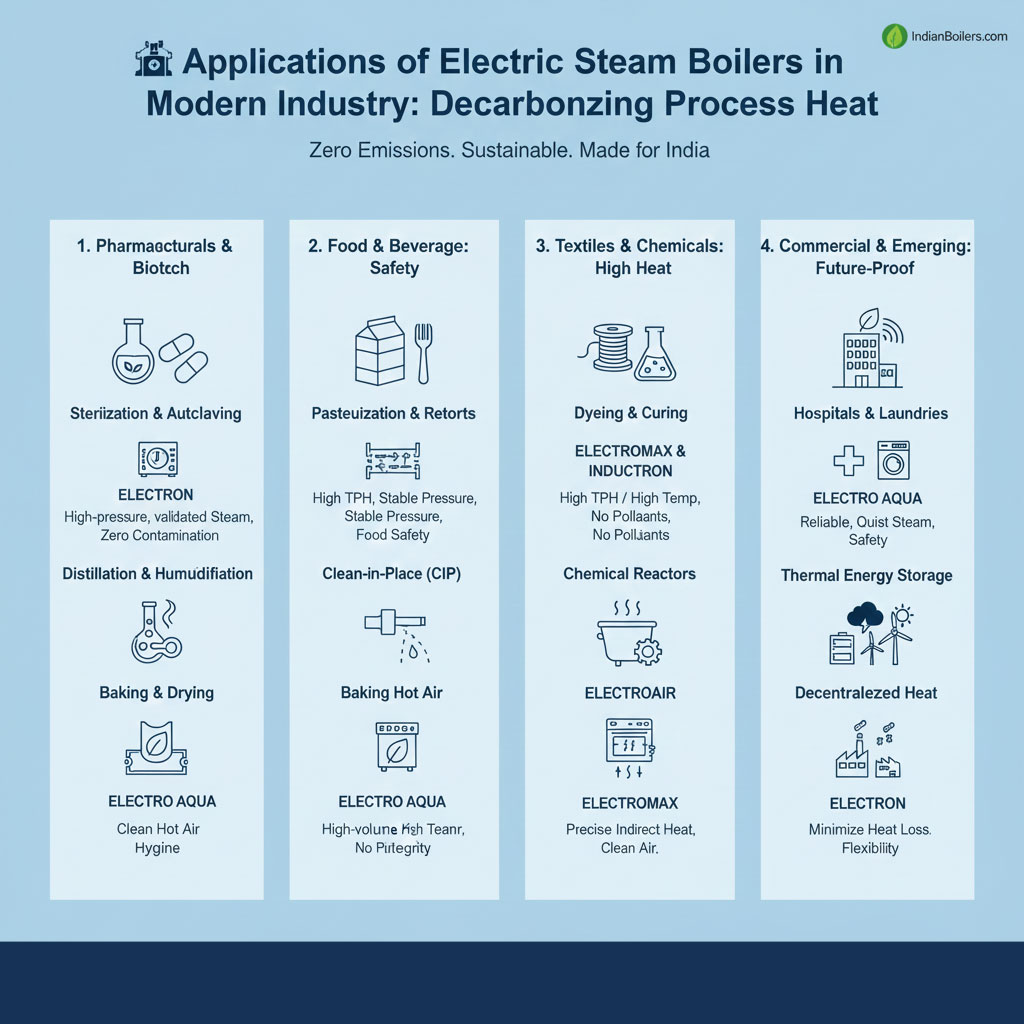
Ask five different industries why they switched to an electric boiler and you’ll get five different answers. A hospital cares about noise and zero-emission air quality near patient wards. A textile plant cares about handling cyclical dye-bath loads without a fuel yard. A dairy cares about hitting exact pasteurization temperatures every single batch. None of them are chasing the same benefit — they’re all just finding that electric heat happens to solve their specific problem better than combustion did.
This piece maps out where electric boilers are actually earning their place across Indian industry today, including a few applications that go well beyond simple process heat — like using large boilers as grid-scale thermal batteries. If you want the deeper technical and regulatory detail on specific sectors, our posts on electric boilers for food, pharma & dairy and boiler selection for food processing units go further into those two sectors specifically. This post is about breadth — the full range of places this technology is showing up, and why.
1. Pharmaceuticals: Where the Utility Itself Is a Quality Control Point
In pharma manufacturing, steam isn’t just a heating medium — it’s often classified as a critical utility with the same validation scrutiny as the product itself. That single fact explains almost every electric boiler decision in this sector.
Autoclave sterilization and validated moist-heat processes need steam that behaves identically every single cycle — no pressure drift, no risk of anything foreign entering the line. The ELECTRON – Electric Steam Boiler fits naturally here because it can sit decentralized, close to a cluster of autoclaves, cutting both piping length and the condensate-contamination risk that comes with long steam runs. Where absolute purity assurance matters even more — say, feeding a Water for Injection still or a clean-steam humidification loop — the INDUCTRON – Induction Boiler‘s scale-resistant core adds a layer of sustained reliability that resistance systems can’t quite match over years of validated operation.
The underlying reason electric wins here isn’t subtle: zero combustion means zero risk of burner fumes, soot, or fuel odor reaching a clean room or an air intake — a risk combustion boilers can manage but never fully eliminate.
2. Food and Beverage: Precision at Scale
Food and beverage steam demand splits into two very different jobs — high-volume continuous heating, and intermittent high-hygiene cleaning.
Pasteurization and retort cooking need large, dependable steam volumes at stable pressure, because microbial kill-rates depend on hitting exact temperature-time combinations without drift. The ELECTROMAX – Electric IBR Steam Boiler is sized for this kind of continuous, high-throughput demand, while INDUCTRON is often the better long-term fit where minimizing water-side maintenance downtime matters as much as raw output.
Clean-in-Place and washdown is a different problem — high volumes of hot water in the 80–95°C range for sanitizing tanks and lines between batches. The ELECTRO AQUA – Electric Hot Water Boiler delivers that instantly and without combustion risk anywhere near a food-contact surface.
And it’s worth calling out ELECTROAIR – Electric Hot Air Generator specifically for baking and drying lines: combustion byproducts can genuinely taint flavor and aroma in sensitive food products, and flameless hot air removes that risk entirely — a benefit that has nothing to do with efficiency and everything to do with product quality.
3. Textiles and Chemicals: Heavy Loads, High Temperatures
Textile and chemical processing tend to need either large cyclical steam volumes or very high indirect temperatures — sometimes both, depending on the process stage.
Dyeing creates a genuinely difficult load pattern: heating a dye bath draws a sharp spike, then demand drops off as the batch soaks, then spikes again for the next one. ELECTROMAX‘s high-capacity design handles that cyclical swing without the slow recovery lag combustion burners show after a demand spike.
Heat setting and curing, by contrast, often needs temperatures pushing 300°C without wanting the pressure complexity that comes with steam at that temperature. This is exactly the gap the ELECTROPAC – Electric Thermic Fluid Heater fills — flameless, precise, high-temperature heat transfer via thermal fluid rather than steam.
Chemical reactors and polymer processing lean on the same ELECTROPAC principle for jacketed reactor heating, where flameless operation and tight temperature stability directly affect whether a batch comes out on-spec. Our safety guide to thermic fluid heaters in the chemical industry goes deeper into this specific application.
One quieter benefit worth mentioning: both sectors historically relied on furnace oil and similarly hazardous, polluting fuels for high-temperature process heat. Removing that fuel storage requirement improves a plant’s environmental and safety profile in a way that shows up in insurance and compliance conversations, not just the utility bill.
4. Commercial and Institutional Settings: Where “Quiet and Reliable” Beats “High Capacity”
This is a category that gets less attention than heavy industry, but it’s a genuine and growing electric boiler market — hospitals, hotels, universities, and commercial laundries.
Hospitals need absolute reliability for sterilization steam and instant hot water for patient care, ideally without loud burner noise disturbing wards or surgical suites. ELECTRON‘s compact, quiet footprint allows placement close to the point of use — near a kitchen or surgical suite — for fast steam delivery, while ELECTRO AQUA handles the continuous hot water demand for laundry and general sanitation. Zero NOx emissions matter here for a reason distinct from industrial compliance: air quality immediately around patients is a clinical consideration, not just a regulatory checkbox.
Commercial laundries need continuous, medium-pressure steam for pressing and drying cycles — smaller operations fit well with ELECTRON, while larger commercial facilities scale up to ELECTROMAX for sustained throughput.
What both settings share is a preference for low-maintenance, low-noise, space-efficient equipment over raw capacity — priorities that align naturally with what electric systems are already good at.
5. The Application Nobody Expects: Electric Boilers as Grid-Scale Thermal Batteries
Here’s where electric boiler use is expanding in a direction that has nothing to do with a specific factory’s process heat needs at all.
As solar and wind generation grows on India’s grid, utilities face a recurring problem: renewable output doesn’t always align with demand. Excess solar power at midday, for instance, needs somewhere to go if demand is low at that exact moment.
Large ELECTROMAX-class boilers can be run deliberately during these high-renewable-generation windows, converting surplus electricity into stored thermal energy in large insulated accumulators — effectively turning the boiler into a giant thermal battery. That stored heat gets drawn down later, during peak demand periods, without needing to run the boiler itself at that moment.
This isn’t a theoretical use case — it’s a genuine emerging role for large electric boilers in grid balancing, and it’s worth understanding even for plants that aren’t directly participating in grid-scale programs, because the same principle applies at plant level: running your boiler during off-peak tariff windows and storing heat for use during expensive peak hours can meaningfully change your operating cost, independent of any grid-balancing arrangement. Our electric boiler sizing guide covers how this kind of tariff-driven strategic oversizing gets factored into a capacity decision.
6. Decentralization: The Quiet Architectural Shift
The last application worth flagging isn’t industry-specific at all — it’s a change in how plants are choosing to lay out their heating infrastructure entirely.
Traditional plants run one large central boiler feeding steam through an extensive distribution network — and that network loses heat along the way, sometimes 10–20% of total output in large facilities with long pipe runs. Electric boilers’ compact footprint (no fuel train, no chimney, no large air intake ducting) makes it practical to do the opposite: install several smaller ELECTRON units at individual processing stations across a plant floor or campus, generating steam exactly where it’s consumed.
The result isn’t just reduced distribution loss — it’s also built-in redundancy. If one unit needs maintenance, the rest of the plant keeps running, rather than the whole facility depending on a single central boiler room.
A Quick Cross-Reference: Application to Product
| Where You Need Heat | Best-Fit Product |
|---|---|
| Sterilization, autoclaves, clean steam | ELECTRON / INDUCTRON |
| High-volume continuous pasteurization or retort | ELECTROMAX / INDUCTRON |
| CIP, washdown, general hot water | ELECTRO AQUA |
| Baking, drying, curing (no combustion risk) | ELECTROAIR |
| High-temperature indirect heat (dyeing, reactors) | ELECTROPAC |
| Grid balancing / off-peak thermal storage | ELECTROMAX (with accumulator) |
| Decentralized, point-of-use steam | ELECTRON |
All six systems are available across IndianBoilers.com and the full Balkrishn.com catalogue.
Conclusion: The Common Thread Isn’t Efficiency — It’s Fit
Every application in this piece arrives at electric heating from a different starting problem — product purity in pharma, flavor integrity in food, cyclical load handling in textiles, noise and space constraints in hospitals, and grid economics in thermal storage. The 99%+ efficiency number gets all the marketing attention, but the actual decision in each of these sectors is really about whether the specific technology — resistance, induction, or thermal fluid — solves the problem that combustion couldn’t.
Balkrishna Boilers Pvt Ltd designs and installs the full range covered here — ELECTRON, ELECTROMAX, INDUCTRON, ELECTROPAC, ELECTRO AQUA, and ELECTROAIR — matched to your specific application, not sold as a one-size-fits-all upgrade.
Not sure which application category your plant falls into? Talk to our engineering team for a consultation matched to your specific process and industry.
Related Reading
- The Complete Guide to Industrial Electric Steam Boilers
- Electric Boilers for Food, Pharma & Dairy: Safe, Clean Steam Solutions
- Electric Boiler Technology: From Immersion Elements to Electrode Types
- Choosing the Right Electric Steam Boiler Capacity for Your Process
- Thermic Fluid Heaters in the Chemical Industry: The Ultimate Safety Guide