
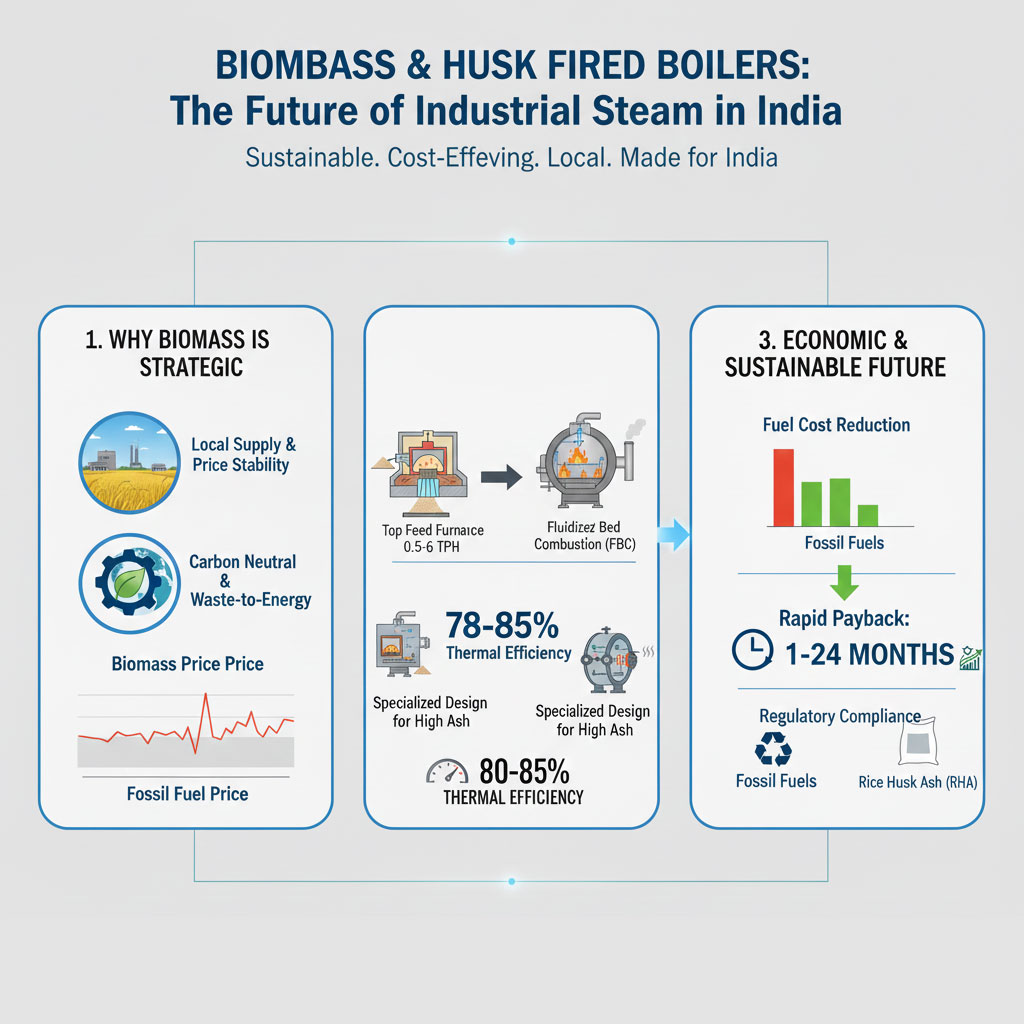
Biomass & Husk Fired Boilers: The Future of Industrial Steam Generation in India
India’s industrial sector stands at a genuine turning point. Fossil fuel prices keep climbing, global energy markets stay unpredictable, and pollution control norms are tightening every year. Plant owners across textiles, food processing, pharmaceuticals, chemicals, and rice milling are all asking the same question: how do we keep steam flowing without letting fuel costs and compliance risk eat into margins?
The answer isn’t imported, isn’t scarce, and isn’t new — it’s sitting in the fields and mills around every industrial cluster in the country. It’s biomass, and in particular, rice husk.
At IndianBoilers.com, part of Balkrishna Boilers Pvt Ltd, we’ve spent years engineering Biomass Fired Steam Boilers and Rice Husk Fired Steam Boilers for exactly this shift. This isn’t a niche alternative fuel story anymore — it’s the direction the entire Indian industrial steam segment is heading, and the sooner a plant makes the switch, the sooner it starts saving.
With more than 25 years of engineering experience and over 5,000 installations across India and overseas, we’ve watched fuel-switching decisions play out across rice mills, textile units, food plants, and pharmaceutical facilities. The pattern is consistent: plants that move early to biomass and husk firing lock in lower operating costs years before their coal-dependent competitors are forced to react to tightening emission norms.
1. Why Biomass Has Become a Strategic Necessity, Not a Trend
India’s industrial energy appetite is enormous, and very little of the coal or furnace oil that traditionally fed it is actually produced domestically at the volumes required. That single fact is reshaping fuel strategy across the country.
A. Insulating Your Plant from Import Volatility
Coal and furnace oil prices are set by global markets, shipping costs, and currency swings that no plant manager can control. Biomass fuels — rice husk, bagasse, groundnut shells, wood chips, mustard straw — are grown, processed, and traded locally.
- A supply chain that stays in India. Sourcing fuel from local agro-processing clusters keeps money circulating in the domestic economy and removes exposure to international freight and currency risk.
- Prices that don’t swing overnight. While furnace oil and imported coal can jump 15–20% in weeks, biomass pricing tends to move gradually with harvest cycles, making budgeting far more predictable for a plant’s finance team.
B. The Carbon-Neutral Argument That Actually Holds Up
Biomass combustion is treated as carbon-neutral under most global and Indian regulatory frameworks, and the science behind that is straightforward.
- A closed carbon loop. The CO₂ released when biomass burns is roughly the same CO₂ the plant absorbed while growing — unlike fossil fuels, which release carbon that had been locked away for millions of years.
- Turning agricultural waste into a solution. Every tonne of husk or straw diverted into a boiler is a tonne that doesn’t get openly burned in a field, a practice that drives severe air quality problems across North India every winter. If you want the deeper mechanics of how modern systems keep this combustion clean, our guide on Biomass Boiler Emission Control Systems breaks down the filtration and scrubbing technology involved — technology we also supply as standalone Pollution Control Equipment.
2. Rice Husk: India’s Most Practical Biomass Fuel
Every form of biomass has a place, but rice husk occupies a special position in the Indian fuel landscape because of how it’s produced and where it’s available.
A. Availability That Doesn’t Disappear Between Seasons
Unlike sugarcane bagasse, which is tied to a crushing season, rice is milled through most of the year across major growing states.
- A non-seasonal fuel stream. Continuous milling activity means husk supply doesn’t dry up for months at a stretch the way some other agro-residues do.
- Fuel that’s already near your plant. Rice mills are spread across nearly every agricultural belt in India, so textile units, food processors, and chemical plants located near these clusters can secure husk at low transport cost.
B. Designing Around Husk’s Quirks
Husk isn’t a drop-in replacement for coal — it has low bulk density and a high silica ash content, both of which demand purpose-built boiler engineering rather than a retrofit of a coal-fired unit.
| Boiler Technology | Ideal Capacity (TPH) | Key Feature for Husk | Benefit |
|---|---|---|---|
| Top Feed / Internal Furnace | Low to Medium (approx. 0.5 – 6) | Large furnace volume, pneumatic feeding | Excellent efficiency, compact footprint, fast ROI |
| Fluidized Bed Combustion (FBC) | Medium to High (approx. 4+) | Turbulent mixing, fuel flexibility | Handles varying moisture/ash content, highest efficiency, stable operation |
Beyond these, grate design plays a major role in how well a boiler handles husk and other biomass fuels day-to-day. If you’re comparing options, our detailed breakdowns of Vibrating Grate vs. Reciprocating Grate Boilers and Chain Grate Boiler Speed and Its Effect on Steam Output walk through exactly which technology suits which fuel and load profile. For a broader primer, see What Are the Types of Boiler Grates?
On efficiency: Modern Husk Fired Boilers from IndianBoilers.com — fitted with economisers and air preheaters for heat recovery — consistently deliver thermal efficiencies of 78% to 85%, matching or beating many conventional coal-fired systems. On the Balkrishna Boilers product range, this technology is available as the HUSKPOWER series, part of our wider Steam Boiler line-up.
3. The Economics: Why the Fuel Bill Is the Real Story
The strongest argument for switching to biomass and husk firing isn’t environmental — it’s financial, and the payback numbers are hard to ignore.
A. Cutting Fuel Cost at the Source
The fuel cost component of a Husk Fired Boiler can run as low as one-fifth of an equivalent coal-fired system, and a fraction of what a diesel-fired unit costs to run.
- Near-zero fuel cost for rice mills. For a rice mill converting its own husk into steam, the fuel is essentially a byproduct it already owns — this also eliminates disposal costs for what would otherwise be waste.
- Payback in 1–2 years. The extra capital cost of a biomass-specific boiler and its fuel handling system is typically recovered within one to two years purely through fuel savings — a number that gets attention from any industrial CFO. Our earlier post, From Waste to Power: How Husk Fired Boilers Cut Your Fuel Bill, walks through the cost breakdown in more detail.
B. A Byproduct That Pays for Itself
Coal ash is a disposal headache. Rice Husk Ash (RHA), by contrast, is mostly silica (SiO₂) and has genuine commercial value.
- A revenue line, not a cost line. RHA is sought after by the cement, refractory, and construction industries, turning what used to be a waste disposal problem into an additional revenue stream.
If you’re weighing husk against other agro-residues for your specific plant, our comparison guides on Rice Husk vs. Mustard Straw: Which Biomass Fuel Offers Better ROI and Biomass Pellet vs. Biomass Briquette: Which Fuel Gives Better Boiler Performance? are worth reading before finalizing your fuel strategy. For plants that want maximum flexibility across multiple agro-residues rather than committing to one fuel type, it’s also worth looking at Multi-Fuel Boilers: The Future of Industrial Heating in India.
4. Getting the Engineering Right: Grates, Moisture, and Fuel Selection
A biomass boiler is only as good as the combustion system underneath it, and grate technology is where most of the real engineering differences show up.
- Reciprocating grate systems handle high-moisture biomass better than many conventional designs — our guide on How Reciprocating Grate Boilers Handle High-Moisture Biomass explains why, and Fuel Moisture vs. Boiler Efficiency: Finding the Ideal Range shows exactly where efficiency starts to fall off.
- Vibrating grate systems are a strong fit for certain fuel classes — see Best Biomass Fuels for Vibrating Grate Boilers and How to Improve Efficiency of a Vibrating Grate Boiler Without Increasing Fuel Consumption.
- Travelling grate boilers, widely used in sugar mills, have their own fuel-selection logic — covered in How to Select the Right Fuel for a Travelling Grate Boiler and Travelling Grate Boilers for Sugar Mills: The Ultimate Engineering Guide.
- Running an older reciprocating grate unit and considering an upgrade instead of a full replacement? Our Reciprocating Grate Boiler Retrofit Guide for Existing Plants is a useful starting point, alongside How Reciprocating Grate Technology Improves Biomass Combustion Efficiency and Best Biomass Fuels for Reciprocating Grate Boilers.
And no biomass system runs trouble-free forever — for common operational issues and how to fix them without a full shutdown, see Common Biomass Boiler Problems and Their Solutions.
5. Regulatory Alignment and Long-Term Compliance
Biomass and husk firing don’t just cut costs — they future-proof a plant against tightening emission norms.
- Policy is moving in this direction, not away from it. As government policy continues to favour renewable and low-emission fuel sources, biomass-fired systems avoid the expensive retrofits that coal-fired plants will eventually face. Compliance documentation matters here too — our reference posts on The Boilers Act, 2025 and The Indian Boilers Act, 1923 are useful references for plant compliance teams.
- A reputational asset, not just an operational one. Using local biomass strengthens a company’s environmental and social credentials — increasingly a real factor when securing contracts with multinational clients who audit supplier sustainability.
6. Where the Technology Is Headed
Biomass boiler operations are also getting smarter. Real-time monitoring, predictive maintenance, and remote diagnostics are no longer confined to large power utilities — they’re becoming standard on industrial-scale biomass systems too. Our posts on How AI and IoT Are Transforming Biomass Boiler Operations in 2026 and Digital Twin Technology: Revolutionizing Boiler Efficiency and Reliability look at where this is heading — and for plants weighing an entirely different fuel path, Hydrogen-Ready Boilers: Are They Practical for Indian Industries? is a useful comparison read.
7. Which Industries Benefit Most
Biomass and husk-fired steam isn’t limited to rice mills. It’s a strong fit anywhere continuous, cost-sensitive steam is central to operations — textile processing, food and beverage manufacturing, pharmaceutical production, chemical plants, sugar mills, and more.
- Textile processing relies on stable, high-volume steam for dyeing and finishing, where fuel cost per kg of output directly affects margins.
- Food and beverage plants need consistent steam quality for sterilization and processing, and biomass systems deliver that without the price swings of furnace oil.
- Pharmaceutical manufacturing demands strict reliability and documentation, and a well-engineered husk-fired system meets both, while also supporting sustainability reporting that many pharma exporters now require.
- Sugar mills, already generating bagasse as a byproduct, are natural candidates for travelling grate biomass systems that turn their own waste stream into process steam.
For a sector-by-sector breakdown, see Best Boiler for Textile, Pharma, and Food Industry: An Industry-wise Guide, and browse our full Industries page (or the equivalent Applications page on Balkrishna Boilers) to see where this fits your operation specifically. If you’d like to see how similar plants have made this transition, our installation story at Bluecraft Agro and our roundup of Top 10 Industries That Can Benefit from Waste Heat Recovery Boilers are worth a read.
8. The Future Is Green, Local, and Profitable
The move to biomass and husk-fired steam isn’t a passing trend — it’s a structural shift that Indian industry needs to make to stay competitive on cost and compliant on emissions at the same time.
Biomass is decentralized, abundant, and economically powerful in a way few other fuel sources are for Indian manufacturers. Investing in a high-efficiency Husk or Biomass Fired Boiler means lower operating costs, greater energy security, and a genuinely smaller environmental footprint — not in theory, but in the fuel bill you’ll see next quarter.
Ready to make the switch?
Explore our full range of Steam Boilers, Thermic Fluid Heaters, and Hot Air Generators built for Indian fuel and industrial conditions — or view the same range on Balkrishna Boilers, including the HUSKPOWER and ENERPOWER series.
Contact IndianBoilers.com or Balkrishna Boilers today to understand how our expert-engineered Biomass Fired Boilers and Husk Fired Boilers can power your plant’s transition to the next generation of industrial steam.