
Top 10 Benefits of Biomass Fired Boilers for Indian Factories (2026 Guide)
India’s factory owners are under constant pressure from three directions at once — rising fuel bills, tightening pollution norms, and buyers who now ask for proof of sustainable manufacturing before signing a purchase order. A biomass fired boiler answers all three problems at the same time, which is why it has quietly become the default choice for new steam and thermal installations across rice mills, textile units, food plants, and chemical factories in India.
At Balkrishna Boilers Pvt Ltd, we’ve engineered and commissioned biomass-fired systems for over 25 years and 5,000+ installations, so this guide isn’t theory — it’s a summary of what actually moves the needle for plant owners who make the switch. Below are the ten biggest, most practical benefits of installing a biomass boiler in an Indian factory, and what to check before you buy one.
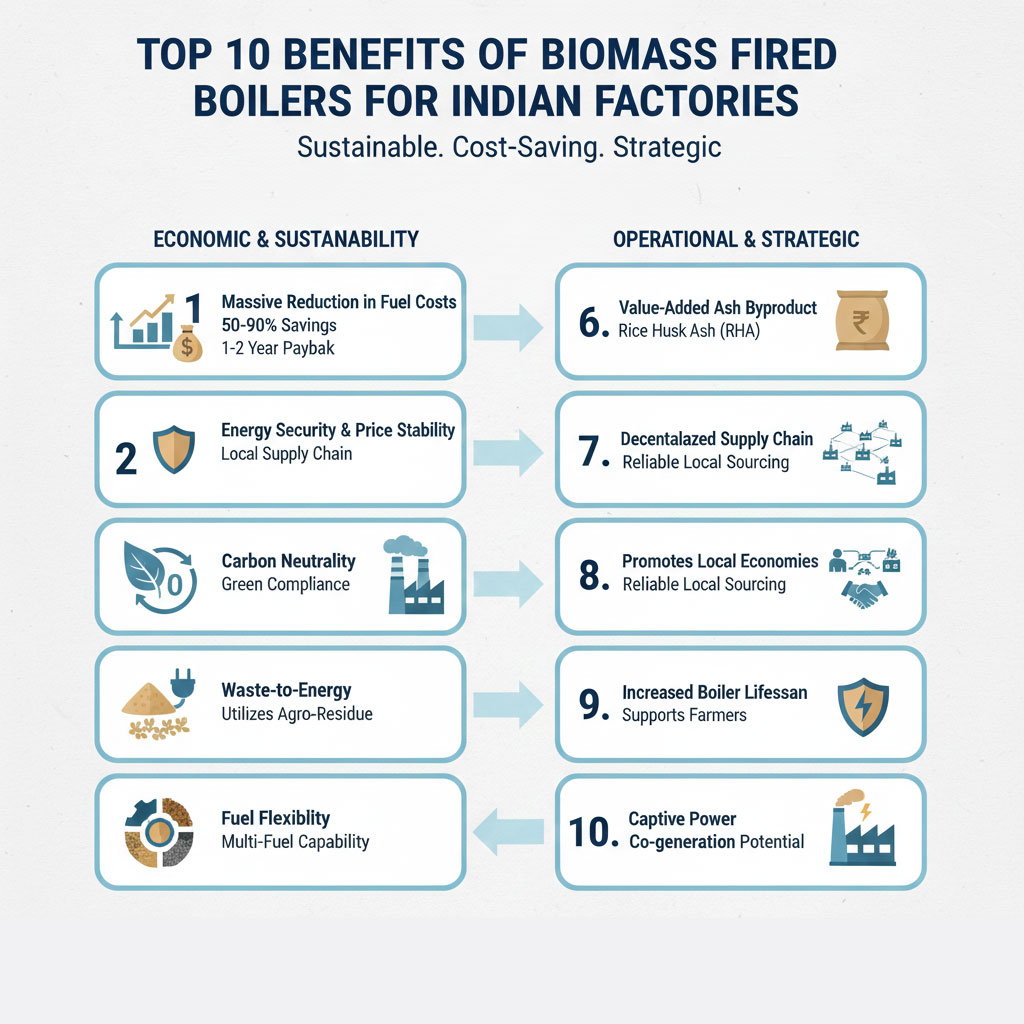
1. Fuel Cost Savings That Pay for the Boiler Itself
This is the number one reason factories switch. Coal, furnace oil, and diesel prices move with international markets and currency swings that no plant manager can control. Biomass — rice husk, groundnut shell, bagasse, wood chips, mustard straw, cotton stalk — is grown, processed, and priced locally.
For units near agricultural belts, or those that already generate husk, bagasse, or shell waste on-site, the effective fuel cost can fall close to zero. That’s why most biomass boiler installations recover their entire capital cost within 12 to 24 months, a payback period that’s hard to match with any other industrial fuel-switching decision. Explore the full range of steam boilers engineered for this fuel category, including husk, pellet, and multi-fuel variants like HUSKPOWER and PELLETAX.
2. Protection from Fuel Price Volatility
Beyond the raw savings, biomass gives factories something coal and oil never will: price predictability. Because the fuel is sourced from local farmers, mills, and traders rather than global commodity markets, plant budgets stop swinging with every OPEC announcement or shipping disruption. Finance teams can lock in annual energy budgets with far greater confidence — a benefit that compounds year after year as fossil fuel markets stay unpredictable.
3. A Direct Route to Carbon Neutrality and ESG Compliance
Sustainability reporting is no longer optional for factories that export, supply to large corporates, or work with financial institutions offering green loans. Biomass fuel operates on a closed carbon cycle: the CO₂ released during combustion is roughly equal to what the plant absorbed while growing, making it functionally carbon-neutral compared to fossil fuels.
This matters in two very concrete ways:
- ESG scorecards and buyer audits increasingly ask for proof of low-carbon energy sourcing, and a biomass boiler is one of the clearest, most auditable answers a factory can give.
- Pollution Control Board (PCB) compliance becomes considerably easier, since biomass systems generate far lower SOx emissions than coal or furnace oil, reducing the need for expensive downstream scrubbing equipment.
For a deeper look at emission performance, see our detailed guide on biomass boiler emission control systems.
4. Turning Agricultural Waste Into an Energy Asset
India generates enormous volumes of crop residue every harvest season — husk, straw, stalks, shells — much of which is still openly burned in fields, a major contributor to seasonal air pollution in northern India. Biomass boilers convert this “waste” directly into thermal energy, giving factories, especially rice mills, sugar mills, and oil extraction units, a productive use for material that would otherwise be a disposal headache.
This is one reason biomass adoption is growing fastest in agro-processing clusters. If your factory already generates husk, shell, or fibrous waste as a by-product, pairing it with the right boiler design (see our Biomass & Husk Fired Boilers overview) can turn a cost center into a genuine efficiency gain.
5. Fuel Flexibility Through Modern Grate and FBC Technology
Older biomass boiler designs were often built around one specific fuel, which created supply risk if that fuel became scarce or expensive. Modern systems solve this with advanced combustion technology:
- Fluidized Bed Combustion (FBC) boilers can burn blended fuels — husk, shell, pellets, even low-grade coal — without a major efficiency drop.
- Reciprocating and vibrating grate boilers are engineered to handle varying fuel sizes, densities, and moisture content, which is critical in India where biomass quality varies by region and season.
If you’re evaluating grate technology for a multi-fuel setup, our comparison of Vibrating Grate vs Reciprocating Grate boilers and our guide on selecting the right fuel for a travelling grate boiler are good starting points.
6. Ash Byproducts That Generate Additional Revenue
Unlike coal ash, which is largely a disposal cost, ash from certain biomass fuels — particularly Rice Husk Ash (RHA) — has real commercial value. RHA is rich in reactive silica and is actively purchased by cement manufacturers, refractory producers, and concrete additive companies.
For rice mills and agro-processing units already generating husk ash, this creates a secondary revenue stream that further shortens the payback period on the boiler investment, on top of the fuel savings already discussed in point 1.
7. A More Resilient, Decentralized Fuel Supply Chain
Coal and furnace oil typically travel long distances through complex logistics chains before reaching a factory, exposing plants to transport delays, port congestion, and freight cost spikes. Biomass fuel, by contrast, is available in nearly every agricultural state in India, sourced from mills and farms often within a short trucking radius of the factory.
This decentralized supply model reduces single-point-of-failure risk. A plant sourcing husk from three or four local suppliers is far less vulnerable to disruption than one depending on a single coal linkage or imported fuel contract.
8. Stronger Local Economic and Community Impact
Every tonne of biomass a factory buys supports a chain of local farmers, aggregators, and transporters. For factories operating under CSR mandates or seeking stronger community relationships near their plant site, biomass procurement is a tangible, easy-to-communicate contribution to the local rural economy — something coal or imported fuel simply can’t offer.
9. Purpose-Built Engineering for Longer Boiler Life
Biomass fuels behave very differently from coal — higher silica content, lower bulk density, and variable moisture. Boilers not designed for these properties suffer from faster wear, clinker formation, and frequent shutdowns. This is where boiler design quality makes a measurable difference to total cost of ownership.
Purpose-built biomass systems typically include:
- Reinforced combustion chambers and anti-erosion ferrules for husk-heavy fuels
- Multi-Cyclone Dust Collectors (MCDC) to protect downstream components
- Grate designs matched to fuel type — reciprocating, vibrating, or travelling grate
If uptime and fuel efficiency are a priority, it’s worth reading our guides on improving vibrating grate boiler efficiency and common biomass boiler problems and their solutions before finalizing a specification.
10. A Foundation for Captive Power Generation (Co-generation)
For factories with high and consistent steam demand, a biomass boiler isn’t just a heating asset — it can be the starting point for a captive power setup. By pairing a higher-pressure biomass steam boiler with a back-pressure or extraction-condensing turbine, factories can generate their own electricity alongside process steam, cutting dependence on grid power and further improving overall plant energy economics.
This co-generation route is especially relevant for sugar mills, large textile units, and continuous-process chemical plants where both steam and power demand run around the clock.
Choosing the Right Biomass Boiler for Your Factory
The benefits above only materialize if the boiler is correctly sized and specified for your fuel, steam pressure, and load profile. A few practical starting points:
- Rice mills, oil mills, and agro units generating their own husk or shell waste should look closely at dedicated husk-fired systems like HUSKPOWER.
- Pellet-based operations with consistent fuel supply chains often prefer PELLETAX for cleaner, more automated combustion.
- Factories needing hot water rather than steam — common in food processing and textile dyeing — should evaluate our hot water boiler range, including the biomass-fired hot water boiler.
- Plants that also need thermal fluid heating for processes like drying, curing, or thermal oil circuits can review our Thermic Fluid Heater range and the chemical industry safety guide for thermic fluid heaters.
- If fuel costs will vary through the year, compare options in our post on Biomass Pellet vs. Biomass Briquette performance and Rice Husk vs. Mustard Straw ROI comparison.
For factories weighing biomass against other fuel-switching options, our earlier piece on why factories are switching to biomass boilers breaks down the cost-versus-green-compliance decision in more detail.
Get a Free Energy Audit and ROI Estimate
Every factory’s fuel mix, steam load, and payback timeline are different, which is why a generic quote rarely tells the full story. Our engineering team at Balkrishna Boilers Pvt Ltd offers a complimentary energy audit and ROI projection so you know the real numbers before you commit.
- Browse our complete product range on IndianBoilers.com or the full catalog on Balkrishn.com
- Read more industry insights on our blog
- Request your free consultation and our team will get back to you with a tailored recommendation.
Balkrishna Boilers Pvt Ltd — 25+ years, 5,000+ installations, and boilers engineered for the way Indian factories actually run.