
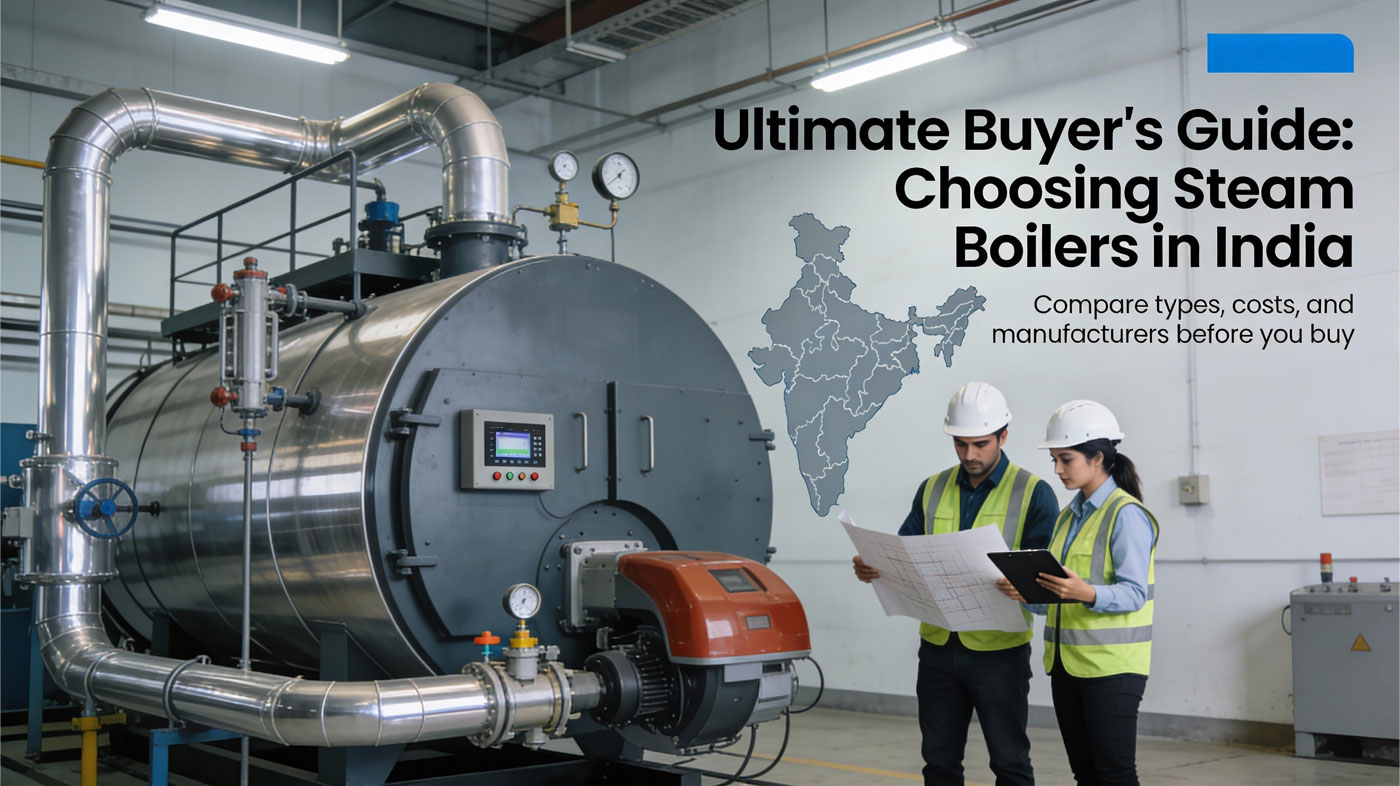
Ultimate Buyer’s Guide: Choosing Steam Boilers in India
Industrial steam generation keeps India’s factories running — from dyeing units in Surat to sugar mills in Uttar Pradesh and pharma plants in Ahmedabad. Yet a steam boiler is also one of the biggest capital decisions a plant manager will make: the wrong choice locks a company into years of high fuel bills, compliance headaches, and unplanned downtime. This guide walks you through everything a serious buyer needs to evaluate in 2026 — boiler types, fuel strategy, IBR compliance, cost, automation, and how to shortlist a manufacturer you can trust for the next decade.
Why the Boiler Decision Matters More Than Ever
Energy costs, emission norms, and fuel availability have all shifted in the last few years. Coal linkage has become harder to secure for smaller units, biomass prices fluctuate by region and season, and the Central Pollution Control Board‘s emission limits are tightening for particulate matter and NOx. A boiler purchased purely on upfront price, without factoring in fuel flexibility and lifecycle efficiency, often ends up costing far more over a 15–20 year service life. That’s why serious buyers now evaluate boilers the way they’d evaluate any long-term capital asset — on total cost of ownership, not sticker price.
Steam Boiler Fundamentals and IBR Compliance
At its core, a steam boiler is a pressure vessel that converts feed water into steam through combustion of a fuel — coal, biomass, rice husk, agro-waste, oil, or gas. In India, any boiler operating above 22.75 litres of water capacity and generating steam at pressure above the threshold defined under the boiler regulations must be registered and inspected by the state’s Chief Inspector of Boilers. We’ve covered the regulatory backbone of this in detail in The Boilers Act, 2025 and the original Indian Boilers Act, 1923, both available as free downloads — worth bookmarking before you finalize any purchase order.
Beyond legal compliance, the core engineering fundamentals that decide a boiler’s real-world performance are furnace design, heat-transfer surface area, drum construction, and the control system governing combustion air, feed water, and blowdown. Efficiency ratings for a well-designed unit typically sit between 82% and 95%, and even a 3–5% efficiency gap compounds into lakhs of rupees in fuel cost over a year of continuous operation.
Matching Boiler Type to Your Process
Not every plant needs the same boiler architecture. The right type depends on required pressure, load pattern, fuel, and space available.
Fire tube boilers remain the workhorse for small and mid-sized Indian units — textile dyeing, rice mills, small food plants — because hot combustion gases pass through tubes submerged in water, giving a simple, compact, quick-starting design suited to loads up to roughly 20 TPH.
Water tube boilers flip that arrangement, routing water through tubes surrounded by hot gases. This lets them handle much higher pressures and faster steam generation, which is why pharmaceutical plants and captive power units lean toward this design when they need dependable high-pressure steam.
Packaged boilers are pre-assembled, skid-mounted units that cut installation time dramatically — a strong fit for MSMEs that need to be operational fast without a lengthy site-erection phase.
Fluidized Bed Combustion (FBC) boilers burn a wider range of fuels — coal, biomass, agro-residue — more cleanly and efficiently than conventional grates, making them attractive as emission norms tighten.
Solid-fuel grate boilers deserve special mention for biomass-heavy operations. If you’re weighing grate technology specifically, we’ve published detailed engineering comparisons on this — see our guide on Vibrating Grate vs Reciprocating Grate boilers, how grate speed affects steam production and fuel consumption, and a practical retrofit guide for reciprocating grate boilers already installed at your plant.
| Boiler Type | Typical Capacity | Best Suited For | Efficiency Range |
|---|---|---|---|
| Fire Tube | 1–20 TPH | Textiles, food, rice mills | 82–85% |
| Water Tube | 5–100 TPH | Pharma, captive power | 88–92% |
| Packaged | 0.5–10 TPH | MSMEs, fast commissioning | 85–90% |
| FBC | 2–50 TPH | Multi-fuel, biomass-heavy plants | 87–95% |
| Grate-fired (biomass) | 1–40 TPH | Rice husk, agro-waste operations | 84–93% |
Choosing the Right Fuel — The Decision That Drives Your Running Cost
Fuel selection often matters more than the boiler brand itself, because fuel is typically 60–70% of total operating cost over the boiler’s life. Rice husk, mustard straw, wood chips, briquettes, and pellets each carry different calorific values, moisture behaviour, and regional pricing. We’ve broken down two of the most commonly debated comparisons for Indian plant owners: Rice Husk vs Mustard Straw — which biomass fuel gives better ROI, and Biomass Pellet vs Biomass Briquette performance in real operating conditions.
Moisture content in particular has an outsized effect on combustion efficiency and flame stability — our guide on fuel moisture vs boiler efficiency walks through the ideal range to target, and how reciprocating grate boilers handle high-moisture biomass better than conventional designs. If your operation is genuinely multi-fuel — switching between coal, biomass, and agro-waste depending on availability and price — it’s worth reading our overview of multi-fuel boilers as the future of industrial heating in India.
Industry-Specific Selection Criteria
A textile unit, a pharma plant, and a food processing facility don’t share the same steam quality or hygiene requirements, even if their TPH demand looks similar on paper. We’ve written an industry-wise breakdown covering the best boiler choice for textile, pharma, and food industries, and a more focused piece on boiler selection specifically for food processing units, where steam purity and quick load response typically outweigh raw capacity.
If your interest extends beyond steam generation to thermal oil systems, our Thermic Fluid Heaters in the Chemical Industry safety guide and the smart sensors that actually matter in thermic fluid heaters are useful companion reads, since many chemical and pharma plants run both steam and thermic fluid systems side by side.
Key Buying Factors Beyond the Spec Sheet
Load calculation: Size the boiler to your actual steam demand plus a realistic 10–20% buffer for peak load — oversizing wastes capital and undersizes efficiency at partial load; undersizing chokes production during peak shifts.
Automation and controls: PLC-based combustion control, automatic blowdown, low-water cutoffs, and remote monitoring reduce both fuel waste and safety risk. This is increasingly where the real differentiation between vendors lies — our piece on how AI and IoT are transforming biomass boiler operations in 2026 and digital twin technology for boiler efficiency and reliability shows how far this has come even for mid-sized plants.
Emission compliance: Grate and combustion design directly affects particulate and NOx output — see our dedicated guide on biomass boiler emission control systems for what CPCB-compliant setups actually require, and pair it with pollution control equipment such as bag filters, ESPs, or wet scrubbers where local norms demand it.
After-sales support and spares: In tier-2 and tier-3 industrial belts, a manufacturer with a genuine service network matters as much as the machine itself — ask any vendor how fast they can mobilise a technician and whether critical spares are stocked domestically.
Common Problems Worth Knowing Before You Buy
Every boiler owner eventually runs into operational issues — clinker formation, uneven combustion, tube fouling, or efficiency drift over time. We’ve catalogued the most common biomass boiler problems and their solutions from an engineering standpoint, and a practical guide on improving vibrating grate boiler efficiency without increasing fuel consumption — both worth reviewing so you know what to ask your shortlisted vendor about long-term maintainability, not just day-one performance.
Cost Breakdown and ROI in 2026
Entry-level non-IBR units (around 1 TPH) typically start in the ₹5–10 lakh range, while IBR-certified fire tube boilers around 5 TPH fall between ₹20–35 lakh depending on fuel system and automation level. Water tube and FBC systems above 10 TPH can run ₹40 lakh to over ₹1 crore. Add roughly 10–15% of the base cost for installation, and budget 2–5% annually for operations and maintenance.
Biomass-fired systems generally pay back their premium over coal or oil-fired alternatives within 2–3 years given current fuel price spreads, and energy-efficient models can qualify for incentives under applicable government efficiency schemes — always confirm current eligibility with your CA or the scheme administrator, as these change year to year. Get quotes from at least 3–4 manufacturers, insist on a like-for-like specification comparison, and weight the decision toward lifecycle fuel savings rather than the lowest quoted capex.
Installation, Commissioning, and Ongoing Compliance
Site preparation needs a properly engineered foundation and adequate clearance for service access — don’t compromise on this to save floor space. Commissioning by an IBR-approved agency, including hydrostatic testing, typically takes one to two weeks depending on capacity. Once operational, registration with the state Boiler Inspectorate and periodic third-party inspection isn’t optional — it’s the law, and it’s also your best protection against catastrophic failure. Reviewing our downloadable Boilers Act, 2025 summary before your inspection date will save you a lot of back-and-forth with the inspector’s office.
If you’re specifically running a sugar mill, our engineering guide to travelling grate boilers for sugar mills and the companion piece on selecting the right fuel for a travelling grate boiler are both directly relevant given the bagasse-fired operating pattern unique to that industry.
Choosing the Right Manufacturer
Once you know your capacity, fuel, and pressure requirements, the manufacturer conversation becomes about engineering depth and after-sales reliability rather than just price. Balkrishna Boilers Pvt Ltd — operating under IndianBoilers.com and Balkrishn.com — has over 25 years of manufacturing experience and 5,000+ installations across India and 30+ countries, with in-house design, fabrication, and testing at our Ahmedabad facility.
Our product range spans the full spectrum a plant might need:
- Steam Boiler range, including field-proven models like STEAMPOWER, STEAMGEN, STEAMJET, and the husk-and-biomass-focused HUSKPOWER and ENERPOWER waste heat recovery series.
- Thermic Fluid Heater range including THERMPAC, DELTAPAC, and the VTF Series.
- Hot Water Boiler range including AQUAJET and AQUAMAX.
- Electric Boiler range including ELECTROMAX and ELECTROPAC.
- Hot Air Generator range including AIRPOWER and AIRTHERM.
- Pollution Control Equipment including bag filters, ESPs, and wet scrubbers to keep your combustion system compliant as norms tighten.
We recently showcased our waste heat recovery and pharma-grade systems at PharmaTech Expo & LabTech Expo 2026, and completed a recent field installation you can read about in Successful Installation: Enerpower Waste Heat Recovery Boiler at Bluecraft Agro — a good real-world reference if you want to see how a project like yours might actually get delivered.
Making the Final Decision
Before you sign a purchase order: get written quotes from three to five manufacturers on identical specifications, ask each vendor for a client reference in your industry, and visit an operating installation if at all possible rather than relying on a brochure. Calculate a simple payback comparison across fuel type and efficiency rating rather than comparing quoted price alone — in almost every case, the boiler with the higher efficiency rating and better automation package wins over a 5–7 year horizon, even at a higher initial cost.
If you’d like a tailored recommendation based on your TPH requirement, fuel availability, and budget, our engineering team at Balkrishna Boilers Pvt Ltd is happy to walk through the numbers with you — get in touch here or explore our full product range directly.
Frequently Asked Questions
What size steam boiler does a small textile unit need? Most small dye-houses and processing units in India operate comfortably on a 1–3 TPH fire tube or packaged boiler. Always calculate your actual peak steam demand first rather than sizing off installed machine capacity alone — our Steam Boiler range covers this segment with models like STEAMAX and COMCUBE.
Is a non-IBR boiler legal in India? Yes, for pressures and capacities below the threshold defined in the boiler regulations — but it’s worth confirming your exact operating pressure against current rules, since a marginal upgrade in production later can push you over the IBR threshold unexpectedly. Our download of The Boilers Act, 2025 sets out the current thresholds in full.
Which fuel gives the best ROI for a biomass boiler in India? It depends heavily on your region and what’s locally available — rice husk tends to win in paddy-growing states, while mustard straw or other agro-residue may be cheaper elsewhere. Our comparison of Rice Husk vs Mustard Straw ROI breaks this down by calorific value and delivered cost.
How often does a steam boiler need inspection? Under Indian boiler regulations, registered boilers require periodic third-party inspection — typically annual, with more frequent internal checks recommended for high-utilisation plants. Daily blowdown, quarterly tube checks, and a full annual inspection are good baseline practice regardless of the statutory minimum.
Can one boiler run on multiple fuels? Yes — FBC and certain grate-fired designs are built to switch between coal, biomass, and agro-waste depending on availability and price, which is increasingly valuable given how volatile fuel supply has become. See our detailed take on multi-fuel boilers as the future of industrial heating.
Further reading: Top 10 Steam Boiler Types for Indian Industries · Steam Boiler Efficiency: Boost Savings by 30% · Waste Heat Recovery Boiler for Cement Plants · Hydrogen-Ready Boilers: Are They Practical for Indian Industries?