
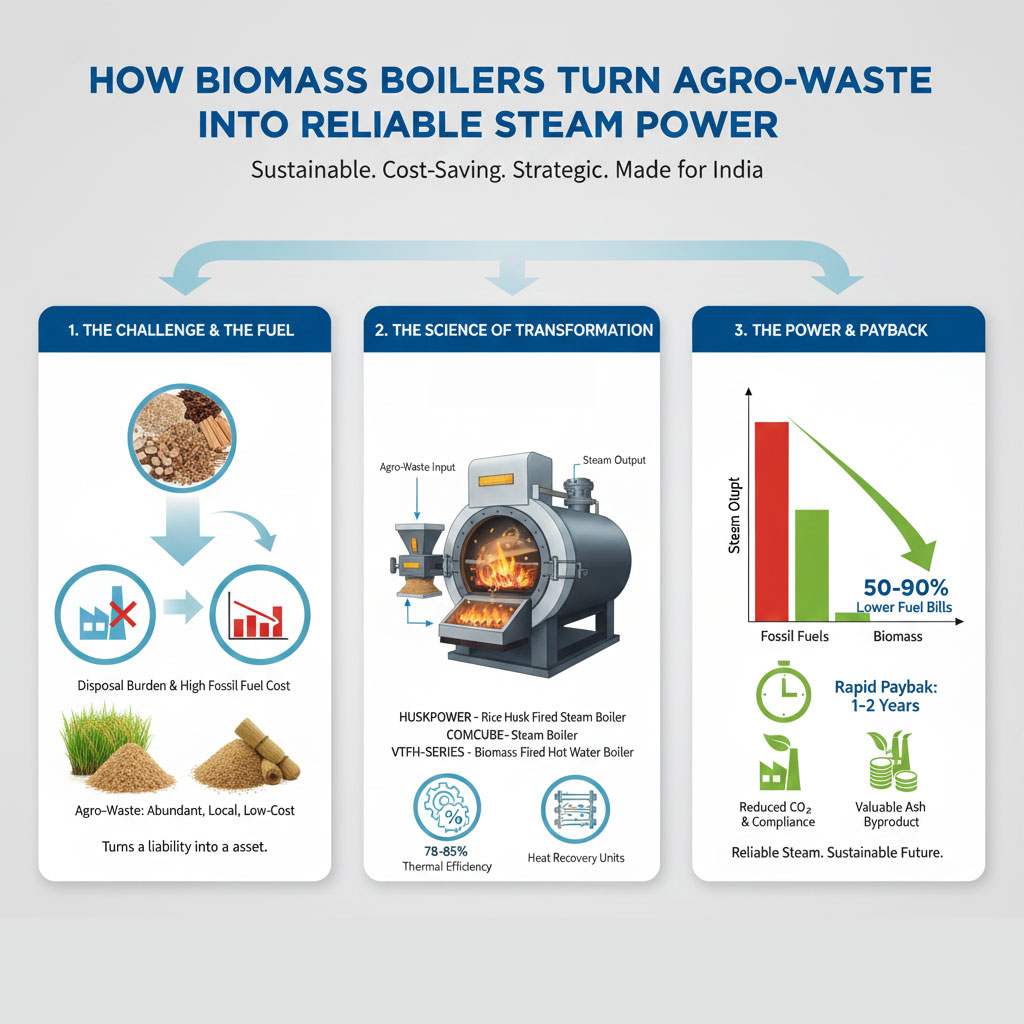
Every harvest season, Indian farms and processing units generate enormous volumes of leftover organic material — rice husk, sugarcane bagasse, groundnut shells, mustard stalk, coffee husk, and cotton stalk, to name just a few. For decades, most of this material was either burned in open fields (a major contributor to air pollution) or dumped as low-value waste. Today, that same “waste” is quietly powering some of India’s largest rice mills, textile units, food plants, and pharmaceutical factories.
The bridge between agricultural residue and dependable industrial steam is the biomass-fired boiler — a purpose-engineered system that burns organic residues cleanly and efficiently to produce steam or hot water on demand. At Balkrishna Boilers Pvt Ltd (IndianBoilers.com), we design and manufacture these systems specifically for the realities of Indian agro-industrial fuel: variable moisture, high ash content, inconsistent particle size, and seasonal availability.
This guide breaks down exactly how that conversion happens — from raw residue to usable steam — and where different boiler technologies fit best.
1. Why Agro-Waste Is an Energy Opportunity, Not a Liability
Agro-residue creates two problems for industry at once, and a biomass boiler solves both simultaneously:
- Disposal cost and environmental damage. Uncontrolled burning of crop residue releases particulate matter and contributes to regional air quality crises, while landfilling or open dumping degrades land and water tables.
- Rising fossil fuel exposure. Furnace oil, diesel, and imported coal prices are volatile and consistently trending upward, squeezing the operating margins of steam-dependent industries.
A well-designed biomass system converts the disposal problem directly into the fuel solution — residue that would otherwise cost money to remove instead generates the steam a plant needs every day. This is the same logic covered in our earlier post on why industries are switching to biomass boilers for cost savings and green benefits.
2. Not All Agro-Waste Behaves the Same Way
Before combustion technology even enters the picture, fuel characteristics dictate boiler design. Three variables matter most:
- Moisture content – Fresh bagasse can carry 45–50% moisture, while dried rice husk may sit below 10%. Higher moisture reduces the net calorific value and demands different grate and airflow design. We cover this relationship in detail in Fuel Moisture vs Boiler Efficiency: Finding the Ideal Range for Reciprocating Grate Boilers.
- Ash content – Rice husk can leave behind 18–22% ash after combustion, far higher than wood biomass. This directly influences whether a fixed grate, travelling grate, or fluidized bed system is the right fit.
- Bulk density and particle size – Loose husk and shredded stalks behave very differently on a feeding system than densified pellets or briquettes. Our comparison of biomass pellets vs biomass briquettes explains how densification changes combustion performance and logistics economics.
Because no two agro-residues are identical, fuel-flexible engineering is essential — a theme we explore further in Multi-Fuel Boilers: The Future of Industrial Heating in India.
3. Preparing the Fuel Before It Enters the Furnace
Most agro-waste can be fired with minimal pre-treatment, but three preparation steps improve consistency and combustion quality:
- Sizing and shredding – Bulky residues like cotton stalk or wood waste are chopped to a uniform size so the feeding mechanism delivers a steady, predictable fuel rate.
- Drying – Very wet biomass may be partially dried to lift its effective calorific value before firing, reducing unburnt carbon losses.
- Densification (optional) – For sites sourcing fuel from long distances, pelletizing or briquetting increases bulk density, cuts transport cost per delivered kilocalorie, and improves feed uniformity. Our article on rice husk vs mustard straw ROI walks through how these fuel economics play out for real factories.
None of this preparation is mandatory for every fuel — rice husk, for instance, is typically fired directly from the mill with no processing at all.
4. Combustion Technology: Matching the Grate to the Fuel
This is where boiler engineering really separates efficient operations from inefficient ones. Balkrishna Boilers deploys different combustion platforms depending on fuel type, capacity, and application.
A. Fixed and Travelling Grate Systems
For biomass with moderate ash and moisture — such as wood chips, bagasse, or agro-briquettes — grate-fired systems remain the most robust and field-proven choice. Fuel is fed onto a grate (fixed, reciprocating, vibrating, or travelling), primary air rises through the fuel bed, and secondary air completes combustion above it.
- Our VTFH-SERIES – Biomass Fired Hot Water Boiler uses this approach for reliable hot-water generation, especially suited to textile dyeing lines and process heating.
- Grate speed, spacing, and movement pattern have a direct impact on burn quality — see our deep-dive on Chain Grate Boiler Grate Speed: How It Affects Steam Production and Fuel Consumption.
- For plants retrofitting or upgrading existing installations, our Reciprocating Grate Boiler Retrofit Guide and Vibrating Grate Boiler vs Reciprocating Grate Boiler comparison explain which grate technology suits which fuel mix.
- High-moisture biomass needs a grate design capable of drying fuel in-bed before ignition — a challenge addressed specifically in How Reciprocating Grate Boilers Handle High-Moisture Biomass Better Than Conventional Boilers.
On Balkrishn.com, the equivalent product families are listed under Hot Water Boiler, including the VTFH SERIES.
B. Fluidized Bed Combustion (FBC)
For high-ash, low-density fuels like rice husk — India’s single largest agro-residue stream — fluidized bed combustion delivers superior efficiency at scale.
- Principle: Air is forced upward through a bed of inert sand, causing the bed to behave like a boiling liquid.
- Combustion: Fuel injected into this turbulent, hot bed (typically 800–900°C) burns almost completely, with excellent temperature control and low NOx formation compared to open grate combustion.
Our HUSKPOWER – Rice Husk Fired Steam Boiler is engineered around this principle, purpose-built for rice mills that need dependable, high-volume steam. The compact COMCUBE – Biomass Steam Boiler series extends this efficiency to smaller footprint installations.
The corresponding Balkrishn.com product pages are HUSKPOWER and COMCUBE, both listed under Steam Boiler.
Engineering takeaway: More complete combustion means more heat extracted per kilogram of fuel — which translates directly into lower fuel bills and fewer unburnt-carbon losses.
5. From Heat to Steam: How the Boiler Actually Transfers Energy
Burning the fuel is only half the story — the heat generated must be transferred into water efficiently, or the fuel savings never reach the plant floor.
- Multi-pass design. Most of our biomass systems, including the COMCUBE range, use a three-pass flue gas path. This routes hot combustion gases through the boiler multiple times, maximizing the contact surface between hot gas and boiler water before the gases exit the stack.
- Water-tube vs smoke-tube configuration. Depending on required pressure and capacity, water may flow inside tubes surrounded by hot gas, or hot gas may flow inside tubes surrounded by water. Both layouts are selected based on the specific steam pressure and output the plant needs.
- Heat recovery add-ons. An economiser preheats incoming feedwater using residual flue gas heat, while an air preheater (APH) uses the same waste heat to warm combustion air before it enters the furnace. Together, these two components typically add another 5–10% to overall thermal efficiency — a meaningful number when fuel costs are recurring and fuel volumes are large.
For plants troubleshooting efficiency shortfalls in existing systems, our guide on Common Biomass Boiler Problems and Their Solutions is a useful diagnostic reference, and How to Improve Efficiency of a Vibrating Grate Boiler Without Increasing Fuel Consumption covers practical tuning steps operators can apply directly.
6. Where Agro-Waste Steam Actually Gets Used
The output of a biomass boiler isn’t just “green energy” on paper — it’s process-critical utility steam and hot water across multiple industries:
- Rice mills — parboiling, drying, and conditioning paddy, ideally served by HUSKPOWER-class fluidized bed systems.
- Textile units — dyeing, sizing, printing, and general utility heating, well matched to COMCUBE and VTFH-SERIES platforms.
- Food processing — cooking, sterilization, and pasteurization, where steam quality and consistency directly affect product safety. See our related guide, Boiler Selection for Food Processing Units.
- Pulp and paper — continuous process heat for drying operations.
- Pharmaceuticals — sterilization, humidification, and controlled heating, where uptime reliability is non-negotiable.
Browse the complete range under our Steam Boiler category and Hot Water Boiler category, or the equivalent listings on Balkrishn.com under Steam Boiler and Hot Water Boiler.
7. What Plants Actually Gain
Switching from fossil-fuel-fired systems to properly engineered agro-waste boilers delivers measurable outcomes:
- Stable steam output — consistent pressure and temperature critical for uninterrupted production runs.
- Lower fuel spend — the single biggest driver of return on investment, especially where agro-residue is locally sourced.
- Smaller environmental footprint — supporting compliance with emission norms; see our companion guide on Biomass Boiler Emission Control Systems.
- A genuine circular-economy loop — converting a disposal liability into an operating asset, season after season.
For plants weighing longer-term technology direction, our articles on Digital Twin Technology in boiler efficiency and how AI and IoT are transforming biomass boiler operations look at where combustion monitoring and control are headed next.
Conclusion: Engineering Agro-Waste Into a Competitive Advantage
Rice husk, bagasse, groundnut shells, and dozens of other agricultural residues aren’t disposal headaches — they’re an underused domestic fuel source sitting right next to the plants that need steam most. With the right combustion technology matched to the right fuel, a biomass boiler turns that residue into stable, lower-cost, lower-emission steam and hot water, day after day.
Balkrishna Boilers’ HUSKPOWER, COMCUBE, and VTFH-SERIES platforms are built specifically around the realities of Indian agro-waste — variable moisture, high ash, and seasonal supply — so plants get dependable output instead of a one-size-fits-all import design.
Ready to put your agro-waste to work as industrial steam power?
Contact IndianBoilers.com or get in touch with Balkrishna Boilers via Balkrishn.com to discuss the right biomass boiler configuration for your fuel and capacity needs.
Related Reading
- Why Switch to Biomass Boilers? Cost Savings and Green Benefits Explained
- Reduce Carbon Emissions with Biomass Fired Steam Boilers in 2025
- Best Biomass Fuels for Vibrating Grate Boilers
- Best Biomass Fuels for Reciprocating Grate Boilers: An Industrial Guide
- How to Select the Right Fuel for a Travelling Grate Boiler