
India’s industrial sector stands at a turning point. With state pollution control boards tightening emission norms, the Boilers Act, 2025 raising compliance benchmarks, and global buyers demanding lower-carbon supply chains, factories that still depend on coal, furnace oil, or diesel for steam generation are running out of runway. The good news is that the fix is not experimental — it is proven, commercially available, and often pays for itself within two years.
Biomass fired steam boilers convert agricultural and forestry residues — rice husk, bagasse, mustard straw, wood chips, pellets, and briquettes — into process steam, hot water, and thermic fluid heat, while cutting net carbon emissions by 80–90% compared to fossil-fuel-fired systems. At Balkrishna Boilers Pvt Ltd, we design, manufacture, and install these systems for rice mills, textile units, food processing plants, chemical and pharma manufacturers, and sugar mills across India and 30+ countries. This guide explains exactly how biomass steam boilers reduce emissions, which technologies deliver the best results in 2025, and how to build a compliant, cost-efficient decarbonization plan for your plant.
1. Why 2025 Is the Deadline, Not Just a Milestone
Three pressures are converging on Indian manufacturers simultaneously:
Regulatory pressure. Pollution Control Boards are enforcing stricter particulate matter and stack emission limits, and the new Boilers Act tightens inspection and safety-compliance requirements for every thermal system on the shop floor. Non-compliant boilers face shutdown orders, not just fines.
Cost pressure. Coal and furnace oil prices remain volatile and import-dependent. Biomass, sourced from local agro-waste, is largely insulated from these swings and is frequently available at a fraction of fossil-fuel cost — in rice mills running on husk, fuel cost can approach zero.
Market pressure. Export-oriented sectors — textiles, pharma, food processing — increasingly answer to buyers who audit Scope 1 emissions. A biomass-fired boiler is now a documented sustainability credential, not just an operational upgrade.
Put together, these forces mean a biomass conversion decided today is both a compliance necessity and a competitive advantage — not a discretionary green initiative.
2. The Science of Why Biomass Is Carbon-Neutral
Coal and diesel release carbon that has been locked away for millions of years, adding entirely new CO2 to the atmosphere. Biomass works differently: the CO2 released when rice husk, bagasse, or wood chips are burned is roughly equal to the CO2 the plant absorbed while growing. This closed loop is what makes biomass combustion carbon-neutral rather than carbon-adding.
There’s a second, equally important benefit: agro-waste disposal. Millions of tonnes of rice husk, mustard straw, and bagasse are burned in open fields every year across India, a practice that contributes heavily to seasonal air quality crises. Routing this same waste through an engineered biomass steam boiler does two things at once — it eliminates uncontrolled field burning and displaces fossil fuel, delivering a double reduction in net emissions rather than a single one.
For a deeper look at how this fuel-to-steam conversion actually works inside the furnace, see our earlier guide on how biomass boilers turn agro-waste into reliable steam power.
3. Boiler Technology That Actually Delivers Low Emissions
Not every biomass boiler burns clean. Ash content, fuel moisture, and combustion design determine whether a system meets 2025 emission norms or struggles to pass a stack test. Here’s what to look for.
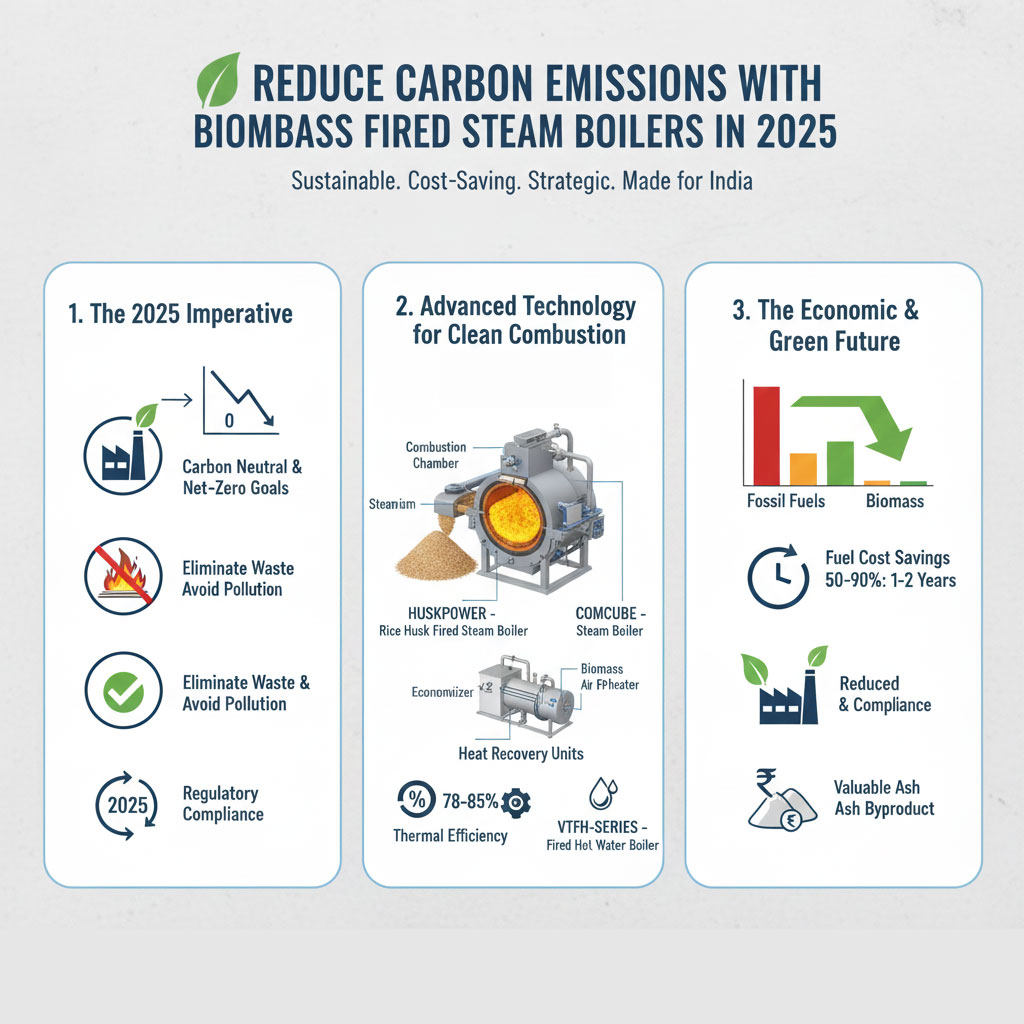
A. High-Silica Fuels Need Purpose-Built Combustion — HUSKPOWER
Rice husk contains unusually high silica ash content, which clogs conventional grates and causes incomplete combustion if the boiler isn’t designed for it. Our HUSKPOWER rice husk fired steam boiler (also listed as HUSKPOWER on Balkrishna Boilers) uses Fluidized Bed Combustion (FBC) to maintain complete burnout at 800–900°C, minimizing unburnt carbon and particulate matter while maximizing heat recovery from every kilogram of husk.
B. General Biomass Fuels — COMCUBE
For bagasse, wood chips, and pellets, our COMCUBE biomass steam boiler (also on Balkrishna Boilers as COMCUBE) uses a compact multi-pass design with tightly controlled air staging. This ensures maximum heat transfer to water, so less fuel is required per tonne of steam — and less fuel burned means less CO2, NOx, and particulate matter released per unit of output.
C. Fuel-Flexible Options for Variable Biomass Supply
Where fuel availability varies seasonally — husk in one quarter, pellets or briquettes in another — a multi-fuel-capable design future-proofs your emissions performance. Our range spans the STEAMPOWER, STEAMAX, COMBIPOWER, and SIB series, each engineered for different capacities and fuel combinations under the broader steam boiler category. If you’re unsure which fuel mix makes financial and environmental sense, our comparison of biomass pellets vs. biomass briquettes and rice husk vs. mustard straw ROI breaks down performance and cost per fuel type.
D. Hot Water and Utility Heating — VTFH-SERIES
Steam isn’t the only load driving fossil-fuel consumption. Dyeing, washing, sanitation, and utility heating typically run on diesel or coal-fired hot water systems. Our VTFH-SERIES biomass fired hot water boiler (available on Balkrishna Boilers as VTFH SERIES) replaces this fossil load directly, removing another significant source of on-site CO2 without touching your primary steam system. It sits within our broader hot water boiler category, alongside options like AQUAJET and AQUAMAX for different load profiles.
E. Heat Recovery: The Free Emissions Reduction
Every biomass system we install includes economisers and air preheaters as standard, not optional add-ons. These recover heat from flue gas that would otherwise escape up the stack, using it to preheat feedwater or combustion air. This single design choice typically improves thermal efficiency by 5–10% — and since higher efficiency means less fuel burned for the same steam output, it is effectively a permanent, ongoing emissions reduction with no operating cost attached.
4. Emission Control Doesn’t Stop at the Furnace
A well-designed combustion chamber gets you most of the way to compliance, but stack-level emission control equipment is what makes the difference on an actual pollution board audit. Depending on fuel type and local norms, this typically includes:
- Multi-cyclone / TREMA Cyclone separators for coarse particulate removal
- Bag filters for fine particulate capture
- Electrostatic Precipitators (ESP) for high-efficiency PM control on larger installations
- Wet scrubbers for combined particulate and gas absorption
- Flue Gas Desulphurization (FGD) systems where sulphur content in fuel is a factor
These fall under our Pollution Control Equipment range, and we specify them alongside the boiler itself rather than as an afterthought — a biomass boiler without the right stack-side controls can still fail an emissions test even though the fuel itself is carbon-neutral. For a full technical breakdown, read our dedicated guide: Biomass Boiler Emission Control Systems: A Complete Guide.
5. Sizing It Right: Capacity Decides Your Emissions Profile
An oversized boiler cycles on and off, burning fuel inefficiently at partial load and increasing emissions per tonne of steam produced. An undersized one runs constantly at maximum output, straining components and shortening equipment life. Either mistake works against your carbon-reduction goals.
Before finalizing a purchase, map your actual steam demand across shifts, seasons, and production peaks — not just nameplate capacity of existing equipment. Our detailed walkthrough, How to Choose the Right Biomass Boiler Capacity for Your Plant, covers the exact calculations and common sizing mistakes we see across rice mills, textile units, and food processing plants.
6. The Economics: Why Green Is Also Cheap in 2025
Environmental compliance is the headline driver, but the financial case for biomass is, if anything, stronger.
Near-zero fuel cost for captive-waste industries. Rice mills running a HUSKPOWER boiler on their own husk byproduct often see fuel costs approach zero, since the “fuel” is a waste stream they were already disposing of.
Fast payback across sectors. For plants sourcing biomass externally, the price gap versus coal or diesel is still substantial. Combined with efficiency gains from heat recovery, most conversions pay back their capital cost within 1 to 2 years.
A revenue stream from ash. Rice Husk Ash (RHA) is rich in reactive silica and is in active demand from the cement and construction industry. Instead of paying for ash disposal, many of our clients now sell it — turning a waste-handling cost into incremental revenue.
Insulation from future carbon costs. Carbon taxes, stricter emissions penalties, and continued fossil-fuel price volatility are near-certainties over the next decade. A biomass system installed now locks in lower operating costs before those pressures bite.
7. Built for the Industries That Need It Most
Biomass steam and hot water systems are already proven across the sectors we serve daily: rice mills, sugar mills, textile processing, dyes and dye intermediates, food and beverage manufacturing, bulk drugs and pharmaceuticals, chemical processing, and ceramics. Each of these industries has a different steam quality, pressure, and hot-water requirement, which is why we maintain a full technology range — from Electric Boilers and Thermic Fluid Heaters to Hot Air Generators — rather than a one-size-fits-all product. You can see our full sector-wise deployment history on the Industries page and browse verified installations on our Clients page.
8. Common Questions Plant Managers Ask Before Converting
“Will switching to biomass affect my steam pressure or quality?” No — when the boiler is correctly engineered and sized for your fuel type, steam pressure and dryness fraction match or exceed what a comparable coal-fired unit delivers. The combustion chamber, grate design, and heat-transfer surfaces are simply matched to biomass’s burn characteristics instead of coal’s.
“What happens during monsoon or off-season when biomass supply is tight?” This is exactly why multi-fuel flexibility matters at the design stage. Boilers like the STEAMPOWER and COMBIPOWER are built to handle more than one biomass type, so a plant can shift between husk, pellets, briquettes, or wood chips as local availability changes through the year, without a drop in output or a spike in emissions.
“Do I need to replace my entire boiler house, or can I retrofit?” Many plants don’t need a full teardown. Depending on the existing structure, a retrofit that upgrades the grate, combustion air system, and emission control stack can bring an older unit closer to 2025 norms at a fraction of new-installation cost. A site assessment is the only reliable way to know which route makes sense for your specific plant.
“How long does installation typically take?” For a standard capacity steam boiler or hot water boiler, most installations — from foundation work to commissioning — are completed within a few weeks to a couple of months, depending on capacity and site readiness, with minimal disruption to ongoing production.
9. What a Compliant 2025 Boiler House Actually Looks Like
Pulling everything above together, a factory that has genuinely future-proofed its emissions profile for 2025 typically has four things in place simultaneously, not just one:
- The right combustion technology for its fuel — FBC-based systems like HUSKPOWER for high-ash fuels, or a compact multi-pass design like COMCUBE for general biomass, matched to the specific waste stream the plant generates or has reliable access to.
- Heat recovery built in from day one — economisers and air preheaters aren’t retrofits added after a compliance notice; they’re specified at the point of purchase so the efficiency gain is present from the first day of operation.
- Stack-side emission control sized to the fuel and load — a cyclone separator or bag filter chosen for the actual ash characteristics of the biomass being burned, not a generic specification copied from a different plant.
- Correct capacity for actual (not assumed) steam demand — verified against shift patterns and seasonal peaks rather than the rating of the boiler being replaced.
Skipping any one of these four elements is the most common reason a biomass conversion underperforms on paper despite using genuinely carbon-neutral fuel. It’s also why we treat every enquiry as an engineering consultation first and a product sale second — the combustion technology, the heat recovery package, and the pollution control equipment all have to be sized together against your specific fuel and load profile.
Conclusion: The Transition Starts With the Right Design Partner
By 2025, reducing carbon emissions from industrial steam generation isn’t a future goal — it’s an active compliance and cost requirement. Whether your plant needs the high-efficiency HUSKPOWER system for rice husk, the robust COMCUBE for general biomass, or the VTFH-SERIES for hot water utility loads, the right combination of combustion technology, heat recovery, and stack-side emission control determines whether you meet 2025 norms comfortably or scramble to catch up.
Ready to cut carbon emissions and fuel costs at your plant in 2025? Contact Balkrishna Boilers / IndianBoilers.com today for an engineering consultation tailored to your fuel availability, steam load, and compliance timeline.
Explore more on our blog: How Biomass Boilers Turn Agro-Waste into Reliable Steam Power · How to Choose the Right Biomass Boiler Capacity for Your Plant · Biomass Boiler Emission Control Systems: A Complete Guide · Biomass Pellet vs. Biomass Briquette · Rice Husk vs. Mustard Straw: Which Offers Better ROI