
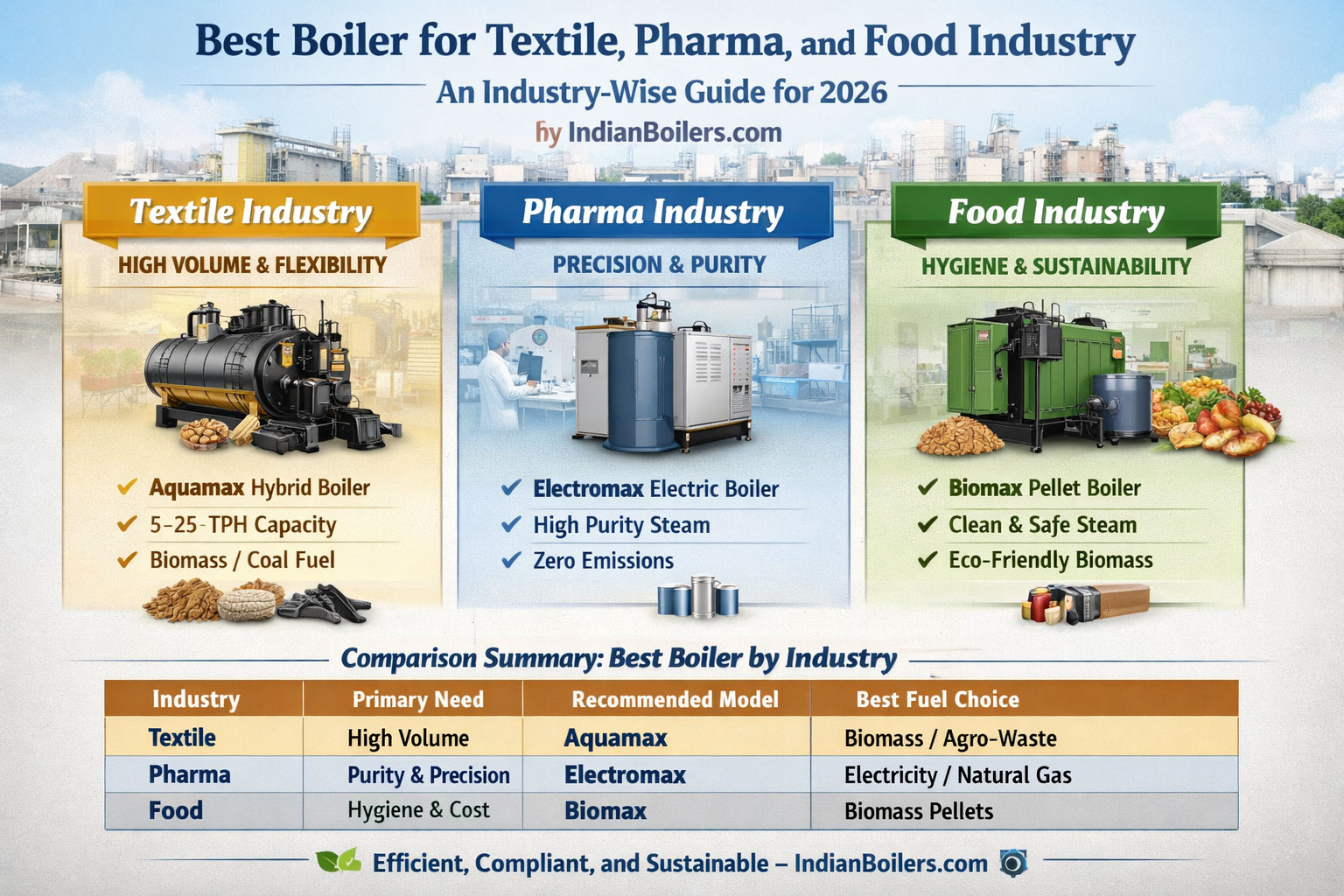
In the diverse industrial landscape of 2026, a “one-size-fits-all” approach to steam generation is a relic of the past. From the high-hygiene requirements of a pharmaceutical lab in Ahmedabad to the heavy-duty dyeing vats of a textile mill in Surat, the “best” boiler is defined by its specific application, fuel availability, and regulatory compliance.
As India accelerates toward its Net-Zero 2070 goals, choosing the right boiler from IndianBoilers.com means balancing thermal efficiency with environmental responsibility. This guide provides a strategic breakdown of the ideal boiler systems for India’s three most steam-dependent sectors.
1. The Textile Industry: High Volume & Constant Demand
The textile industry is one of the most energy-intensive sectors, requiring massive amounts of steam for dyeing, printing, finishing, and sizing.
Key Requirements:
- Large Capacities: Often requiring steam in the range of 5 TPH to 25 TPH.
- Rapid Load Response: Steam demand fluctuates quickly when large dyeing vats are filled or emptied.
- Fuel Economy: Because fuel is the largest OPEX, multi-fuel flexibility is non-negotiable.
The Top Recommendation: Aquamax (Biomass/Coal-Fired Hybrid)
For large-scale textile mills, the Aquamax series is the gold standard.
- Why it works: It utilizes a Water-Tube/Fire-Tube hybrid design. The water-wall furnace provides a large heating surface for rapid steam generation, while the fire-tube bank ensures thermal stability.
- Fuel Advantage: In states like Gujarat and Punjab, using agricultural waste (rice husk, stalks) in an Aquamax boiler can reduce fuel costs by 40% compared to imported coal.
Small/Medium Units: Steamjet (IBR Shell Type)
For smaller garment processing or boutique dyeing units, the Steamjet offers a compact, horizontal fire-tube design that is easy to maintain and highly efficient for low-to-medium pressure needs.
2. The Pharmaceutical Industry: Precision, Purity & Compliance
In pharma, the boiler isn’t just a utility; it’s a critical part of the production chain. Steam is used for sterilization (autoclaves), granulation, and maintaining precise temperatures in chemical reactors.
Key Requirements:
- Steam Purity: Zero tolerance for contaminants or “carryover.”
- Precise Control: The ability to maintain pressure within a ±0.1 kg/cm² margin.
- Compliance: Strict adherence to IBR (Indian Boiler Regulations) and environmental norms.
The Top Recommendation: Electromax (Electric Steam Boilers)
For high-purity applications and clean-room environments, the Electromax series is unrivaled.
- Why it works: It produces zero on-site emissions, making it ideal for pharma hubs where air quality is strictly monitored. Since there is no combustion, there is no risk of soot or flue gas contaminating the facility.
- Precision: Fully automated PLC controls allow for instantaneous response to the delicate temperature requirements of drug formulation.
For Large-Scale Bulk Drugs: Steamax (Gas/Oil-Fired)
If electricity costs are a concern for large-scale production, a gas-fired Steamax boiler provides the clean combustion and high efficiency required to meet pharmaceutical hygiene standards.
3. The Food & Beverage Industry: Hygiene & Versatility
From milk pasteurization to the dehydration of vegetables, the food industry requires steam that is reliable and safe for indirect heating.
Key Requirements:
- Safety & Hygiene: Non-toxic water treatment and clean exhaust.
- Reliability: Food processing often involves perishable goods; a boiler breakdown can result in massive product loss.
- Sustainability: Many global food brands now mandate “Green Steam” from their suppliers.
The Top Recommendation: Biomax (Biomass Pellet Fired)
The Biomax series is the preferred choice for the modern food processor.
- Why it works: By using standardized biomass pellets, these boilers provide the consistent heat of a gas boiler with the cost profile of a biomass system.
- Zero Smoke: Advanced dust collectors and scrubbers ensure that the factory environment remains clean, which is vital for food safety audits.
For Small Food Startups: Non-IBR Vertical Boilers
For small bakeries or craft breweries with a steam demand of less than 500 kg/hr, a Non-IBR Vertical Boiler from IndianBoilers.com provides a cost-effective, space-saving solution that doesn’t require a certified boiler house.
4. Comparison Summary: Which Boiler for Your Industry?
| Industry | Primary Need | Recommended Model | Best Fuel Choice |
| Textile | High Volume/Bulk | Aquamax | Biomass / Agro-Waste |
| Pharma | Purity & Precision | Electromax | Electricity / Natural Gas |
| Food | Hygiene & Cost | Biomax | Biomass Pellets |
| Chemical | High Pressure | Steamax | Coal / Multi-Fuel |
5. Critical Selection Factors for 2026
A. IBR vs. Non-IBR
In India, any boiler with a capacity over 25 liters must be IBR-approved. For most industrial applications in Textile and Pharma, IBR boilers are mandatory. They offer higher safety standards, longer lifespans, and better resale value.
B. Automation Level
Don’t settle for manual controls. In 2026, your boiler should have:
- SCADA/PLC Integration: For remote monitoring.
- Auto-Blowdown: To maintain water quality without manual error.
- VFDs on Fans: To save up to 20% on electricity.
C. Local Fuel Availability
Before choosing a boiler, map your fuel supply. If you are in a “Gas Grid” area, a gas-fired unit is efficient. If you are in an agricultural belt, a biomass-fired system is the most profitable choice.
6. Why Partner with IndianBoilers.com?
At IndianBoilers.com, we don’t just manufacture steel vessels; we engineer business solutions. Our 2026 range is designed to help Indian manufacturers compete on the global stage by lowering the “Cost Per Tonne of Steam.”
- Custom Engineering: We tailor the grate and furnace design to your specific industry waste.
- Pan-India Support: From Ahmedabad to Nagothane, our service teams ensure your boiler stays IBR-compliant.
- Innovation-First: Whether it’s hydrogen-ready burners or AI-driven efficiency tracking, we bring the future to your boiler house today.
Ready to upgrade your steam generation?
Consult with the experts at IndianBoilers.com to find the specific boiler model that fits your industry, your budget, and your sustainability goals.
