
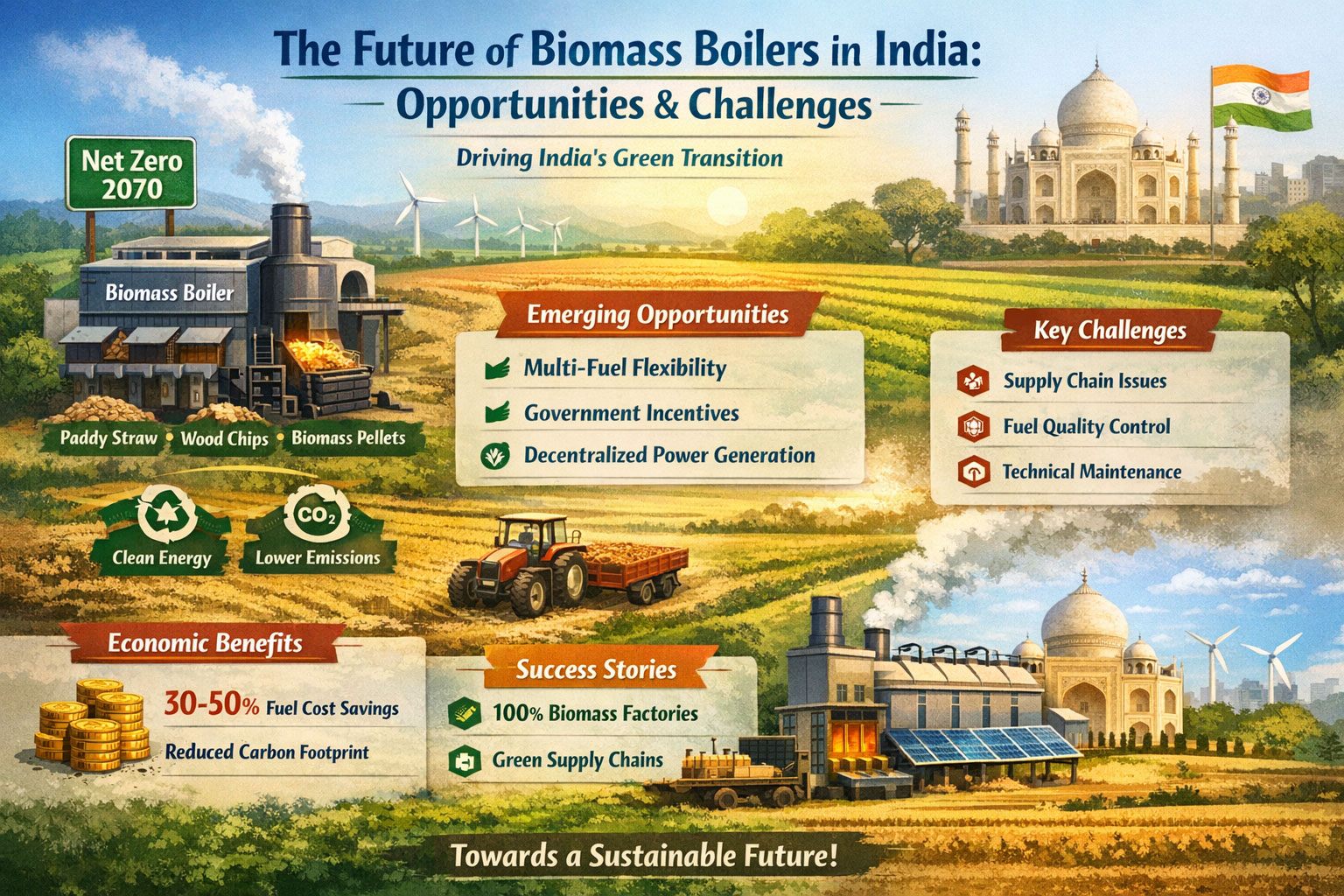
As India aggressively pursues its goal of achieving Net Zero by 2070, the industrial landscape is undergoing a seismic shift. The era of uninhibited fossil fuel consumption is drawing to a close, replaced by a mandate for sustainable, carbon-neutral energy. At the heart of this transition lies biomass energy—a resource India possesses in abundance.
For industries ranging from textiles and food processing to chemical manufacturing, the adoption of biomass boilers is no longer just an environmental “choice”; it is a strategic economic necessity. This article explores the evolving landscape of biomass technology in India, the massive opportunities it presents for 2026 and beyond, and the hurdles that must be cleared to realize its full potential.
1. The Current State of Biomass in India
India generates approximately 750 million metric tonnes of agricultural residue annually. While a significant portion is utilized as fodder or for domestic fuel, a staggering surplus remains. Historically, this surplus was managed through “stubble burning”—a practice that contributes to severe seasonal air pollution in Northern India.
The shift toward industrial biomass boilers serves a dual purpose:
- Waste-to-Energy: Converting agricultural liabilities into high-value thermal energy.
- Decarbonization: Reducing the reliance on coal and furnace oil (FO), which carry heavy carbon taxes and volatile pricing.
Modern biomass boilers have evolved far beyond simple wood-fired units. Today, we see advanced Fluidized Bed Combustion (FBC) and Reciprocating Grate technologies capable of handling diverse feedstocks like paddy straw, mustard husk, sawdust, and even industrial briquettes with high thermal efficiency.
2. Emerging Opportunities in the Indian Market
A. The Rise of “Multi-Fuel” Flexibility
One of the most significant opportunities lies in fuel flexibility. In the past, boilers were often designed for a single fuel source. However, modern engineering allows for the design of combustion systems that can toggle between rice husk, wood chips, and biomass pellets without a significant drop in IBR (Indian Boiler Regulations) certified efficiency. This protects industries from seasonal fuel shortages.
B. Government Policy & Incentives
The Indian government, through the Ministry of New and Renewable Energy (MNRE), has introduced various schemes to promote biomass pellets and co-firing in thermal power plants. Key opportunities include:
- Capital Subsidies: Grants for setting up biomass pellet plants.
- Carbon Credits: Businesses can now monetize their carbon savings through emerging domestic and international carbon markets.
- Strict Emission Norms: As the Central Pollution Control Board (CPCB) tightens norms on SOx and NOx emissions, biomass—which is naturally low in sulfur—becomes the path of least resistance for compliance.
C. Decentralized Power Generation
Beyond process steam, there is a growing trend toward Biomass Cogeneration (CHP). Industries can now generate their own electricity while simultaneously meeting their steam requirements. This “behind-the-meter” generation offers immense cost savings compared to grid electricity and provides energy security in remote industrial hubs.
3. Critical Challenges to Overcome
Despite the clear benefits, the transition to biomass is not without its complexities. To scale successfully, the industry must address three primary “bottlenecks.”
A. Supply Chain Fragmentation
Unlike coal, which has a centralized distribution network, biomass is decentralized. Collecting, transporting, and storing low-density agricultural waste is expensive.
- The Solution: The development of Biomass Pelleting Plants is crucial. Transforming loose husk into high-density pellets makes transportation viable and standardized.
B. Fuel Quality Consistency
Biomass fuel quality varies based on moisture content, ash percentage, and calorific value. High moisture content in fuels like green wood or fresh paddy straw can lead to:
- Incomplete combustion.
- Increased flue gas temperatures.
- Reduced boiler lifespan.
- The Solution: Implementing advanced Auto-Fuel Feeding Systems and automated sensors that adjust combustion parameters in real-time based on fuel quality.
C. Technical Maintenance & Corrosion
Certain biomass fuels, particularly those with high alkali content (like wheat straw), can cause clinkering and slagging on the boiler tubes. This requires specialized material science and regular maintenance protocols to ensure the longevity of the pressure parts.
4. Technological Innovations Shaping the Future
The future of biomass in India is being written by engineering excellence. Several key technologies are defining the next generation of boilers:
| Technology | Benefit |
| PLC-Based Automation | Reduces human error and optimizes fuel-to-air ratios for maximum efficiency. |
| Hybrid Designs | Boilers that can integrate with Solar Thermal or Waste Heat Recovery (WHR) systems. |
| Advanced Dust Collectors | Utilizing ESPs (Electrostatic Precipitators) or Bag Filters to ensure zero visible smoke emissions. |
| IBR Compliance | Ensuring safety and performance standards that meet stringent Indian regulatory frameworks. |
5. Economic Impact: The Bottom Line
For an Indian manufacturer, the switch to biomass typically results in a 30% to 50% reduction in fuel costs compared to LDO (Light Diesel Oil) or FO. In many cases, the capital expenditure (CAPEX) for a new biomass boiler can be recovered through fuel savings within 12 to 24 months.
Furthermore, as global brands increasingly demand “Green Supply Chains,” Indian exporters who utilize biomass-generated steam gain a competitive edge in European and American markets.
6. Case Study: Success in the Industrial Belt
Consider the industrial clusters in Gujarat or Uttar Pradesh. Factories that once struggled with the rising cost of imported coal have successfully transitioned to 100% biomass pellets. By installing high-efficiency, multi-pass boilers, these units have not only stabilized their energy costs but have also achieved “Star Export House” status by lowering their carbon footprint.
7. Conclusion: The Road Ahead
The “Future of Biomass Boilers in India” is no longer a distant prospect—it is the reality of 2026. While challenges in the supply chain exist, the combination of government support, technological innovation, and undeniable economic ROI makes biomass the fuel of choice for the future.
At IndianBoilers.com, we are committed to driving this change. By providing high-efficiency, IBR-approved steam solutions tailored to the unique Indian landscape, we help industries turn agricultural waste into industrial wealth.
Final Thought: The transition to biomass is a journey from being an energy consumer to an energy steward. By investing in biomass today, Indian industries are securing a cleaner, more profitable tomorrow.
Contact Indian Boilers today to discuss your transition to sustainable thermal energy. Experts in IBR Steam Boilers, Thermic Fluid Heaters, and Custom Industrial Heating Solutions.
