
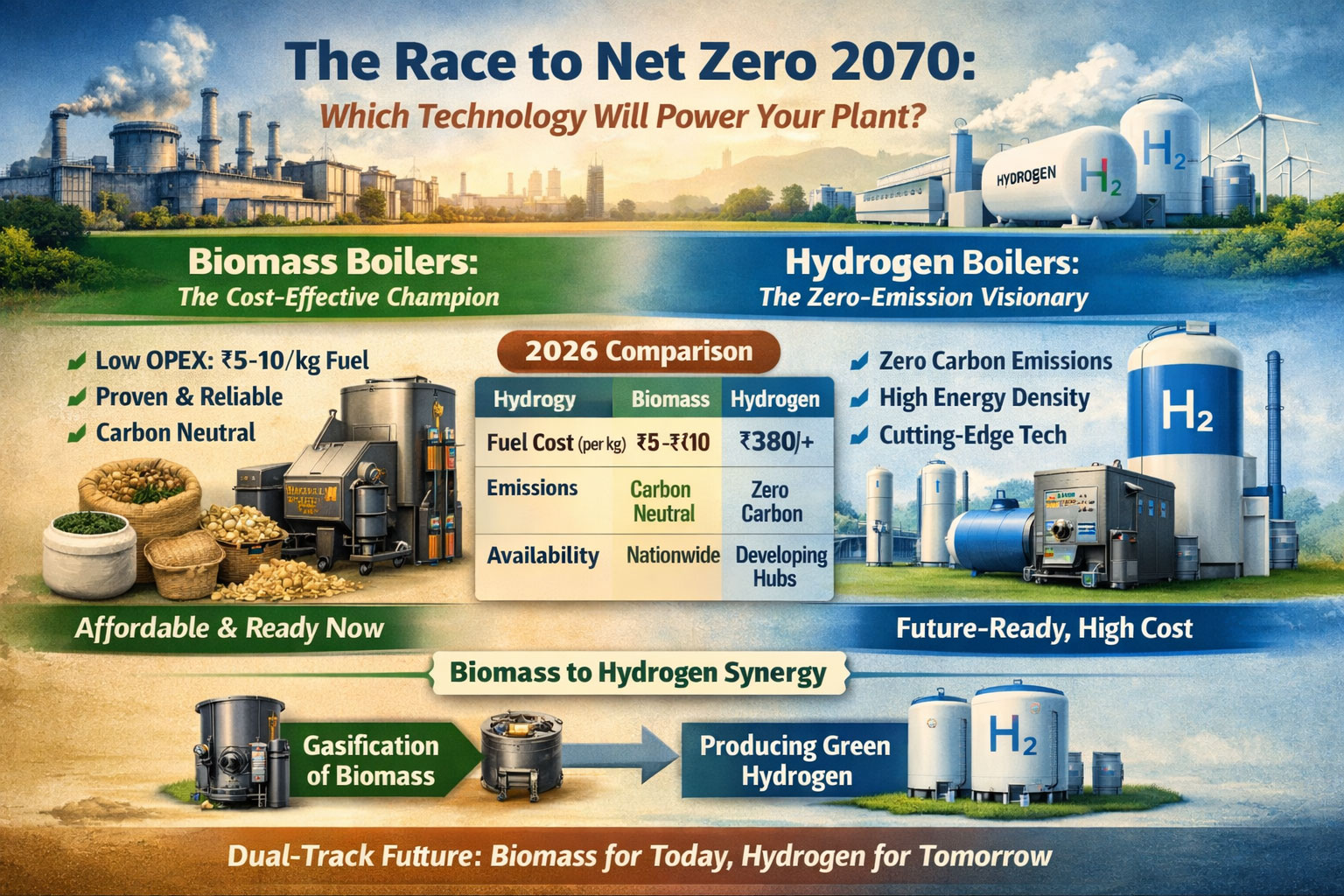
The global race toward industrial decarbonization is no longer a slow crawl; it is a full-scale sprint. For Indian manufacturers, the pressure to move away from coal and furnace oil is intensifying as the 2070 Net Zero target draws closer. However, a critical question remains for plant managers and business owners: Which technology will power the next generation of industrial heating?
In one corner, we have Biomass, the battle-tested veteran that leverages India’s agricultural abundance. In the other, Hydrogen, the high-tech challenger backed by billions in government subsidies through the National Green Hydrogen Mission.
This 2026 update explores the mechanical, economic, and strategic differences between these two powerhouses to help you decide which path is right for your facility.
1. Biomass Boilers: The Immediate Champion
Biomass is currently the most practical and cost-effective alternative to fossil fuels in India. In 2026, the technology has reached a high level of maturity, offering a “plug-and-play” solution for industries like textiles, food processing, and pharmaceuticals.
The Advantages:
- Cost-Effectiveness: Biomass remains significantly cheaper than hydrogen. With agricultural residues like rice husk, sawdust, and mustard stalk readily available, the operational cost (OPEX) is often 30-50% lower than traditional fuels.
- Technology Maturity: Biomass combustion systems, particularly Reciprocating Grate and Fluidized Bed Combustion (FBC) boilers, are refined technologies. They are reliable, easy to maintain, and IBR-approved.
- Carbon Neutrality: Biomass is considered carbon-neutral because the CO2 released during combustion is equal to the amount absorbed by the plants during their growth cycle.
The Challenges:
- Logistics: Collecting and transporting low-density agricultural waste remains a hurdle.
- Storage: Large-scale biomass storage requires significant space and protection from moisture to prevent fuel degradation.
2. Hydrogen Boilers: The “Zero-Emission” Visionary
Hydrogen is often touted as the “ultimate” green fuel. When burned, its only byproduct is water vapor. In 2026, the National Green Hydrogen Mission has already commissioned over 8,000 tonnes per annum (TPA) of capacity in India, with prices beginning to fall toward the ₹300-400 per kg range.
The Advantages:
- Absolute Zero Carbon: Unlike biomass, which has “lifecycle emissions,” green hydrogen produces zero carbon at the point of combustion.
- High Energy Density: Hydrogen provides an incredibly high energy-to-mass ratio, making it suitable for high-temperature industrial processes (above 1000°C) where other fuels might struggle.
- Existing Infrastructure Integration: “Hydrogen-ready” boilers are now entering the market, designed to burn a blend of natural gas and hydrogen, allowing for a gradual transition.
The Challenges:
- High Cost: Despite falling prices, green hydrogen remains 4 to 6 times more expensive than biomass per unit of energy produced.
- Storage and Safety: Hydrogen is a tiny molecule that can leak easily and embrittle metals. It requires specialized high-pressure storage and advanced safety sensors.
- Efficiency Losses: Producing hydrogen via electrolysis and then burning it in a boiler involves significant energy losses compared to using biomass directly.
3. Head-to-Head Comparison (2026 Data)
| Feature | Biomass Boilers | Hydrogen Boilers |
| Fuel Source | Agri-waste, Pellets, Briquettes | Electrolysis (Green H2) |
| Current Availability | High (Across India) | Developing (Cluster-based) |
| Installation Cost | Moderate | Very High |
| Fuel Cost (Energy Equiv.) | Low (₹5 – ₹10 per kg) | High (₹380+ per kg) |
| Emissions | Carbon Neutral | Zero Carbon |
| Maintenance | Regular (Ash management) | Technical (Leak detection) |
| Best For | Medium/High pressure steam | Ultra-high temperature process |
4. The “Biomass-to-Hydrogen” Synergy
It is a mistake to view these two as enemies. In fact, 2026 is seeing the rise of Biomass Gasification to Hydrogen. India’s vast agricultural sector can be used to produce “Bio-Hydrogen,” combining the best of both worlds.
By gasifying biomass in a controlled environment, industries can produce a hydrogen-rich syngas. This allows companies to leverage existing biomass supply chains while moving toward a hydrogen-based heating future.
5. Future Outlook: Which One Should You Choose?
Choose Biomass Boilers if:
- Your primary goal is immediate cost reduction.
- You are located in an agri-heavy state like Punjab, Haryana, Gujarat, or Maharashtra.
- You need a reliable, high-uptime steam solution for process heating.
- You want a proven ROI within 18–24 months.
Choose Hydrogen-Ready Boilers if:
- You are part of a Green Hydrogen Hub (like those developing in Gujarat or Odisha).
- Your industry is “Hard-to-Abate” (Steel, Heavy Chemicals, or Fertilizer).
- You are planning for a 10–15 year horizon and want to future-proof against carbon taxes.
- You have access to highly subsidized green energy for onsite electrolysis.
6. Conclusion: A Dual-Track Future
In 2026, the verdict is clear: Biomass is the solution for today, while Hydrogen is the solution for tomorrow. For most Indian SMEs and mid-sized industrial units, Biomass Boilers remain the superior choice for achieving sustainability without sacrificing profitability. However, the rise of “Hydrogen-ready” designs means that even if you buy a boiler today, you can prepare for the hydrogen revolution of the 2030s.
At IndianBoilers.com, we specialize in bridge-technology—efficient biomass systems that meet the highest IBR standards while keeping an eye on the future of green energy. Whether you are ready to switch to pellets today or are curious about hydrogen-ready systems, our engineering team is here to guide your transition.
Ready to decarbonize? Contact the experts at Indian Boilers to find the right thermal energy strategy for your plant’s future.
