
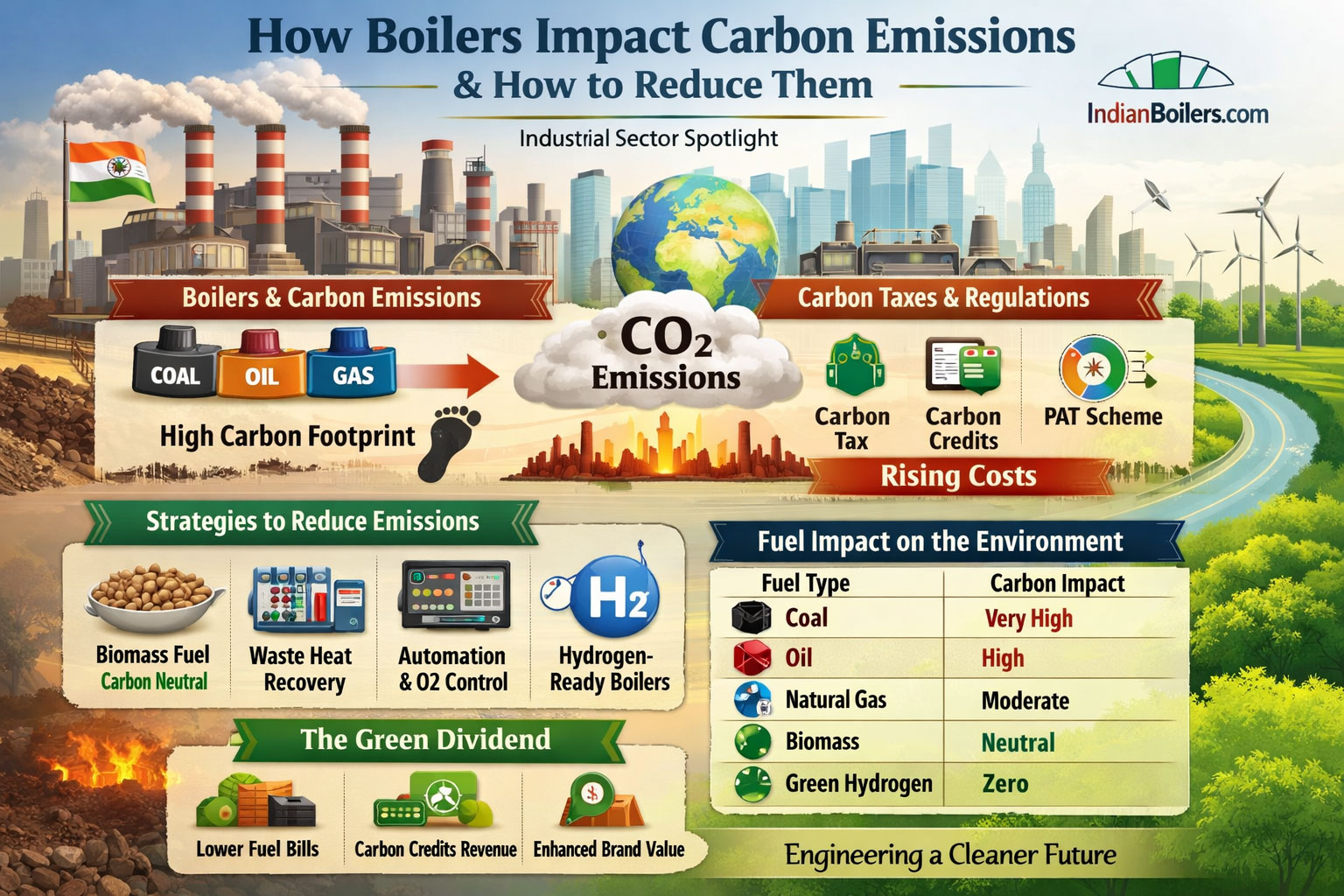
In the global fight against climate change, the industrial sector stands at a critical crossroads. As India marches toward its ambitious Net-Zero 2070 target, the spotlight has turned sharply toward the heart of the factory: the boiler house. Historically, industrial steam generation has been one of the largest contributors to carbon footprints, but in 2026, it is also becoming the greatest opportunity for environmental and economic transformation.
For manufacturers in India’s booming industrial hubs—from the chemical corridors of Gujarat to the pharmaceutical parks of Maharashtra—understanding the carbon impact of thermal energy is no longer just a “green” initiative; it is a regulatory and financial mandate. This guide by IndianBoilers.com explores the link between steam generation and the atmosphere, and provides a roadmap for drastic emission reduction.
1. The Anatomy of a Carbon Footprint: How Boilers Emit CO2
At its simplest level, carbon emissions from a boiler are the result of a chemical reaction. When we burn fossil fuels (coal, furnace oil, or natural gas) to generate heat, the carbon in the fuel reacts with oxygen to form Carbon Dioxide (CO2).
The Hierarchy of Emission Intensity:
Not all fuels are created equal. The “Carbon Intensity” of your boiler depends heavily on its fuel source:
- Coal: The most carbon-intensive, releasing high amounts of CO2, SOx, and NOx.
- Furnace Oil (FO) / LDO: Highly polluting with significant sulfur emissions.
- Natural Gas: Cleaner than coal or oil, but still a fossil fuel that adds “new” carbon to the atmosphere.
- Biomass: Considered Carbon Neutral. The CO2 released during combustion was recently absorbed by the plant from the atmosphere, creating a closed-loop cycle.
Beyond the fuel itself, incomplete combustion—where fuel isn’t burned efficiently—leads to the release of Carbon Monoxide (CO) and soot (Black Carbon), which have a much higher global warming potential than CO2.
2. The Hidden Cost: Carbon Taxes and Regulations
In 2026, the cost of carbon is moving from the “external” environment to the internal balance sheet.
- PAT Scheme (Perform, Achieve, Trade): The Indian government’s mandate for energy-intensive industries to reduce specific energy consumption.
- Carbon Credits: Industries that lower their emissions below the baseline can now earn and trade carbon credits, turning emission reduction into a revenue stream.
- Border Carbon Adjustments: For Indian exporters, reducing the carbon footprint of their products is essential to avoid heavy taxes when shipping to markets like the EU or North America.
3. Five Strategies to Reduce Boiler Carbon Emissions
A. The Shift to Carbon-Neutral Biomass
The most effective way to slash emissions is to stop using “ancient carbon” (fossil fuels). Transitioning to biomass briquettes, pellets, or rice husk can reduce your net carbon emissions by up to 90%. Modern IBR-approved biomass boilers are now designed with advanced grates that ensure clean combustion of these fuels.
B. Enhancing Thermal Efficiency
Every percentage point of efficiency you gain is a percentage of carbon you don’t emit.
- Waste Heat Recovery (WHR): Installing Economizers or Air Pre-Heaters (APH) captures heat that would otherwise escape through the chimney.
- Impact: Recovering waste heat can reduce fuel consumption (and emissions) by 5-8%.
C. Smart Automation and O2 Trimming
Excess air in a boiler carries heat away through the stack, while too little air leads to incomplete combustion. Automated Oxygen Trimming systems use sensors to maintain the “perfect” air-fuel ratio. This precision ensures that every gram of fuel is used to create steam, not smoke.
D. Improving Steam Distribution & Insulation
Carbon reduction doesn’t stop at the boiler; it extends to the pipes.
- Insulation: Poorly insulated steam lines lose massive amounts of energy.
- Steam Traps: Faulty steam traps lead to steam loss, forcing the boiler to work harder.
- Condensate Recovery: Returning hot condensate to the boiler reduces the energy required to heat fresh feedwater.
E. Transitioning to “Hydrogen-Ready” Designs
As the National Green Hydrogen Mission scales, the future involves blending hydrogen with natural gas. Investing in boilers that can be retrofitted for hydrogen combustion is a high-level strategy for reaching “Absolute Zero” emissions in the next decade.
4. Head-to-Head: Fuel Impact on the Environment
| Fuel Type | Carbon Impact | Primary Pollutants | Sustainability Rating |
| Coal | Very High | CO2, SO2, Ash, NOx | 1/10 |
| Furnace Oil | High | CO2, Sulfur, Particulates | 2/10 |
| Natural Gas | Moderate | CO2, NOx | 5/10 |
| Biomass Pellets | Neutral | Minimal (Closed Loop) | 9/10 |
| Green Hydrogen | Zero | Water Vapor | 10/10 |
5. The Economic “Green Dividend”
Lowering emissions is often perceived as an expense, but the data in 2026 proves otherwise. A high-efficiency, low-emission boiler house typically sees:
- Lower Fuel Bills: Because you are burning less fuel to get the same results.
- Reduced Compliance Costs: No more fines from pollution control boards.
- Enhanced Brand Value: Attracting environmentally conscious investors and global B2B clients.
6. Case Study: The Ahmedabad Transformation
In a recent project handled by IndianBoilers.com, a chemical manufacturer in Vatva GIDC switched from a coal-fired system to a high-efficiency biomass-fired Aquamax boiler.
- Result: A 75% reduction in their carbon footprint.
- Financial Impact: The fuel savings alone paid for the new installation in just 14 months, while the company successfully secured a green-energy subsidy.
7. Conclusion: Engineering a Cleaner Future
The boiler is no longer just a piece of utility equipment; it is a tool for climate action. Reducing carbon emissions is a multi-front war involving fuel choice, mechanical efficiency, and digital automation.
At IndianBoilers.com, we are dedicated to helping Indian industries lead the global transition. Our range of Steamjet and Aquamax boilers are built with the future in mind—maximizing every calorie of heat while minimizing every gram of carbon.
Is your boiler house a carbon liability or a green asset?
Contact the engineering experts at IndianBoilers.com for a Carbon Audit and explore our range of sustainable, IBR-approved steam solutions.
