
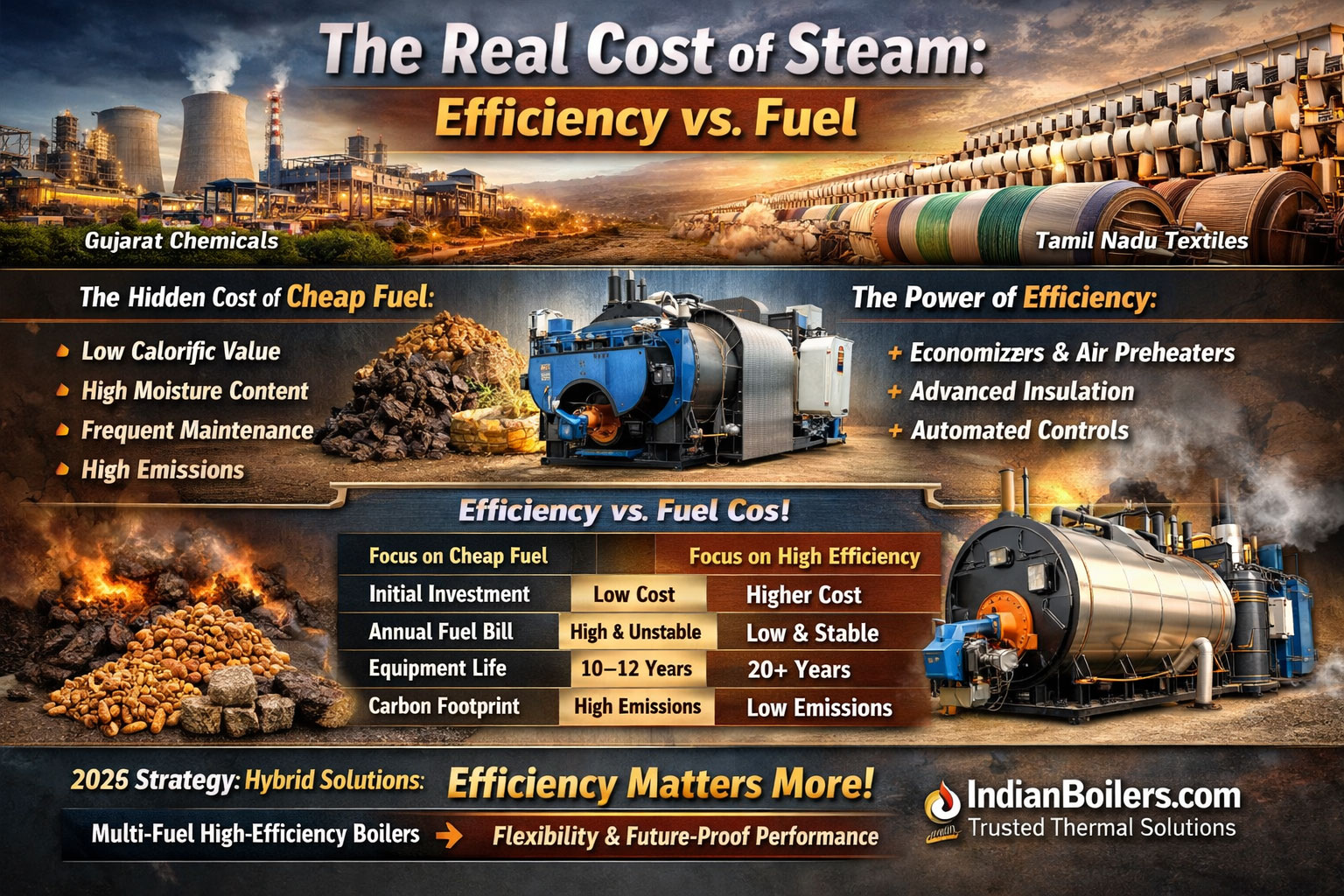
In the competitive landscape of Indian manufacturing—from the chemical hubs of Gujarat to the textile clusters of Tamil Nadu—steam generation is often the largest single operational expense. When plant managers look to optimize their thermal energy systems, the debate usually centers on two variables: Boiler Efficiency and Fuel Cost.
Should you invest in a high-efficiency, technologically advanced boiler that carries a premium price tag? Or should you focus on sourcing the cheapest possible fuel, even if the combustion system is less refined?
In 2026, with fluctuating global energy prices and tightening environmental regulations, the answer isn’t just about choosing one over the other. It’s about understanding the Total Cost of Steam (TCS). This article by IndianBoilers.com breaks down the math, the mechanics, and the strategic roadmap for industrial heating.
1. The High Cost of “Cheap” Fuel
The temptation to chase the lowest price per kilogram of fuel is understandable. Whether it’s unrefined coal, low-grade wood, or loose agricultural waste, “cheap” fuel offers an immediate, visible reduction in procurement costs. However, this often leads to a “Fuel Trap.”
The Hidden Penalties of Low-Grade Fuel:
- Lower Calorific Value (CV): Cheap fuel often has lower energy content. You end up burning significantly more volume to achieve the same steam output, which increases logistics and handling costs.
- High Moisture Content: If you are using wet biomass or low-grade coal, a massive portion of the heat generated is wasted just evaporating the water within the fuel itself. This directly drops your thermal efficiency.
- Maintenance Scourge: Low-cost fuels often contain high levels of impurities, sulfur, or ash. This leads to clinkering on the grates and soot buildup on the tubes, requiring more frequent shutdowns and reducing the lifespan of your pressure parts.
- Emission Compliance: Cheap fuels are notorious for high particulate matter (PM) and SOx/NOx emissions. In 2026, the cost of pollution fines often outweighs the savings on fuel procurement.
2. The Power of Efficiency: A 1% Difference Matters
Efficiency in a boiler is the ratio of heat exported by the steam to the heat provided by the fuel. While a 1% or 2% increase in efficiency might sound marginal, when projected over an annual operating cycle of 8,000 hours, the financial impact is staggering.
Where Efficiency is Won or Lost:
- Stack Losses: The largest loss in any boiler is the heat that escapes through the chimney. Modern boilers utilize Economizers and Air Pre-Heaters (APH) to trap this waste heat and feed it back into the system.
- Radiation Losses: Poor insulation leads to heat bleeding from the boiler shell. High-efficiency units use superior refractory materials and high-density insulation.
- Blowdown Losses: Inefficient water treatment leads to scale formation, requiring frequent blowdowns (releasing hot water to remove solids). Advanced automation can minimize these losses.
The Math of Efficiency (Example):
For a 10 TPH (Tons Per Hour) boiler running on biomass briquettes:
- A 2% increase in efficiency can result in savings of nearly ₹15–20 Lakhs per year in fuel costs alone.
- Over a 10-year lifespan, that efficiency pays for the entire cost of the boiler multiple times over.
3. Efficiency vs. Fuel Cost: The Comparison Table
| Factor | Focus on Cheap Fuel | Focus on High Efficiency |
| Initial Investment | Lower (Standard Boilers) | Higher (Advanced Tech) |
| Annual Fuel Bill | Volatile and High | Stable and Lower |
| Equipment Life | 10–12 Years (High Wear) | 20+ Years (Cleaner Combustion) |
| Carbon Footprint | Usually Higher | Significantly Lower |
| Operational Ease | Manual/Labor Intensive | Automated/Predictive |
4. The 2026 Perspective: Strategic Energy Management
As we move further into 2026, the “Future-Proof” factory doesn’t just look for efficiency or cost; it looks for Flexibility.
The Hybrid Approach
The most successful Indian industries are adopting Multi-Fuel High-Efficiency Boilers. These systems are designed to maintain high thermal efficiency across a variety of fuels—from rice husk and mustard stalk to wood pellets. This allows the plant manager to switch fuels based on seasonal market prices without losing the performance benefits of a high-efficiency design.
The Role of Automation
You cannot manage what you do not measure. In 2026, efficiency is maintained through IoT-enabled monitoring. Real-time oxygen (O2) trimming and automated fuel-to-air ratio controllers ensure that the boiler stays in its “sweet spot” of efficiency, regardless of fuel quality fluctuations.
5. Final Verdict: What Matters More?
While fuel cost is a recurring monthly bill, Boiler Efficiency is the multiplier that determines how much of that bill is converted into productive work. Efficiency Matters More. Why? Because fuel prices are a market variable you cannot control. However, your boiler’s efficiency is a technical constant you can control. A high-efficiency boiler protects you against fuel price hikes. If fuel prices go up by 20%, the efficient plant feels the sting far less than the inefficient one.
6. How IndianBoilers.com Can Help
At IndianBoilers.com, we don’t just sell equipment; we sell thermal performance. Our IBR-approved range of boilers—from the compact Steamjet to the heavy-duty Aquamax—are engineered for the highest possible efficiency ratings in the Indian market.
- Custom Economizers: We help you recover up to 5-8% of waste heat.
- Fuel Analysis: We match the combustion technology to your most local, cost-effective fuel source.
- Automation Upgrades: We bring “Industry 4.0” to your boiler house with real-time efficiency tracking.
Stop burning your profits. Choose a partner that understands the delicate balance between the science of efficiency and the reality of fuel costs.
Is your boiler costing you more than it should?
Contact our engineering team at IndianBoilers.com for a comprehensive thermal audit and efficiency upgrade plan.
