
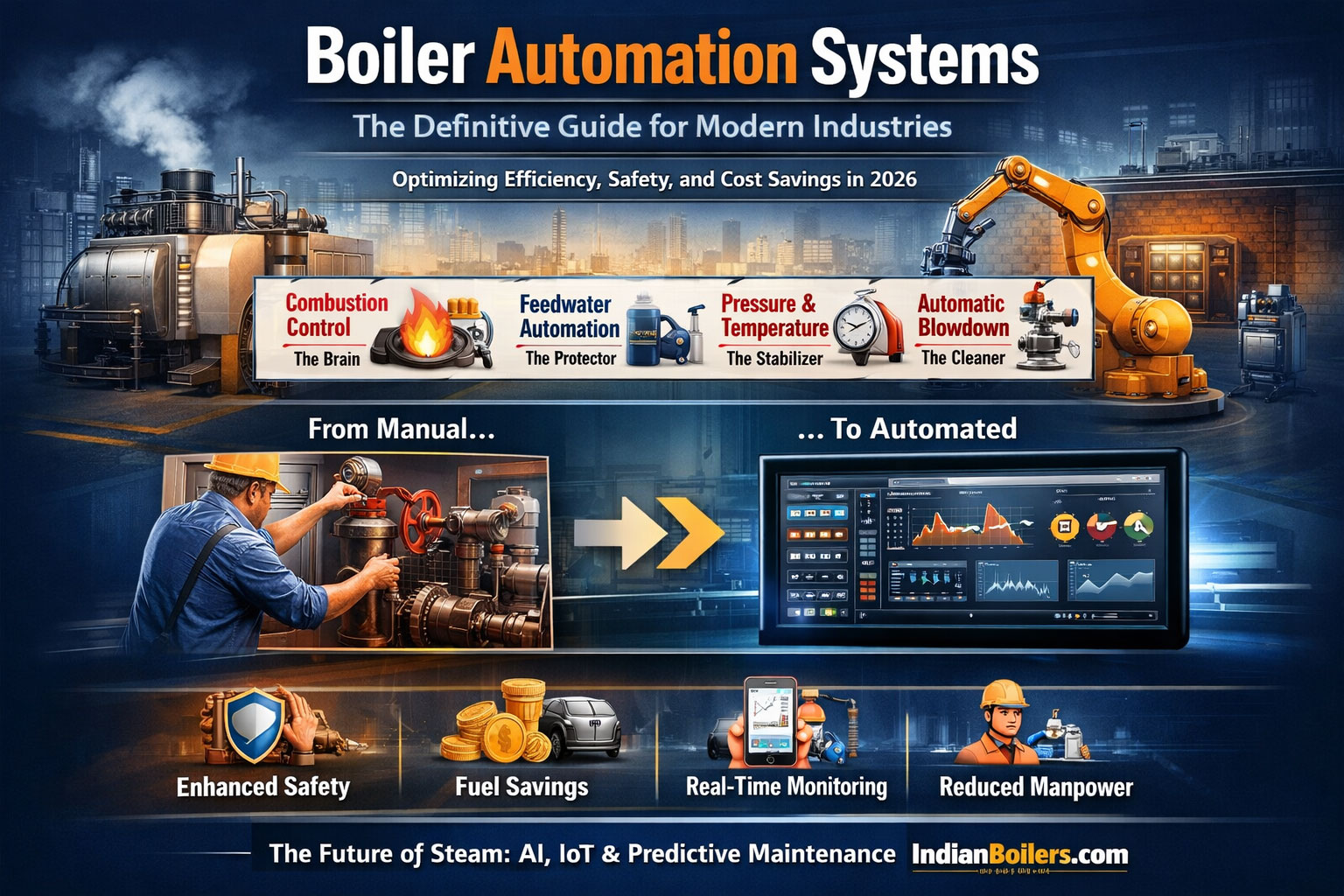
In the competitive landscape of 2026, the traditional image of a boiler house—characterized by manual valve turning, constant pressure gauge monitoring, and smoke-filled rooms—is rapidly disappearing. As Indian industries strive for Global Manufacturing Standards, the shift toward Boiler Automation Systems has evolved from a luxury to a fundamental requirement for survival.
Whether you are operating a textile unit in Surat, a pharmaceutical plant in Ahmedabad, or a food processing facility in Punjab, automation is the key to unlocking hidden margins. This comprehensive guide by IndianBoilers.com explores the components, benefits, and the future of automated steam generation.
1. What is Boiler Automation?
At its core, boiler automation is the integration of sensors, controllers, and actuators that manage the boiler’s operation without constant human intervention. In an IBR (Indian Boiler Regulations) compliant environment, automation ensures that the boiler stays within safe operating parameters while maximizing thermal output.
Modern automation ranges from simple Water Level Controllers to complex Distributed Control Systems (DCS) that manage entire boiler batteries from a single remote screen.
2. Core Components of an Automated System
To understand how automation transforms a boiler house, we must look at the four “pillars” of the system:
A. Combustion Control (The Brain)
The most critical aspect of automation is managing the fuel-to-air ratio.
- Oxygen (O2) Trimming: Sensors in the flue gas detect the amount of excess oxygen. The system automatically adjusts the air fan (FD Fan) speed to ensure complete combustion.
- Variable Frequency Drives (VFDs): Instead of fans running at 100% speed and being throttled by dampers, VFDs adjust the motor speed to match exact demand, saving up to 20% in electrical power.
B. Feedwater Automation (The Protector)
Fluctuating water levels are the leading cause of boiler accidents and “low water” trips.
- Three-Element Control: Advanced systems monitor steam flow, feedwater flow, and drum level simultaneously. This prevents the “swell and shrink” effect, ensuring a steady supply of dry steam even during sudden load changes.
C. Pressure & Temperature Management
Automation ensures that steam pressure remains constant regardless of the factory’s demand. When a machine on the shop floor turns on, the boiler “senses” the pressure drop and ramps up fuel feeding and air supply instantly, preventing production delays.
D. Automatic Blowdown Control
Manual blowdown often leads to excessive heat loss. Automated systems monitor the Total Dissolved Solids (TDS) in the boiler water and trigger a blowdown only when necessary, saving thousands of liters of treated hot water annually.
3. Why Automation Matters in 2026: The Benefits
I. Unmatched Safety
Automation removes the “human error” factor. High-pressure or low-water conditions are detected in milliseconds, triggering an instant, fail-safe shutdown. In an era of strict industrial safety audits, an automated boiler is your best insurance policy.
II. Significant Fuel Savings
By maintaining the “Perfect Combustion” zone, automated boilers typically reduce fuel consumption by 3% to 7%. For a high-capacity biomass or coal boiler, this translates into millions of Rupees saved every year.
III. Data-Driven Decision Making (IoT)
Modern systems at IndianBoilers.com now include Cloud Integration. Plant managers can monitor steam flow, fuel consumption, and efficiency in real-time on their smartphones. This historical data allows for “Predictive Maintenance”—fixing a small issue before it causes a major breakdown.
IV. Reduced Manpower & Training
While automation doesn’t replace the boiler operator, it shifts their role from “manual laborer” to “system supervisor.” This reduces the physical strain on staff and minimizes the risks associated with manual operation in high-heat environments.
4. Comparison: Manual vs. Automated Operation
| Feature | Manual Operation | Automated System (PLC/SCADA) |
| Response to Load Change | Slow, prone to pressure drops | Instantaneous and precise |
| Fuel Efficiency | Highly dependent on operator skill | Consistently optimized |
| Safety Alerts | Gauges and Alarms (Human reaction) | Auto-shutdown and digital logging |
| Maintenance | Reactive (Fix when broken) | Predictive (Fix based on data) |
| Record Keeping | Manual logbooks (often inaccurate) | Digital reports with 100% accuracy |
5. Implementing Automation: The Step-by-Step Path
Transitioning to an automated system doesn’t always require buying a brand-new boiler. Many existing IBR boilers can be retrofitted.
- The Energy Audit: Identify where the most heat is being lost.
- Sensor Integration: Install high-quality pressure transducers, thermocouples, and flow meters.
- The PLC/SCADA Hub: Install the central “brain” that will process the sensor data.
- Actuator Installation: Replace manual valves and dampers with motorized or pneumatic versions.
- Commissioning & Training: Fine-tuning the PID loops to ensure smooth operation under different load conditions.
6. The Future: AI and Machine Learning in the Boiler House
As we look beyond 2026, the next frontier is Artificial Intelligence. AI algorithms are beginning to predict fuel quality variations in biomass and adjust combustion parameters before the efficiency drops. This “Self-Healing” boiler house is the ultimate goal of industrial heating.
7. Conclusion: Staying Ahead with IndianBoilers.com
At IndianBoilers.com, we believe that automation is the “silent engine” of industrial growth. Our range of Steamjet and Aquamax boilers come equipped with industry-leading automation suites designed specifically for the rugged conditions of Indian factories.
We don’t just provide a boiler; we provide a smart thermal energy solution that grows with your business. In the battle for industrial efficiency, automation is no longer an option—it is your most powerful ally.
Is your boiler house ready for the future?
Contact IndianBoilers.com today for a consultation on new automated systems or retrofitting your existing plant for maximum efficiency.
