
Traveling Grate Boilers: The Engineering Behind Sugar Mill Cogeneration
Sugar mills occupy a genuinely unusual position in Indian industry — most manufacturing sectors are net energy consumers, but a well-run sugar mill is effectively a self-sustaining biorefinery, burning its own crushing byproduct to generate not just its own process steam but substantial surplus electricity for grid export. The mechanical technology that makes this possible at scale is the traveling grate boiler, and understanding its specific engineering is worth doing before specifying cogeneration equipment.
This piece focuses specifically on traveling grate mechanics and sugar mill cogeneration engineering. For the underlying bagasse fuel chemistry — moisture behavior, calorific value, and combustion physics — our bagasse and pellets guide covers that foundation in depth.
1. What a Traveling Grate Boiler Actually Is
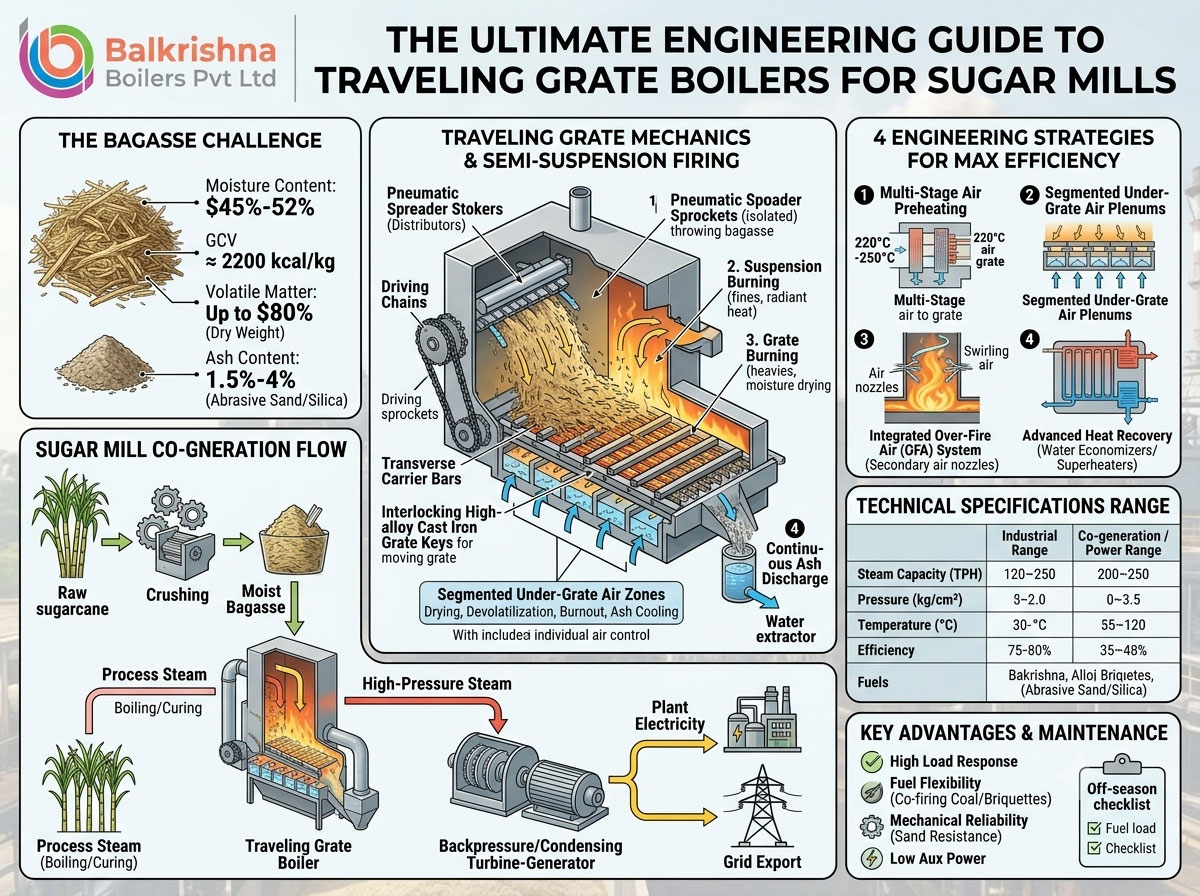
A traveling grate is an automated, continuous ash-discharging mechanical stoker — genuinely distinct from stationary grates requiring manual cleaning, or from a reciprocating grate’s shearing-based clinker management (covered in our reciprocating grate mechanics guide). Its core components:
The drive chain — heavy-duty, heat-treated alloy steel chains positioned outside or beneath the grate structure, driven by a variable-frequency drive motor.
Transverse carrier bars — high-strength structural steel bars mounted across the drive chains, forming the mechanical skeleton the grate keys attach to.
Grate keys — individual, interlocking, heat-resistant high-chromium cast iron plates clipped onto the carrier bars, forming the actual moving furnace floor that fuel rests and burns on.
Pneumatic spreader stokers — mounted on the furnace front wall, these use high-velocity air currents to distribute incoming bagasse evenly across the full length of the moving grate.
2. Semi-Suspension Firing: The Mechanism That Makes This Work
Traveling grate boilers for sugar mills operate on a thermodynamic principle called semi-suspension firing, or spreader stoker firing — genuinely well suited to bagasse’s mixed particle size distribution.
Fuel injection and spreading — bagasse feeds from the storage yard via screw conveyors or rotary feeders into the boiler hopper, where high-pressure pneumatic distributors blast it into the furnace.
Suspension burning of fine particles — the smaller, lighter bagasse fragments dry almost instantly and ignite mid-air as they fall through hot furnace gases, generating immediate, intense radiant heat in the upper furnace chamber.
Grate burning of heavier particles — larger, wetter chunks land on the slowly moving grate below. As the grate carries this material forward, intense radiant heat from above drives off remaining moisture, and the fuel transitions through gasification to complete combustion.
Automatic ash discharge — by the time the grate completes its slow journey to the furnace front, bagasse has burned completely, and remaining ash spills continuously over the edge into a water-submerged ash extractor or dry conveyor system, requiring no manual intervention during normal operation.
3. Why This Design Specifically Suits Sugar Mill Operating Conditions
Rapid Response to Genuinely Volatile Load
Sugar mills run under highly dynamic load conditions — a sugar boiling pan or cane shredder turbine starting or stopping can shift steam demand by a meaningful percentage within minutes. Because a substantial portion of bagasse burns in suspension rather than on the grate, adjusting the pneumatic feeder rate produces a near-instantaneous change in steam generation — a responsiveness that approaches what gas or oil burner systems offer, genuinely unusual for a solid-fuel combustion system.
Fuel Flexibility Across the Crushing Season
Sugarcane crushing is seasonal — typically running 120–180 days annually — but many mills continue operating their cogeneration plants through the off-season to maintain grid electricity export. A well-designed traveling grate transitions between 100% wet bagasse and alternative fuels — coal, biomass briquettes, mustard husk, cotton stalks, wood chips — without requiring mechanical modification, a genuine operational advantage for maintaining year-round cogeneration revenue.
Mechanical Resilience Against Abrasive Field Sand
Harvested sugarcane commonly carries field sand and soil into the mill, and burning that silica-laden material acts abrasively on moving mechanical parts. A traveling grate’s design genuinely protects against this: drive chains and sprockets sit physically isolated below or outside the active combustion zone, with only the easily-replaceable cast iron grate keys directly exposed to abrasive ash — a design choice that meaningfully reduces mechanical wear and extends time between major overhauls.
Lower Auxiliary Power Consumption Than FBC
Fluidized Bed Combustion systems, while offering strong thermal efficiency, require high-pressure forced draft fans to suspend tons of hot sand bed material — a genuine auxiliary power cost. Traveling grates operate at meaningfully lower air pressure, reducing boiler house auxiliary power consumption and leaving more of the mill’s generated electricity available for grid export rather than consumed internally. FBC systems also carry a real vulnerability specific to bagasse: bagasse’s alkali-rich ash chemistry can cause severe sand bed agglomeration in FBC combustion, a problem the traveling grate design avoids entirely by its different combustion mechanism.
4. Sugar Mill Boiler Specifications by Application Scale
| Parameter | Industrial Range | Cogeneration/Power Range |
|---|---|---|
| Steam capacity | 20–75 TPH | 80–150+ TPH |
| Steam pressure | 45–67 kg/cm² | 87–110+ kg/cm² |
| Steam temperature | 400–485°C | 515–540°C |
| Primary fuel | Wet bagasse (~50% moisture) | Wet bagasse / biomass |
| Secondary fuels | Coal, wood chips, mustard husk | Coal, agro-briquettes |
| Efficiency | Up to ~87% on bagasse | Up to ~89% with advanced heat recovery |
For the industrial range, our STEAMAX – Wood/Briquette Fired Steam Boiler applies traveling grate engineering to this scale. For high-pressure cogeneration-scale applications, our STEAMGEN range is engineered for the higher-capacity, higher-pressure end of sugar mill cogeneration specifically.
5. Four Engineering Systems That Push Efficiency Higher
Multi-Stage Air Preheating
Burning fuel containing up to 50% moisture genuinely requires very hot incoming combustion air. Multi-pass air preheaters recover waste heat from flue gas to heat primary under-grate air to roughly 200–250°C, which instantly vaporizes surface moisture as bagasse lands on the grate — a critical enabler for burning wet bagasse without auxiliary fossil fuel support.
Segmented Under-Grate Air Plenums
Combustion on a traveling grate proceeds through distinct zones as the bed moves forward — drying, devolatilization, carbon burnout, ash cooling — and partitioning the air chamber beneath the grate into separate compartments lets operators direct maximum air to high-combustion zones while reducing air to drying and cooling zones, preventing excess air from needlessly cooling the furnace.
Integrated Over-Fire Air Systems
Because bagasse’s high volatile matter content means a significant share of fuel gasifies rapidly and rises toward the chimney before combusting fully, strategically placed high-velocity over-fire air nozzles above the grate inject secondary air with genuine turbulence, creating a swirling flame pattern that drives complete combustion of volatile gases — directly reducing unburnt carbon losses and visible dark smoke.
Advanced Heat Recovery
Custom-engineered economizers and superheaters positioned behind the main boiler bank recover residual heat from exhaust gas before it exits through the chimney, pushing overall system efficiency toward the upper end of what bagasse combustion can realistically achieve.
6. Maintenance: What Actually Matters Through the Season
During Active Crushing
Grate tensioning — driving chains need even tension on both sides; uneven tension can cause the grate to drift sideways, risking genuine structural damage to side casings.
Lubrication — main drive bearings, shaft bearings, and sprocket gears need high-temperature EP-2 rated grease maintained consistently.
Ash inspection — regularly checking discharged ash for unburnt black fibers or heavy clinkers gives an immediate read on whether grate speed or under-grate air dampers need adjustment.
During Off-Season Overhaul
This idle period between crushing seasons is when critical preventative maintenance genuinely has to happen, since a mid-season failure carries real production cost:
Grate key inspection — cracked, warped, or missing cast-iron keys should be replaced before the next season starts, since gaps let unburnt fuel slip through into the air plenums.
Chain link wear analysis — measuring pitch elongation against manufacturer tolerances catches developing chain wear before it causes jumping on the sprockets mid-season.
Refractory and baffle repair — the refractory arch at the furnace front reflects radiant heat back down onto wet bagasse to assist drying, and needs to be kept in genuinely good condition for the boiler to handle wet fuel effectively.
7. Frequently Asked Questions
What’s the maximum moisture content a traveling grate can handle? A well-designed system with preheated combustion air (220–250°C) and a properly maintained radiant refractory arch can handle bagasse moisture up to roughly 50–52% without needing auxiliary fuel support.
How does traveling grate compare to FBC for sugarcane bagasse specifically? FBC offers strong thermal efficiency in general applications, but bagasse’s alkali-rich ash chemistry makes it genuinely prone to causing sand bed agglomeration in FBC systems, and FBC’s high-pressure fan requirement adds meaningful auxiliary power draw. Traveling grates are mechanically simpler, handle abrasive field sand more robustly, and consume less auxiliary power — which is why they remain the sugar industry standard despite FBC’s efficiency advantages in other biomass applications.
How long does a traveling grate stoker typically last? With proper water treatment, disciplined off-season maintenance, and high-chromium cast iron construction, main structural components commonly last 15–20 years, with grate keys treated as expected wear items replaced periodically during off-season maintenance.
Conclusion: Purpose-Built Mechanics for a Genuinely Difficult Fuel
Traveling grate technology earns its status as the sugar industry standard through specific mechanical choices matched precisely to bagasse’s challenges — semi-suspension firing that handles bagasse’s mixed particle sizes, isolated drive mechanisms that survive abrasive field sand, and staged air preheating that makes burning genuinely wet fuel practical without auxiliary fossil fuel. This is purpose engineering, not a generic solid-fuel solution adapted to fit.
Balkrishna Boilers Pvt Ltd designs traveling grate boilers customized to your mill’s specific crushing capacity and cogeneration goals, with complete EPC services from feasibility through commissioning. Explore our range on IndianBoilers.com or Balkrishn.com.
Planning a new installation or upgrade for your sugar mill’s steam infrastructure? Contact our industrial boiler specialists for a technical consultation matched to your crushing capacity and cogeneration targets.
Related Reading
- Bagasse and Pellets: The Engineering Behind India’s Two Biggest Biomass Fuels
- Reciprocating Grates: The Mechanical Engineering Behind Clinker-Proof Biomass Combustion
- Vibrating Grate Boiler vs Reciprocating Grate Boiler: Which Technology Delivers Better Performance?
- The Boilers Act, 2025 – Download PDF
- Multi-Fuel Boilers: Engineering Flexibility Into Your Fuel Strategy