
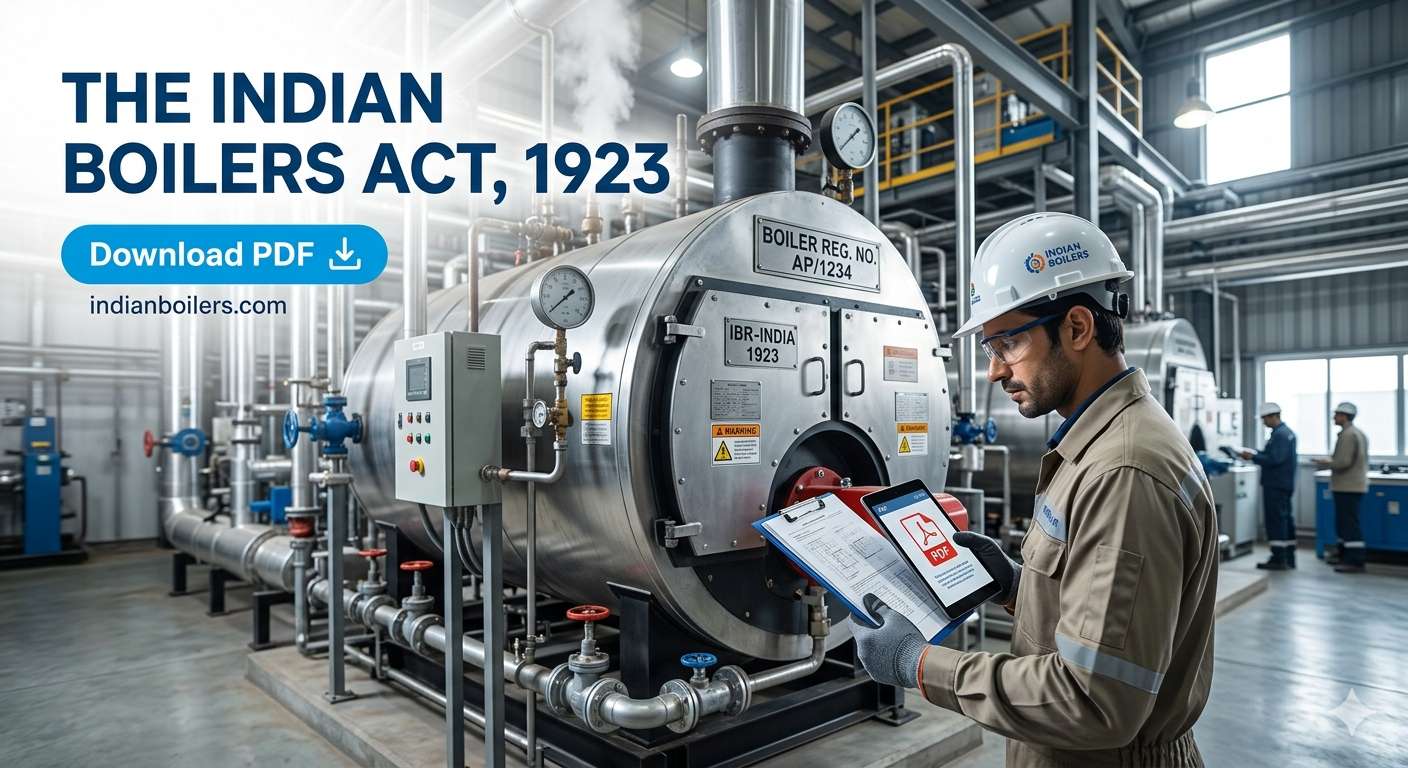
Industrial boilers are the beating heart of India’s manufacturing, power generation, textile, chemical, and processing industries. However, because they operate under extreme pressures and temperatures, they pose inherent risks to human life and property if left unregulated. For over a century, the foundational legal framework governing these high-pressure vessels was The Indian Boilers Act, 1923 (Act No. 5 of 1923).
Whether you are an industrial plant manager, a boiler manufacturer, an operations engineer, or a compliance officer, having access to the official text of this legislation is critical for historical context, legal audits, and understanding how modern boiler safety evolved.
Below, you can immediately access the download link for the complete text of the Act, followed by a comprehensive, 2,000-word deep-dive analysis of its core sections, mandatory compliances, and the recent transition into the new legislative era.
📥 CLICK HERE TO DOWNLOAD THE INDIAN BOILERS ACT, 1923 PDF
Section 1: Introduction and Historical Context of the 1923 Act
The Indian Boilers Act was enacted on February 23, 1923, during the British colonial era, and officially came into force on January 1, 1924. Prior to 1923, different provinces across India had their own fragmented, inconsistent regulations regarding steam boilers. This lack of uniformity led to widespread confusion, substandard manufacturing, and frequent, catastrophic industrial accidents due to boiler explosions.
The primary objective of the 1923 legislation was to consolidate and amend the laws relating to steam boilers, establishing a single, unified framework across the country. Its core mandates were clear:
- Protect human life and property from the immense dangers of steam explosions.
- Ensure strict uniformity in registration, operational maintenance, and regular safety inspections.
- Define explicit legal boundaries for owners, operators, and manufacturers.
For more than 100 years, this Act served as the legal spine of India’s heavy industries. Even as technology progressed from simple coal-fired fire-tube boilers to ultra-supercritical power plant units, the foundational principles of the 1923 Act remained highly relevant.
Section 2: Statutory Definitions You Must Know
To navigate the legal text effectively, it is essential to understand how the Act defines its most critical technical terms under Section 2:
- Boiler [Section 2(b)]: Any closed vessel exceeding 22.75 liters (or 25 liters in modern amended terms) in capacity used expressly for generating steam under pressure. This definition includes all mountings, fittings, and attachments that remain wholly or partly under pressure when the steam is shut off. It explicitly excludes vessels operating with a design gauge pressure of less than 1 kg/cm² or those where water is heated below 100°C.
- Boiler Component [Section 2(ba)]: This encompasses steam piping, feed piping, economizers, superheaters, and any internal or external part subjected to a pressure exceeding 1 kg/cm² gauge.
- Accident [Section 2(a)]: Defined as an explosion of a boiler or its component, or any uncontrolled release of water or steam that weakens its structural strength, causing injury, death, or material property damage.
- Owner [Section 2(d)]: Includes not just the legal proprietor of the equipment, but also any agent, hirer, or bailee utilizing the boiler on a daily basis.
- Steam-pipe [Section 2(f)]: Any pipe through which steam passes from a boiler to a prime-mover or user system, provided the internal diameter exceeds 254 mm or the operational pressure exceeds 3.5 kg/cm² above atmospheric pressure.
Section 3: Key Structural Framework of the Act (The Core Sections)
The Indian Boilers Act, 1923 is systematically structured into sections that mandate exactly how a high-pressure unit can exist and operate within the Indian territories.
1. Prohibition of Unregistered or Uncertified Boilers (Section 6)
This is the most critical operational clause of the entire Act. Section 6 explicitly states that no owner shall use or permit the use of a boiler unless it is registered under the provisions of the Act and a valid certificate or provisional order authorizing its use is actively in force. Running an uncertified boiler is a severe criminal and civil offense. Furthermore, the boiler must never be operated at a pressure higher than the maximum pressure specified in its certificate.
2. The Registration Process (Section 7)
When an enterprise purchases or installs a new boiler, it must submit an application for registration to the State Inspectorate. The registration sequence follows a strict timeline:
- Application: The owner submits an application along with the prescribed fee, structural drawings, and manufacturer certificates.
- Inspection Notice: Upon receipt, the Inspector provides at least 10 days’ notice to the owner and schedules a physical evaluation within 30 days.
- Measurement and Testing: The Inspector physically measures, examines, and subjects the boiler to a hydrostatic test to determine its safe maximum working pressure.
- Reporting: The Inspector submits the structural report to the Chief Inspector, who registers the unit and issues a unique Registration Number that must be permanently engraved or marked onto the boiler shell.
3. Renewal of Certificates (Section 8)
Boiler certificates are not permanent; they are typically valid for a period of 12 to 24 months depending on the boiler class and regional state amendments. Before a certificate expires, the owner must apply for a renewal. The boiler must be entirely shut down, cooled, opened, and prepared structurally for an internal and external visual evaluation and pressure test.
4. Major Alterations and Renewals (Sections 12 & 13)
An owner cannot simply modify or repair a boiler at will. Sections 12 and 13 stipulate that any major structural alteration, addition, or renewal to a boiler shell or attached steam piping requires prior written approval from the Chief Inspector. Unauthorized welding, component replacement, or design changes immediately invalidate the active certificate.
Section 4: Duties, Obligations, and Compliance Mandates for Owners
Possessing an industrial boiler comes with significant legal accountabilities. Under the 1923 framework, owners are strictly bound by the following mandates:
+-----------------------------------------------------------------------------------------+
|                              DUTIES OF A BOILER OWNER                                   |
+-----------------------------------------------------------------------------------------+
| 1. Mandate Preparation (Sec 14): Provide full access, lighting, scaffolding, and safety |
|    gear to Inspectors during scheduled audit visits.                                    |
+-----------------------------------------------------------------------------------------+
| 2. Accident Reporting (Sec 18): Report any explosion, structural leakage, or pressure    |
|    failure in writing to the Inspector within 24 hours.                                 |
+-----------------------------------------------------------------------------------------+
| 3. Qualified Supervision: Ensure that the boiler is continuously managed by a certified  |
|    Boiler Operation Engineer (BOE) or a competent Boiler Attendant.                      |
+-----------------------------------------------------------------------------------------+
| 4. Transfer Regulations (Sec 16): If a boiler is sold or moved to another state, the    |
|    transfer must be registered with the receiving state before operation begins.         |
+-----------------------------------------------------------------------------------------+
- Duty to Provide Facilities (Section 14): When an Inspector is scheduled to examine a boiler, the owner is legally required to prepare the boiler structurally—this means cleaning the tubes, draining the drums, removing scale, and providing adequate lighting, scaffolding, and testing equipment.
- Mandatory Reporting of Accidents (Section 18): If an industrial accident occurs, the person in charge must report it within 24 hours. The written report must detail the precise nature of the accident, the extent of structural damage, and any injuries or loss of life. Failing to report an accident is a punishable offense.
Section 5: The Enforcement Machinery: Inspectors and Appellate Authorities
The execution of the Act is handled by a dedicated hierarchy of technical civil servants:
- The Inspectors [Section 5]: Appointed by State Governments, these highly qualified engineers possess the legal power of entry (Section 17) to walk into any factory or facility housing a boiler at any reasonable hour to inspect and assess safety levels.
- The Chief Inspector: Manages the State Boiler Inspectorate, reviews structural assessment reports, issues registration numbers, and grants or revokes operating permits.
- Appellate Authorities (Sections 19, 20 & 20A): If an owner is aggrieved by an order issued by an Inspector (e.g., if an Inspector reduces the maximum allowed operating pressure or demands costly structural modifications), the owner has the right to file an appeal with the Chief Inspector within 30 days. If the conflict remains unresolved, it can be escalated to an Appellate Authority constituted by the State or Central Government.
Section 6: The Central Boilers Board (CBB) and IBR
While state departments enforce the law locally, the power to create standard technical rules belongs to a national centralized body. Under Section 27A, the Central Boilers Board (CBB) was formed.
The CBB is the standard-setting body responsible for drafting the Indian Boiler Regulations (IBR).
- What is IBR? Formulated extensively in 1950, the IBR regulates the design, materials, fabrication, testing, and inspection standards of all boilers manufactured or used in India.
- When a company purchases material, valves, or pipes for a boiler system, they must check if they are “IBR Approved.” This means the component has been manufactured in strict adherence to the regulations laid out by the CBB under the authority of the Boilers Act.
Section 7: Modern Evolution: The Shift to the Boilers Act, 2025
For businesses operating today, staying compliant requires acknowledging a major regulatory milestone. The Government of India has officially reviewed, updated, and re-enacted the century-old law, replacing it with the new Boilers Act, 2025 (which went into full operational effect on May 1, 2025).
Why was the 1923 Act Re-enacted?
While the 1923 Act laid the groundwork for safety, it was drafted in a different industrial era. Over the decades, it created heavy administrative hurdles, delays in inspections, and criminalized minor administrative errors, which slowed down modern industrial growth. The updated framework introduces several key improvements:
- Grouping and Structural Clarity: The outdated laws have been consolidated into six clear, easily readable chapters.
- Decriminalization for Ease of Doing Business (EoDB): To support industries and MSMEs, minor bureaucratic mistakes have been decriminalized. Out of seven major historical offenses, three have been converted from criminal charges to fiscal penalties handled via executive mechanisms instead of dragging business owners through courts.
- Strict Safety Focus Reconciled: Criminal liabilities are still strictly enforced for four critical offenses that directly endanger human life (such as operating an unregistered boiler, falsifying safety certificates, or ignoring structural crack alerts).
- Third-Party Inspecting Authorities (TPIAs): To reduce administrative delays, the modern framework fully integrates independent, recognized competent persons and third-party agencies to execute structural audits alongside government inspectors.
- Certified Welders Rule: The updated law explicitly mandates that all critical structural welding must be performed only by highly specialized welders certified by government-recognized institutions.
Section 8: Summary Comparison: 1923 Act vs. Modern 2025 Framework
| Regulatory Metric | The Indian Boilers Act, 1923 | The Modern Boilers Act, 2025 |
| Inspection System | Exclusively managed by state-appointed government inspectors. | Co-managed by State Inspectors and authorized Third-Party Inspecting Authorities (TPIAs). |
| Legal Framework | Fragmented amendments spread across a century of individual updates. | Streamlined into 6 clear chapters aligning with modern engineering standards. |
| Minor Offenses | Criminal fines requiring lengthy judicial processes in lower courts. | Decriminalized civil penalties resolved quickly through executive review boards. |
| Major Safety Breaches | Imprisonment and standard fines. | Significantly higher financial penalties (up to ₹1 Lakh+) alongside criminal prosecution. |
| Process Execution | Manual application submissions and physical paperwork tracking. | Digitized documentation, swift approvals, and streamlined safety protocols. |
Conclusion & Action Steps for Plant Managers
The Indian Boilers Act, 1923 established the foundational safety principles that protected Indian factories for over a century. However, as the industry transitions under the Boilers Act, 2025, plant operators must remain proactive to keep their facilities compliant and safe.
Your Compliance Checklist:
- Audit Current Documentation: Ensure your boiler’s existing registration numbers, IBR structural certificates, and data books are accurate and up to date.
- Verify Operator Certifications: Check that your running staff hold active Boiler Operation Engineer (BOE) or Attendant competencies according to state guidelines.
- Validate Structural Repairs: Never perform freelance or unapproved modifications on a pressure parts system. Always utilize IBR-certified welders and obtain prior approvals.
- Stay Informed on Local State Rules: Keep up with the latest state notifications regarding the deployment of Third-Party Inspecting Authorities (TPIAs) to streamline your renewal timelines.
At Indianboilers.com, we are committed to keeping India’s engineering and manufacturing communities informed, safe, and fully compliant. Share this blog with your industrial operations team, and make sure to download the statutory PDF guide for your compliance records!
💬 What are your thoughts on the transition from the 1923 Act to the new modern regulations?
Leave a comment below or get in touch with our technical compliance desk at Indianboilers.com & Balkrishna Boilers for expert guidance on boiler certifications, operations, and technical safety audits!