
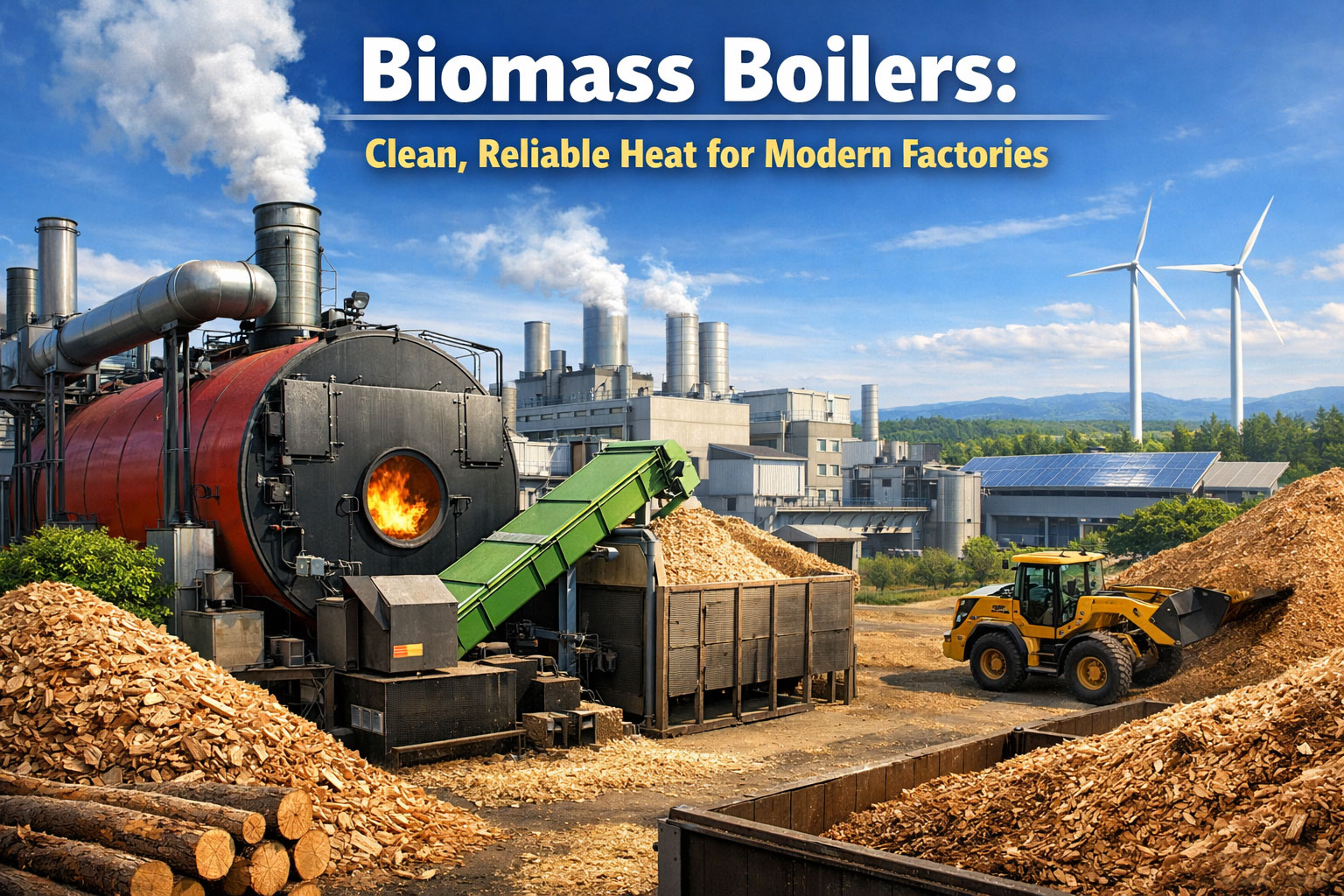
Biomass Boilers Have Outgrown Their Old Reputation
Ask an engineer who hasn’t looked at biomass technology in a decade what they picture, and you’ll likely hear “manual feeding, smoky chimneys, unpredictable steam pressure.” That reputation is out of date. Modern biomass combustion systems are digitally controlled, automated, and engineered for the same reliability standards that continuous industrial operations demand from any fuel source. This piece walks through what’s actually changed — the combustion science, the automation, the emission control — and where biomass genuinely fits for factories that can’t afford unplanned downtime.
Where the Old Reputation Came From, and What Replaced It
The historical concerns about biomass weren’t unfounded — they described real limitations of older, manually operated systems. Three specific engineering advances have addressed each one directly.
Precision combustion control. Oxygen (lambda) sensors continuously monitor exhaust gas composition, feeding real-time data into automated control of the forced draft (FD) and induced draft (ID) fans via variable frequency drives (VFDs). This maintains a tightly controlled air-to-fuel ratio automatically, rather than relying on an operator’s periodic manual adjustment — the direct result is more complete combustion, less unburnt carbon, and steadier heat output than manually tuned systems could ever reliably achieve.
Modern emission control. Pulse-jet bag filters, properly sized and maintained, capture the large majority of particulate matter before it reaches the stack, and where higher-capacity control is needed, electrostatic precipitators (ESPs) handle larger industrial volumes. Combined with multi-cyclone dust collection upstream to capture coarser particles first, a properly specified modern biomass system’s stack emissions bear little resemblance to the “smoky chimney” image — see our biomass boiler emission control systems guide for what a fully compliant setup requires.
Automated ash handling. Submerged belt conveyors or pneumatic ash handling systems now transport combustion residue directly from the furnace to sealed collection points, removing the manual raking and associated dust exposure that defined older biomass operations.
Engineering for Reliability: The Hybrid Design Approach
For a factory running continuous multi-shift production, reliability isn’t a nice-to-have metric — it’s the only one that matters, since a steam interruption stops the production line regardless of how efficient the boiler otherwise is. A hybrid water-cum-fire-tube design is a common approach for factories prioritising this kind of reliability:
A water-wall furnace surrounds the combustion chamber with water-filled tubes, providing substantial radiant heat transfer surface and enabling relatively quick steam-raising from a cold start — useful for plants that shut down and restart on a daily cycle rather than running truly continuous shifts.
A fire-tube shell section for subsequent gas passes provides a larger water inventory acting as a thermal buffer, which helps the system absorb sudden peak-load demand from the factory floor without a meaningful pressure drop — combining the fast response of water-tube-style heat transfer with the load-stability advantage of a larger water volume. Our Water Tube vs Fire Tube guide goes deeper into the underlying trade-offs each architecture brings on its own.
Fuel Versatility: Not Beholden to a Single Supplier
A genuinely modern biomass combustion chamber is engineered to handle more than one fuel type, which matters because no factory wants its steam supply beholden to a single regional supplier’s harvest cycle or pricing. Combustion systems designed for fuel flexibility can typically handle:
- Rice husk — granular and widely available, though its high silica ash content demands specific furnace and grate engineering
- Wood chips — higher moisture tolerance with strong energy density
- Briquettes and pellets — high density and low ash, trading a small cost premium for combustion consistency
- Agro-waste — mustard stalk, corn cobs, and other regionally available residues
Our overview of multi-fuel boilers as the future of industrial heating in India covers this flexibility strategy in more depth, and our comparisons of Rice Husk vs Mustard Straw ROI and Biomass Pellet vs Biomass Briquette performance help evaluate specific fuel trade-offs before you finalise a supply strategy.
The Digital Layer: Biomass Joins Industry 4.0
Modern factories run on data, and biomass combustion equipment has caught up to that expectation rather than remaining an analog holdout:
| Capability | What It Does | Why It Matters |
|---|---|---|
| Remote telemetry | Boiler status accessible via smartphone or dashboard | Management can monitor fuel consumption and performance without being on-site |
| Predictive maintenance | Sensors detect early signs of bearing wear, pump issues, or combustion drift | Components get serviced before they fail and cause an unplanned shutdown |
| Automated digital logging | Continuous recording of steam output and fuel input | Accurate, auditable cost-per-kg-of-steam tracking for both operations and finance |
Our pieces on how AI and IoT are transforming biomass boiler operations and digital twin technology for boiler efficiency and reliability cover how this is increasingly standard on new installations rather than a premium extra.
Carbon Accounting: What’s Actually Verifiable
If your factory exports to markets with carbon border requirements, it’s worth being precise about scope rather than assuming a blanket rule applies. The EU’s Carbon Border Adjustment Mechanism (CBAM) currently applies to a specific set of sectors — cement, iron and steel, aluminium, fertilisers, electricity, and hydrogen — not a general requirement across all exports. If your product falls outside these categories, CBAM in its current form doesn’t directly apply, though international buyers increasingly request carbon data regardless of formal mandate, and coverage has expanded before.
What is broadly true regardless of formal compliance requirements: biomass combustion sits within the short-term carbon cycle, since the CO₂ released was absorbed by the plant during its recent growth, unlike coal or oil, which release carbon sequestered for millions of years. Switching from furnace oil to biomass is commonly associated with a substantial reduction in reportable fossil-origin emissions — often cited in the 80–95% range depending on combustion completeness — a genuinely meaningful figure for Scope 1 emissions reporting, whether or not your specific sector faces a formal carbon border mechanism today.
Economic Stability in a Volatile Fuel Market
Fossil fuel pricing is tied to global geopolitics in a way that biomass generally isn’t — a shipping disruption or a regional conflict can meaningfully move oil and gas prices overnight, while biomass fuel sourced within a practical delivery radius of your plant tends to track local harvest cycles and regional supply rather than international commodity markets. This “local energy loop” brings two related benefits: pricing that’s generally more predictable and tied to conditions you can actually monitor, and reduced exposure to currency and import-cost swings that come with fuel purchased internationally.
Sector-Wise Fit
Food and beverage manufacturing needs food-grade steam purity, and biomass boilers paired with proper water treatment — RO and DM plants — deliver steam suitable for direct injection or jacketed kettle applications where purity genuinely matters. Our boiler selection guide for food processing units covers this in more depth.
Pharmaceutical manufacturing in hubs with strict air quality requirements can pair biomass combustion with electrostatic precipitators to meet emission standards while still capturing the fuel-cost advantage over gas or oil. Our industry-wise guide to the best boiler for textile, pharma, and food industries goes deeper into pharma-specific steam requirements.
Textiles and chemical processing typically need large, sustained volumes of process heat, where a biomass boiler’s ability to hold a constant high-pressure steam supply generally outperforms electrical heating for large-scale continuous operation on a cost basis.
A Practical Modernisation Checklist
If you’re currently running an aging coal boiler or an expensive oil-fired unit, the practical path to a modern biomass system runs through these steps:
- Conduct a genuine steam audit. Many plants are “over-boilered” relative to their actual demand, which erodes achievable efficiency — size to real peak and average load, not a rounded-up historical estimate.
- Evaluate fuel logistics realistically. Confirm you have adequate yard space for a reasonable storage buffer — commonly 15–30 days — and a genuine local supply chain, not just a spot-market assumption.
- Select grate technology deliberately. A static grate suits small, simple operations; reciprocating or travelling grates suit continuous, automated operation at scale. Our grate speed and fuel consumption guide and Vibrating Grate vs Reciprocating Grate comparison help with this choice.
- Plan for ash value recovery from day one. Identify a local brick manufacturer, cement plant, or fertiliser buyer for your ash before commissioning, turning a disposal cost into a modest secondary revenue stream rather than an afterthought.
Maintenance: The Discipline Behind the Reliability Claim
None of the automation and engineering described above eliminates the need for a consistent maintenance routine — it changes what that routine looks like. Daily checks on water treatment and blowdown, weekly inspection of fuel-feeding mechanisms for abrasive wear (particularly relevant for silica-heavy fuels like rice husk), monthly cleaning of heat-recovery surfaces like economizers and air preheaters, and annual full inspections remain the backbone of long-term reliability. Automation reduces the labour burden of running a biomass system well, but it doesn’t remove the need for that underlying discipline — a well-automated boiler that skips its maintenance cadence will still drift from its rated performance over time, just as any mechanical system would.
What Balkrishna Boilers Brings to a Modernisation Project
Balkrishna Boilers Pvt Ltd — IndianBoilers.com and Balkrishn.com — engineers combustion systems around the specific fuel-flexibility, automation, and emission-control requirements described above, rather than adapting a generic design after the fact. Our Steam Boiler range includes husk-specific HUSKPOWER and waste-heat-focused ENERPOWER systems, alongside our Pollution Control Equipment range for integrated emission compliance from day one.
Frequently Asked Questions
Are modern biomass boilers really as clean as the marketing suggests? When properly specified with pulse-jet bag filters or ESPs and multi-cyclone pre-filtration, yes — stack emissions from a well-maintained modern system are substantially cleaner than older, uncontrolled biomass combustion, though ongoing filter maintenance is essential to sustain that performance.
Can a biomass boiler really handle sudden load swings as well as gas? A well-designed hybrid or fluidized bed system with proper automation handles load variation well, though response characteristics differ somewhat from gas firing — the key is matching combustion technology and control automation to your actual load pattern rather than assuming any biomass system performs identically.
Does my industry face CBAM or similar carbon border charges? The EU’s CBAM currently applies specifically to cement, iron and steel, aluminium, fertilisers, electricity, and hydrogen — not a blanket rule across all exports. Check your product’s classification against current CBAM scope, since it has expanded before and buyer expectations around carbon data are rising regardless of formal mandate.
Is fuel flexibility worth paying for upfront, or should I design around one fuel? If your region has genuinely reliable single-fuel supply, a dedicated design can be more cost-effective. Multi-fuel flexibility is worth the design investment specifically where seasonal availability or pricing volatility for your primary fuel is a real risk.
Getting the Sequencing Right on a Modernisation Project
The order in which you approach a modernisation matters as much as the individual technology choices. Confirming your genuine steam demand and local fuel supply chain first, before specifying combustion technology and automation level, avoids the common trap of over-specifying an expensive digital monitoring package on a boiler that turns out to be the wrong size for actual demand, or under-specifying grate technology for a fuel that shifts seasonally. A proper technical proposal — sized to your real load and fuel access, not a generic template — is worth requesting before finalising any modernisation budget.
Talk to Our Engineering Team
If you’re evaluating a modernisation from an aging fossil-fuel system to a reliable, automated biomass installation, get in touch with our engineering team or browse our complete product range.
Further reading: The Complete Guide to Biomass Boilers for Steam Generation · How AI and IoT Are Transforming Biomass Boiler Operations · Biomass Boiler Emission Control Systems: A Complete Guide · Reduce Your Carbon Footprint with Biomass Boiler Technology