
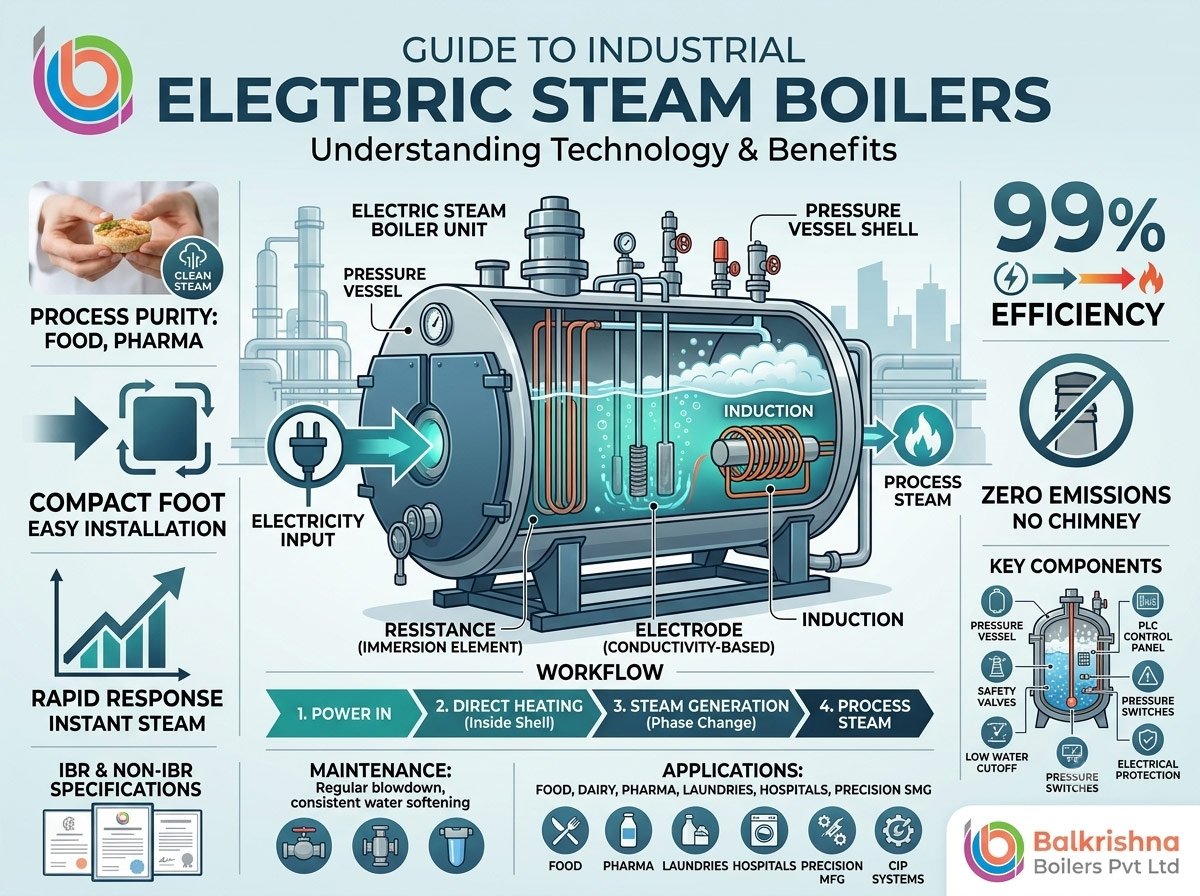
For most of industrial history, generating steam meant burning something — coal, wood, diesel, gas, or biomass — to boil water. An electric boiler breaks that pattern entirely. Instead of a flame and a chimney, it uses electrical energy directly to heat water into steam, with no combustion, no flue gas, and often no chimney at all.
This shift isn’t just a novelty. Electric steam boilers have become a serious mainstream choice for Indian manufacturers, particularly in food, pharma, and precision manufacturing, where clean steam, compact footprint, and instant response matter as much as raw capacity. This guide explains exactly what an electric boiler is, how the different technologies inside one actually work, and where they fit best in an industrial steam strategy.
What Is an Electric Boiler?
An electric boiler is a pressure vessel that converts electrical energy directly into heat to raise water to its boiling point and generate steam, in place of the combustion process used in conventional fuel-fired boilers. The fundamental job is the same as any steam boiler — applying heat energy to water within a pressurized system to force a phase change from liquid to gas — but the heat source, and everything that comes with it, is entirely different.
Because there’s no combustion, an electric boiler eliminates the need for fuel storage, a chimney or flue system, ash handling, and a burner assembly. This translates into a smaller footprint, simpler installation, and — for many industries — a genuinely cleaner process environment.
How Does an Electric Boiler Actually Work?
The short answer: electricity is converted into heat inside the boiler shell, and that heat is transferred to water until it reaches saturation temperature and begins producing steam at the required pressure. The longer, more useful answer depends on which of the three main electric boiler technologies is doing the heating — because each converts electricity into heat in a fundamentally different way.
1. Resistance (Immersion Element) Boilers
This is the most familiar and widely used electric boiler technology. Heavy-duty resistance heating elements — typically made from high-grade stainless steel such as Incoloy or SS 316 — are directly immersed in the water inside the pressure vessel. When electrical current passes through these elements, resistance heating generates heat directly at the element surface, which transfers to the surrounding water by conduction and convection.
Because the elements are immersed directly in the water, heat transfer is essentially instantaneous — a resistance electric boiler can reach full working pressure dramatically faster than a fuel-fired unit still warming through a refractory-lined furnace. Capacity is also easily scaled by adding or removing heating elements, and output can be precisely modulated by staging elements on and off in banks to match fluctuating steam demand — a technology explained in more depth in our guide to electric boiler technology, from immersion elements to electrode types.
The one real limitation of resistance heating is that the element surface is the hottest point in the system — if water treatment is inadequate, dissolved minerals precipitate onto the element, forming scale that insulates it and eventually leads to premature burnout.
2. Electrode (Conductivity-Based) Boilers
Electrode boilers take a different approach entirely — instead of a heating element that gets hot and transfers heat to the water, electricity passes directly through the water itself, using the water’s natural electrical conductivity to generate heat. Electrodes are submerged in the water, and current flowing between them heats the water directly and near-instantaneously.
This design has a built-in safety advantage: if the water level drops, the electrical circuit between the electrodes is broken and the boiler automatically stops — there’s no exposed element left to overheat or burn out. It’s also inherently self-regulating, since steam production is directly proportional to water level and conductivity. This is exactly the principle behind compact units like the 50 Kg/hr Electric Electrode Non-IBR Boiler, a “plug-and-play” solution popular in labs, small food units, and boutique hospitality applications.
3. Induction Boilers
Induction boilers use an entirely different physical principle: an electromagnetic field, generated by a coil, induces eddy currents directly within a metal core, heating the core itself — which then transfers heat to the surrounding fluid. Crucially, the electrical coil never touches the water or fluid directly.
That separation is the key advantage. Because the heating element (the coil) isn’t in direct contact with the corrosive or scaling environment, induction boilers like the INDUCTRON are significantly more resistant to scale-related failure than resistance designs, offer extremely fast heat-up times, and are well suited not just to steam but to clean water heating and thermal fluid applications where element degradation is a genuine concern.
Key Components of an Electric Boiler
Beyond the heating technology itself, an electric boiler shares many of the same core safety and control components found in any steam boiler:
- Pressure vessel/shell: houses the water and steam space, built and tested to the relevant IBR or Non-IBR specification
- Control panel: typically PLC or thyristor-based, regulating power input, pressure, and water level automatically
- Safety valves: mechanically relieve excess pressure if it exceeds the set limit
- Low-water cutoff: shuts off power to the elements or electrodes if water level drops to an unsafe point
- Pressure switches and gauges: monitor and display operating pressure in real time
- Electrical protection: MCBs and short-circuit protection specific to the high-current electrical load an electric boiler draws
Why Electric Boilers Are So Efficient
This is one of the most compelling technical arguments for electric boilers: they convert nearly all of the electrical energy input directly into usable thermal output, commonly cited at 98–99.5% efficiency — compared to 80–88% for even well-designed modern combustion boilers. The difference comes down to where energy is lost. Combustion boilers inevitably lose a portion of fuel energy up the chimney as stack heat, in unburned fuel, and through radiation from the furnace. Electric boilers have no chimney and no combustion byproduct to lose energy to — nearly every unit of electrical energy purchased ends up as heat in the water.
That said, “efficient” doesn’t automatically mean “cheapest to run” — the actual operating cost depends heavily on local electricity tariffs versus fuel prices, a trade-off worth weighing carefully alongside our broader comparison of boiler efficiency vs. fuel cost.
IBR and Non-IBR Electric Boilers
Like any steam boiler, electric units fall under the same statutory framework once they cross the water capacity and pressure thresholds set by the Indian Boiler Regulations. Compact, low-pressure electrode units — such as small lab or R&D boilers — commonly qualify as Non-IBR, avoiding the need for a certified attendant or annual statutory inspection. Larger resistance or induction units, particularly those built for continuous high-pressure industrial demand, are manufactured and registered as IBR-certified electric steam boilers. If you’re unsure which category applies to your requirement, our detailed comparison of IBR vs. Non-IBR steam boilers walks through exactly where that line sits and what it means operationally either way.
Key Benefits of Electric Boilers
Zero on-site emissions With no combustion, there’s no smoke, CO₂, NOx, or SOx released at the site — a major driver for plants in urban or environmentally sensitive zones, and a strategic advantage as India’s grid decarbonizes further, a point we cover in detail in our guide on why electric boilers are the best choice for low-emission plants.
Compact footprint and simpler installation No fuel storage tank, no chimney, no ash handling system, and no dedicated boiler house ventilation requirement. Electric boilers can often be installed directly next to the process equipment they serve, saving significant floor space and piping costs.
Rapid response and precise control Electric boilers reach full working pressure in minutes and respond almost instantly to load changes — a genuine advantage for plants managing sharp demand swings, a topic we explore further in our guide to managing steam boiler load variation.
High steam quality Because of steady, precise heat control, electric boilers reliably produce very high-quality “dry” steam, which matters significantly for sensitive processes like pharmaceutical sterilization and clean-room applications.
Lower maintenance complexity No burner to tune, no soot to clean, and — for induction and electrode designs particularly — reduced exposure to scale-driven component failure compared to older resistance-element designs.
Where Electric Boilers Are Used
While laundries and hospitals remain classic use cases, electric boilers have expanded well beyond them. Food, pharma, and dairy plants increasingly favour electric boilers for the strict process purity they enable — our guide to electric boilers for food, pharma, and dairy covers why contamination-sensitive environments benefit from eliminating combustion byproducts entirely. Beyond these traditional sectors, our article on less obvious applications of electric steam boilers covers everything from CIP (Clean-in-Place) systems to niche high-tech process applications where combustion simply isn’t compatible with the required environment.
Maintenance Considerations Specific to Electric Boilers
Water quality matters just as much — arguably more — for electric boilers as it does for combustion units, because the heating surface (element, electrode, or induction core) is the single point where scale can compromise performance fastest. Our detailed guide on steam boiler scaling causes, signs, and prevention applies directly here — regular blowdown to remove concentrated salts and consistent water softening are non-negotiable for keeping an electric boiler running at its rated efficiency and element lifespan.
Choosing the Right Electric Boiler Capacity
Selecting capacity isn’t just about peak steam demand — it also depends on electrical infrastructure, since electric boilers draw substantial current relative to their thermal output. A proper capacity assessment weighs your required Kg/hr output, available electrical supply, and whether demand is steady or highly variable, since resistance, electrode, and induction technologies each respond differently to fluctuating load.
How Indian Boilers and Balkrishna Boilers Support Electric Boiler Adoption
Both companies offer the full spectrum of electric heating technology under one roof. Indianboilers.com’s electric boiler range spans the compact Electric Steam Generator line, the Non-IBR 50 Kg/hr Electrode Boiler, and the heavy-duty IBR Electric Steam Boiler — giving plants a genuine choice of technology and capacity rather than a one-size-fits-all electric unit.
Balkrishna Boilers offers the same breadth across its electric boiler category, including ELECTRON and ELECTROMAX resistance-based steam boilers, the scale-resistant INDUCTRON, and specialized systems like ELECTROPAC for thermic fluid heating and ELECTRO AQUA for hot water applications — engineered to bring zero-emission, precision steam to virtually any industrial process.
Frequently Asked Questions
Is an electric boiler more expensive to run than a fuel-fired boiler? It depends entirely on local electricity tariffs versus fuel costs. Electric boilers save on installation, maintenance, and chimney/fuel infrastructure, but the per-unit energy cost of electricity can be higher than some fuels in certain regions — a full cost comparison should factor in both capital and operating expense.
Do electric boilers need a certified boiler attendant? Only if they fall under IBR jurisdiction based on water capacity and pressure. Many compact electrode-based units are Non-IBR and don’t require a certified attendant, while larger IBR-certified electric boilers do.
How long do heating elements or electrodes typically last? With proper water treatment, resistance elements and electrodes commonly last 5 to 10 years. Induction boiler coils, being isolated from the water entirely, generally last even longer since they aren’t directly exposed to scaling.
Can an electric boiler produce the same pressure as a combustion boiler? Yes — modern electric boilers, particularly IBR-certified resistance and electrode designs, are engineered for pressures comparable to fuel-fired industrial boilers, commonly up to 10.54 kg/cm² as standard and higher on custom-engineered units.
Do electric boilers require a chimney? No. Since there’s no combustion, there’s no flue gas to vent, eliminating the chimney requirement entirely — one of the reasons electric boilers install so compactly next to process equipment.
Curious whether an electric boiler is the right fit for your process? Talk to the Indian Boilers engineering team or contact Balkrishna Boilers for an electrical load assessment and capacity recommendation.