
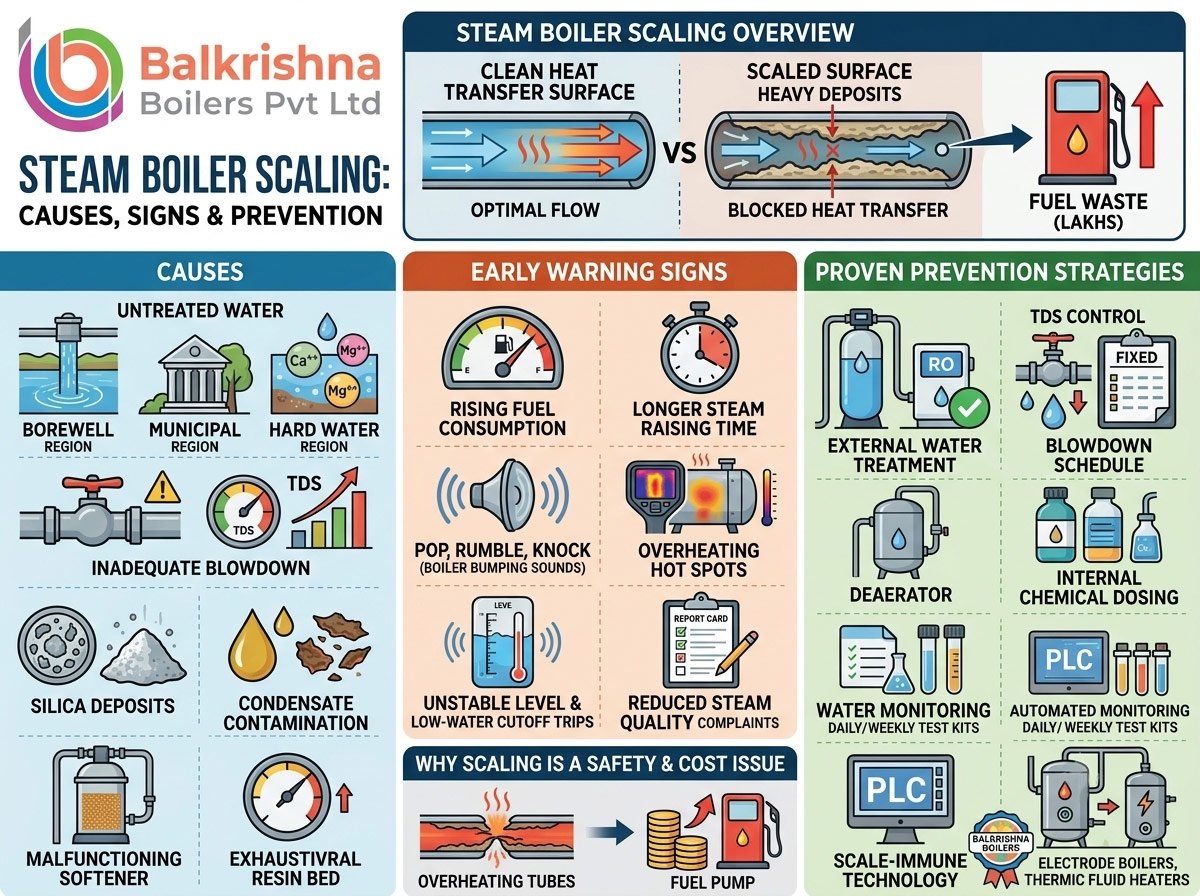
Ask any plant engineer what quietly eats into fuel budgets, and “scaling” comes up before almost anything else. It doesn’t announce itself with a bang. It builds up tube by tube, week by week, until a boiler that once fired up in minutes starts taking longer, running hotter, and consuming more fuel for the same steam output. By the time most plants notice, scale has already cost them lakhs in wasted fuel — and in the worst cases, put tube integrity at risk.
This guide breaks down exactly what causes scale formation inside a steam boiler, how to catch the early warning signs before they become expensive problems, and the prevention practices that keep boilers running at rated efficiency for decades.
What Is Steam Boiler Scaling?
Scaling is the buildup of hard mineral deposits — mainly calcium carbonate, calcium sulfate, magnesium silicate, and silica — on the internal heat-transfer surfaces of a boiler. As water is heated and converted into steam inside the shell or tubes, dissolved minerals that were once held in solution reach their solubility limit and precipitate out. Instead of leaving with the blowdown water, a portion of these minerals bond to the hot metal surface, forming a hard, glass-like layer.
Unlike soft sludge, which can often be flushed out during blowdown, scale is chemically bonded to the metal. Once it forms, it has to be removed mechanically or chemically — it will not wash away on its own.
The real danger isn’t the deposit itself; it’s what the deposit does to heat transfer. Scale is an extremely poor conductor of heat. A layer just 1–1.5 mm thick can cut heat transfer efficiency by 8–10%, and by the time deposits reach 3mm, efficiency losses commonly exceed 25%. To compensate, the burner has to work harder and the flame-side metal temperature climbs — which is exactly where the real risk begins.
What Causes Scale to Form Inside a Boiler?
1. Untreated or Poorly Treated Feedwater
This is, by far, the single biggest cause. Raw water — whether from borewells, municipal supply, or surface sources — carries dissolved hardness salts (calcium and magnesium bicarbonates, sulfates, and chlorides). If this water isn’t softened, demineralized, or otherwise conditioned before it enters the boiler, those hardness salts have nowhere to go except onto the tube walls. As we’ve covered in our breakdown of core boiler components, the water treatment plant isn’t an optional add-on — it’s one of the components most directly responsible for boiler longevity.
2. High TDS Concentration from Inadequate Blowdown
Every time water evaporates into steam, the dissolved solids left behind stay in the boiler and concentrate. Without regular blowdown to remove this concentrated water, Total Dissolved Solids (TDS) climb steadily until minerals are forced out of solution — even in feedwater that was reasonably treated to begin with. This is why blowdown isn’t just a housekeeping task; it’s a frontline defense against scale, a point we’ve discussed in detail in our piece on boiler efficiency vs. fuel cost.
3. Hard Water Regions and Local Water Chemistry
Water hardness varies significantly across India. Plants operating in regions with naturally hard groundwater — common across parts of Gujarat, Rajasthan, and interior Maharashtra — face a much faster scaling timeline than those on softer municipal supplies. Textile units in particular are known for this challenge, something we’ve addressed specifically in our guide to steam boilers for textile mills, where hard water combined with continuous 24/7 operation accelerates deposit buildup.
4. Silica Deposits
Silica behaves differently from calcium and magnesium salts — it doesn’t just deposit as loose scale, it can volatilize and carry over into steam, later depositing on turbine blades or control valves downstream. In high-pressure systems, silica control becomes as critical as hardness control.
5. Condensate Contamination
Where condensate return is used to save energy and reduce makeup water demand, any process-side contamination (oil carryover, corrosion products, or leaks in heat exchangers) can introduce fresh scale-forming material back into the boiler feed loop, even after the raw water itself has been properly treated.
6. Bypassed or Malfunctioning Softeners
Softener resin exhaustion, valve malfunctions, or a plant operator manually bypassing the softener during a rush production period are surprisingly common real-world causes. A softener that isn’t regenerating on schedule offers no more protection than no softener at all.
Where Scale Forms — And Why Boiler Type Matters
Scale doesn’t form uniformly. It concentrates at the hottest points of the heat-transfer surface — precisely where heat flux is highest and water is evaporating fastest.
- Fire-tube boilers: Scale tends to build up on the waterside of the tube bundle, particularly near the furnace-facing tubes where heat flux is most intense.
- Water-tube boilers: Because water is inside the tubes and flue gas is outside, scale forms directly on the internal tube wall exposed to the highest radiant heat — the riser tubes closest to the furnace. Our detailed explainer on water-tube boiler design and circulation covers exactly why blowdown and water quality control matter so much for this configuration.
- Electric and electrode boilers: Scale deposits directly onto the heating element or electrode surface. Because these components rely on direct contact with water for heat transfer, even a thin scale layer causes a disproportionately large efficiency drop — a risk we cover in our guide to electric boiler technology.
Choosing between fire-tube and water-tube designs also affects how forgiving a boiler is to imperfect water treatment — a trade-off worth understanding in our comparison of water-tube vs. fire-tube steam boilers.
Warning Signs of Scaling You Shouldn’t Ignore
Scale rarely causes a sudden failure — it causes a slow drift away from normal operating parameters. Plants that catch these signs early save significantly on fuel and avoid emergency tube repairs.
1. Rising fuel consumption for the same steam output This is usually the first measurable sign. If your boiler is burning noticeably more fuel to produce the same tonnage of steam it did a few months ago, scale is one of the most likely culprits.
2. Longer time to raise steam pressure A clean boiler reaches working pressure predictably. A scaled boiler takes progressively longer because heat isn’t transferring efficiently into the water.
3. Popping, rumbling, or knocking sounds Often called “boiler bumping,” this happens when water trapped under a scale layer superheats and flashes to steam suddenly, creating audible knocking — a classic early symptom operators are trained to listen for.
4. Overheating and hot spots on the shell or tube surface Because scale insulates the metal from the water that should be cooling it, flame-side metal temperatures rise. Infrared surveys often reveal hot spots exactly where internal scale has built up.
5. Frequent low-water cutoff trips or unstable water level Scale can interfere with water circulation, particularly in water-tube designs relying on natural circulation, leading to unpredictable water level behavior.
6. Elevated TDS readings during blowdown checks Routine TDS testing that trends upward over weeks — even with regular blowdown — signals that feedwater treatment isn’t keeping pace with makeup water demand.
7. Reduced steam quality or wet steam complaints In process industries like pharma or food processing, scaling-related inefficiencies often show up first as complaints about inconsistent steam quality reaching the process, as discussed in our overview of industrial uses of steam boilers.
Why Scaling Is a Safety Issue, Not Just an Efficiency One
It’s tempting to treat scale purely as an efficiency and cost problem. It isn’t. Scale forces flame-side metal temperatures well above their design limits because the deposit blocks heat from escaping into the water that’s supposed to cool the tube. Left unaddressed, this can lead to localized overheating, metal fatigue, and in severe cases, tube rupture. This is precisely why IBR (Indian Boiler Regulations) inspections place such heavy emphasis on water treatment records and blowdown logs — scaling isn’t just an operating cost, it’s a documented safety hazard.
Proven Prevention Strategies
1. Install Proper External Water Treatment
Softening (ion exchange), reverse osmosis (RO), or dealkalization should match your feedwater hardness and the boiler’s operating pressure. Higher-pressure boilers demand tighter feedwater specifications, since scale-forming tendencies increase with temperature.
2. Maintain a Consistent Blowdown Schedule
Both bottom blowdown (to remove settled sludge) and continuous/TDS-controlled blowdown (to manage dissolved solids) should be scheduled based on actual water test results, not guesswork. Automated TDS-controlled blowdown valves, now standard on many modern boiler packages, remove the guesswork entirely.
3. Use a Deaerator
Beyond removing corrosive dissolved oxygen and CO₂, a properly functioning deaerator also helps stabilize feedwater chemistry before it enters the boiler — reducing the load on internal chemical treatment.
4. Dose Internal Chemical Treatment Correctly
Phosphate, polymer, or chelant-based internal treatments help keep any residual hardness in a suspended, non-adherent form that blowdown can remove, rather than letting it bond to tube surfaces. This should complement — never replace — proper external treatment.
5. Monitor Water Quality on a Fixed Schedule
Daily TDS checks, weekly hardness tests, and periodic silica testing catch drift before it becomes deposit. Many boiler owners underinvest here simply because water testing feels like a minor task — until a tube failure proves otherwise.
6. Recover and Protect Condensate Return
Condensate is essentially distilled water — recovering it reduces both fuel costs and the volume of fresh makeup water that needs treatment. Just ensure condensate lines are monitored for process contamination before returning to the feed tank.
7. Choose Boiler Technology That Matches Your Water Profile
In regions with consistently hard water or limited access to skilled water-treatment operators, a thermic fluid heater can be a strategically smart alternative — since thermal fluid systems are non-aqueous and inherently immune to mineral scaling. For lower-capacity applications, electrode-based electric boilers — such as the 50 Kg/hr Electric Electrode Boiler — are engineered so that scale buildup on the electrodes simply interrupts current flow rather than causing burnout, unlike traditional immersion elements.
8. Automate Monitoring Where Possible
PLC-based systems that continuously track blowdown, feedwater conductivity, and flame parameters catch scaling trends long before they show up as a fuel bill spike or an audible knock. This kind of integrated monitoring is increasingly standard across modern industrial boiler installations, including biomass systems, as outlined in our biomass boiler installation guide.
How Balkrishna Boilers Helps Prevent Scaling From Day One
Prevention starts at the design and commissioning stage, not after scale has already formed. Balkrishna Boilers Pvt Ltd engineers its steam boiler range — including the STEAMGEN, STEAMJET, and COMBIPOWER series — with accessible tube-cleaning ports, proper blowdown provisions, and design specifications matched to Indian water conditions. For plants seeking a scale-immune alternative for lower-capacity process heating, the INDUCTRON induction boiler and the broader electric boiler range are built specifically to minimize scale-related downtime. Where thermal fluid is a better fit for the process, the thermic fluid heater range — including THERMPAC and DELTAPAC — sidesteps the scaling problem entirely.
Beyond equipment, both Indianboilers.com and Balkrishna Boilers’ engineering teams support clients with water treatment recommendations, commissioning checklists, and PLC-based monitoring integration — because the most cost-effective boiler is the one that never has to fight its own scale buildup.
Frequently Asked Questions
How often should a boiler be checked for scale? Internal inspection during scheduled shutdowns (typically annually, or per IBR requirements) is standard, but water quality — the root cause — should be tested daily to weekly depending on load and water hardness.
Can scale be removed without acid cleaning? Light scale can sometimes be managed through mechanical tube cleaning during shutdowns, but established scale usually requires chemical descaling performed by trained personnel, followed by a review of the water treatment process to prevent recurrence.
Does scale affect boiler lifespan, not just efficiency? Yes. Beyond the fuel cost impact, chronic overheating from scale accelerates metal fatigue and can shorten tube life significantly, sometimes leading to premature tube failure well before a boiler’s rated service life.
Is scale a bigger problem for high-pressure boilers? Generally, yes. Higher operating pressures mean higher saturation temperatures, which increases the rate at which dissolved minerals reach their solubility limit and precipitate — making feedwater quality control even more critical as pressure increases.
Looking to reduce scaling risk in your plant? Get in touch with Indian Boilers or contact Balkrishna Boilers for a water-treatment and boiler-selection assessment suited to your site conditions.