
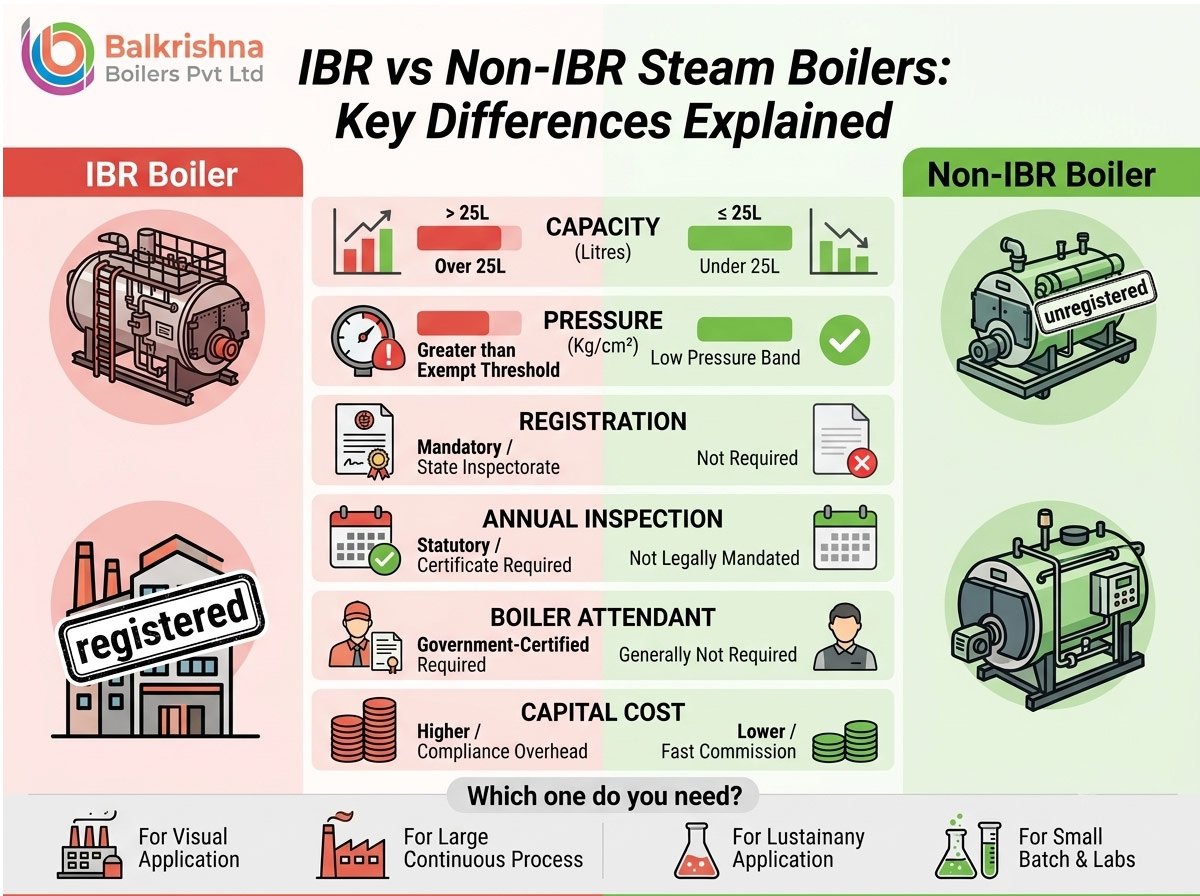
It’s one of the first questions every buyer asks when shopping for a steam boiler in India — and one of the most misunderstood: is this an IBR boiler, or a Non-IBR one? The answer changes your capital cost, your registration paperwork, your staffing requirements, and in some cases, whether you’re even legally allowed to install the unit at your address.
This guide breaks down exactly what IBR and Non-IBR mean, how the classification is decided, the practical trade-offs of each, and how to figure out which category actually fits your plant — without the jargon.
What Does “IBR” Actually Mean?
IBR stands for the Indian Boiler Regulations, 1950, framed under the Indian Boilers Act, 1923. It’s a national safety code that governs the design, manufacture, installation, operation, and periodic inspection of steam boilers and their attached pressure parts across India. The regulations are enforced by the Central Boilers Board (CBB) at the national level and by State Boiler Inspectorates at the state level.
The core purpose of IBR isn’t bureaucratic red tape — it exists because steam boilers store enormous thermal and pressure energy. A poorly designed or poorly maintained pressure vessel can fail catastrophically. IBR mandates specific material standards, welding qualifications, hydrostatic testing, and third-party inspection at every stage — from raw material procurement to final commissioning — to make sure that risk is engineered out before the boiler ever fires up.
When Does a Boiler Legally Require IBR Certification?
Under the Act, a pressure vessel is classified as a “boiler” — and therefore falls under IBR jurisdiction — if it meets both of these conditions:
- Water/steam capacity exceeds 25 litres, and
- It operates above atmospheric pressure, specifically generating steam at a pressure greater than what’s exempted under the Act’s threshold (in practice, this generally applies once operating pressure exceeds roughly 1 kg/cm²).
If a unit crosses these thresholds, it must be designed to IBR specifications, manufactured by an IBR-approved manufacturer, registered with the State Boiler Inspectorate, and subjected to periodic statutory inspection — typically annually — before its certificate of operation is renewed. This is echoed clearly in our industry-wise buyer’s guide for textile, pharma, and food plants, where IBR compliance is treated as non-negotiable for continuous, higher-pressure industrial steam demand.
What Is a Non-IBR Boiler?
A Non-IBR boiler is a steam-generating unit that falls below the statutory thresholds — either because its water capacity is under 25 litres, or because it operates within an exempted low-pressure band. These units are legally outside the scope of the IBR Act, which means they don’t require registration with the Boiler Inspectorate, don’t need an annual inspection certificate, and generally don’t require a government-certified boiler attendant to operate them.
That doesn’t mean Non-IBR boilers are unsafe or unregulated in a broader sense — reputable manufacturers still build them to sound engineering standards, complete with safety valves, low-water cutoffs, and pressure relief devices. It simply means the statutory oversight burden is lighter, because the stored energy risk at this scale is considered manageable without the full IBR compliance framework.
IBR vs Non-IBR: Side-by-Side Comparison
| Parameter | IBR Boiler | Non-IBR Boiler |
|---|---|---|
| Water capacity | Above 25 litres | 25 litres or below |
| Operating pressure | Above the exempted low-pressure threshold | Within the exempted low-pressure band |
| Government registration | Mandatory, with the State Boiler Inspectorate | Not required |
| Annual inspection | Mandatory statutory inspection & certificate renewal | Not legally mandated |
| Certified boiler attendant | Required for operation | Generally not required |
| Manufacturing standard | Must be IBR-approved manufacturer with approved drawings | Built to sound engineering practice, no statutory approval needed |
| Typical capacity range | 500 Kg/hr and above, high-pressure industrial use | Up to roughly 500 Kg/hr, low-pressure use |
| Capital cost | Higher, due to certification, testing, and compliance overhead | Lower, faster to commission |
| Best suited for | Continuous, high-volume, high-pressure industrial processes | Small batch operations, labs, low-volume process heating |
The Case for an IBR Boiler
For most mid-to-large industrial operations, IBR isn’t optional — it’s the only legally compliant path, and frankly, the safer one at scale. Textile mills running 24/7 dyeing and finishing lines, pharmaceutical plants needing sterile, continuous steam, and food processing units running large pasteurization batches all typically require steam volumes and pressures that push them well past the IBR threshold. As covered in our industry-wise guide, IBR-certified units also tend to offer higher build quality, longer service life, and significantly better resale value — because every stage of manufacturing has already been independently verified.
IBR boilers are also the default choice wherever a plant plans to scale. Even if today’s steam demand technically sits under the Non-IBR threshold, a business anticipating growth often finds it more economical to install an IBR-rated unit from day one, rather than replacing an undersized Non-IBR boiler in two years.
Indianboilers.com’s IBR Electric Steam Boiler range — commonly used for capacities from 50 Kg/hr up to 5,000 Kg/hr and higher — is a good example of a Non-IBR-to-IBR pressure and capacity jump handled within a single product family, simply by crossing into the higher-pressure ELECTROMAX configuration. Balkrishna Boilers offers the equivalent through its ELECTROMAX series, alongside its combustion-fired COMBIPOWER and STEAMGEN IBR-certified steam boiler lines.
The Case for a Non-IBR Boiler
Non-IBR units make the most sense wherever steam demand is genuinely small and intermittent, and where the administrative overhead of statutory registration and a certified attendant would be disproportionate to the operation’s scale. Common use cases include:
- Laboratories and R&D facilities running small-batch sterilization or testing
- Boutique hotels, spas, and laundries needing steam for finishing and steam rooms
- Small food units and bakeries doing batch pasteurization or cooking
- Academic and institutional labs, where safety-of-operation matters but throughput is low
- MSMEs and startups that need working steam capacity without a large upfront capital outlay
These use cases are exactly where products like the 50 Kg/hr Electric Electrode Non-IBR Boiler fit — a compact, skid-mounted, “plug-and-play” unit that avoids the need for a certified boiler attendant altogether, since electrode-based heating is inherently self-regulating. Our low-cost industrial boiler range is built on the same logic — many of these models fall under the Small Industrial Boiler (SIB) category, giving MSMEs industrial-grade steam without the full compliance burden of a large IBR installation. Balkrishna Boilers’ SIB and ELECTRON product lines serve the same segment directly.
It’s worth being clear-eyed about the trade-off, though: Non-IBR boilers are not a workaround for avoiding safety standards on a unit that actually needs to run at higher capacity. Deliberately under-specifying a boiler to dodge IBR registration is a false economy — it usually means undersizing steam capacity for your actual process load, which shows up later as poor efficiency and constant demand shortfalls, a pattern discussed in our post on boiler efficiency vs. fuel cost.
Design and Build Differences Beyond Paperwork
The IBR classification isn’t just a certificate stapled to an otherwise identical boiler — it shapes the physical build.
- Material traceability: IBR-approved boilers use plate and tube material with full mill test certificates and documented traceability, while Non-IBR units can use standard commercial-grade material appropriate to their lower design pressure.
- Welding standards: IBR fabrication requires welders qualified under IBR welding procedures, with radiographic testing of critical joints — a level of documentation not mandated for smaller Non-IBR vessels.
- Mountings and safety accessories: Both categories require safety valves, pressure gauges, and water level indicators — topics we cover in detail in our breakdown of core boiler components — but IBR units carry additional statutory mountings and require these to be individually approved and stamped.
- Hydrostatic testing: IBR boilers are tested at 1.5× working pressure under witnessed conditions before commissioning; Non-IBR units are tested to sound engineering practice but without third-party witness requirements.
- Boiler type flexibility: Both fire-tube and water-tube configurations can be built to either IBR or Non-IBR specification, depending on capacity and pressure — a distinction explained further in our comparison of water-tube vs. fire-tube steam boilers.
Operational and Compliance Differences
Beyond the boiler itself, the ongoing operating obligations differ sharply:
IBR boilers require:
- Registration with the State Boiler Inspectorate before first firing
- A government-certified Boiler Operation Engineer or attendant, depending on capacity
- Annual inspection and renewal of the operating certificate (Form VA and related documentation)
- Maintained logs of water treatment, blowdown, and maintenance activity, which inspectors review — a discipline covered in our steam boiler maintenance checklist
Non-IBR boilers require:
- No statutory registration
- No mandatory certified attendant (though basic operator training is still strongly recommended)
- No annual government inspection, though routine internal maintenance remains essential for safe, efficient operation
- Standard preventive maintenance, including scale and water quality monitoring, which matters just as much on a small unit as a large one — see our detailed guide on steam boiler scaling causes, signs, and prevention
How to Decide Which One Your Plant Actually Needs
Rather than starting from “which is cheaper,” the right starting point is your actual process steam demand:
- Calculate your peak steam requirement in Kg/hr, based on your heaviest production shift — not your average day.
- Check your required operating pressure. Processes needing consistent high pressure (dyeing, sterilization, high-temperature drying) almost always sit above the Non-IBR threshold.
- Factor in growth. If capacity needs are likely to double within 2–3 years, it’s often more cost-effective to install IBR capacity now than to replace a Non-IBR unit later.
- Consider staffing realities. If your facility can’t commit to a certified boiler attendant, that’s a strong practical argument for staying within the Non-IBR category, provided your steam demand genuinely fits.
- Match technology to water and fuel conditions. Electric, biomass, and combustion-fired boilers are all available in both categories — our guide to industrial uses of steam boilers walks through how different heating technologies apply across process types.
How Indian Boilers and Balkrishna Boilers Support Both Categories
Both companies design and manufacture across the full IBR and Non-IBR spectrum, so the classification decision is driven by your actual process needs — not by what’s easiest to sell. On the Indianboilers.com steam boiler category and electric boiler category, you’ll find both IBR-certified, high-capacity models and compact Non-IBR units designed for MSMEs and small process lines. Balkrishna Boilers mirrors this across its steam boiler range, from the entry-level Non-IBR SIB series through to heavy-duty IBR-certified systems like STEAMPOWER and VEPOMAX.
Frequently Asked Questions
Can a Non-IBR boiler be upgraded to IBR later? Generally, no — IBR classification is tied to the vessel’s original design, material certification, and fabrication documentation. If your steam demand grows beyond Non-IBR limits, the practical path is installing an additional IBR-rated unit rather than attempting to re-certify an existing Non-IBR vessel.
Is a Non-IBR boiler less safe than an IBR one? Not inherently. Reputable manufacturers build Non-IBR units with the same core safety devices — safety valves, low-water cutoffs, pressure gauges — appropriate to their lower design pressure and capacity. The difference lies mainly in the statutory oversight and documentation burden, not in an absence of engineering rigor.
Do I need a certified boiler attendant for a Non-IBR unit? It isn’t legally mandated the way it is for IBR boilers, but basic operator training is still strongly recommended for safe day-to-day operation, especially for units running continuously.
What happens if I operate an IBR-threshold boiler without registration? This is a legal violation under the Indian Boilers Act and carries penalties, in addition to significant safety risk. Any boiler crossing the 25-litre/pressure threshold must be registered and inspected — there’s no informal exemption for “small” IBR-class units.
How often does an IBR boiler need re-inspection? Typically once a year, though the exact interval can vary by state Boiler Inspectorate. The boiler cannot legally continue operating past its certificate’s validity without renewal.
Not sure which category fits your process? Talk to the Indian Boilers engineering team or reach out to Balkrishna Boilers for a capacity and compliance assessment based on your actual steam demand.