
A boiler purchase order is just the beginning. The gap between “the boiler arrived on site” and “the boiler is safely, efficiently producing rated steam” is where most first-year problems actually originate — undercured foundations, skipped hydro tests, water treatment plants commissioned after the boiler was already filled, control loops never actually tuned. None of these show up on day one. They show up three months later as a tripped low-water cutoff, a failed inspection, or a fuel bill that doesn’t match the spec sheet.
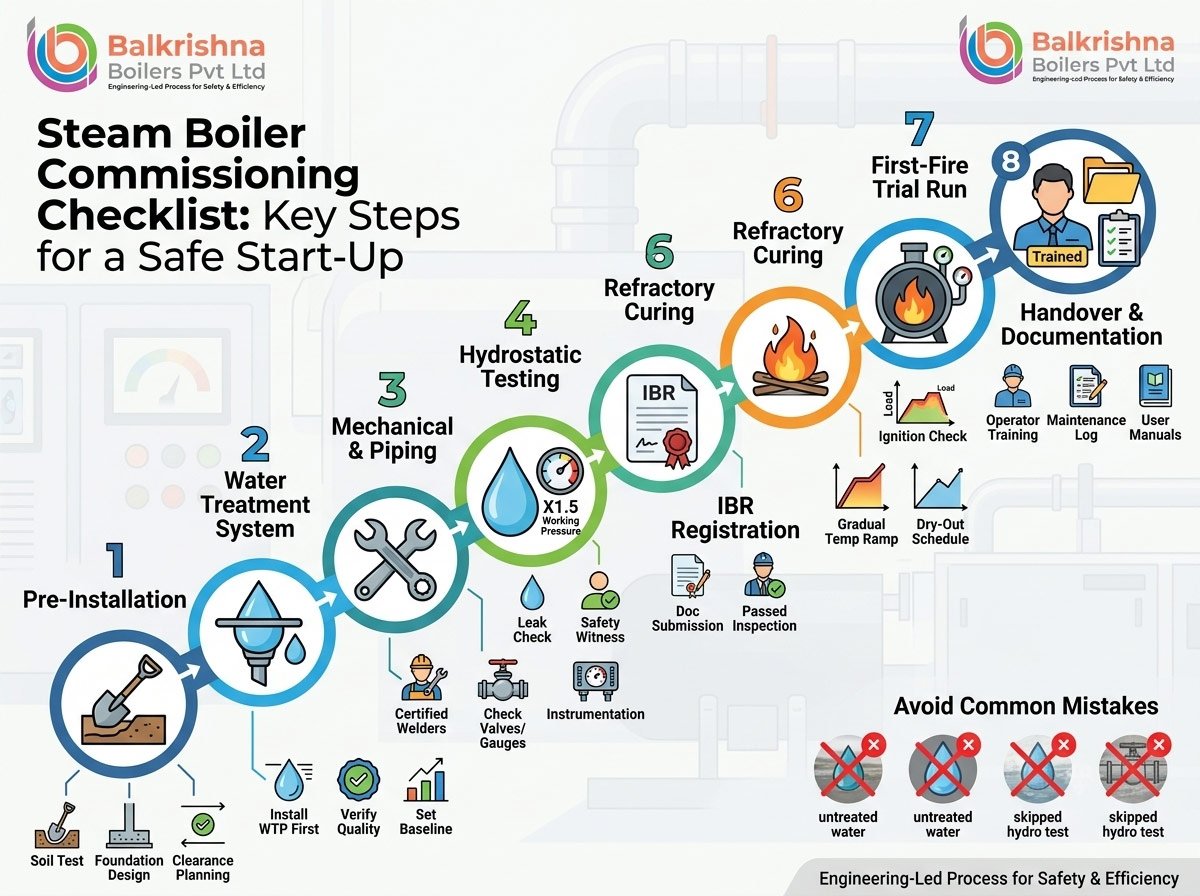
This checklist walks through every stage of commissioning a new steam boiler — from the first soil test to the final trial run — in the order a competent commissioning team actually works through it.
Why Commissioning Deserves Its Own Checklist
Installation and commissioning are often treated as the same activity. They aren’t. Installation is the physical placement and connection of equipment. Commissioning is the structured process of proving that everything installed actually performs to design intent, safely, before it’s handed over for routine production use. Skipping steps in commissioning doesn’t just risk a slow start-up — it can mean discovering a design or installation flaw only after the boiler is already under load, which is a far more expensive and disruptive time to find it.
Stage 1: Pre-Installation Site Preparation
Commissioning quality is decided before the boiler ever reaches site.
Soil testing and foundation design The foundation must be engineered for the specific static and dynamic load of the boiler shell, water content, and any attached economizer or chimney. This matters even more for solid-fuel and biomass units, which run significantly heavier than oil or gas-fired equivalents due to refractory lining and fuel-feed systems — a point covered in detail in our biomass boiler installation guide.
Foundation curing time Concrete foundations typically need 21–28 days of curing before the boiler is mounted. Rushing this step to save schedule time is one of the most common causes of structural cracking once the boiler starts vibrating under load.
Space and clearance planning Confirm clearances for tube pulling, burner maintenance access, and — for fire-tube designs — front and rear door swing radius. Position the boiler with adequate distance from processing areas, accounting for exhaust venting requirements, a practice detailed in our guide to steam boilers for textile mills.
Fuel storage and handling For solid-fuel or biomass units, the storage yard needs to be sized for your fuel consumption rate and covered against moisture — wet fuel can drop combustion efficiency by 20% or more. Fire safety provisions, including hydrants and clear separation from the boiler house, need to be finalized at this stage, not retrofitted later.
Utility and civil readiness Confirm electrical supply capacity matches the control panel and pump load, compressed air availability if pneumatic controls are used, and drainage for blowdown water before the boiler shell is even lifted into position.
Stage 2: Water Treatment System Commissioning — Before the Boiler Is Filled
This is the single most commonly rushed stage, and the one with the longest-tailed consequences.
Install and commission the water treatment plant first Whether it’s a softener, RO plant, or dealkalizer, the water treatment system must be installed, tested, and proven to deliver spec-quality water before the boiler shell is filled for the first time. Filling a brand-new boiler with untreated water — even “just for the hydro test” — starts the scaling clock on day one. Our detailed breakdown of steam boiler scaling causes, signs, and prevention explains exactly why this sequencing matters.
Deaerator commissioning For larger plants, the deaerator needs to be commissioned and its dissolved-oxygen removal performance verified before continuous operation begins, protecting piping and tubes from early-life corrosion.
Initial water quality baseline Take and record baseline TDS, hardness, and pH readings for the treated feedwater. This baseline becomes the reference point for every future maintenance check, tying directly into the water quality monitoring practices covered in our steam boiler maintenance checklist.
Stage 3: Mechanical, Piping, and Electrical Checks
Piping and welding verification All high-pressure steam piping must be welded by IBR-certified welders and radiographically tested at the joints, in addition to the boiler shell itself. This applies specifically to units that fall under the IBR threshold — a distinction we cover fully in our comparison of IBR vs. Non-IBR steam boilers.
Mounting and accessory verification Confirm every mounting is correctly installed and matches the approved drawing: safety valves set to the correct relief pressure (typically 10% above working pressure), pressure gauges, water level indicators, feedwater regulators, and blowdown valves. Our guide to core boiler components covers what each of these accessories does and why none of them are optional at commissioning.
Electrical and control panel checks Verify control wiring against the panel schematic, test interlocks (flame failure, low-water cutoff, high-pressure trip), and confirm motor rotation direction on feed pumps and fans before running them under load.
Instrumentation calibration Pressure transmitters, temperature sensors, and level probes should be calibrated and cross-checked against a reference instrument before being trusted for automated control decisions.
Stage 4: Hydrostatic Testing
Before any fire is lit, the boiler and its steam piping undergo a hydrostatic (“hydro”) test — pressurizing the system with water to roughly 1.5 times the design working pressure to check every joint, weld, and fitting for leaks. For IBR-registered boilers, this test is witnessed by the state boiler inspector as part of the formal registration process. Even for Non-IBR units, skipping this step is a false economy — it’s far cheaper to find a weak joint under a controlled hydro test than under live steam pressure during production.
Stage 5: IBR Registration and Statutory Approvals (Where Applicable)
If the unit falls under IBR jurisdiction, registration with the State Boiler Inspectorate must be completed and the inspection passed before the boiler can legally be fired for production use. This includes submission of manufacturing documentation, the witnessed hydro test, and — post first firing — a trial run log for the Form-VA submission. If you’re unsure whether your unit falls under this requirement, our article on IBR vs. Non-IBR steam boilers walks through exactly where that line sits and what each classification requires operationally.
Stage 6: Refractory Curing and Dry-Out (Combustion-Fired Boilers)
For coal, biomass, and oil/gas-fired boilers with refractory-lined furnaces, a controlled dry-out firing schedule is essential before full-load operation. Firing too aggressively on a freshly installed or repaired refractory lining causes cracking from trapped moisture flashing to steam. Manufacturers typically specify a graduated temperature ramp over 24–72 hours depending on refractory thickness and furnace size — this schedule should be followed precisely, not compressed to meet a production deadline.
Stage 7: First-Fire Trial Run
With water treatment proven, hydro testing complete, and (where applicable) refractory cured, the boiler is ready for its first controlled firing.
- Low-fire ignition check: Confirm stable ignition and flame pattern at minimum firing rate before increasing load.
- Gradual pressure build-up: Bring the boiler up to working pressure incrementally, checking for leaks, unusual noise, or vibration at each stage.
- Safety valve pop test: Verify each safety valve lifts at its rated set pressure and reseats correctly.
- Load response test: Run the boiler through a simulated demand cycle to confirm the control system responds correctly to load swings, particularly important for water tube boilers where circulation dynamics differ meaningfully from fire-tube designs.
- Blowdown system test: Confirm both bottom and continuous blowdown systems function correctly and that TDS readings stabilize within target range.
- Steam quality check: Confirm dry, saturated steam is being delivered without excessive carryover or wetness at the process point.
Stage 8: Operator Training and Documentation Handover
A boiler is only as safe as the people running it day to day. Commissioning isn’t complete until:
- Operators are trained on start-up, shutdown, and emergency shutdown procedures specific to the installed control system
- Boiler attendants (where legally required under IBR) are briefed on their statutory responsibilities
- A maintenance log, water treatment log, and blowdown log format is established and handed over, ready for the ongoing routines covered in our maintenance checklist
- All manufacturer documentation — drawings, test certificates, mounting approvals — is filed and accessible for the next statutory inspection
This kind of hands-on training and documentation handover is exactly what made the difference in our Nagothane hot water boiler installation, where engineers stayed on-site specifically to train local operators on the automated control panel and safety protocols before handover.
Common Commissioning Mistakes to Avoid
- Filling the boiler before water treatment is proven — starts scale formation before production even begins
- Compressing refractory dry-out schedules to hit a go-live date — leads to early cracking and costly repairs
- Skipping or rushing the hydro test witness — creates compliance gaps that surface at the first statutory inspection
- Under-training operators on a new control system, particularly PLC-based automation that differs from a previous boiler
- Not baselining water quality and instrument calibration, which leaves the maintenance team with no reference point once the boiler is in routine service
How Indian Boilers and Balkrishna Boilers Support Commissioning
Both companies treat commissioning as an engineering-led process, not a handover formality. Indianboilers.com’s industrial boiler range — spanning steam boilers, electric boilers, hot water boilers, and thermic fluid heaters — is backed by on-site commissioning support covering civil coordination, IBR documentation, hydro testing, and operator training, whether you’re commissioning an IBR Electric Steam Boiler or a compact Non-IBR electrode unit.
Balkrishna Boilers offers the same structured commissioning support across its steam boiler, ELECTROMAX, SIB, and AQUAMAX hot water boiler lines — ensuring every installation, from a small MSME unit to a large IBR-registered plant, is proven safe and efficient before it’s handed over for production use.
Frequently Asked Questions
How long does a typical boiler commissioning take? This varies significantly by boiler type and capacity, but as a rough guide, turnkey installation and commissioning — including civil work, piping, and IBR certification — commonly runs 4–6 weeks for mid-sized industrial units, longer for large biomass or high-pressure systems requiring extended refractory curing.
Can commissioning happen before the water treatment plant is ready? No — the boiler should not be filled with untreated water at any point, including for hydro testing where possible. If the WTP isn’t ready, testing should use appropriately treated or demineralized water rather than raw feedwater.
Is a hydro test mandatory for Non-IBR boilers too? It isn’t a statutory requirement in the same way it is for IBR units, but it remains standard sound engineering practice for any pressure vessel before first firing, and reputable manufacturers include it regardless of classification.
Who is responsible for IBR registration — the manufacturer or the buyer? It’s typically a joint process: the manufacturer supplies IBR-approved drawings and documentation, while the buyer (as the boiler owner) submits the registration application to the State Boiler Inspectorate, often with support from the manufacturer’s commissioning team.
What’s the biggest cause of commissioning delays? Site readiness — specifically incomplete foundation curing, water treatment plants not yet installed, or electrical supply not matching panel requirements — causes more commissioning delays than equipment issues.
Planning a new boiler installation? Talk to the Indian Boilers commissioning team or contact Balkrishna Boilers for a site assessment and turnkey commissioning plan.